Random Posts

Monday, March 13, 2023

Pennsylvania vs. New York 1898

     The Finger Lakes are a group of eleven long, narrow, roughly north–south lakes located south of Lake Ontario in an area of New York called the Finger Lakes region.
     Lake Keuka is one of the major lakes in the the group and it's different because it is Y-shaped in contrast to the long and narrow shape of the other Finger Lakes and so in the past it was referred to as Crooked Lake. 
     I don't know about today, but in the late 1800s and early 1900s it was one of the garden spots of New York and it was charmed with the beauty of the scenery. The water of the lake was said to be so clear that the pebbles on the bottom could be counted and in every direction on the sloping hill sides which surround the lake, miles of vineyards dotted with patches of woods and fields of grain stretched away into the distance. 
     In 1898 the meeting of the New York State Chess Association took place at the Grove Spring Hotel at Keuka Lake during the second week of August. In addition to tournaments there was a match between Pennsylvania and New York in which each team member played every member of the opposing team. I am unsure if there is an actual name for this type of match, but the old Chess Review magazine called them Virginia Reel matches. 
 

     A highlight of the event was that the local wine companies took the opportunity to allow players and guests to test the quality of their champagne and one company put up a dozen bottles as prizes and, also, to be used at a dinner. Another offered a bottle of wine as a prize for the best game in the match. The below Kemeny-Delmar game won the prize. 
     There were many regrets expressed at the absence of Walter P. Shipley, secretary of the Pennsylvania State Chess Association, who was unable to attend due to illness. 
     In the wine-winning game the Hungarian born Emil Kemeny (1860-1925), master, editor and publisher scored a quick point thanks to his swift and precise K-side attack. 
     Born Budapest, Kemeny lived in New York, Philadelphia and Chicago and during the mid-1890s, he was one of the strongest players in the country. He returned to Budapest some time in the 1900s and died there in 1925. His friend, Walter P.Shipley, described him as "...tall, standing over six feet in height. Kemeny was a genial companion with a keen sense of humor, well read, spoke several languages fluently and besides being an able chess player was passionately fond of good music." 
     Eugene Delmar (1841-1909) was born in New York City and for over 50 years he was a leading player in America. 

  A game that I liked (Fritz 17)

[Event "New York v Pennsylvania Team Match"] [Site ""] [Date "1898.??.??"] [Round "?"] [White "Emil Kemeny"] [Black "Eugene Delmar"] [Result "*"] [ECO "C41"] [Annotator "Stockfish 15.1"] [PlyCount "45"] [EventDate "1898.??.??"] {Philidor Defense} 1. e4 e5 2. Nf3 d6 {Today this relic of a bygone era is considered solid, but passive and so it has largely been abandoned.} 3. d4 { Almost always played. 3.Bc4 is playable, but it's very rare.} Nf6 4. Nc3 (4. dxe5 {According to Pillsbury this is premature.} Nxe4 5. exd6 (5. Qd5 Nc5 { And white's Q is exposed which will result in a loss of time.}) 5... Bxd6 { Black has fully equalized.}) 4... Nbd7 5. Be3 Be7 6. Bd3 {When commenting on the game Pillsbury preferred 6.Bc4} (6. dxe5 dxe5 7. Bc4 O-O 8. h3 c6 9. Qe2 { is fully equal. Regan,N (2165)-Vatter,H (2385) Berlin 1998}) 6... c6 (6... Ng4 7. Qd2 Nxe3 8. Qxe3 O-O 9. O-O c6 10. Rad1 Qc7 {is about equal. Noa, J-Blackburne,J Hamburg 1885}) (6... O-O 7. O-O {White 's other option was 7.d5} c6 8. a4 b6 9. Qe2 a6 10. Rfd1 Qc7 {equals. Schweitzer,W (2022)-Kleissl,H (2271) Jenbach 2009}) 7. Ne2 Qc7 8. c3 d5 9. Qc2 {This is just one of several reasonable moves at white's disposal.} dxe4 10. Bxe4 Nxe4 {Pillsbury felt that instead of this black should have simply castled and reserved the capture of the B which would have given him a good game. Actually, there is nothing at all wrong with black's move.} (10... O-O 11. Nxe5 Nxe4 12. Qxe4 {is completely even.}) (10... exd4 11. Bxd4 O-O 12. O-O Re8 {is yet another option that results in equality.}) 11. Qxe4 O-O {Pillsbury thought it was far preferable to continue with 11...exd4} (11... exd4 12. Bxd4 {However, white now has the advantage.} Rg8 13. O-O Kf8 14. Rfe1 Nf6 15. Qd3 {Black is in an awkward position at best.}) (11... f6 {This surprising move is black's best option.} 12. O-O O-O 13. Ng3 {with a minimal advantage.}) 12. dxe5 b6 {This move is really where black goes wrong.} (12... f6 {Challenging white in the center is not entirely satisfactory, but it's black's best option.} 13. Qc4+ Kh8 14. exf6 Bxf6 15. Ng3 {And white is only slightly better because of his more active pieces.}) 13. Ned4 Bb7 {Placing his B on the same diagonal as white's Q is very inviting, but it's also wrong! After this white gets a decisive advntage.} (13... Nc5 14. Qc2 Ne6 {is his best chance of holding his position together. After} 15. Nf5 Rd8 16. Qa4 {In order to transfer the Q to the K-side.} c5 17. Qg4 Bf8 18. O-O Bb7 19. Ng5 {qith good attacking chances.}) 14. Nf5 Rae8 (14... Nc5 {keeps fighting.} 15. Qg4 g6 16. O-O-O Bc8 17. Nxe7+ {White is better, but he has no forced win.} Qxe7) 15. O-O-O ({White needs this N for his attack so exchanging to would be wrong because it would allow black to equalize.} 15. Nxe7+ Rxe7 16. O-O-O c5 17. Qh4 Rfe8 {and white's attack has dissipated.}) 15... Bf6 16. Rxd7 (16. Bf4 {also works.} Bxe5 17. Bxe5 Nxe5 18. Nd6 Re7 19. Nxe5) 16... Qxd7 17. Qg4 Qe6 (17... Bxe5 18. Nh6+ {wins the Q}) 18. exf6 g6 { This loses quickly.} (18... Qxf6 {would have been better because after} 19. Bd4 Qg6 20. Qxg6 hxg6 21. Nd6 Re7 22. Nxb7 Rxb7 {Black has practical chances. True, white scored 5 wins in Shootouts, but they were 70+ ,ove games and tricky B+N vs R endings.}) 19. Nh6+ Kh8 20. Qxe6 (20. Ng5 {is an equally good alternative. } Qxg4 21. Ngxf7+ Rxf7 22. Nxf7+ Kg8 23. Nh6+) 20... Rxe6 21. Ng5 c5 (21... Ree8 {White mates in 10} 22. Bf4 Ba6 23. Ngxf7+ Rxf7 24. Nxf7+ Kg8 25. Nh6+ Kh8 26. f7 Re1+ 27. Rxe1 Kg7 28. Re8 g5 29. Bxg5 Kg6 30. Rg8+ Kh5 31. g4#) 22. Nxe6 fxe6 23. Rd1 {Black resigned.} *

Thursday, March 9, 2023

William de Visser

     New York master and organizer William de Visser was born on November 5, 1855 and passed away on Long Island at the age of 68 on December 4, 1923. He was a charter member of the Manhattan Chess Club and in 1899, he won the New York State Championship. 
     Charles A. Gilberg (1835-1898) was the author of two chess books. American Chess-Nuts, a collection of problems, was published in 1868. The other book was Crumbs from the Chess-board, also a book of problems, that was published in1890. 
     He had the second largest chess library in America consisting of over 1,500 books.  After Gilberg, who lived in Brooklyn, died his daughter Eugenie inherited her father's chess library upon the death of her mother. Eugenie was married to de Visser. 
     de Visser's opponent in the following game was Walter Penn Shipley (1860-1942, 81 years old), a well-known organizer and chess patron. He was friendly with many famous players, including Steinitz, Lasker, Pillsbury and Capablanca. 
     He served as the referee of 1909 Capablanca - Marshall match and was an organizer of the famous 1904 Cambridge Springs and 1924 New York tournaments. He formed and was the first president of the US Chess Association, a forerunner of the present US Chess Federation. 
     Shipley was also a very strong amateur player, having faced and held his own with strong masters such as Steinitz, Lasker, Bird, Gunsberg and the leading US players of the day including Pillsbury and Marshall. 
     On May 30, 1900, the Franklin Mercantile Chess Club (Philadelphia) met the Manhattan Chess Club in a telegraph match. 

     Founded in 1885, the Franklin Mercantile Chess club was one oldest chess clubs in the country. From the appearance in 1786 of Benjamin Franklin's famous essay "The Morals of Chess," Philadelphia has long been a prominent center of chess activity. International and American chess greats like Stientz, Zukertort, Lasker, Pillsbury, and even Paul Morphy were frequent visitors. I believe that the club has been closed for some time.
     The Manhattan Chess Club was founded in 1877 and started with three dozen men, eventually increasing to hundreds, with women allowed as members from 1938. The club closed in 2002. Famous members of the club included Denker, Horowitz, Lombardy, Reshevsky and Fischer. It was in the Manhattan, on March 7. 1942, that Capablanca suffered a stroke while watching a casual game; he died the next day. 
     In the following game de Visser played the Wing Gambit against Shipley's Sicilian and wild complications developed. de Visser finished off the game with a long mating combination that included a sham Q-sac. 

A game that I liked (Fritz 17)

[Event "Manhattan-Franklin Match"] [Site "New York, NY"] [Date "1900.05.30"] [Round "?"] [White "William de Visser"] [Black "Walter P. Shipley"] [Result "1-0"] [ECO "B20"] [Annotator "Stockfish 15.1"] [PlyCount "59"] [EventDate "1900.??.??"] [Source "Edward Winter, A"] {Sicilian Wing Gambit} 1. e4 c5 2. b4 {A very early attempt to disrupt black’s standard play, the Wing Gambit deflects black's P in an attempt to secure control of d4. White can postpone the gambit playing 2.Nf3 followed by 3.b4, but this deferred line is considered to be best when black plays 2...e6. Most GMs consider the Wing Gambit too reckless.} cxb4 3. a3 {This most frequently seen although 3.d4 is occasionally played.} e5 {3...bxa3 is theoretically OK, but in practice it has shown itself to be very risky for black.} 4. Nf3 Nc6 5. axb4 (5. Bb5 {is probably best.} Nf6 6. O-O Nxe4 7. Re1 Nd6 8. Nxe5 {with equal chances. Riha,V (2145)-Lalic,B (2418) Prague 2019}) 5... Bxb4 6. Bc4 Nf6 7. Qe2 {White has no especially efficient way of defending the e-Pawn.} (7. c3 Be7 8. d4 (8. Qb3 O-O 9. Ng5 Qe8 10. O-O { Black stands well. Gorovykh,E (2447)-Yemelin,V (2571) St Petersburg 2010}) 8... O-O 9. d5 Na5 10. Rxa5 Qxa5 11. d6 Bd8 12. O-O {Nanu,C (2325)-Bernat,R (2140) Szeged 1998. Black is winning, but in the game he soon made a catastrophic gaffe and lost!}) 7... O-O {Threatens to win with ...d5.} 8. O-O d5 9. exd5 Nxd5 10. Nxe5 Nd4 (10... Nf4 {is the best followup.} 11. Qe4 Qh4 {Threatening . ..Nh3+ because white's Q is undefended.} 12. d3 Nh3+ {Anyway!} 13. gxh3 Qxe4 14. dxe4 Nxe5 {Black is clearly better.}) 11. Qd3 Nf4 {Will the harrassment ever stop?!} 12. Qe4 Nfe2+ {[%mdl 8192] This check results in major complications as a highly unbalanced material situation that Shipley has completely misjudged.} (12... Be6 {would have kept a meager advantage.} 13. Bxe6 Nfxe6 14. c3 Nb3 15. Ra2 Bd6 16. d4 Nxc1 17. Rxc1) 13. Bxe2 Bf5 14. Qe3 Nxc2 15. Qf4 Nxa1 (15... Be6 {might work better.} 16. Ra4 Qd4 17. Qxd4 Nxd4 18. Bg4 a5 {but here, too, white would have a decisive advantage.}) 16. Qxf5 { What a mess! Counting material we find that white has a B+N+P vs R+2Ps, an approximately even match up, but in reality white is winning in this situation because he has a very dangerous attack against black's K.} (16. Qxb4 {is imprecise and loses the advantage after...} Nc2 17. Qf4 Nd4 18. Bc4 {and black has equal play.}) 16... Qc7 17. Bb2 {The looming attack on black's K cannot realistically be met.} Nb3 18. Bd3 g6 {This loses in brilliant fashion, but there was no way of saving the game.} (18... Rfe8 19. Qxh7+ Kf8 20. Re1 f6 21. Qh8+ Ke7 22. Qxg7+ Kd6 23. Qxf6+ Kc5 24. Qf5 Kb6 25. Nc3 Bxc3 26. Bxc3 a6 27. Rb1 Ka7 28. Rxb3 Rac8 29. h4 {and it's over.}) 19. Ng4 {[%mdl 512] Logical looking and de Visser is not to be criticized for missing the mate in 12!} (19. Qf6 Bc3 20. Bxc3 Qxc3 21. Nxc3 Nxd2 22. Ng4 h5 23. Nh6+ Kh7 24. Nxf7 Rg8 25. Ng5+ Kh6 26. Ne6 Ne4 27. Bxe4 Kh7 28. Qe5 Kh6 29. Qg5+ Kh7 30. Qxh5#) 19... Bc3 (19... gxf5 20. Nh6#) 20. Qf6 {[%mdl 512] A brilliant solution.} (20. Bxc3 { is met by the surprising} Qxc3 21. Nh6+ (21. dxc3 gxf5 22. Bxf5 {White is better, but the position is a difficult one.}) 21... Kh8 22. Qd5 Qg7 23. Nf5 ( 23. Ng4 Nd4 {and black is back in the game.}) 23... gxf5 24. Qxb3 Rab8 25. Bxf5 {Stockfish says white is clearly better. Is he really? The answer is yes...in Shootouts white scored 5-0.}) 20... Bxf6 21. Nxf6+ {[%mdl 32]} Kg7 22. Ne8+ Kg8 (22... Kh6 23. Bg7+ Kh5 24. Be2+) 23. Nxc7 Rad8 (23... Rac8 24. Nd5 {Still wins the exchange.}) 24. Be4 Nxd2 25. Nxd2 Rxd2 26. Bc3 Re2 27. Nd5 f5 (27... Rxe4 28. Nf6+ Kh8 29. Nxe4+ Kg8 30. Nf6+ Kh8 31. Nd7+) 28. Bd3 Ra2 29. Bc4 Ra4 {Losing instantly, but there was no way of saving the game.} 30. Ne7# {de Visser's conduct of the attack was nearly flawless.} 1-0

Wednesday, March 8, 2023

Losing A Won Game

     In 1951-52 Arthur Bisguier (1929-2017) was a draftee serving in the Army and eventually found himself stationed in Germersheim in what was then West Germany. After WWII it was an Army storage site for equipment and stored, received and issued equipment and supplies. It could store 25,000 vehicles such as trucks, jeeps, ambulances, armored cars, tractors and trailers. Bisguier called it a "hell hole." 
     While there he got permission to represent the US in the 1952 Helsinki Olympiad and, also, play in a small international tournament in Vienna in which he rolled over the competition. 
 

     The Rabar vs. Paoli contest was an amusing one. We've all lost games in which we were winning and that's what happened to Rabar. In a winning position he decided to win a R and missed a rather obvious mate in two.
     Yugoslav IM Braslav Rabar (September 27, 1919 - December 6, 1973, 54 years old). He was born in Zagreb and was awarded the IM title in 1950. He was Yugoslav Champion in 1951 and 1953 (jointly). He is probably best remembered, if he is remembered at all, for designing the opening classification system that was used in the Chess Informant. 
     Italian Enrico Paoli (January 13, 1908 - December 15, 2005, 97 years old) was born in Trieste. He was awarded the IM title in 1951, he was Italian Champion in 1951, 1957 and 1968. He was awarded the Honorary GM title in 1996. Paoli was also famous for his endgame and study compositions. 

A game that I liked (Fritz 17)

[Event "Vienna"] [Site ""] [Date "1953.??.??"] [Round "?"] [White "Braslav Rabar"] [Black "Enrico Paoli"] [Result "0-1"] [Annotator "Stockfish 15"] [PlyCount "67"] [EventDate "1952.12.??"] {King's Indian} 1. d4 Nf6 2. c4 g6 3. Nc3 Bg7 4. e4 O-O 5. Be2 d6 6. Nf3 Nbd7 7. O-O c5 8. Rb1 b6 9. Kh1 $146 (9. d5 Ba6 10. Nd2 Qc7 11. b3 Rfe8 12. Bb2 e6 13. f4 {White enjoys a space advantage. Nebel,R-Bosau,J Recklinghausen 2003}) ( 9. Re1 Bb7 {Better is 9...cxd4} 10. d5 b5 11. cxb5 a6 12. a4 axb5 13. Bxb5 { White is better. Valles,M (2340)-Ermeni,A (2301) Switzerland SUI 2015}) 9... Bb7 {Considering white's next move 9...e6 might have been better.} 10. d5 { White is better thanks to black's cramped position and his lack of counterplay on the Q-side.} Ne8 11. Bg5 h6 12. Bf4 Ne5 13. Qd2 Kh7 14. Ng1 Bc8 {Black's play is too passive. Countering in the center with ...e6 was called for.} 15. Bg3 f6 {After this black's position is bordering on lost.} (15... g5 {was his best option even though it does not prevent 16.f4} 16. f4 gxf4 {when, at least, the N on e5 is is better placed and black can then counter in the center with . ..e6} 17. Bxf4) 16. f4 {[%mdl 32]} Nf7 17. Bd3 Nc7 18. Nge2 Bd7 19. Qc2 Nh8 20. h4 Bg4 21. f5 g5 22. hxg5 hxg5 23. e5 dxe5 24. Bxe5 {[%mdl 512] this wins a P.} Nf7 (24... fxe5 25. f6+ Kh6 26. fxg7 {etc.}) 25. Bh2 Rh8 26. Kg1 Kg8 27. Ne4 Na6 {[%mdl 32]} 28. a3 {Preventing ...Nb4} Nb8 29. Nf2 Bxe2 30. Qxe2 Nd7 31. Be4 {White is threatening 21.d6, or so he thinks! That said, 31.Be4 is hardly a bad move.} Nde5 {Setting a clever, but flawed trap into which Rabar falls!} 32. d6 Qxd6 33. Bxa8 {[%mdl 8192] Rabar has failed to see the mate in two!} ( 33. Bg3 {keeps the advantage.} Rd8 (33... Nf3+ 34. Qxf3 {simply wins a piece.}) 34. Rfd1 {with a considerable advantage.}) 33... Nf3+ {[%mdl 512]} 34. gxf3 { Rabar resigned before Paoli could play 34...Qxh2#} 0-1

Tuesday, March 7, 2023

Charles Henin

     Los Angeles National Master Charles Henin was born on January 28, 1936 and passed away at the age of 36 on February 14, 1972. He was the 1966-67, 1969-1970, and 1970-71 California Champion. 
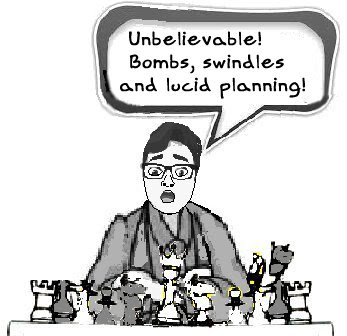
     National Master Jude Acers, himself a colorful character, once described Henin as "an extraordinary practical player who wins, draws, and even loses in the most unbelievable fashion. His games are full of bombs, swindles and occasionally lucid planning." 
     Acers went on to describe Henin as "unpredictable, and a fighter who lives and dies at the board..." 
     During games he was silent, ponderous and expressionless, but if things got wild he became animated and could even be heard to "murmur a word or two." After the game it was his habit to quickly depart the premises. 
     According to Acers, when it came to Henin's swindles, Henin claimed that he, himself, was just as often a victim. Henin was sometimes the recipient of a lot of luck.
     There was the time in a tournament in Santa Monica in 1968 when Henin's opponent had a mate in two moves plus Henin's flag had been down for five minutes and his opponent didn't notice it. 
     Henin kept playing even though hos flag was down and his opponent, with 5 moves to make in 15 minutes got nervous about what he thought was approaching time pressure and offered a draw. They shook hands and Henin, as was his habit, quickly departed. 
     That story reminds me of the time I was playing in a very small tournament one Sunday afternoon in a church basement. My first round opponent was only rated a bit over 1200, so I had an easy win. 
     While looking at my fingernails and waiting for him to move, the TD stopped by, stared at the position, shrugged his shoulders, snickered and walked off. When I looked down I immediately saw that my opponent had a Q move that mated in one! 
     After thinking for a few minutes he played the Q move and mated me, but he didn't say anything and I quickly realized that he was unaware that I was in check, let alone mated, so I shot out a Q move offering to exchanges Qs. He didn't hesitate to exchange Qs and I went on to win. After the game I did like Henin and told him I couldn't look at the game because I was going down the street to grab some fast food. 
     In the 1954 US Open in New Orleans, Henin tied for places 8-13 with a score of 8-4. His opponent, Kurt Loening (1924-2000, 76 years old) tied for places 65-69 with a 5.5-6.5 score. 
     At one time (around 1949) Loening served as secretary of the Firestone Chess Club in Akron, Ohio. From 1952-56 he was the Editor of the Ohio Chess Bulletin. At the time this game was played Loening, who was living in Columbus, Ohio, was rated 1815. Henin was living in Chicago and was rated 2020.

  A game that I liked (Fritz 17)

[Event "US Open, New Orleans"] [Site "New Orleans, LA USA"] [Date "1954.08.05"] [Round "?"] [White "Kurt L. Loening"] [Black "Charles Henin"] [Result "0-1"] [ECO "E27"] [Annotator "Stockfish 15.1"] [PlyCount "48"] [EventDate "1954.08.02"] {Nimzo-Indian} 1. d4 Nf6 2. c4 e6 3. Nc3 Bb4 4. a3 Bxc3+ 5. bxc3 O-O 6. Qc2 c5 7. Nf3 Nc6 8. e3 d5 9. Bd3 Qc7 10. O-O dxc4 11. Bxc4 e5 12. h3 {Theory on this line is enormous and besides the text white has tried 6 different moves.} e4 13. Nd2 (13. Ng5 {is also playable.} Na5 14. Ba2 Bf5 15. f3 {equals. Akdag,D (2172)-Marusenko,P (2327) Helsingor 2008}) 13... Bf5 (13... Na5 14. Be2 cxd4 15. exd4 Bf5 {equals. Colon,A-Belkadi,R Varna 1962}) 14. a4 {At some point over the next few moves black could very well have played ...Na5, but thankfully he didn't ot the game would not have had the clever finish.} Rfe8 15. Qa2 Rad8 16. Ba3 b6 17. Rfc1 Qd7 {Henin is clearly planning something... line a sacrifce on h3 which white could have prevented with 18.Bf1!} 18. Bb5 ( 18. Bf1 {Intending to add the R to the attack.} Re6 (18... Bxh3 19. gxh3 { is obviously not good for black.}) 19. a5 Nd5 20. axb6 axb6 21. dxc5 Rg6 22. cxb6 Ne5 {and the best continuation is} 23. Bc5 Bxh3 24. Qa4 Bxg2 25. Qxd7 Bf3+ 26. Kh2 Nxd7 27. Bd4 Rh6+ 28. Kg3 {forcing the draw.}) 18... Bxh3 {While this hardly wins by force, it make life difficult for white because one wrong move will prove fatal.} 19. Bxc6 {[%mdl 8192] It looks like 19...Qxc6 is forced.} ( 19. gxh3 {should be rejected because after} Qxh3 20. Bf1 Qh4 21. Bg2 Re6 22. dxc5 Ne5 {Here black has a very strong attack, but unlike in the note to 18. Bf5 white cannot force a draw.} 23. c6 Rc8 24. a5 h5 25. axb6 axb6 26. Rcb1 Qg4 27. Rb4 h4 28. f3 Qg3 29. Nf1 Nxf3+ 30. Kh1 Nh5 31. Bxf3 (31. Nxg3 Nxg3#) 31... Qxf3+ 32. Qg2 Qf5 33. Rab1 Rg6 {with a winning attack.}) (19. Nf1 {is his best defense and it minimizes the damage.} Bg4 20. dxc5 h5 {Ignoring white's Q-side play and going for the attack.} 21. cxb6 axb6 22. Qc4 Re6 {Defending the N and preparing to add the R to the K-side attack. Black is better.}) 19... Qg4 { Crushing...the N on c6 isn't needed.} (19... Qxc6 {is OK, but it's not nearly as strong as the text. For example...} 20. gxh3 Rd5 21. Kf1 Qe6 22. Ke2 Qxh3 23. Rg1 {with a minimal advantage for black.}) 20. g3 Re6 21. Bb5 Nh5 {Adding a N to the attack.} 22. Kh2 Rh6 {Adding a R to the attack.} 23. Rg1 (23. Kg1 { This avoids the mate in 5, but it, too, is hopeless.} Nxg3 24. f3 exf3 25. Kf2 Bg2 26. e4 Rh2 27. Ke3 f2 28. Nf1 Qg5+ 29. Kxf2 Bxf1+ {and now it's mate in 5 again.} 30. Ke1 Rh1 31. Qxf7+ Kxf7 32. Be8+ Rxe8 33. Kf2 Nxe4+ 34. Kf3 Qg3#) 23... Nf4 {[%mdl 512]} 24. Rh1 (24. gxf4 Bg2#) (24. exf4 Bf1#) (24. Qxf7+ { dealys the mate.} Kxf7 25. Bc4+ Kf8 26. Bxc5+ bxc5 27. Bf7 Bg2+ 28. Bh5 Rxh5#) 24... Bg2+ {White reigned; it's mate next move.} 0-1

Monday, March 6, 2023

Williams Wallops Wyvill

     In May 1851, London staged the Great Exhibition to showcase British technology and the metropolis' chess community felt obliged to do something similar and so Britain's leading player, Howard Staunton, took the lead in organizing the first international tournament.
It was the first time the best players in Europe met in a single event. 
     There was also a "London Provincial Tournament" for British players who were not strong enough to be invited to play in the International Tournament. 
     In addition to the tournament, Staunton and other players wanted to meet to standardize rules, notation and set time limits. This last was a major problem because some players were notorious for just out-sitting their opponents. Staunton also suggested publishing an opening book with the moves in the form of a table. 
     Before the tournament a couple of columnists proposed that the winner should be regarded as the World Champion, but there was never any indication that crowning a world champion was an official objective. 
     The tournament was a knock-out event with sixteen of Europe's best players. Unfortunately many of the invitees were unable to play. Some of the better players absent were Pierre Saint-Amant, Tassilo von Heydebrand und der Lasa, Alexander Petrov and Carl Jaenisch. 
     Saint-Amant was in far away California. He had been sent there by the French government as a diplomat following the state's independence from Mexico during the California Gold Rush. 
     Also missing was Thomas Buckle who was considered to be second only to Staunton among British players. A number of other British players were missing as a result of a dispute with the London Chess Club, most notably Daniel Harrwitz and George Walker. 
     Adolf Anderssen was reluctant to accept his invitation because of the travel expenses, but Staunton offered to pay Anderssen's travel expenses out of his own pocket if necessary, should Anderssen fail to win any prize money. Anderssen accepted Staunton's offer. 
     The first round pairings were made by lot and the eight losers in the first round, which consisted of a best-of-three games with draws not counting, were eliminated. Subsequent rounds were best-of-seven, and losers played consolation matches. 
     Immediately after the tournament Staunton challenged Anderssen to a twenty-one-game match for a 100 pound stake. Anderssen agreed to the match, but could not play right away as he had been away from his job as a school teacher for over two months. In addition Staunton was having physical problems. As a result, the match was never played. 
     His win resulted in Anderssen being recognized as Europe's best player and Staunton was bitter; he blamed his failure to win the strain of organizing the event and a weak heart. Staunton also condemned chess as a profession even though the bulk of his income was derived from chess. 
     It should be mentioned that the famous Anderssen vs Kieseritzky, the famous Immortal Game, was an offhand game played at the venue, but it was not played in the tournament. 
     In one of the lesser known games from the event Elijah Williams (1809-1854) defeats Marmaduke Wyvill (1815-1896) in a pretty game. At London, Williams defeated Lowenthal and Staunton before losing to Wyvill. Wyvill, a Member of Parliament, finished 2nd in the tournament. 

A game that I liked (Fritz 17)

[Event "London"] [Site ""] [Date "1851.06.??"] [Round "3.1"] [White "Elijah Williams"] [Black "Marmaduke Wyvill"] [Result "*"] [ECO "B21"] [Annotator "Stockfish 15.1"] [PlyCount "63"] [EventDate "1851.??.??"] {Sicilian Defense} 1. e4 c5 2. f4 {Originally known as the McDonnell Attack which comes from the McDonnell vs. de La Bourdonnais match played in London in 1834, today it's known as the Grand Prix Attack. The usual way of reaching it today is to first play 2.Nc3.} e6 3. Nf3 g6 4. e5 (4. d4 Bg7 {Better was either 4...d5 or 4...cxd4} 5. Nc3 cxd4 6. Nxd4 Ne7 7. Be3 Bxd4 8. Qxd4 O-O 9. O-O-O f5 10. e5 Nbc6 11. Qd2 Qa5 12. Kb1 a6 13. Bc4 b5 14. Bb3 Kh8 15. Qf2 Rb8 16. Rd6 Qc7 17. Rhd1 a5 18. a4 b4 19. Nb5 {Black resigned. Bisguier,A (2237) -Merlin,A Parsipanny 2009}) 4... Nh6 5. b3 Nc6 6. Bb5 Ne7 7. Nc3 a6 {A tactical oversight. Correct was 7...Bg7, but white's position is preferable thanks to his spatial advantage.} 8. Ne4 {White is better. There is no really satisfactory way for black to meet this move.} Bg7 9. Nd6+ Kf8 10. Be2 Nhf5 11. Ne4 {This is better than trading Ns. As it is, at some point black's N will have to vacate f5 with a loss of time and in the meantime, white's N remains well placed.} b6 {Black underestimates the strength of white's next move or else he would have played 11...h5 trying to maintain the N on f5.} (11... h5 12. Nxc5 {OK, so black givens up a P, but he gains some measure of freedom.} d6 13. Ne4 b5 {and black is getting developed and white can only claim to be slightly better.}) 12. d3 {Too passive...the position calls for aggressive play.} (12. g4 {drives the N away and after} Nd4 13. Nxd4 Bb7 14. Bf3 cxd4 15. Ba3 Kg8 16. h4 Nd5 17. Nd6 {white has a very nice position. There's no clear forced win, but black's carmped position would require careful defense.}) 12... d5 {[%mdl 32] Driving the N back and gaining control of the important square d6.} 13. Nf2 (13. exd6 Nd5 14. Ne5 Nfe3 {and it's now black's Ns that dominate. } 15. Bxe3 Nxe3 16. Qd2 Nxg2+ {and the N can safely get back by ...Nh4-f5}) 13... d4 {A sudden turn of events has left white cramped.} 14. g4 {Safer would have been 14.O-O then just trying to hang on, but instead Williams chooses to play aggressively and it pays off.} Nh6 {The N is misplaced here and white seizes the initiative.} (14... Ne3 {Wyvill may have avoided this thinking the P on e3 would he vulnerable.} 15. Bxe3 dxe3 16. Ne4 {However, after} Nd5 { white can't defend the f-Pawn.} 17. Qc1 Nxf4 18. Rg1 (18. Qxe3 Ng2+) 18... Nd5 {with a vastly superior position.}) 15. Ng5 Nd5 16. Nfe4 f6 {This only weakens his Ks position. The ugly retreat 16...Ng8 was best.} 17. exf6 Bxf6 18. O-O Kg7 19. Nxf6 Qxf6 20. Bf3 {In spite of everything, black's position, while inferior, is still defensible. However, his next move placing the B on an undefended square is illadvised. Moving the R from potential attack with 20... Ra7 would have been a wee bit better.} Bb7 21. Qe1 Rae8 22. Bd2 Rhf8 23. Qh4 Rh8 24. Rae1 Ng8 {It's hard to see how, but this move turns out to be the losing move.} (24... Nf7 {is tougher, but even then black has no way to equalize! One possibility is} 25. Qh3 Nxf4 {Winning the P does not help.} ( 25... Kg8 26. Qg3 Ba8 27. h4 h6 28. Ne4 {and black is facing insurmountable difficulties.}) 26. Bxf4 Qxf4 27. Nxf7 Qxf7 28. Bc6 Qe7 29. Bxe8 {with a decisive advantage.}) 25. Qg3 h6 26. Ne4 Qd8 27. f5 {Cracking open the Ks position.} exf5 28. gxf5 g5 29. Nxg5 {[%mdl 512]} hxg5 30. Bxg5 Rh3 {Well played! It hardly saves the game, but it was worth a shot.} 31. Bf6+ {[%mdl 512] A problem-like finish.} (31. Qxh3 Qxg5+ 32. Qg3 Qxg3+ 33. hxg3 Rf8 34. g4 {White ahs a R+2Ps vs 2Ns and should win with little difficulty, but at least black has some hope however forlorn it might be.}) 31... Kxf6 32. Qg6# *

Friday, March 3, 2023

Kenneth Clayton

 
Kenneth Clayton
     Kenneth Clayton (July 26, 1938 - December 26, 2017, age 79) won US Amateur Championship in 1963. He passed away from the effects of Alzheimer’s.
     Clayton was one of the earliest pioneers of Black chess in the US and was described as distinguished and a man with a presence that commanded respect.
    His first rated tournament was the 1959 Washington, DC Open in which he placed 6th earning a provisional rating of 2020. In 1963 he entered the US Amateur Championship with a 2102 rating that ranked him in 8th place; he won the title. 
     Making Master was a struggle, but he achieved the coveted 2200 rating in 1967 and became only the 4th Black player in the US to earn the title. He was also known for his coaching ability and he successfully mentored many young Black players. 
     Clayton, who came from a relatively well-to-do family, was born and raised in Washington, DC. He earned early admissions to attend any Ivy-League university and he chose Harvard where he studied chemistry. At the age of 17 he enrolled and that was also the same year he took up chess and improved rapidly. For the next two years, he played for the Harvard chess team along with Shelby Lyman who became famous for his broadcasts of the Fischer-Spassky World Championship match in 1972. 
     He dropped out of Harvard because he had gotten involved computer science and found employment with a company in Laurel, Maryland. He then got a contract as a computer advisor in Vietnam. Nobody knows exactly what that job entailed, but it was speculated that he was involved with US intelligence. 
     Stationed in Saigon, he met the Truong family. Mentored by Clayton, the son, Trong Hoai Nhan, created a sensation when he won the national championship at the age of eight! 
     When the South Vietnamese government collapsed in the spring of 1973, the family made a death defying escape and ended up in the US where the boy became known as Paul Truong, a Master, trainer, and organizer. Clayton helped the family resettle. 
Milton Danon
     Going into the last round (the 7th) of the 1963 US Amateur, the 24-year old Clayton, 17-year old Stan Tomchin and 21-year old David Daniels stood at 5.5-0.5. 

     In the last round Clayton and Tomchin played a quick draw and so Daniels had a chance to become the clear winner, but he was unable to get past his opponent's staunch defense and could only draw. Thus, the finish based on tiebreaks was 1) Clayton 2) Tomchin and 3-4) Daniels and George Sendeckyj.
     Here is Clayton's crush of USCF Expert Milton Danon (January 15, 1921 - November 14, 2006, 85 years old) of New Jersey. He was the US Amateur Champion in 1979 and a very strong postal player with the USCF

A game that I liked (Fritz 17)

[Event "US Amateur Champ, Asbury Park, NJ"] [Site ""] [Date "1963.??.??"] [Round "?"] [White "Kenneth R Clayton"] [Black "Milton Danon"] [Result "1-0"] [ECO "B90"] [WhiteElo "2102"] [Annotator "Stockfish 15.1"] [PlyCount "46"] [EventDate "1963.??.??"] [Source "Kenneth Clayton,"] {Sicilian Scheveningen/Najdorf} 1. e4 c5 2. Nf3 d6 3. d4 cxd4 4. Nxd4 Nf6 5. Nc3 a6 6. Bc4 e6 7. Bb3 Be7 8. f4 Qc7 9. Be3 {White had a very strong move in 9.f5!} (9. f5 exf5 (9... e5 10. Nf3 b5 11. Bg5 Nbd7 12. Bxf6 Nxf6 13. Nd5 { with an excellent position.}) 10. Nxf5 Bxf5 11. exf5 O-O {is favorable to white because of black's isolated d-Pawn.}) 9... Bd7 (9... b5 {is more to the point.} 10. a3 Bb7 11. Qf3 Nbd7 {Matthews,S-Noaman,H (2205) Thessaloniki 1988 Now white's best move is 12.f5 which leaves black only slightly better. In the game white played the risky 12.Bxe6, but managed a draw.}) 10. g4 e5 {This is the wrong P push because it allows white to get a very strong attack. However, calculating the best move (10...d5!) OTB would not be an easy task!} (10... b5 {is not worthy of serious consideration because after} 11. g5 Ng8 12. f5 { White has what should amount to a winning attack. For example...} b4 13. fxe6 fxe6 14. Nce2 e5 15. Ne6 Bxe6 16. Bxe6 Nd7 17. Qd5 {and wins.}) (10... d5 { is black's best option, but after} 11. exd5 e5 {This complicates things and is black's best chance.} (11... Nxd5 12. Bxd5 exd5 13. Qf3 {white's position is favorable.}) 12. g5 Ng4 {In order to keep any advantage white needs to find...} 13. Bg1 Ba3 {Clever.} 14. d6 {Again, the only good move.} Bxd6 15. Nde2 exf4 16. Nd5 Qa5+ 17. Nec3 Ne3 18. Bxe3 fxe3 19. Nf6+ gxf6 20. Qxd6 {White is better, but visualizing all this is beyond a human player.}) 11. Nf5 {White has a decisive advantage.} Bxf5 (11... g6 12. Nxe7 Kxe7 13. fxe5 dxe5 14. g5 { wins the N because if it retreats white has the fork 15.Nd5+}) (11... exf4 { This is the only other option, but after} 12. Bxf4 Bxf5 13. exf5 {White's position is much better.}) 12. gxf5 (12. exf5 {was even better.} Nbd7 13. Qe2 Nc5 14. g5 Nfd7 15. O-O-O Nxb3+ 16. axb3 {followed by Nd5 leaves white calling the shots.}) 12... Nbd7 13. Rg1 Rg8 {Black does best to ignire the threat to his g-Pawn and stike back in the center.} (13... d5 14. fxe5 Nxe5 15. Nxd5 Nxd5 16. Bxd5 Bh4+ 17. Kf1 Nc4 18. Bxc4 Qxc4+ 19. Qd3 {White is better, but black can continue the fight.}) 14. Qd2 Nc5 15. Bd5 Nxd5 (15... exf4 {Black's position is very difficult, but this was a better try.} 16. Bxf4 Nh5 17. Bg5 h6 18. Bxe7 Qxe7 19. O-O-O {and black can put up a stubborn defense.}) 16. Nxd5 Bh4+ 17. Ke2 Qc6 18. fxe5 dxe5 19. Qc3 {This excellent move wraps it up.} Rc8 20. Qxe5+ Kf8 21. f6 {Digging out black's K.} Bxf6 22. Nxf6 Qb5+ (22... gxf6 { leads to mate.} 23. Bh6+ Rg7 24. Bxg7+ Kg8 25. Bxf6+ Kf8 26. Qe7#) 23. Kf3 Qe2+ {Pointless, but he was facing a mate in 3, so after playing this move black resigned. Excellent play by Clayton.} (23... Qe2+ 24. Kxe2 gxf6 25. Qd6+ Ke8 26. Rxg8#) 1-0

Thursday, March 2, 2023

Who Was Albert Roddy, Jr.?

  
     The year was 1940. WWII had started in September of 1939, but the US didn't enter it until December of 1941. In England they had been enduring the German Blitzkreig which had started on September 7, 1940 and lasted until May 21, 1941
     On the US chess scene Adele Rivero won the women's championship, Samuel Reshevsky the men's and Reuben Fine the US Open. Al Horowitz was seriously injured and New England champion Harold Morton died in Iowa after a car wreck when Morton collided with a truck. The strong Boston amateur John F. Barry died at the age of 66. 
     In Russia Igor Bondarevsky and Andor Lilienthal tied for first in the USSR Championship. 
     The 59-year old Polish champion David Przepiorka was present at a forbidden meeting of the Warsaw Chess Circle when the Germans arrested everyone there. As a result, he was executed by the Nazis in part of what became known as the Palmiry massacre, a series of mass executions carried out near the village of Palmiry in the Kampinos Forest northwest of Warsaw. 
     Alexander Alekhine's whereabouts at the time was not known, but in September the New York Times reported that both Alekhine and Capablanca were in Buenos Aires and Alekhine was hoping they could play a match. 
     Capablanca had said that two other players were worthy of consideration: Paul Keres and Mikhail Botvinnik. Fred Reinfeld wrote that he suspected they were mentioned only because they were not available ...they were in Russia and the war was going on. Reinfeld also mentioned that he was baffled by the snootiness of their ignoring Samuel Reshevsky and Reuben Fine. 
     As mentioned, Reuben Fine won the US Open that was held in Dallas, Texas when he scored 8-0 in the finals ahead of Herman Steiner, Weaver Adams, Erich Marchand, W.N. Kendall, J.C. Thompson, Arpad Elo, Howard Ohman and Harold Burge. 
     In one of the preliminary qualifying sections Fine finished ahead of Thompson, Elo, Albert Roddy, Jr., Joseph Rauch, Edgar Hartsfield, R.S. Underwood and R.D. Allentharp In that section Fine and Thompson scored 6.5-1.5 and Elo scored 6-2.
     Albert Roddy, Jr., who was living in Tulsa, Oklahoma just missed qualifying, but in the process he created a stir with a sensational draw against Fine. 
     Almost nothing is known about Roddy, but I discovered an Albert Roddy (1900-1966) who is listed as registering for the WWI draft in the September 26, 1918 issue of the Ada (Oklahoma) Weekly News. 
     There was also an Albert H. Roddy (1919-1999) who lived in Tulsa for a while and registered for military service in 1942. He died at the age of 79 on February 6, 1999, in Dallas, Texas. This may have been Junior and the Army Second Lieutenant that I discovered who was captured by the Nazis while serving in Germany and was sent to Stalag Luft 3 near Sagan, Germany. He was freed in 1945. 
     I searched the first USCF rating list in 1950 and the list for 1951 and did not find a Roddy listed. Only three of Roddy's games seem to be known and they are from the 1940 US Open. Did he ever play any tournament chess again?! One wonders how good he really was. Here's one of his games from that 1940 US Open. 

A game that I liked (Fritz 17)

[Event "US Open. Prelims, Dallas"] [Site ""] [Date "1940.08.20"] [Round "2"] [White "Arpad Elo"] [Black "Albert Roddy"] [Result "0-1"] [ECO "B58"] [Annotator "Stockfiah 15.1"] [PlyCount "82"] [EventDate "1940.??.??"] {Sicilian Dragon} 1. e4 c5 2. Nf3 Nc6 3. d4 cxd4 4. Nxd4 Nf6 5. Nc3 d6 6. Be2 g6 {In his 1953 autobiography, the Russian master and amateur astronomer Fyodor Dus-Chotimirsky claimed that he coined the name Dragon Variation in 1901, after the fancied resemblance between black's K-side P-structure and the constellation Draco.} 7. O-O Bg7 8. Nb3 O-O 9. f3 Be6 10. Nd5 Rc8 (10... b5 { was played in Euwe,M-Landau,S Netherlands 1939 which continued...} 11. a4 bxa4 12. Rxa4 Bxd5 13. exd5 Qb6+ 14. Kh1 Nb4 {with equal chances.}) 11. c4 {More solid would have been 11.c3} b5 (11... Ne5 {would have challenged white's last move. After} 12. Nd2 {This N wanted to go to d4, but now it's needed to defend the c-Pawn.} (12. Nd4 {works out in black's favor after} Nxc4 13. Nxe6 fxe6 14. Nf4 d5 {and now} 15. Nxe6 {would lose to} Qb6+) 12... h5 {This hinders any white advances on the k-side. here black can claim to have at least equalized.} ) 12. Nxf6+ Bxf6 13. cxb5 Qb6+ 14. Kh1 Nb4 15. Bd2 Nc2 16. Rb1 Ne3 17. Bxe3 Qxe3 {Here white must figure out how to avoid getting his Q-side Ps wrecked by ...Bxb3} 18. Nc1 {But this isn't the way to do it.} (18. Na5 Bxa2 19. Ra1 Be6 20. Nc6 {is completely equal.}) 18... Rc7 19. Re1 Qb6 {Certainly not bad, but he had an even stronger continuation.} (19... Qh6 {This strongly threatens ... Be5} 20. g3 {and black has two promising continuations: 20...Rfc8 and 20...d5}) 20. b3 Rfc8 {[%mdl 3072] Black has good piece activity for the P.} (20... d5 { was also quite good according the engines, but no human could see the long sequence that leads to the advantage. In fact, at the end it's not likely that black, a P up with all Ps on the same side, could win.} 21. exd5 Rd7 22. Bc4 Bxd5 23. Bxd5 e6 24. a4 Rxd5 {Black is actually better here. A sample line...} 25. Qc2 Rfd8 26. b4 Be7 27. Rf1 Rd2 28. Qc4 R2d4 29. Qc6 Qb8 30. Ne2 Rd2 31. Ng3 Rc8 32. Qe4 Ra2 33. Ra1 Rcc2 34. Rxa2 Rxa2 35. Qc6 Qd8 36. Ne4 Rxa4 37. b6 Ra6 38. Qb7 Rxb6 39. Qxa7 Rxb4) 21. Bd3 Qf2 22. Ne2 Qh4 {This prevents Nf4, but 22...Qe3 was a better way to do it.} 23. g3 Qh6 24. Rc1 {[%mdl 8192] This is a tactical blunder!} (24. Nf4 {does not work out too well against} Be5 25. Ne2 d5 26. exd5 Bxd5 {and white's position is unenviable.}) (24. Kg1 {This move would have allowed white to claim he had equalized because black no longer has any forcing continuation.} Bh3 (24... Be5 25. f4 {leads nowhere for black.}) 25. Nf4 Bc3 26. Re2 Bd4+ 27. Kh1 {White's K is quite safe and black can't make any use of the c-file.}) 24... Rxc1 25. Nxc1 Bc3 26. Rf1 Bh3 27. Rf2 {This not only gets out of the line of fire of the B on h3, but it will, white thinks, prevent ...Bb2} (27. f4 {was the best try he had, but after} Bb2 { From the human point of view this is better than winning the exchange at once.} (27... Bxf1 28. Bxf1 {and black has winning chances.}) 28. Ne2 Qh5 {and white has to surrender the exchange anyway.} 29. f5 (29. Rg1 Qf3+ {mate next move.}) (29. Rf2 Rc1) 29... Bxf1 30. Qxf1 Qg4 31. fxg6 hxg6 {Black is clearly better.}) 27... Bb2 {[%mdl 512] There is absolutely no way to meet this.} 28. Ne2 Qe3 29. Ng1 {This allows a nifty finish. Technically 29.Qg1 was no better, but it would have made black work for the point.} (29. Qg1 e5 30. Bc4 Rxc4 31. bxc4 Ba3 32. g4 Bc5 33. Nc1 Qxf2 34. Qxf2 Bxf2 35. Nd3 Bb6 36. a4 Bf1 37. Nb4 Bxc4 38. Nc6 {is Stockfish's line.}) 29... Qxf2 30. Nxh3 {Black still has his work cut out to score the point!} Qd4 31. Qe2 Ba3 32. Bc4 e6 33. Nf4 Kg7 34. Kg2 g5 35. Bxe6 Rc3 (35... fxe6 {Of course this is not playable.} 36. Nxe6+) (35... Rc1 {was a bit better.} 36. Nh5+ Kg6 37. Bg4 Qc3 {and white is in even more serious trouble}) 36. Nh5+ Kg6 37. Bf5+ Kxh5 {[%mdl 32]} 38. f4+ Kh6 39. fxg5+ Kg7 40. Qh5 {Threatening mate with Qh6+, but the fun is over!} Rc2+ 41. Kh3 { A most interesting situation has arisen! Black has only one move that secures the win!} Kf8 {Very nice. White resigned. A fine attacking game by Roddy.} ( 41... Qg1 42. Qh6+ Kg8 43. Bxh7+ {mates in 3}) (41... Qf2 42. Qxh7+ Kf8 43. Qh6+ Ke8 44. Qh8+ Ke7 45. Qf6+ {draws}) (41... Qf2 42. Qh6+ Kg8 43. Bxh7+ Kh8 44. Bg6+ {draws}) (41... Kf8 {The only move to avoid the draw.} 42. Qh6+ { and black can play either 42...Qg7 or 42...Ke8 and white will be helpless.}) 0-1

Wednesday, March 1, 2023

Counting Pieces

 
     A mental image is a mental picture of an object or event...or a chess position. We form mental images of all kinds of things: faces of familiar people, the location of the furniture in our homes, etc. This ability to hold and manipulate mental images helps us perform many cognitive tasks, including calculating chess variations. 
     Mental images can also lead to solutions when it comes to solving problems. Albert Einstein used a mental image in developing his theory of relativity when he pictured in his mind what it would be like to ride a light beam at the speed of light. He later said that words played no role in his creative thought; instead, he created mental images. 
     Chess players know something about visualization. It's the skill used to form mental images of future positions. Strategy and tactics require creating mental images and the move selected is played because the outcome has been visualized. It works that way for all players, but, of course, the stronger the player, the better they are at it. 
     However, as we will see in today's game sometimes calculating and mental imaging can go haywire even for masters.     
     In 1970 the US team captured the World Student Team Championship that was held in Haifa, Israel. The team was made up of Kenneth Rogoff, Andrew Soltis, Michael Senkiewicz, Richard Verber, James Tarjan and Marc Yoffie. 
     Although winning the event by a single point meant every point and half point was critical, the one game that gave the team the championship was one that, well, was literally given to them...it was Richard Verber's win over the Austrian player Werner Mikenda. 

Against Austria, at the beginning of the fifth hour of play, the US was losing 2-1 and things looked bad. In Verber's game he had a poor game positionally and if he lost the US team would most surely be eliminated from the race for first. 
     Out of desperation Verber began to complicate things and in the end a miracle happened...Mikenda miscounted the pieces on the board and resigned in a position in which his winning chances were quite good!
     Senior Master Richard Verber (June 3, 1944 – December 10, 2001) was long one of the strongest players and most prominent chess organizers and teachers in the Chicago area when he passed away at the age of 57. A National Tournament Director, Verber organized many important events in Chicago.
     As a player he represented the US three times in the World Student Team Championships. His score at Haifa in 1970 was the highlight of his career because he won the gold medal for best fourth board score with a 5.5-1.5 score. 
     In his later years, Verber, who was quite obese, was plagued by poor health and was confined to a wheelchair. 
     Verber's opponent in this game was Austrian FM Werner Mikenda (September 15, 1946-September 11, 2008, 76 years old) who was a chemist and an associate professor at the Institute for Organic Chemistry at the University of Vienna. His last chess activity seems to have been around 1985

A game that I liked (Fritz 17)

[Event "World Student Team Chp, Haifa"] [Site "?"] [Date "1970.??.??"] [Round "?"] [White "Richard Verber (USA)"] [Black "Werner Mikenda (Austria)"] [Result "1-0"] [ECO "A14"] [Annotator "Stockfish 15.1"] [PlyCount "65"] [SourceVersionDate "2023.02.27"] {Reti Opening} 1. g3 d5 2. Bg2 Nf6 3. Nf3 e6 4. c4 Be7 5. O-O O-O 6. b3 c5 7. Bb2 Nc6 8. d3 b6 9. e3 Bb7 10. Qe2 Qc7 11. Nc3 dxc4 12. bxc4 Rad8 13. Rfd1 Rd7 {This has all been played before and besides 14.h3 white has tried 5 other moves!} 14. h3 Rfd8 15. a3 Qb8 16. Kh2 Ne8 17. Ne1 Bf6 18. Rab1 Na5 19. Ba1 Nd6 20. Bxb7 Qxb7 {If you are bored, hang on...things are about to get exciting.} 21. e4 {This turns out not to be so good because it saddles white with a backward d-Pawn. Either 21.Na4 or 21.f4 would have kept up the boredom.} Bd4 22. Nc2 Nc6 23. f4 Nc8 24. e5 N8e7 {Positionally black stands well here because of white's backward d-Pawn and the fact that he can occupy d5.} 25. Ne4 { One suspects the N is headed for d6, but one would be wrong!} Bxa1 26. Nxc5 { Objectively this is not a very good move, but because he has a poor game positionally and a slow strategic battle is not likely to turn out well for him Verber decides on some tactical shenanigans.} (26. Rxa1 Nf5 {Play now will revolve around d4} 27. g4 (27. Rd2 Nfd4 28. Nxd4 Nxd4 29. Qd1 (29. Qg4 Nb3 30. Nf6+ Kh8 31. Nxd7 Nxd2 32. Qe2 Nf3+ {is winning for black.}) 29... h6 {Black stands slightly better.} 30. Nd6 {won't work because of} Rxd6 31. exd6 Nf3+ 32. Kg2 Nxd2+) 27... Nfd4 28. Nxd4 Nxd4 29. Qf2 Qb8 30. Nd6) (26. Nd6 {This also allows black to maintain his positional advantage after} Rxd6 27. exd6 Nf5 28. Rxa1 Rxd6 {Black has a N+P for the R and his more active pieces give him a slight advantage.}) 26... Qa8 27. Nxd7 Nd4 {This attacks the Q, but it's the wrong piece to place on d4.} (27... Bd4 28. Nxd4 Nxd4 29. Qe4 Nec6 30. Nxb6 axb6 {This is a very complicated position! Black has two Ns vs a R+2Ps but his position is judged to be better because of the activity of his pieces. In fact, in 5 Shootouts using Stockfish, black scored 5 wins.}) 28. Qe4 Nxc2 (28... Qxe4 {Trading Qs would cost black the game.} 29. dxe4 Nec6 (29... Nxc2 30. Nf6+ gxf6 31. Rxd8+ {wins}) 30. Nxa1 Rxd7 {and white is winning.}) 29. Qxa8 Rxa8 30. c5 { With this move Verber frees his N on d7, but more than that, Mikenda has become confused about the material situation!} (30. Rxa1 {loses the game.} Nxa1 31. Rxa1 Rd8 32. Nxb6 axb6 33. Rd1 Nf5 {and black is winning.}) 30... Ne3 { This is, or should have been, a losing move!} (30... Bd4 31. cxb6 axb6 32. Nxb6 {is nearly identical to the final position.}) 31. Re1 {Verber counter-blunders! } (31. Rxa1 Nxd1 32. Rxd1 Rd8 33. Nxb6 axb6 34. cxb6 Rb8 {with a likely draw.}) (31. cxb6 axb6 32. Nxb6 Rd8 (32... Nxd1 33. Nxa8 Bb2 34. a4 {and white is winning after} Nd5 35. Rxd1) 33. Rxa1 Nxd1 34. Rxd1 {and white has a decisive advantage.}) 31... Bd4 32. cxb6 axb6 33. Nxb6 {Incredibly, black resigned. GM Andrew Soltis pointed out that black's two pieces are superior to white's R and so black definitely has winning chances. But, somehow Mikenda believed he had lost the exchange and when he resigned he told Verber, "I have no moves."} (33. Nxb6 Bxb6 34. Rxb6 N7d5 {In Shootouts black won 2 games while 3 were drawn.} (34... Rxa3 35. Rb8+ Nc8 36. Rxc8#)) 1-0

Tuesday, February 28, 2023

1945 Canadian Championship Miniature

     Saskatoon is the largest city in the Canadian province of Saskatchewan and to me it looks to be in the middle of nowhere...it's lies over 450 miles north of the US border state of Montana. That said, surveys indicate that the city is a good place to live with high ratings in housing, safety and healthcare. 
     The only real problem with the city seems to be its winters which generally last from early November to mid-March. Temperatures usually remain below freezing at all times, even during the daytime. January and February are the coldest months with low temperatures often dropping below -22°F and high temperatures not rising above 14°F. 
     The city is well over 1,800 miles from Toronto and it's nearly 2,200 miles from Montreal. Nevertheless, in June of 1945, Saskatoon was the location for the 1945 Canadian Championship which was a tie between Abe Yanofsy and Frank Yerhoff.
     Today's game is a miniature between John H. Belson and Leonard Hall. Miniature games are not just entertainment...they can teach you a lot about chess and help you improve your own play. 

     Games between two equally strong players can belong, subtle and...boring. Just ask any of us who suffered through the first Karpov-Kasparov match! On February 15, 1985, the President of FIDE Florencio Campomanes terminated the match after 48 games. Here is a little secret...to this day I have never played over a single game of that match. 
     Miniatures, games lasting about 25 moves usually come to an end with a spectacular tactical shot or an admirable idea and that makes them profitable to study. Or, if you're not interested in studying they are just plain entertaining. Take the following game, for instance. It didn't take Belson long to reach an overwhelming position and then deliver mate to his hapless opponent. 
     John Harold Belson (February 23, 1906 - March 13, 1947, 41 years old), known as Harry Belson, was born in Finland (his Finnish last name was Belczinsky) and after moving to Canada circa 1926 he lived in Toronto. He was Canadian champion in 1934 and 1946 and he won the Toronto city championship 7 times. By profession he was an automotive finance expert. I was unable to locate any information on Leonard Hall other that he appears to have been a local player from Saskatoon. 

  A game that I liked (Fritz 17)

[Event "Canadian Championship, Saskatoon"] [Site ""] [Date "1945.??.??"] [Round "?"] [White "John H Belson"] [Black "Leonard Hall"] [Result "1-0"] [ECO "C13"] [Annotator "Stockfish 15.1"] [PlyCount "41"] [EventDate "1945.06.05"] {French: Classical System} 1. e4 {[%mdl 32]} e6 2. d4 d5 3. Nc3 Nf6 4. Bg5 Be7 5. e5 Nfd7 6. h4 {White almost always plays the boring 6.Bxe7, but here Belosn plays the bold Alekhine–Chatard Attack offering to sacrifice a P to keep black's K in the center. As will soon be seen, things can get complicated after 6.h4} c5 {This move illustrates another point of white's 6.h4} (6... Bxg5 7. hxg5 Qxg5 {Experience has shown this is not a good way to test the soundness of white's 6th move.} 8. Nh3 Qe7 {Here white often plays 9.Nf4, but it does not appear to be the best.} 9. Qg4 g6 10. Ng5 {and whether black plays 10...h6 or 10...h5 white has a nice initiative.}) 7. Nb5 {However, with this move which white may have thought was just a transposition, fails to demonstrate the mentioned point!} (7. Bxe7 {and black is forced to displace his K with 7...Kxe7} Qxe7 {is not so good because of} 8. Nb5 {and the threat of Nxc7+ leaves black in a pickle.}) 7... f6 {This upsets the applecart.} 8. Bd3 (8. exf6 Nxf6 9. dxc5 O-O 10. Bd3 Nc6 {Black will follow up with ...e5 with an excellent position.}) 8... O-O {[%mdl 8192] This is castling into trouble!} (8... fxg5 {and the best white has seems to be a draw.} 9. Qh5+ Kf8 ( 9... g6 10. Bxg6+ hxg6 11. Qxh8+ Nf8 {is too dangerous for black to risk.}) 10. hxg5 cxd4 11. Qf3+ Ke8 12. Qh5+ {draws. Note that 12...g6 loses.} g6 13. Bxg6+ Kf8 (13... hxg6 14. Qxg6+ Kf8 15. Rxh8#) 14. Qh6+ Kg8 15. Bxh7+ Rxh7 16. Qxh7+ Kf8 17. Qh8+ Kf7 18. g6+ Kxg6 19. Qh7+ Kg5 20. Qh5+ Kf4 21. Ne2+ Ke4 22. Qf3+ Kxe5 23. Qf4#) (8... cxd4 {was played in Guimard,C-Stahlberg,G Mar del Plata 1942 and after} 9. Qh5+ Kf8 10. exf6 Nxf6 11. Qe2 Bb4+ 12. Kf1 Nc6 {White is slightly better, but in the game he could only draw.}) (8... Nc6 9. Qh5+ Kf8 { The game is equal after 10.exf6, but there followed a comedy of errors.} 10. Rh3 Nb4 (10... cxd4 {leaves him with a great position after} 11. exf6 Nxf6) 11. Bd2 Nxd3+ 12. cxd3 Qb6 {Chances are equal after 12...a6} 13. Rg3 Rg8 14. Qxh7 fxe5 15. Rf3+ Bf6 16. dxe5 {1Black resigned. Abreu Jean,C (2246)-Infante,M (2275) Santo Domingo 2015}) (8... a6 {This unlikely looking move (it seems to ignore white's threats) leaves black clearly better after...} 9. Qh5+ Kf8 { And, incredibly, white has no way of successfully continuing the attack. After 10 minutes the best line Stockfish came up with was} 10. Nd6 Bxd6 11. exd6 Nc6 12. Bd2 cxd4 13. f4 e5 14. Be2 Qe8 15. fxe5 Ndxe5 16. O-O-O Qxh5 17. Bxh5 { and black has a considerable advantage.}) 9. Qh5 f5 (9... fxg5 10. Qxh7+ Kf7 11. Bg6#) (9... h6 10. Bxh6 cxd4 11. Bxg7 Nxe5 12. Rh3 {and the end is not far off.}) 10. Nc7 {This turns out to be a rather lame continuation.} (10. Bxe7 Qxe7 11. Qg5 Qxg5 12. hxg5 Na6 {White stands well. Winning is another matter though.} 13. f4) 10... Qxc7 (10... Nxe5 {giving up the R but getting some play is a plausible try.} 11. Nxa8 cxd4 12. Qe2 Nec6 {After either 13.O-O-O or 13. f4 white's position is better.}) 11. Bxe7 Rf7 12. Bd6 {[%mdl 128] Black is in trouble.} Qd8 13. Nf3 {Strongly threatening Ng5.} g6 14. Qh6 Nf8 15. h5 { Black's K-side is about to be ripped apart.} Rg7 16. Ng5 Nc6 (16... gxh5 17. Bxf8 Qxf8 18. Rxh5 Qe7 19. O-O-O {and time is running out for black.}) 17. Bxf8 (17. hxg6 {is not nearly as good.} Rxg6 18. Qxf8+ Qxf8 19. Bxf8 Rxg5 20. Bxc5 Rxg2 21. c3 {Positionally white is better in spite of black's passed h-P; his pieces are much more active than black's.}) 17... Kxf8 18. Nxh7+ Kf7 19. Ng5+ Kg8 20. hxg6 Nxd4 (20... Kf8 21. Nh7+ Ke8 (21... Kg8 22. Nf6+ Kf8 23. Qh8+ Ke7 24. Qxg7#) 22. Nf6+ {and wins...black must surrender his Q to avoid a mate in 3.}) 21. Qh8# {Great play by Belson.} 1-0

Monday, February 27, 2023

An Unexpected Tribute to Oscar Chajes

     The First World War began on July 28, 1914 and ended on November 11, 1918. Two days before the war ended, on Saturday, November 9th, the New York Masters tournament ended. 
     Although the war was nearly over, the Brooklyn Daily Eagle reported 40 Brooklynites who had been casualties. There was also a flu pandemic in 1918. In the United States, it was first identified in military personnel in spring 1918. It is estimated that about 500 million people or one-third of the world’s population became infected with this virus. The number of deaths was about 675,000 in the United States. 
     With the war ending on November 11th and Thanksgiving being on November 28th, even in the midst of the pandemic, the nation exuberantly celebrated the holiday. Unfortunately, the deprivations caused by the war and the pandemic made Thanksgiving food more expensive than ever and the price of turkey and all the embellishments was sky-high. 
     During the war the Federal Food Administration had taken measures designed to conserve food for the war effort. Americans were asked to reduce their consumption of wheat, meat, sugar and fats in particular. 
     For this Thanksgiving, for reasons known only to bureaucrats at the FFA, they had ruled that any turkey offered for sale had to weigh at least eight pounds, meaning that it would cost $2.80 for the smallest bird people were allowed to buy; that was nearly a dollar more than a year before. 
     In Russia a Civil War was taking place and in Odessa, Ossip Bernstein was arrested and imprisoned by the Bolshevik secret police for the crime of being a legal advisor to bankers. Without benefit of a trial a firing squad lined up Bernstein and other prisoners to be shot. A superior official arrived and looked at the list of prisoners and asked Bernstein if he was the famous master. Not satisfied with Bernstein's answer, the two played a game and when Bernstein quickly won he was released and soon escaped to France. 
     Everybody knows of German air raids against Britain during WWII and that Vera Menchik was killed in one of them. Not so many know that during WWI the Germans also conducted air raids and in July of 1918, a 76-year old J.H. Blackburne was injured in a London air raid and was rendered temporarily deaf. His wife was also injured. 
     In August, German master Eric Cohn (1884-1918), a field doctor for the Red Cross, was killed in France. Then on December 27, 1918, Carl Schlechter (1874-1918) died in Budapest at the age of 44. In poor health aggravated by the war, he was found in his room without money, heat or food. 
     In the year 1918, on October 23rd, Frank Marshall played his famous the Marshall Attack in the Ruy Lopez against Capablanca in the first round in the strong New York tournament. Capablanca won that game, but the Marshall Attack proved a viable defense. 
     The New York tournament was originally planned as an 8-player double round robin tournament, but Norman T. Whitaker began a game a day before Round 1, got sick and withdrew, leaving it as a 7-player field. 

     Capablanca won, but a somewhat surprising second was the Yugoslav player Boriskav Kostic who despite going undefeated in the tournament wasn't able to come close to Capablanca. 
     By the way, you might be wondering who that last place finisher was. It was John H. Morrison (1889-1975, 85 years old) from Toronto, Canada. He was Canadian Champion in 1910, 1913, 1922, 1924, 1926 and 1931. 
     Let's take a gander at a long forgotten game from that event. David Janowsky (1868-1927) is pretty well known, but his opponent, Oscar Chajes (1873-1928) is virtually a forgotten master. 
     Normally one would pay tribute to  player by presenting one of his wins, but in this case I had already played over and made notes to the game and it was only when I looked up Chajes' biography that I realized tomorrow is the anniversary of his passing. That's when I discovered that he was a much stronger player than I realized!
     Chessmetrics estimates his highest ever rating to have been 2660 in 1920 which put him at number 10 in the world! The top 5 were Capablanca, Alekhine, Lasker, Marshall and Vidmar. 
     Prounounced HA-yes, he was Jewish and was born in Brody in the Austria-Hungary Empire in what is now the Ukraine. He studied medicine at the University of Vienna, near the home of his uncle, a Rabbi. 
     In 1904, Chajes immigrated to the United States from Hamburg, Germany and moved to Chicago before finally settling in New York City. He had been convalescing from an illness and on Monday, February 27, 1928, he was discovered unconscious in his apartment in Manhattan. He died the next day, Tuesday, February 28, 1928 at Bellevue Hospital in New York City without regaining consciousness. 
 

A game that I liked (Fritz 17)

[Event "New York"] [Site "New York, NY USA"] [Date "1918.10.30"] [Round "?"] [White "David Janowsky"] [Black "Oscar Chajes"] [Result "1-0"] [ECO "A46"] [Annotator "Stockfish 15.1"] [PlyCount "53"] [EventDate "1918.10.23"] {London System} 1. d4 Nf6 2. Nf3 d6 {This defense was a favorite with Chajes, who has employed it with considerable success in a match that he won earlier in the year against Janowsky.} 3. Bf4 {This is the London System which can be used against virtually any black defense. It's a solid opening, but offers little in the way of dynamic play.} Nbd7 4. h3 c6 5. Nbd2 (5. e3 Qc7 6. Be2 e5 7. Bh2 Be7 8. O-O {equals. Sergeev,V (2428)-Stocek, J (2592) CZE 2010}) (5. c3 g6 6. e3 Bg7 7. Be2 O-O 8. O-O {equals. Rakhmangulov,A (2350) -Bikuzhin,M (2241) Kirov 2014}) 5... Qc7 6. e4 e5 7. Bh2 (7. dxe5 {is not bad, but it's less effective because it releases the pressure in the center.} Nxe5 8. Bxe5 dxe5 9. Bc4 Be7 10. O-O {Black has fully equalized. Cirjan,D (2051)-Sorbun,C (2083) Miercurea Ciuc 2002}) 7... exd4 8. Nxd4 g6 (8... Nc5 9. Qf3 Ne6 10. Nxe6 Bxe6 11. O-O-O Be7 12. Bc4 O-O (12... Bxc4 13. Nxc4 {would be too costly for black} Rd8 14. e5 dxe5 15. Bxe5 Qc8 16. Nd6+ Bxd6 17. Bxd6 {White is winning.}) 13. Bxe6 fxe6 14. Qb3 {Here, too, black's position is difficult.}) 9. Bd3 (9. g4 {was a good alternative. For example...} Nb6 {Preventing Nc4} (9... Bg7 10. Nc4 O-O 11. Bxd6) 10. Bg2 Bg7 11. c3 O-O 12. O-O {and white has an aggressive position.}) 9... Ne5 10. Be2 Bg7 11. c3 O-O 12. O-O Re8 13. f4 Ned7 14. Bf3 Nc5 15. Qc2 Ne6 16. Rad1 d5 {Chajes has not been as successful with his defense as he had been in previous encounters with Janowsky and now he is now faced with a dangerous onset on the K-side, and his efforts to avert it break down completely.} (16... Qb6 17. Nc4 Qc5 (17... Nxd4 18. Rxd4 Qd8 19. e5 {wins}) 18. f5 {and black is still facing a dangerous attack.}) 17. e5 {The attack begins.. .are black's defensive resources going to be adequate?} Nxd4 18. cxd4 Bf5 19. Qc3 Ne4 $16 20. Bxe4 Bxe4 21. Nxe4 dxe4 22. f5 Qb6 (22... gxf5 23. Rxf5 Qd7 24. Rg5 Re6 {and black actually has what looks to be good defenive chances.}) 23. e6 fxe6 {This move turns out to be a complete disaster.} (23... f6 {is tougher. } 24. g4 Rad8 {and while white clearly stands better, there is no immediate winning breakthrough.}) 24. f6 Bxf6 (24... Bh8 25. f7+ {is even worse.}) 25. Rxf6 {Black can now resign.} e5 {After this white has a mate in 11...not that it matter because there was nothing any better.} 26. Qc4+ Kh8 (26... Kg7 { holds out a bit longer.} 27. Rf7+ Kh8 28. Rf8+ Kg7 29. Qf7+ Kh6 30. Bf4+ exf4 31. Qxf4+ g5 32. Rf6+ Kg7 33. Rf7+ Kg8 34. Qf6 Qxd4+ 35. Rxd4 e3 36. Qg7#) 27. Rf8+ {[%mdl 512] A nifty finish. Black resigned.} (27. Rf8+ Rxf8 28. Bxe5+ Rf6 29. Bxf6#) 1-0

Friday, February 24, 2023

Annibale Dolci , Mystery Man

     The Italian player and problemist Annibale Dolci was born in 1873...the exact date is unknown. Nobody knows when he died. In fact, nobody knows much about him at all. 
     What is known is that between 1901 and 1904 and again between 1908 and 1913 he was staying in England before moving back to Genoa. 
     In 1916 he participated in the 1st Crespi Tournament in Milan. 
     The Crespi is named after Edoardo Crespi (1849-1910), an Italian player and patron of the arts. He bequeathed a substantial sum to the Braidense library to create a small chess section, funds to organize a club tournament annually as well as a national tournament every four years. 
     The club tournament was held in 1914 when the funds were finally released, whereas the national tournament was postponed because of World War I; it finally took place in 1916 and was won by Arturo Reggio. 
     Today the Crespi tournament, besides being one of the most important Italian events, has also became a major event on the international calendar thanks to the participation of many strong players from all over the world. 
     Dolci finished 3rd in that first Crespi tournament and as a result he was officially recognized as a Master. He then took part in the tournaments in Milan in 1919 and Genoa in 1920 and the last he was heard of he was in Genoa in May of 1924. After that he disappeared and nobody knows where he went or what happened to him. 
     It was not unusual for Dolci to be absent for long periods to go abroad, but he always returned to Italy. During his stays in England he had always sent news of himself to friends at his club and to the magazine L'Italia Scacchistica. However, at the age of 51 in 1924, he disappeared without a trace and was never heard from again. 
     Some have hypothesized that he left on a trip either for the summer holidays, or to return to England, or to go to Peru and during the trip he died; or that he died not long after his arrival. But, that is only a hypotheses. 
     Apparently he had no relatives in Italy; no mention was ever made of a wife or children. And, there is no record of him having ever owned any property. Besides that, after his return to Genoa there is little chess activity recorded for the city. 

A game that I liked (Fritz 17)

[Event "1st Crespi Memorial, Milan"] [Site "Milan ITA"] [Date "1916.11.??"] [Round "?"] [White "Luca Morelli"] [Black "Annibale Dolci"] [Result "0-1"] [ECO "D40"] [Annotator "Stockfish 15.1"] [PlyCount "74"] [EventDate "1916.??.??"] {Queen's Gambit Declined: Semi-Tarrasch} 1. d4 e6 2. c4 Nf6 3. Nc3 d5 4. Nf3 c5 {Unlike the regular Tarrasch (1.d4 d5 2.c4 e6 3.Nc3 c5) black does not accept an isolated P. This is because he intends to recapture on d5 with the N after cxd5. In the Semi-Tarrasch black cedes a spatial advantage to white.} 5. Bf4 { Usual are either 5.cxd5 or 5.e3} (5. Bg5 {leads to an entirely different type of game after} cxd4 6. Nxd4 {Also playable is 6.Qxd4} e5 {and white can play either 7.Nf3 or 7.Nbd5}) 5... a6 (5... dxc4 {is better.} 6. e4 cxd4 7. Nxd4 a6 8. Bxc4 b5 9. Be2 Bb7 {Milos,G (2601)-Caldeira,A (2291) Sao Paulo 2004}) 6. Bxb8 {Obviously trading his developed B for the undeveloped N is not especially good.} (6. e3 Nc6 7. Be2 Be7 8. O-O O-O {is equal. Ramirez,H-Zheng Ruorong Heraklio 2002}) (6. dxc5 Bxc5 7. cxd5 Qb6 8. e3 Qxb2 9. Rc1 O-O 10. Bc4 exd5 11. Nxd5 Nxd5 12. Bxd5 Bb4+ {a complicated position with equal chances. In Vitenberg,N (2203)-Sisatto,O (2276) Fagernes NOR 2019, black managed to win. }) 6... Rxb8 7. dxc5 Bxc5 8. b4 {Interesting, but 6.e3 was more solid.} Be7 9. e3 (9. cxd5 {initiating exchanges would have kept black's advantage at a minimum.} Nxd5 10. Nxd5 Qxd5 11. Qxd5 exd5) 9... O-O (9... dxc4 {was much stronger.} 10. Bxc4 b5 11. Qxd8+ Kxd8 12. O-O-O+ Ke8 13. Be2 Bxb4 {and black should be able to nurse his advantage to a win.}) 10. a3 Qc7 11. Qb3 Bd7 { [%mdl 32]} 12. Be2 {This is a tactical mistake!} (12. Rc1 dxc4 (12... Rbc8 13. c5 a5 {with the initiative.}) 13. Bxc4 Rbc8 14. Na2 Bc6 15. O-O {seems to hold. }) 12... dxc4 13. Qc2 (13. Bxc4 {loses a piece after} Rbc8 14. Nd2 b5) 13... b5 14. O-O Bc6 15. Nd4 e5 16. Nf5 {It's not possible to see now, but white will regret not having eliminated the B on the a8-h1 diagonal with 16.Ncc6} g6 17. Ng3 {It's not possible to see now, but white will regret not having eliminated the B on e7 with 17.Nxe7} Qb7 18. f3 Nd5 19. Nxd5 Bxd5 20. Bd1 Bd8 {[%mdl 32] Very nice; the B is headed for a more active diagonal.} 21. Qc3 Bb6 {Hoping for ...f5.} 22. Kh1 f5 {The attack is building.} 23. Ra2 f4 24. exf4 Bd4 25. Qc2 Rxf4 26. Be2 Rbf8 27. a4 Qe7 28. axb5 Qh4 {This is hardly bad, but 28... axb5 first would have been even better.} 29. Ne4 (29. Bxc4 {allows an abrupt finish.} Qxh2+ 30. Kxh2 Rh4#) 29... Bxe4 30. Qxc4+ Kg7 {White is lost, but his next move only hastens the end.} 31. g3 {After this black must find the only move that keeps the advantage...which he does.} (31. bxa6 Ba8 32. b5 {and suddenly black has to stop and deal with white's Os.} Qf6 33. Rd2 Rh4 34. h3 Bb6 {Technically black has a won game, but there is no forced winning line and white's Ps have the potential to become dangerous should black get careless. This is why black should have taken the time to play ...axb5}) 31... Rxf3 { This is the only move.} (31... Bxf3+ 32. Rxf3 {Black loses material.}) 32. Bxf3 (32. gxh4 Rxf1#) 32... Rxf3 {[%mdl 512]} 33. Rg2 (33. Rxf3 Bxf3+ 34. Rg2 Qe4 { wins}) 33... Qf6 (33... Rxg3 {Stockfish points out that white gets mated in 17 moves.} 34. Rf7+ Kh6 35. Rxh7+ Kxh7 36. Qf7+ Kh6 37. Qf8+ Kg5 38. Qd8+ Kf5 39. Qc8+ Kf6 40. Qf8+ Ke6 41. Qe8+ Kd6 42. Qf8+ Kc7 43. Qf7+ Kb6 44. Qe6+ Kxb5 45. Qd7+ Bc6 46. Qxc6+ Kxc6 47. Rc2+ Kb7 48. Rg2 Rc3 49. Rxg6 Qe4+ 50. Rg2 Rc1#) 34. Rfg1 Rf2 {It's mate in 12} (34... axb5 35. Qc7+ Kh6 36. Qc8 Rf2 37. Qh3+ Kg7 38. Qd7+ Qf7 {and wins.}) 35. Qc7+ Kh6 36. Qc1+ g5 37. h4 Bxg2+ {White resigned.} (37... Bxg2+ 38. Rxg2 Rf1+ 39. Qxf1 Qxf1+ 40. Kh2 axb5 41. g4 gxh4 42. g5+ Kg6 43. Rg4 e4 44. Rg2 Be5+ 45. Kh3 Qf3+ 46. Kxh4 Qh5#) 0-1