Random Posts

Wednesday, November 8, 2023

Richard J. Sutton

     FIDE Master Richard J. Sutton (September 23, 1938 - April 17, 2009) was born in London, England and was a New Zealand legal academic. 
     He earned degrees from Auckland University and Harvard Law School. He was employed by the University of Auckland Law School and in 1980 became a full professor at the Faculty of Law of the University of Otago in Dunedin. At Otago he served on two occasions as dean of the faculty. He became an emeritus professor in 2005. 
     He was the New Zealand champion in 1962–63, 1970/71 and 1971–72. In the 1962/63 championship he held Ortvin Sarapu to a draw in the last round and so the two were declared co-champions. He won the other championships outright.
     He represented New Zealand at the 1966 Zonal tournament in Auckland and the 1972 Olympiad in Skopje, Yugoslavia. 
     Sutton was also a correspondence player of renown. He was the New Zealand Correspondence Champion in 1970 and in 1975 he lost to Jorn Sloth in the final of the world CC championship. 
     He was a foundation trustee of the Chess Friends of New Zealand Trust and the founder of the Otago Chess Club. In addition to holding the FM title with FIDE, Sutton also held the Master title in both New Zealand and the United States. Sutton lost his battle with cancer and passed away in Dunedin, New Zealand in 2009. 
     His scrappy attacking play is seen the following wild game that was played in the 1961/62 New Zealand Championship. 

A game that I liked (Fritz 17)

[Event "61-62 New Zealand Champ, Wellingtom"] [Site "Wellington NZL"] [Date "1962.??.??"] [Round "?"] [White "Richard Sutton"] [Black "Christopher A Evans"] [Result "1-0"] [ECO "C35"] [Annotator "Stockfish 16"] [PlyCount "53"] [EventDate "1962.??.??"] {C35: King's Gambit Accepted} 1. e4 e5 2. f4 {Boris Spassky beat Fischer with the King’s Gambit at Mar del Plata in 1960. That defeat caused Fischer to begin analyzing it and he calimed toi have discovered a bust. He even claimed that the King's Gambit loses by force.} exf4 3. Nf3 Be7 {Fischer advocated 3... d6 and wrote, "This is the key to a troublesome position, a high-class "waiting move. At Mar Del Plata, 1959, I played 3...g5 against Spassky, but this is inexact because it gives white drawing chances in the ensuing ending." Fischer went on to show analysis and concluded by saying, "Of course white can always play differently, in which case he merely loses differently."} 4. Bc4 Nf6 (4... Bh4+ {is frequently played, but it leads nowhere after} 5. Kf1 (5. g3 {is risky because after} fxg3 6. O-O (6. hxg3 {should be avoided.} Bxg3+ 7. Kf1 d5 8. exd5 Bg4 {White; position is no fun to play.}) 6... d5 7. exd5 Bh3 8. Re1+ Kf8 {black has an aggressive position.}) 5... d5 6. Bxd5 {and black's position is rather harmless because he has no forceful followup.}) 5. Nc3 { This routine move gives black a clear advantage.} (5. e5 Ng4 6. d4 d5 {with equal chances.}) 5... Nxe4 6. Ne5 (6. Nxe4 {favors black.} d5 7. Bxd5 Qxd5 8. d3 Bf5 9. Qe2 Nc6 10. Bxf4 O-O-O {with an active position.}) (6. O-O O-O 7. Nxe4 d5 8. Bd3 dxe4 9. Bxe4 {Black is slightly better. Sogaard,S (2270) -Pedersen,N (2295) Aarhus DEN 1995}) 6... Ng5 {This well played move gives black a promising position.} (6... Nd6 {is sold and it, too, leaves black with slightly the better of it, but Evans' move is more aggressive.} 7. Bb3 Nc6 8. d4 O-O 9. Bxf4 Na5 {Black's slight advantage didn't mean much in Honfi, K-Pogats,J Budapest 1955 though because white went on to win.}) 7. d4 d6 { [%mdl 32]} 8. Nd3 {Black is clearly better.} c6 9. Nxf4 d5 10. Bd3 Ne6 11. O-O O-O (11... Nxd4 {allows white too much play...} 12. Qh5 Qd6 13. Nfxd5 g6 14. Qh6 cxd5 15. Qg7 Rf8 16. Qxd4 {and white has at least succeeded in equalizing., }) 12. Nce2 Nd7 {The strange looking retreat 12...Nc7 was better because it would not have allowed black to get a backward e-Pawm.} 13. c3 (13. Nxe6 { keeps the balance.} fxe6 14. Nf4 {Black's e-Pawn has become a target and so white can be considered to have equalized.}) 13... Nf6 14. Ng3 Nxf4 15. Bxf4 Be6 16. Qc2 g6 {While this can hardly be considered bad, it contains a bad seed...a weakened K-side.} (16... c5 17. dxc5 Bxc5+ 18. Kh1 h6 {is a better line.} 19. Qd2 d4 20. Bxh6 {Tempting, but it's harmless.} dxc3 (20... gxh6 { loses of course.} 21. Qxh6 Ne4 22. Bxe4 f5 23. Qxe6+ Rf7 24. Nxf5) 21. Qxc3 { The best defense.} (21. Qg5 Ne8 22. Bh7+ Kxh7 23. Qxc5 Qd6 {Black is safe.} ( 23... gxh6 24. Qxf8)) 21... Qd4 22. Bg5 Ng4 {Surprisingly, black's position is far from overwhelming! AFter} 23. Ne4 Bb6 24. h3 Ne5 25. Bc2 {Black's attack has been beaten back.}) 17. Rae1 {Black's position has drifted from promising to no more than equal after, say, 17...Qd7, but white's last move contains a drop of poison that Evans is unaware of!} Ne8 {This is bad!} 18. Bxg6 {Luckily for black, so is this!} (18. Rxe6 {This is the correct sequence.} fxe6 { and now...} 19. Bxg6 Ng7 20. Bxh7+ Kh8 21. Bd3 {and black's position is precarious at best.}) 18... hxg6 19. Rxe6 fxe6 {[%mdl 8192] Finally, black makes a fatal error.} (19... Qd7 {and black stays safe.} 20. Re3 Nd6 {Black's position holds and white has no forced win.}) (19... Ng7 {also proves sufficient.} 20. Re2 Bd6 {with equal chances.}) 20. Qxg6+ {Now black has no escape, but only if white's play is precise.} Ng7 21. Nh5 {And precise it is!} (21. Be5 {Threatening mate is really bad.} Rxf1+ 22. Nxf1 Qf8 {and white is a R down.}) 21... Rf7 22. Nxg7 Rxg7 23. Qxe6+ Kh7 {Does white have enough to finish off his opponent?} 24. Qh3+ {He does, but not with this mvoe!} (24. Qh6+ Kg8 25. Be5 Bf8 (25... Rh7 26. Qg6+ Rg7 27. Qxg7#) 26. Qe6+ Kh7 27. Rf3 { wraps it up.}) 24... Kg8 {[%mdl 8192] In his turn, black counter-blunders!} ( 24... Bh4 {and black is quite safe.} 25. Bg3 Qg5 26. Rf4 Re8 27. Rxh4+ Kg8 28. Rh8+ Kf7 29. Rxe8 Kxe8 30. Qc8+ Qd8 {The result from this position could be anything.}) 25. Be5 {[%mdl 8192] White counters black's counter-blunder with yet another blunder!} (25. Qe6+ {was the only winning move.} Kh8 26. Be5 Bf8 27. Rf6 {Black has no move}) 25... Bf8 {[%mdl 8192] Will the blunders ever cease?!} (25... Qc8 {not only avoids disaster, but secures what should be (or should it be might be?) a winning position.} 26. Rf5 (26. Qxc8+ Rxc8 27. Bxg7 Kxg7 {with what amounts to a theoretical win.}) 26... Bf8 27. Bxg7 Bxg7 28. Qg4 Qc7 29. Rg5 Re8 {with a theoretical win.}) 26. Qe6+ {Finally! After this any more blunders are unlikely.} Kh7 27. Rf3 {Black resigned. Spirited, if inaccurate, play by both sides.} 1-0

Tuesday, November 7, 2023

No Respect

   
     He was an International Master and Chessmtrics estimates his highest ever rating to have been 2543 on their December 1951 rating list, placing him at number 103 in world. 
     He once held Soviet kingpin Yefim Geller to a draw and he scored wins against such stalwarts as I.A. Horowitz, Nicolas Rossolimo, Migual Najdorf, Arturo Pomar, Albrec O’Kelly, Ludek Pachman, Savielly Tartakower, J.H. Donner and Max Euwe.
     He was an FIDE arbiter, chess author, represented England nine times in the Chess Olympiads, was three times British chess champion (1947, 1949 and 1955), finished second in 1948, was the first British player to qualify for an Interzonal and was awarded that of Honorary Grandmaster in 1985. 
     Harry Golombek was born on March 1, 1911, in Lambeth, a district in South London, England; he passed away on January 7, 1995. 
     At the outbreak of World War II in September 1939, Golombek was in Buenos Aires, Argentina, competing in the Chess Olympiad. The British team immediately returned home and Golombek, Alexander and Milner-Barry were soon recruited to Bletchley Park where they were involved in code breaking. 
     He was appointed Order of the British Empire (OBE) in 1966, the first to be so honored for services to chess. OBE is an order of chivalry, rewarding contributions to the arts and sciences, work with charitable and welfare organizations and public service outside the civil service.
 

     In the following game Golombek defeats the former World Champion at the historic Paignton tournament in 1951. The Paignton Chess Congress started annually in 1951 in the prestigious Oldway Mansion as a celebration of the Devon County Chess Association's 50th year of existence.

  A game that I liked (Fritz 17)

[Event "Paignton"] [Site "Paignton ENG"] [Date "1951.09.??"] [Round "?"] [White "Harry Golombek"] [Black "Max Euwe"] [Result "1-0"] [ECO "E04"] [Annotator "Stockfish 16"] [PlyCount "81"] [EventDate "1951.??.??"] {Catalan} 1. d4 Nf6 2. c4 e6 3. g3 {In the Catalan white combines the Queen's Gambit with the Reti. The c4-Pawn my become vulnerable and white might have to sacrifice it. Black has two main approaches. In the Open Catalan seen in this game black plays ...dxc4 and can either try to hold on to the Pawn with ...b5 or give it back to gain time to free his game. In the Closed Catalan, black does not capture on c4 which leaves his position somewhat cramped, but very solid.} d5 {[%mdl 32] Of course black can avoid the Catalan with either 3... Bb4+ of 3...c5} 4. Bg2 dxc4 5. Nf3 a6 6. a4 {White generally castles or plays 6.Ne5} c5 7. O-O (7. dxc5 Qxd1+ 8. Kxd1 Bxc5 {favors black.}) 7... Nc6 8. Nbd2 cxd4 9. Nxc4 Bc5 10. Nfe5 Nxe5 11. Nxe5 O-O 12. Qc2 Ba7 (12... Bd6 13. Nc4 Bc7 14. Rd1 e5 15. e3 Bg4 {Black is better. Lazarne Vajda,S (2294)-Bulmaga,I (2438) Petrovac MNE 2023}) 13. Rd1 Nd5 {White has sufficient play for his P minus.} 14. Qc4 {This turns out not to be an especially good square for the Q. Either 14.Nf3 or 14.Bd2 would have been better.} Qd6 15. Nf3 e5 {[%mdl 32] Black's control of the center and space advantage give him the advantage.} 16. Ng5 Be6 {But this move should have allowed white to regain equality by simply playing 17.Nxe6} (16... Rd8 {leaveds white in a difficult situation.} 17. Ne4 Qc6 18. Qxc6 bxc6 19. Bd2 f5 20. Ba5 Rd7 21. Nd2 e4 (21... c5 22. e4 {is much less effective.} Nf6 23. exf5) 22. Rac1 Rb7 23. Rxc6 Rxb2 24. Rdc1 Bb7 {with the advantage.}) 17. Qd3 f5 18. Bd2 e4 19. Qb3 h6 {[%mdl 2048]} 20. Nxe6 Qxe6 21. Rac1 (21. Qxb7 {is a losing blunder...} Rfb8 {traps the Q}) 21... Rf7 22. Kh1 Re8 23. a5 Qe5 {23...g5 would also have left white facing a strong attack.} 24. f3 Qe6 25. fxe4 fxe4 26. Rf1 {Black should now have consolidated his position by playing 26...Rfe7 or 27...Rd7. Instead, he allows the exchange of Qs which dissipates his advantage.} Nf6 27. Qxe6 Rxe6 28. Bh3 Re8 29. Bf5 {How should black neet the threat of 30.Bg6?} e3 {oOf all the moves available to black this is the least effective way of meeting white's threat.} (29... Rff8 30. Bb4 Rf7 31. Bg6) (29... Rd8 30. Be6) (29... Rfe7 {results in equal chances after} 30. Bb4 Re5 31. Bg6 Rd8 32. Rc4 {Black's P center is under attack.}) (29... d3 {gets tricky, but it results in equal chances after} 30. exd3 e3 (30... exd3 31. Bg6) 31. Be1 e2 32. Rf3) 30. Bb4 (30. Bg6 exd2 31. Bxf7+ Kxf7 32. Rcd1 Rxe2 {and black is winning.} 33. Rf3 Ke6 34. Rd3 (34. Rff1 Ng4 35. Rf3 d3 {There is no way to meet the threat of ...Rxf2#}) 34... Re1+) 30... Ne4 {[%mdl 8192] A simple tactical blunder. Euwe was susceptible to making these throughput his career.} (30... Nd5 31. Ba3 Rf6 32. Bd3 Kf7 33. Rxf6+ gxf6 34. Bf5 {with about equal chances. Black's extra P is countered by white's two Bs and R on the open file.}) 31. Bh7+ {[%mdl 512]} Kxh7 32. Rxf7 {The exchange up, Golombek has no trouble securing the win.} d3 {Euwe complicates the issue, but Golombek is up to the task of seeing his way through them/} 33. exd3 Nf2+ 34. Kg2 Nxd3 35. Bc3 {New York Yankee baseball catcher Yogi Berra once said "It's not over 'til it's over" and that is the case here!} (35. Rd1 {and black wins.} Nxb4 36. Rdd7 (36. Re1 e2 37. Kf3 Re3+ 38. Kg2 Nd3) 36... Kg6 37. Rxg7+ Kf6 38. Rdf7+ Ke6 39. Kf3 Nd3 40. Rc7 Rf8+ 41. Ke2 Ne5 42. Rge7+ Kd6 43. Rxb7 Rf2+ 44. Ke1 Nd3+ 45. Kd1 Rd2#) (35. Rxb7 {allows black to equalize.} Nxc1 36. Bc3 e2 {loses } (36... Bd4 37. Bxd4 Kg6 38. Rxg7+ Kf5 39. Kf3 e2 40. g4+ Ke6 41. Bf2 Kd5 42. Rh7 Re6 {and the game should resolve into a draw.}) 37. Rxa7 e1=Q 38. Rxg7+ Kh8 39. Re7+ Kg8 40. Rxe1 Rxe1 41. Bxe1) 35... Kg6 36. Rcf1 {White is clearly winning now.} Nf2 37. Rxb7 Bc5 38. Rxg7+ Kf5 39. Rc7 Bd6 40. Rc6 Be5 41. Rc5 { Euwe resigned. A fine finish, especially beginning with Golombek's 35.Bc3!} ( 41. Rc5 Ke4 42. Rxf2 Bc7 (42... exf2 43. Rxe5+) 43. Rf7 Bd8 44. Rd7 e2 45. Rd4+ Ke3 46. Rcd5 {with the threat of Bd2#}) 1-0

Friday, November 3, 2023

Petrosian Pounds Korchnoy

     In May and June of 1962 eight players met in Curacao in the Netherlands Antilles to determine the challenger to Mikhail Botvinnik. The field consisted of the top five from the Interzonal that was held in Stockholm. 
     There was a tie between Leonid Stein, Pal Benko and Svetozar Gligoric for sixth spot which was won by Stein in a playoff. Unfortunately for him, he was ineligible because there was an FIDE rule that limited the number of players from the same country to three. So Benko, who had finished second in the playoff, got the sixth spot. 
     The remaining two places were the seeded players Paul Keres and Mikhail Tal who had qualified by finishing first and second at the Bled-Zagreb-Belgrade Candidates in 1959. . 
     Korchnoy led after the first cycle, but then collapsed and scored only one win in the next 11 rounds. 
     Bobby Fischer, who had won the Stockholm Interzonal by 2.5 points, got off to a terrible start and after the first cycle his score was a miserable 2-5. Ex-world champion Tal withdrew due to kidney illness after the end of the third cycle. 
     Going into the last cycle, Keres was leading with Petrosian and Geller a half point behind. Geller lost only one game in thw tournament. It came in round 23 and it was to Fischer. 
     Also in round 23 Petrosian tied Keres by destroying Korchnoy in today’s featured game. The win gave Petrosian a half-point lead over Keres going into the last round. 
     In the last round Petrosian surprised everybody when he took a quick draw as white against the tail-ender, Dr. Miroslav Filip. Maybe it was not a surprise though because of claims that the Russians had fixed the results.
     Keres had a chance IF he beat Fischer. But. even though Keres got the advantage, he managed to let it slip and Fischer got the draw. One wonders if Keres was ordered not to win. 
     While all that was going on Benko was beating Geller in a Queen and Pawn ending, but lost on time. If you ever saw Benko playing that should not come as a surprise...the guy moved as slow as molasses. As a result Petrosian eked out a first place finish by just a half a point. He went on to become the World Champion from 1963 to 1969.
 
 
     In this tournament Petrosian, Keres,and Geller drew all twelve of their games against each other...the average length of the games was only 18 moves! As a result there was widespread speculation that the Russians had cheated. 
     Not long after the tournament there was an article by Fischer titled "The Russians Have Fixed World Chess” that appeared in Sports Illustrated and the German magazine Der Spiegel. He claimed that the Russians had agreed in advance to draw their games against each other. As a result, FIDE eliminated candidates tournaments and switched to a matches between the top qualifiers. A game that I liked (Fritz 17)
[Event "Candidates Tournament, Curacao"] [Site "Willemstad CUW"] [Date "1962.06.16"] [Round "23"] [White "Tigran Petrosian"] [Black "Viktor Korchnoi"] [Result "1-0"] [ECO "A31"] [Annotator "Stockfish 16"] [PlyCount "41"] [EventDate "1962.05.02"] {A31: Symmetrical English} 1. c4 c5 2. Nf3 Nf6 3. d4 {Its rather amusing that Alekhlne considered this move to be premature and recommended instead 3.Nf3} cxd4 4. Nxd4 g6 5. Nc3 d5 {If 5...Bg7 the game transposes into the Sicilian Maroczy Bind after 6.e4, something Korcjnoy prefers not to play against.} 6. Bg5 {At the time this was an innovation} dxc4 (6... Bg7 7. Bxf6 Bxf6 8. cxd5 Qb6 9. Nb3 a5 10. a4 Qb4 11. e3 Bd7 12. Nd4 Qxb2 13. Qc1 Qxc1+ 14. Rxc1 O-O { Draw agreed Sakaev,K (2580)-Khalifman,A (2650) St Petersburg 1997}) 7. e3 Qa5 { In view of white's simple development Korchnoi is tempted to play sharply, but this move has its disadvantages as will be seen. First, his Ps are weakened by white's next move, white gets the superior center, jis Ns become very active and in the long run blacks' Q proves to be poorly placed. Best was 7...Bg7} ( 7... Bg7 $14 8. Bxc4 O-O 9. O-O a6 {Korchnoi had reached this position at least twice before. At Moscow in 1952 he faced 10.Qb3 against Smyslov and in Leningrad in 1956 Simagin played 10.Qe2}) 8. Bxf6 exf6 {White already has a slight advantage. Against Petrosian black could aready be considered to be in serious trouble.} 9. Bxc4 Bb4 (9... Bg7 10. Bb5+ Bd7 11. Qf3 Qc7 12. Bxd7+ Qxd7 13. Ne4 f5 14. Nc5 {wuth the advantage.}) 10. Rc1 {Petrosian prefers this move because it keeps the c-file open.} (10. O-O {sacrifices a P, but that was not Petrosian's style. After} Bxc3 11. bxc3 Qxc3 12. Bb5+ Nd7 (12... Bd7 13. Rc1 Qa5 14. Rc8+) 13. Rc1 Qa5 14. Ne6 fxe6 15. Rxc8+ Rxc8 16. Qxd7+) (10. O-O Bxc3 11. bxc3 O-O {This is the correct move as after} 12. Qb3 {black's position is tolerable.}) 10... a6 {This move loses a tempo and it turns out to be a costly mistake.} (10... O-O {should have been played.} 11. O-O Bxc3 12. Rxc3 Nd7 { and white can claim only a small advantage.}) 11. O-O {[%mdl 2048]} Nd7 { An elementary mistake...leaving his K in the center one move too long.} (11... Bxc3 $16 12. Rxc3 O-O 13. Qf3 Nd7 14. Rfc1 {Black's position is difficult, but not without some hope of defending himself.}) 12. a3 {This move was highly praised, but engines don't like it because they think the tactical shot 12. Bxf7+ leads to a winning position.} (12. Bxf7+ {[%mdl 512]} Kxf7 13. Qb3+ Kg7 14. Nd5 Nc5 15. Qxb4 Qxb4 16. Nxb4 Ne6 17. Rxc8 Raxc8 18. Nxe6+ Kf7 19. Nd4 { Stockfish thinks white is clearly winning, but it's probable that Arthur Bisguier was right when he said that he believed he could win with either side if he was the stronger player.}) 12... Be7 {This loses quickly.} (12... Bxc3 13. Rxc3 O-O {is best, but white has a neat reply...} 14. Ne6 fxe6 15. Bxe6+ Kg7 16. Bxd7 Rd8 17. Qa4 {with the advantage.}) 13. b4 {The Q has no good square.} Qe5 (13... Qc7 14. Bxf7+ Kxf7 15. Qb3+ Ke8 16. Nd5 Qb8 (16... Qd8 17. Ne6) 17. Nc7+) (13... Qh5 14. Qxh5 gxh5 15. Nd5 Bd8 16. Bd3 O-O 17. Rxc8 Rxc8 18. Bf5 Nb6 19. Bxc8 Nxc8 {with a won ending.}) 14. f4 {The point or the p revious move. Black can't take the e-Pawn.} Qb8 (14... Qxe3+ 15. Kh1 Nb6 16. Rf3 {The Q has no retreat so...} Bg4 17. Rxe3 Bxd1 18. Nxd1 {and white has won a piece.}) 15. Bxf7+ {[%mdl 512] Initiating a strong (and winning) attack.} Kxf7 (15... Kf8 16. Ba2 Nb6 17. Qb3 Kg7 18. Qf7+ Kh6 19. Qxe7) 16. Qb3+ Ke8 { No other move is worth mentioning.} 17. Nd5 {[%mdl 32] The threat is 18.Nc7+ with mate or winning the Q.} Bd6 {Against Nc7+} 18. Ne6 b5 (18... Ra7 19. Rfd1 b6 20. Rc6 Kf7 21. Nxf6 Nxf6 22. Ng5+ Kg7 23. Rdxd6 Rf8 24. Rxf6 Rxf6 25. Qc3) 19. Ndc7+ Ke7 20. Nd4 {Intending Qe6+ and mate.} Kf8 21. Nxa8 {Black resigned.} (21. Nxa8 Qxa8 22. Qe6 Qb8 23. Rc6 {etc.}) 1-0

Wednesday, November 1, 2023

Players Ignore the Heat and Mosquitoes

    You have probably never heard of Charles Moehle (1859-1898). He was an American master and a strong on at that. Chess metrics estimates the 20-yer old Moehle’s rating in 1880 to have been 2592 which placed him at number 10 on the rating list. 
     Unfortunately not much is known of Charles Adolphus Moehle, the eldest son of Adolph Moehle who acted as Zukertort's umpire and second during the New York portion of the Steinitz - Zukertort World Championship Match in1886.
     Charles operated one of the touring Ajeeb automatons of the 1880s, most famously at the Cincinnati Centennial of 1888. 
     He was born in Hoboken, New Jersey on November 26, 1859 and began to play chess at the age of 16. He soon became master and distinguished himself in a number of tournaments. 
     Considered the best blindfold player in this country, in 1888 he played at the St. Paul (Minnesota) Chess, Checker and Whist Club ten games simultaneous blindfold games, winning eight and losing two. On occasion he played a game of chess, a game of checkers and a game of cards simultaneously. 
     He finished 3rd in the American Chess Congress at New York in 1880 and shared second in the American Chess Association Tournament at Cincinnati in 1888. Moehle played several matches. 
     In 1879 he won two matches. He defeated David G. Baird by a score of 6.5–4.5 and Nicolai Gedalia by a score of 5-1. 
     The virtually unknown Nicolai Gedalia of Denmark was a tragic figure. On the morning of November 13, 1880, his brother heard a gunshot and rushed to find him dead. 
     It was believed that he had not committed suicide because he had purchased a pistol for protection against burglars. It was claimed that he was planning on taking the gun to a gunsmith that day and he was possibly examine it when he accidentally shot himself. 
     David G. Baird (1854-1913) was an American master whose brother, John W. Baird, was also a master. 
     Then in 1890, Moehle lost a match to William H.K. Pollock by a score of 6-7, the single draw not counting. He passed away in Cincinnati, Ohio at the age of 38 on March 27, 1890 shortly after his match with Pollock.
     William H. K. Pollock (1859-1896, 37 years old), the Irish Champion in 1885. He died of what in those days was called consumption, now known as tuberculosis. 
     The match was played in Cincinnati, Ohio, in June of 1890. The winner was the first to win 7 games and draws not counting and the games were “to be played at the rate of not less than two games a day.” 
 
     Cincinnati is at the southern limit of the humid continental climate zone , bordering the humid subtropical climate zone. Summers are hot and humid with significant rainfall in the summer and highs reaching 90 degrees F (32 degrees C) or above on 21 days per year, often with high humidity. 
     It was hot in Cincinnati during the match..some days the temperature was 100 degrees and the room over Katntnaron's saloon was not air conditioned...it wasn't until 1914 that the first residential air conditioner was installed. This groundbreaking unit was an enormous 20 feet long and 7 feet high. It cost half a million dollars in today's money. In 1931, a comparatively more affordable option was introduced in the form of a window unit. 
     Besides being hot, mosquitoes were a problem. Players had to remove their coats and vests and they were provided with ice water and melons. Under the circumstances let’s not be too critical of their moves! 

A game that I liked (Fritz 17)

[Event "Match, Cincinnati"] [Site "?"] [Date "1890.??.??"] [Round "?"] [White "William H.K. Pollock"] [Black "Charles Moehle"] [Result "0-1"] [ECO "A00"] [Annotator "Stockfish 16"] [PlyCount "72"] [EventDate "1890.??.??"] {C59: Two Knights Defense} 1. e4 e5 2. Nf3 Nc6 3. Bc4 Nf6 4. Ng5 d5 5. exd5 Na5 {This remains the most common move in the Two Knights.} (5... b5 {was played in the famous Yakov Estrin-Hans Berliner ICCF 1965} 6. Bf1 Nd4 7. c3 Nxd5 8. Ne4 Qh4 9. Ng3 Bg4 10. f3 e4 11. cxd4 Bd6 {White is better, but black went on to win.}) 6. Bb5+ c6 7. dxc6 bxc6 8. Be2 h6 9. Nh3 Bxh3 (9... Be7 10. d3 O-O 11. Nc3 Rb8 {is equal. Sermek,D (2590)-Romanishin,O (2562) Solin/Spilt 2002}) 10. gxh3 Qd5 {The Q is not well placed here.} (10... Bc5 {is more precise.} 11. d3 O-O {Black has also tried 11...Rb8 and 11...Qb6} 12. O-O Qc7 {with equal chances. Krupa,M (2219)-Galojan,L (2326) Ohrid MKD 2009}) 11. Bf3 e4 {Much better would have been 11...Qe6} 12. Bg2 (12. Nc3 {secures a significant advantage after} Qe6 13. O-O Qxh3 14. Nxe4 Nxe4 15. Bxe4 {Black's psoition has too many weaknesses.}) 12... Qe5 13. Qe2 Bd6 14. Nc3 O-O 15. b3 ({Weaker is} 15. Bxe4 Nxe4 16. Qxe4 Qxe4+ 17. Nxe4 Rae8 {with a decisive advantage.}) (15. d3 $1 {remains equal.} Rfe8 16. Nxe4 Nxe4 17. dxe4) 15... Nd5 {[%mdl 3072]} 16. Bb2 Nf4 17. Qf1 f5 18. O-O-O Qe7 19. Rg1 Ba3 20. Qa6 Qc5 (20... Qb4 {was better.} 21. Kb1 Bxb2 22. Kxb2 Rab8 23. a3 Qc5 24. Ka2 Rb6 25. b4 Rxa6 26. bxc5 Nc4 {and black is clearly better.}) 21. Bf1 (21. Na4 {was the only way to keep the balance.} Bxb2+ 22. Kxb2 Qe5+ 23. Kb1 {with equal chances.}) 21... Rfb8 22. Na4 Qe5 {Better was 22...Bxb2+} 23. c3 (23. d4 {was a healthy choice..} Bxb2+ 24. Kxb2 Qc7 25. Nc5 {with a satisfactory position.}) 23... Bxb2+ 24. Kxb2 Qd5 25. c4 {[%mdl 8192] This move leaves his K wide open.} (25. b4 {was correct.} Nd3+ 26. Bxd3 exd3 27. Ka1 Nc4 {with equal chances. Oddly, there is no way for black to take advantage of the seemingly precarious position of white's Q.}) 25... Qe5+ 26. Ka3 (26. Kb1 {runs into a pretty attack...} Nxb3 27. axb3 Rxb3+ 28. Ka2 Rab8 29. Nc3 Rb2+ 30. Ka1 {and now...} Rxd2 31. Rc1 Qc5 32. Qa4 Rxf2 { Black is mopping up.}) 26... Ne6 27. c5 {This position is not quite so clear cut as it may look...black has only one move that keeps the advantage.} Nd4 { The threat os ...Nc2#} (27... Nxc5 {loses outright after} 28. Qxa5 Nd7 29. Qxe5 Nxe5) 28. Rc1 Nb5+ $1 29. Bxb5 Rxb5 30. b4 Qd4 31. Qxa5 {Resigns was more precise.} Rxa5 32. bxa5 Rb8 33. Rb1 Rb5 34. a6 Ra5 35. Rb4 Qxd2 36. Rb8+ Kh7 { Black resigned. A strong finish by Miehle.} 0-1

Tuesday, October 31, 2023

Nothing New Under the Sun

  
     Pre-arranged results are nothing new. The fifth American Chess Congress (a double round event) was held in New York on January 6–26, 1880, and won by George H, Mackenzie after he beat James Grundy in a tiebreak match, 2–0. 
     The fight for first place turned out to be a close race and in the final round James Grundy was paired against Preston Ware. According to Ware he was walking down the street with Grundy who remarked to Ware that he was poor and really needed the second place prize money ($300, or over $9,000 in today’s currency). 
     Grundy added that when Ware beat him in their first game it had knocked him out of the running for first place ($550, or a little over $15,000 today). He also added that both Charles Mohle and Max Judd were well off. So, if Ware were to take it easy on Grundy it would assure him second prize and earn Ware $20 in bribe money...a little over $500 today). 
     The two agreed to play very slowly and to move back and forth to prolong the game until the other games were finished. The game was adjourned and was to be resumed later that evening after a meal break. At the meal Grundy told him that he (Grundy, who had plenty of time on his clock) would arrive late and Ware should go ahead and start his clock. 
     Then, instead of arriving late, Grundy arrived on time and when they began playing, Ware started shifting piece as per their agreement, but then he realized that Grundy was making a desperate effort to win, which he finally did and as a result he managed to tie for first. 
     The tournament book summed up the case by stating that Ware’s allegation, which implicated himself as an accomplice in the crime “in the undignified transaction” were opposed by a firm denial on Grundy’s part. The tournament book concluded that the case became a question of veracity between two individuals, one of whom freely admitted his guilt while the other pronounced the story as a complete fabrication. In the absence of any corroborative testimony the tournament committee could not impose any penalty upon either player. My guess is that Ware didn’t get his $20 either. 
 

     In any case, even though the game was riddled with mistakes it was quire interesting. Take a look... 

A game that I liked (Fritz 17)

[Event "5th American Congress, New York"] [Site "Manhattan, New York USA"] [Date "1880.01.26"] [Round "?"] [White "Preston Ware"] [Black "James Grundy"] [Result "0-1"] [ECO "D00"] [Annotator "Stockfish 16"] [PlyCount "128"] [EventDate "1880.01.06"] {QP Opening} 1. d4 d5 2. Bg5 Nc6 3. e3 a6 4. h3 Nf6 5. Nc3 {The opening is similar to an irregular Torre Attack} Bf5 6. Bd3 Bg6 7. a3 Qd7 8. Nf3 Ne4 9. Bf4 (9. Bxe4 Bxe4 10. Nxe4 dxe4 11. Nd2 f5 {White has not accomplished much owing to the exchange of minor pieces.}) 9... f6 {This is a bist risky. Simply 9...Nxc3 was good.} 10. Bxe4 dxe4 {Taking with the B was better.} 11. Nd2 f5 { Unlike in the previous note this is now quite bad because white has sufficient minor pieces to actually work uip an attack against black's weakened K-side.} ( 11... e6 12. Ndxe4 O-O-O 13. Qe2 e5 {Black is a P down, but at least he has some play.}) 12. d5 Nd8 13. Nc4 Nf7 14. Qe2 h6 15. Ne5 Nxe5 16. Bxe5 Bf7 17. Rd1 c6 18. dxc6 (18. f3 {This attacks the weakened P-chain and keeps the advantage.} cxd5 19. fxe4 fxe4 20. O-O e6 21. Nxe4 {with an excellent position. }) 18... Qxc6 19. O-O {Oddly enough, as bad as black's position looks he actually has sufficient play that the position can be considered equal.} Rg8 ( 19... Bc4 {leads to interesting play after} 20. Qh5+ g6 21. Qh4 Bxf1 (21... Rg8 22. Rfe1 g5 23. Qh5+ Bf7 24. Qe2 Rc8) 22. Bxh8 Bc4) 20. Qd2 {Now come maneuvering to kill time as per their agreement.} e6 21. Qe2 Qc5 22. Qd2 Qc6 23. Qe2 Be7 24. Rd2 Qc5 25. Bg3 g5 26. Rfd1 {White's position is the more promising. Black should bow offer to exchange Rs with 26...Rd8} e5 {This is too loosening especially with his K in the center.} 27. Nd5 f4 {Grundy clearly has some ideas about attacking...the correct decision because white stands very well.} 28. b4 {Not the best; it loses most of his advantage.} (28. exf4 exf4 29. Qxe4 Bxd5 (29... fxg3 {results in disater.} 30. Nf6+ Kf8 31. Nd7+) 30. Rxd5 Qc6 31. Bh2 Qg6 32. Qe2 Kf8 33. Rd7 {White is much better.}) 28... Qc6 $16 29. Bh2 Rd8 30. c4 Bg6 31. c5 (31. exf4 {is not as good because complications arise and black gets good play after} gxf4 32. c5 e3 33. fxe3 Be4 34. Nxe7 Rxd2 35. Qh5+ Kxe7 36. Rxd2 Rg5) 31... h5 {This results in white gaining what should have been a decisive advantage.} (31... Bf7 {keeps white's advantage to a level had is far from decisive.} 32. Nxe7 Kxe7 33. Rd6 Rxd6 34. Rxd6 Qe8 35. Rxh6 Qd7 36. Rd6 Qf5) 32. Nxe7 Kxe7 33. Rd6 Rxd6 34. Rxd6 Qc8 35. Qb2 Qf5 36. Qd2 {A passive move that allows black to equalize.} (36. b5 {keeps up the pressure.} axb5 37. Qxb5 Qc8 38. Qb3 Bf7 39. Qc3 {leaves black struggling.}) 36... Be8 (36... Bf7 {was much better. For example...} 37. Rb6 Qd7 (37... Rb8 38. Qd6+) 38. Qxd7+ Kxd7 39. Rxb7+) 37. Qc3 (37. Qd5 {was the winner.} Kf8 38. Qxb7 g4 39. Qxa6 {The threat is obviously Rg6+ Black has no good move.}) 37... Bc6 38. Qd2 g4 39. exf4 {[%mdl 8192] White's passive play has allowed black to equalize, but this move, opening up hus K's position, is a serious mistake. 39. b6 was good.} gxh3 {Black counters his opponent's last move by missing the winning line.} (39... e3 40. Qd1 (40. fxe3 gxh3 41. g3 Qb1+ 42. Qd1 Qe4 43. Kf2 Qg2+ 44. Ke1 Qxh2 {and wins.}) 40... gxh3 41. Bg3 Qg4 42. Rd3 Qxd1+ 43. Rxd1 exf4 44. Bh4+ Kf7 45. g3 exf2+ 46. Kxf2 h2 {wins}) 40. Bg3 exf4 41. Bh4+ Kf7 { [%mdl 8192]} (41... Kf8 {and black has nothing to worry.} 42. Qd4 (42. Rf6+ { would be a serious mistake!} Qxf6 43. Bxf6 Rxg2+ 44. Kh1 e3 45. Qd8+ Kf7 46. Qc7+ Kg6 47. f3 Bxf3 48. Qxf4 Bc6 49. Qb8 Rd2+ 50. Kg1 h2+ 51. Qxh2 Rd1#) 42... Rxg2+ 43. Kh1 e3 44. Rf6+ Qxf6 45. Qxf6+ {The position of white's Q and B make all the difference. Compare this position to the one after white wins the Q in the sub-variation (43.Bxf6).} Kg8 46. Qe6+ {draws} (46. Qd8+ Kh7 47. Qd3+ Kh6 48. Qd6+ Rg6+) 46... Kh7 47. Qf5+ Kg8 (47... Rg6+ 48. Kh2 {white wins}) 48. Qe6+ {etc.}) 42. g3 {[%mdl 8192] This is a horrible move!} (42. Qa2+ {was the only winning move.} Kf8 43. Rd8+ Be8 44. Rxe8+ Kxe8 45. Qxg8+ Kd7 46. Qd8+ Ke6 47. gxh3 Qg6+ 48. Kh2 {White has a won ending.}) 42... e3 {This looks good, but it misses the win.} (42... fxg3 43. fxg3 Rg6 44. Rxg6 Qxg6 45. Qf2+ Kg7 { with a won ending.}) 43. Qa2+ Kg7 44. fxe3 {[%mdl 8192] A gross blunder.} (44. Bf6+ {forces black to surrender his Q, but he gets sufficient compensation for it.} Qxf6 (44... Kf8 45. Rd8+ Be8 46. Rxe8+ Kxe8 47. Qxg8+ Kd7 48. Qd8+ { wins...just one example...} Kc6 49. Qb6+ Kd5 (49... Kd7 50. Qd6+ {mste next move.}) 50. Qd6+ Kc4 51. fxe3 Qb1+ (51... fxe3 52. Qf4+) 52. Kh2 fxg3+ 53. Kxh3 Qf1+ 54. Kxg3 {and wins.}) 45. Rxf6 Kxf6 46. Qxg8 exf2+ 47. Kxf2) 44... fxg3 45. Bxg3 Kh7 (45... h4 {was even better.} 46. Bf4 Kh7+) 46. Rh6+ Kg7 47. Qe6 Qxe6 48. Rxe6 Kf7 49. Rxc6 bxc6 {[%mdl 4096] The ending is won for black and he plays the remainder of the game in a decent fashion.} 50. Kh2 Kg6 51. e4 Kg5 52. Kxh3 Rf8 53. a4 Rf3 54. Kg2 Kg4 55. Bd6 Rb3 56. b5 axb5 57. axb5 Rxb5 58. e5 Rb2+ 59. Kh1 Re2 60. Kg1 h4 61. Kf1 Kf3 62. Kg1 h3 63. Kh1 Kg4 64. Kg1 h2+ { Ware resigned} (64... h2+ 65. Kf1 Rb2 {mate next move.}) 0-1

Monday, October 30, 2023

Attacking the Fianchettoed King

     Friday afternoon was warm and sunny. However, during the hour and a half drive to see my favorite high school lose their championship football game in the closing minutes it clouded up. Add to that the fact that we sat through the game in a chilly, misty rain and it was not really a fun trip. We have not seen the sun since Friday afternnon although I am sure it’s shining...it’s just obscured by thick dark clouds that have drizzled rain off and on for the last three days. A good day to blag! 
     Today we’ll be taking a look at a typicle attack against a fianchettoed King’s position. In the game C.H.O’D. Alexander (1909-1974) launches an instructive attack against Ludek Pachman’s fianchettoed King. 
     The Irish born Alexander was famous for having been a cryptanalyst at Bletchley Park during World War II and after the war he was the head of the cryptanalysis division at the Government Communications Headquarters for 25 years. An IM of GM strength, Alexander won the British Championship twice: in 1938 and 1956. He played for England n the Chess Olympiad six times: 1933, 1935, 1937, 1939, 1954 and 1958. 
     He was also awarded the Correspondence IM title in 1970. He was a chess author and columnist for The Sunday Times in the 1960s and 1970s. 
     Alexander’s opportunities to play outside of England after the war were limited because he was not allowed to play in the Soviet bloc because of his secret work in cryptography. 
     Chessmetrics estimates his highest ever rating to have been in 1955 when his estimated rating was 2610 placing him at number 53 in the world. 
     Czech, later West German, GM Ludek Pachman (1924-2003) was a chess writer and author who became a political activist. 
     In 1972, after being imprisoned and tortured almost to death by the Communist in Czechoslovakia, he was allowed to emigrate to West Germany where he remained for the rest of his like. Chess metrics estimates his highest ever rating to have been 2695 in 1959 placing him number 15 in the world. 
 
 
     When the King is castled behind a fianchettoed formation it has both good and bad points. On the good side there is the ability to resist an attack along the b1-hg7 (or the b8-h2) diagonal, plus the squares f6 and h6 (or (f3 and h3) are guarded by the B. Additionally, the Bishop is not exposed to attack and it can also perform a function on the long diagonal. Also, if the h-file is open the Bishop guards against a possible mate on h8 (or h1). 
     On the other hand, the presence of the g-Pawn on g6 (or g3) makes it easier for the attacker to open the h-file by the advance of his h-Pawn. Also, as Alexander shows here, if the fianchettoed Bishop gets eliminated the entire castled position is seriously weakened. 

A game that I liked (Fritz 17)

[Event "Hilversum Zonal"] [Site "Hilversum NED"] [Date "1947.??.??"] [Round "?"] [White "C.H.O'D. Alexander"] [Black "Ludek Pachman"] [Result "1-0"] [ECO "C97"] [Annotator "Stockfish 16"] [PlyCount "81"] [EventDate "1947.??.??"] {C98: Ruy Lopez: Chigorin Defense} 1. e4 e5 2. Nf3 Nc6 3. Bb5 {[%mdl 32]} a6 4. Ba4 Nf6 5. O-O Be7 6. Re1 b5 7. Bb3 d6 8. c3 O-O 9. h3 Na5 10. Bc2 c5 11. d4 Qc7 12. Nbd2 Bb7 13. d5 Bc8 14. Nf1 Re8 {All book so far.} 15. Kh2 (15. a4 Bd7 16. Ne3 c4 17. g4 g6 18. Nf1 Bf8 19. Ra3 Nb7 20. Bg5 Bg7 {equals. Bulski,K (2389)-Gumula,D (2341) Barlinek 2006}) (15. g4 Kh8 16. Ng3 Nb7 17. Kh1 Bf8 18. Rg1 {White has a strong attack in the mkaing. Averbakh,Y-Zagoriansky,E Moscow 1949}) 15... g6 16. Ne3 Bf8 17. g4 {Aggressive play...typical of Alexander's style.} Bg7 18. Rg1 Kh8 {Safety first. Another plan was 18...c4 then maneuver the N via b7 to c5.} 19. Ng5 Rf8 {This overprotects the f-Pawn, but a more aggressive defense was 19...Bh6} (19... Bh6 20. h4 Nc4 (20... Bxg5 21. hxg5 Ng8 22. Rh1 {and black is in danger on the h-file.}) 21. Nxc4 bxc4 22. Qe2 Qe7 { White is better, but blacks defensive chances have improved.}) 20. h4 Ng8 { Black's K's position is quite congested after this so he still should have tried 20...Nc4} 21. Qe2 Bd7 {It wasn't too late for ...Nc4 either here or on his next move.} 22. Bd2 Ne7 {The position is now ripe for white's final assault.} 23. Nf5 {A typical sacrifice in these types of positions. On f5 the N attacks g7 and h6 and, at the same time, threatens to eliminating the fianchettoed B. If black doesn't accept the sacrifice white gets a very strong attack.} gxf5 {[%mdl 8192] A horrible, and surprising, decision by Pachman who even at the age of 22 was certainly strong enough to have known that this leads to a lost position.} (23... f6 {offers a much tougher defense.} 24. Nxg7 Kxg7 {forces the N to retreat and now after} 25. Nh3 h6 26. b3 {This in-between move prevents black for getting counterplay with the previously mentioned ...Nc4} g5 {The idea is to clog up the K0side and if the h-file becomes opened black can oppose Rs on it. White is better here, but he is a long way from winning.}) 24. gxf5 {...and wins might be added here.} f6 { There was nothing better.} 25. Nxh7 {[%mdl 512] A necessary followup.} (25. Ne6 Bxe6 26. fxe6 Nc4 {White's advantage is only marginally better.}) 25... Be8 { The only defense as the Q must not be allowed to reach h5.} (25... Kxh7 26. Qh5+ Kg8 27. Rxg7+ Kxg7 28. Rg1+ Ng6 29. Qxg6+ Kh8 30. Qh6#) 26. Rxg7 {[%mdl 512] The fianchettoed B is removed. He could probably win bt takiung the R, but it would be much less clear.} Kxg7 (26... Rg8 {is no better.} 27. Nxf6 Rxg7 28. Nxe8 Rxe8 29. Qh5+ Rh7 30. Qxe8+ Ng8 31. Bg5 {Black's position is hopeless. }) 27. Nxf8 Kxf8 28. Bh6+ {White's position is overwhelming and black can offer only tokes resistance.} Kf7 29. Qh5+ Ng6 30. fxg6+ Kg8 31. Qf5 {White wants to mate with Qe6+.} Qe7 32. Rg1 Nc4 {It's way too late for this to be effective!} 33. Bc1 Bd7 34. Qf3 Rf8 35. b3 Nb6 36. h5 f5 37. Bg5 fxe4 38. Qe2 ( 38. Qxe4 {wins but offers black some spite checks, but it's easier for white if he just avoids them.} Rxf2+ 39. Kg3 Qxg5+ 40. Kxf2 Qd2+ 41. Kf3) 38... Qe8 39. Bxe4 Bf5 40. Bh6 Rf6 {This move may have been played at the end of the time control. It loses a piece...not that it matters.} (40... Nd7 41. Bxf8 Qxf8 42. g7 Qf6 43. Bxf5 Qxf5 44. Qg4 {wins easily.}) 41. Qf3 {Weighted Error Value: White=0.33/Black=0.76} (41. Qf3 Nd7 (41... Bxe4 42. Qxf6 Qe7 43. Qxe7 {mate next move.}) 42. Bxf5 {Whire has won a piece.}) 1-0

Saturday, October 28, 2023

And, the Winner Is...Joel Fridlizius

     Do people still buy chess books and play through the games using a board and pieces? Or, do they do everything electronically? It’s been years since I have actually fondled chess pieces...in fact, I no longer own a chess set. 
     My old laptop has the ancient Master Chess 8000 on it. The program was distributed by Chess4Less which is owned and operated by an old friend, Paul Azzurro. Also on my laptop are ChessOK Aquarium 2014, Aquarium 2020, Chess Assistant, ChessBase 16, Fritz 12 and my “go to” program Fritz 17. 
     Most of my chess books were either given away or destroyed when our house flooded. One book that remains is Al Horowitz’ Golden Treasury of Chess that was first published in 1943. I no longer have the original edition, but the one that was reprinted in 1971. It has 322 games in descriptive notation up to 1966. The games themselves have a brief and glowing introduction describing how delightful the games is. A lot of the games won’t be found elsewhere...many of them are long forgotten gems that are just fun to play over. 
     The book has an interesting history that was given by chess historian Edward Winter in an article titled The Horowitz-Wellmuth Affair
     Let’s take a look at a game chosen more or less at random...Joel Fridlizius vs. Alexander Alekhine (the loser!) from the tournament Stockholm 1912; the game won the brilliancy prize. Stockholm 1912 was Alekhine's first victory in an international tournament. 
 
 
     Joel Fridlizius (December 3, 1869 – January 6, 1963) was a Swedish master and a correspondence player. He won the first correspondence tournament in Sweden that was played from1897 to 1900. He then won the 1st Nordic correspondence tournament (1900-1902). 
     Fridlizius' best OTB resulte was second place at the 3rd Nordic Championship in Gothenburg 1901. Fridlizius was editor of the chess column in the newspaper Göteborgs Handels- och Sjöfarts-Tidning. In later years he lived in Skara, Sweden, a town of about 18,500 inhabitants that is located about 220 miles west of Stockholm. He won the club championship there in 1954 at the age of 85.

  A game that I liked (Fritz 17)

[Event "Stockholm"] [Site "Stockholm SWE"] [Date "1912.06.27"] [Round "3"] [White "Joel Fridlizius"] [Black "Alexander Alekhine"] [Result "1-0"] [ECO "C77"] [Annotator "Stockfish 16"] [PlyCount "81"] [EventDate "1912.05.26"] {C77: Ruy Lopez} 1. e4 e5 2. Nf3 Nc6 3. Bb5 a6 4. Ba4 Nf6 5. Nc3 Bc5 6. O-O b5 7. Bb3 d6 8. d3 Bg4 9. Be3 {This is the standard move, but engines prefer 9.h3} (9. h3 Be6 10. Be3 Nd4 11. Bxd4 Bxd4 12. Nxd4 exd4 13. Ne2 {Draw agreed. Mamedov,N (2405)-Mamedyarov,S (2503) Oropesa del Mar ESP 2001}) (9. Bg5 Nd4 10. Nd5 c6 11. Ne3 Nxf3+ 12. gxf3 {Black is better. Klundt,K (2325)-Gergel,V (2202) Katerini GRE 2014}) 9... Nd4 $11 10. Bxd4 Bxd4 11. h3 {Black should now play 11...Bx3 or first 11...Bxc3 or even 11...Bh5 is OK. Instead, Alekhine bluffs his opponent with an unsound B offer.} h5 12. Qe2 (12. hxg4 {wins as blacj really has no good way of following up the sacrifice.} hxg4 13. Nxd4 exd4 14. Ne2 Nd7 {to open a line for the Q.} 15. Ng3 Qh4 16. Re1 Ne5 17. c3 dxc3 18. bxc3 O-O-O 19. d4 Ng6 20. Qd2 {Black has no attack.}) 12... Nd7 {Strange...now if the B is taken white has no advantage anbd the chances would be equal!} 13. Nd1 (13. hxg4 hxg4 14. Nxd4 Qh4 {mates as follows...} 15. Bxf7+ Kxf7 16. f4 g3 17. fxe5+ Kg8 18. Rf8+ Rxf8 19. Qh5 Qxh5 {20.any Qh1$}) (13. a4 {is quite satisfactory because after} Rb8 14. axb5 axb5 15. hxg4 {Also good is 15.Nd5} hxg4 16. g3 {He can't allow ...Qh4} Bxc3 17. bxc3 gxf3 18. Qxf3 {the game is completely even.}) 13... Nf8 (13... Qf6 {After this white should avoid taking the B.} 14. hxg4 (14. c3 Bb6 15. Bd5 Rb8 16. Bc6 {with equak chances}) 14... hxg4 15. Re1 gxf3 16. Qxf3 Qxf3 17. gxf3 {Black is better,}) 14. c3 (14. hxg4 { leads to more than equality after} hxg4 15. g3 gxf3 16. Qxf3) 14... Ba7 15. Ne3 {This is better than taking the B which was possible, but it would lead to no more thanb equal chances. After the text white gains the advantage.} (15. hxg4 $6 hxg4 16. g3 gxf3 17. Qxf3) 15... Bd7 {the either had to reteat of capture on f3.} 16. d4 {Fridlizius' restraint in not taking the B has lead to his gaining the initiative thanks to Alekhine's loss of time with his Bs having been driven back.} Ng6 17. Qd2 (17. Rad1 {was a bit more precise.} exd4 18. Nxd4 Kf8 (18... Qg5 19. Nd5 Rc8 20. e5 {and white should win.}) 19. Kh1 Bxd4 20. cxd4 Nf4 21. Qf3 Qh4 22. e5 Rd8 23. Rc1 {with a clear advantage.}) 17... Bc6 18. Nd5 Rc8 19. Rad1 O-O 20. Kh2 (20. dxe5 {was even better.} Nxe5 21. Qf4 Nxf3+ 22. gxf3 Bxd5 23. Rxd5 {with a dangerous attack.}) 20... Bb7 21. Rg1 { The indicates the point of white's last move...he wants to play g4, but the plan is not feasible.} (21. dxe5 {offered better chances. Even then, black can still defend quite strongly.} dxe5 22. Qc1 c5 23. c4 (23. Nf4 Qb6 24. Nd5 Qd8) 23... Bb8 24. g3) 21... c6 22. Ne3 {[%mdl 32]} Qf6 23. Nf5 d5 {At this point, thanks to a few not quite precise moves by Fridlizius, Alekhine has managed to achieve equality.} 24. Ng3 h4 25. Nh5 Qd6 26. Qg5 exd4+ 27. e5 Qe6 {But this moves allows white the opportunity to set up a very strong attack.} (27... Qd8 {offering the exchange of Qs blunts the force of white;s attack and keeps the chances equal.} 28. Qxd8 Rfxd8 29. cxd4 c5 {is equal.}) (27... Qd8 28. Qf5 { Avoiding the exchange if Qs also allows black to solidify his position as follows...} d3 29. Qxd3 Qc7 30. Bc2 Rce8 {and black;s defense will hold.}) 28. cxd4 c5 {Again, offering to trade Qs (28...Qe7) would have been a little better.} 29. Nxh4 cxd4 (29... Qe7 {runs into} 30. Nf6+ gxf6 31. exf6 Qd6+ 32. g3 Rc6 33. Nxg6 {and wins because black cannot play} fxg6 34. Qxg6+ Kh8 35. Qg7#) 30. Rge1 Bb8 (30... Qe7 {loses to} 31. Nf6+ {Again.} gxf6 32. exf6 { as in the previous note...}) 31. f4 Qe7 {Guess what's coming.} 32. Nf6+ { [%mdl 512] Not unpredictable, but still beautiful.} gxf6 33. exf6 Bxf4+ 34. Qxf4 Qxe1 $2 35. Nxg6 Qe4 36. Ne7+ {White mates in 8 moves at most.} Kh8 37. Rxd4 Qh7 (37... Qxf4+ {leads to a pretty mate.} 38. Rxf4 Rc4 39. Bxc4 dxc4 40. Rh4#) 38. Qh4 Rc4 39. Bxc4 dxc4 40. Qxh7+ Kxh7 41. Rh4# {A memorable performance by Ffidlizius!} 1-0

Friday, October 27, 2023

Harold Morton

     Harold Morton (January 10, 1906 - February 17, 1940, 34 years old) was a strong from Providence, Rhode Island. 
     Even though he was a strong payer, Morton had dismal performances in the two US Championships in which he participated. In the first modern 1936 championship which marked Frank Marshall’s retirement Morton finished last with a +1 -10 =4 score. His result in the 1938 championship was a bit better; he scored +3 -9 =4 and finished next to last. 
     I. A. Horowitz and Morton frequently traveled together giving tandem simultaneous exhibitions in which they would alternate making moves. On February 17, 1940 while enroute to Minneapolis, Minnesota after touring in the south and west, they were involved in a car accident on highway 30 about seven miles west of Carroll, Iowa when the car apparently skidded on a curve and collided with a van driven by Frank S. Robbins of Denver, Colorado. 
 
 
     Robbins was uninjured. Morton, who was driving, was thrown from the car and killed outright. He had the dubious distinction of being the county’s first traffic fatality of the year. 
     Horowitz was taken to St. Anthony's Hospital in Carroll where he was able to give his name. He had, among other injuries, a skull fracture and he was initially not expected to recover.. He was hospitalized for some time and during his stay in the hospital his brother, Irving, went to Iowa to be with him. The US Championship was held in April in 1940, but Horowitz still had not recovered sufficiently to play in it. 
     Morton’s opponent in the following game was Augustus N, Towsen (1905-1991, 85 years old). He was champion of Central Pennsylvania in 1930. He was a medical technician in the Abraham Lincoln Brigade. During the Spanish Civil War (1936-39), almost forty thousand men and women from fifty-two countries, including 2,800 Americans, volunteered to travel to Spain and join the International Brigades to help fight fascism. The US volunteers served in various units and came to be known collectively as the Abraham Lincoln Brigade. 
     Towsen was born in Harrisburg, Pennsylvania and attended Albright College and possibly Millerville University in the summer of 1927. He received passport on May 17, 1937 which listed his address as 264 North Street, Harrisburg, Pennsylvania. On May 19, 1937 he sailed aboard the Normandie and arrived in Spain on May 29, 1937 and began serving with Medical Services. He returned to the US on August 14, 1938. 
     After WWII he served as an urban renewal activist. Urban renewal was a nationwide program in which the Federal government cities in the 1950s and '60s. The federal government gave cities billions of dollars to tear down blighted areas and replace them with affordable housing. At least, that's what was supposed to happen. Towsen died in Spalding, Georgia. 

  A game that I liked (Fritz 17)

[Event "ACF Congress. Prelim A, Milwaukee"] [Site "Milwaukee, WI USA"] [Date "1935.??.??"] [Round "?"] [White "Augustus Towsen"] [Black "Harold Morton"] [Result "0-1"] [ECO "D95"] [Annotator "Stockfish 16"] [PlyCount "50"] [EventDate "1935.??.??"] {Gruenfeld Defense} 1. d4 Nf6 2. c4 g6 3. Nc3 d5 4. e3 Bg7 5. Nf3 O-O 6. Qb3 c6 7. Bd3 b6 {Both 7...e6 and 7...dxc4 can be considered the main lines.} 8. cxd5 (8. O-O Be6 9. Bd2 h6 10. cxd5 cxd5 11. Rfc1 {White stands well. Cvek,R (2517) -Walek,M (2350) Czechia 2010}) 8... cxd5 9. Bd2 Bb7 10. Rc1 Ne4 11. Rc2 { Castling was to be preferred. Oddly enough white never doubles Rs on the c-file. And, eventually this R on c2 will be a problem for white.} e6 (11... e5 {Grabs the initiative. After} 12. Nxe5 Bxe5 {This is perfectly safe because white's K-side attacking prospects are zero.} 13. Bxe4 (13. dxe5 Nc5 {Black wins heavy plastic.}) 13... dxe4 14. dxe5 Nd7 15. O-O Nxe5 {Black can claim a slight advantage.}) 12. Ke2 {[%mdl 8192] This strange move leaves his K vulnerable even though it is not yet apparent exactly how.} (12. O-O Nc6 13. Rfc1 {with a perfectly even position.}) 12... Nc6 13. a3 e5 {[%mdl 32]} 14. Nxe4 dxe4 15. Bxe4 Na5 16. Qd3 Bxe4 17. Qxe4 f5 18. Qh4 e4 19. Ng5 {This loses the N!} (19. Qxd8 {is the only way for white to try and stay in the game.} exf3+ 20. Kxf3 Raxd8 21. Bxa5 bxa5 22. Rhc1 f4 {Black is clearly better.}) 19... h6 20. f4 hxg5 21. fxg5 Rc8 22. Bc3 (22. Rhc1 {would have hels out longer, but he would still be lost.} Rxc2 23. Rxc2 Qd7 24. Bxa5 bxa5 25. Qf4 Rc8 26. Rxc8+ Qxc8 27. Kd2 Qa6 28. Qb8+ Bf8 29. Qb3+ Kg7 30. d5 a4 31. Qc3+ Kh7 32. Qd4 Bg7 33. Qc5 Qd3+) 22... Qd5 {Notice how vulnerable the R on c2 is.} 23. Qf2 (23. Qf4 {prevents black's next move, but after} Qa2 24. Rd2 (24. Rhc1 Nb3 25. Rd1 Rxc3 {wins easily.}) 24... Nb3 25. Rhd1 Nxd2 {with an easy win.}) 23... f4 24. exf4 Bxd4 (24... Nb3 {was also good...} 25. Rd1 e3 26. Qf3 Qf5) 25. Qg3 (25. Qxd4 Qxd4 26. Bxd4 Rxc2+ {That vulnerable R again.}) 25... Qb5+ {[%emt 0: 00:33] White resigned.} (25... Qb5+ 26. Kd2 Bxc3+ 27. bxc3 Nb3+ 28. Ke1 Nc5 29. Qe3 (29. Rd2 e3 30. Rd1 Nd3+) 29... Nd3+ 30. Kd2 Rxf4 {and black's pieces are swarming all over white.}) 0-1

Thursday, October 26, 2023

Russell Chauvenet

  
     Besides being an Expert chess player Louis Russell Chauvenet (February 12, 1920 – June 24, 2003) was one of the founders of science fiction fandom. 
     He was the US Amateur Champion in 1959, as well as state champion for Virginia in 1942 through 1948 and for Maryland in 1963, 1969 and 1976. He also wrote columns for Chess Life. When he won the title in 1963, his son also took the state's Junior title.
     In 1991, Chauvenet won the National Deaf Championship in Austin, Texas. In 1992, at Edinburgh, Scotland, the International Committee of Silent Chess awarded him its Grandmaster title. 
     Chauvenet represented the US at the World Individual Deaf Championship four times: (1980, 1984 where he won the Silver medal, 1988 where he won the Silver medal and 1992. In addition, he also won three US National Tournaments of the Deaf: 1980, 1983 and 1987. 
     Besides chess, Chauvenet was an award winning runner. After his retirement, he resumed his college running career with the Montgomery County (Maryland) track club. He was honored in the Washington D.C. area and recognized as a "1,000K Man" when he completed his 100th 10K race (all between the ages of 62-75). 
     He was the founder of Boston's The Stranger Club, a science fiction club active during the 1940s. He also co-founded the National Fantasy Fan Federation. 
     It was Chauvenet who coined the terns “fanzine” (in 1940) and “prozine, a term for professionally published magazines containing science fiction stories.
     Chauvenet was also a sailor and even built his own Windmill class sailboat and participated in regattas. The Windmill is a recreational sailboat, built predominantly of plywood or fiberglass in the form of a double hull with a foam core, resulting in an unsinkable boat. In addition to other positions he served as editor of the Windmill Class Association newsletter. 
     Born in Knoxville, Tennessee, he became completely deaf in 1930 at age 10 after suffering cerebro-spinal meningitis. He attended a special school for the deaf before graduating from Belmont Hill Preparatory School in Belmont, Massachusetts and then went on to Harvard, Boston College and the University of Virginia, receiving a Bachelor of Science in biology in 1943 and a Master of Science in chemistry in 1948. 

     From 1943-1946 he was employed by the Calco Chemical Company in New Jersey, after which he worked with computers as a civilian employee of the US Department of Defense from 1948 until his retirement.
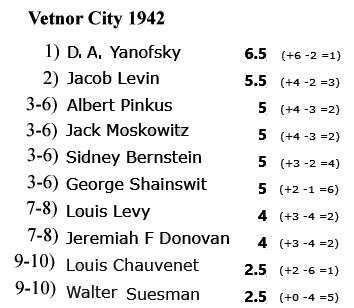
     In the following game he defeated Walter Suesman (1918-1984) who once played in the US Championship in 1938; he finished last (17 players) with a +1 -13 =2. He defeated Isaac Kashdan (!) and drew with George Treysman and George Shainswit. Reshevsky won the tournament a half point ahead of Fine. Suesman, a solid Master, won the 1960 Rhode Island state championship

A game that I liked (Fritz 17)

[Event "Ventnor City"] [Site "Ventnor City, NJ USA"] [Date "1942.06.22"] [Round "?"] [White "Walter B. Suesman"] [Black "L. Russel Chauvenet"] [Result "0-1"] [ECO "D10"] [Annotator "Stockfish 16"] [PlyCount "81"] [EventDate "1942.??.??"] {D12: Slav Defense} 1. d4 d5 2. c4 c6 3. e3 Nf6 4. Nc3 Bf5 5. Nf3 e6 6. Qb3 Qc7 7. Bd2 b6 {An inferior continuation. Correct is 7...Nbd7} 8. Rc1 {The threat is 9.cxd5 exd5 10.Nxd5 sso now the Q has to move to an ineffective square.} Qb7 9. Qa4 {Rather pointless. Simply 9.Nh4 gaining the two Bs was satisfactory.} Bd6 10. Be2 {Here or next move he should still try Nh4} O-O 11. O-O a6 12. Ne5 dxc4 {This should worj out to be in white's favor.} (12... b5 13. Qb3 Bxe5 14. dxe5 Nfd7 15. cxd5 cxd5 {keeps things even.}) 13. Nxc4 $16 Bc7 14. Qb3 Nbd7 { White now has the more active position.} 15. f4 (15. Na5 {Interestiong, but tricky!} Bxh2+ 16. Kxh2 Qc7+ 17. Kg1 bxa5 {White should be OK because of all black's weak Ps.}) 15... b5 16. Ne5 Nxe5 {Taking with B was a little more precise because his Ns would do better in the closed position.} 17. fxe5 { By capturing with the f-Pawn white hopes to use the open f-file to cocnduct a K-side attack.} Ne4 18. Be1 {Too passive.} (18. Nxe4 Bxe4 19. Bd3 Bxd3 20. Qxd3 {and there doesn't seem to be any way for white to take advantage of black's backward c-Pawn.} a5 21. Qe4 Ra6 22. Rc5 Rc8 23. Rfc1 Bd8) 18... Bb6 19. Bf3 { After this the position is only equal, so white should have played 19.Nxe4 and he would have had slightly the better of it.} (19. Nxe4 Bxe4 20. Bb4 Rfd8 21. Bd3 c5 22. Bxc5 Bxc5 23. Bxe4 Qxe4 24. Rf4 Qb7 {and either way white takes on c5 he has a very slight advantage.}) 19... Ng5 20. Be2 c5 {[%mdl 32] Black commences his counterplay.} 21. Bh4 {He simply cannot afford to ignore blak's Q-side activity.} (21. dxc5 {and white has nothing to worry about.} Bxc5 22. Nxb5 Qb6 (22... axb5 23. Rxc5 {and white has the advantage.}) 23. Nd4 Bxd4 24. exd4 Qxd4+ 25. Bf2 Qxe5 {with an equal position.}) 21... Ne4 (21... cxd4 { This takes advantage of white's slip.} 22. exd4 Bxd4+ 23. Kh1 Be4 24. Nxe4 Qxe4 25. Bxg5 Qxe2 26. Be7 (26. Rfe1 Qxb2 27. Qxb2 Bxb2 {with a won ending.}) 26... Rfc8 {Black has a active and theefore promising position.}) 22. Nxe4 Qxe4 23. Rf4 {After this white quickly finds himself in hot water.} (23. dxc5 { Neutralizes black's Q-side play and after} Bxc5 24. Rxc5 Qxh4 {neither side can demonstrate an advantage.} 25. Qc3) 23... c4 {Of course the Q cannot retreat.} (23... Qb7 24. Bf3 Qa7 25. Bxa8) 24. Qc3 (24. Rxe4 cxb3 25. Rf4 bxa2 26. Ra1 Bb1 {is not at all good for white.}) 24... Ba5 {[%mdl 512] A well played followup to his last move as his Q still cannot retreat.} 25. Rxe4 Bxc3 26. Rxc3 Bxe4 27. Bf3 {Trading off his good B only makes things worse, but in the long run black would still be winning after, say, 27.Be7} Bxf3 28. gxf3 { [%mdl 4096]} Ra7 {White's mass of center Ps will prove no match for the exchange.} 29. Kf2 Rc8 30. e4 b4 31. Rc2 Rac7 32. d5 Rd7 33. d6 f6 {Excellent! Black undermines white’s P’s and makes inroads for his R’s.} 34. Bg3 (34. exf6 gxf6 35. Bxf6 Rxd6 {and black is in full control.}) 34... Rc5 35. f4 Kf7 36. Ke3 c3 37. bxc3 $2 (37. Kd4 {is also insufficient, but it would hold out longer.} Rc8 38. bxc3 Rxc3 39. Rxc3 bxc3 40. Kxc3 fxe5 41. fxe5 Rb7 {wins the endin. For example...} 42. Bf4 Rb1 43. Bg5 Ke8 44. h4 Ra1 45. Kb3 Kd7 46. Be7 Re1 47. Kb4 Rxe4+ 48. Ka5 Kc6 49. a3 Re3 50. d7 Kxd7 51. Bf8 Kc6 52. Kxa6 g6 53. Ka5 Rxe5+ 54. Kb4 Re4+ 55. Kb3 Rxh4) 37... Rxc3+ 38. Rxc3 bxc3 39. Kd3 Rb7 40. Kxc3 {This position is very similar to the one reached after move 40 in the the note to move 37.} Ke8 41. Kc4 {White resigned. His resignation is possibly a little premature, but in the long run his position is lost.} (41. Kc4 fxe5 42. f5 {As has been seen, fxe5 leads nowhere.} exf5 43. exf5 Kd7 44. Bxe5 Rb5 45. Kd4 g6 46. fxg6 hxg6 47. Bg3 Ra5 {Black wins. One example...} 48. Kc4 Rxa2 49. Kb3 Rg2 50. Be5 Re2 51. Bf4 Rf2 52. Be5 Rf5 53. Bd4 {White cannot allow the sacrifice of th exchange because the K+P ending is lost.} (53. Bg3 Rf3+ 54. Ka4 Rxg3 55. hxg3 Kxd6) 53... Rh5 54. Bg1 Kxd6 55. Kb4 Rh4+ 56. Kb3 ( 56. Ka5 Kc6 57. Ba7 (57. Kxa6 Ra4#) 57... Rxh2) 56... Kc6 57. Ka3 g5 58. Kb3 g4 59. Kc3 Kd5 60. Kb3 Ke4 61. Kb4 Rh5 62. Kb3 Kf3 63. Ba7 Rxh2 {and wins}) 0-1

Wednesday, October 25, 2023

Dentist to the (Chess) Stars

     Here is an interesting article by Howard Langer about his grandfather Dr. Samuel Greenberg, a New York dentist, that appeared in Tablet Magazine, a conservative online magazine focused on Jewish news and culture. Read article...
     There seems to be very little information available about Dr. Greenberg, but I did find the following game played in 1962 in the Manhattan Chess Club Championship Preliminaries that he lost against William Goichberg. It features a pleasing mating attack by Goichberg. 
     Dr. Greenberg’s name appeared in the USCF’s 1964 rating list...it was Class A (Elo 1905). National Master Bill Goichberg (born November 11, 1942) is a tournament organizer and director. He founded the Continental Chess Association which runs the annual World Open and other large tournaments. He is also a former president of the United States Chess Federation. A game that I liked (Fritz 17)
[Event "Manhattan CC Prelims, New York"] [Site "?"] [Date "1962.??.??"] [Round "?"] [White "William Goichberg"] [Black "Dr. Samuel Greenberg"] [Result "1-0"] [ECO "D46"] [Annotator "Stockfish 16"] [PlyCount "57"] [EventDate "2023.10.24"] [SourceVersionDate "2023.10.24"] {D46: Semi-Slav} 1. d4 d5 2. c4 e6 3. Nc3 Nf6 4. Nf3 c6 {In the Semi-Slav black's Ps sre a mixture of the Orthodox Q-Gambit (...e6) and the Slav (...c6). Black is threatening to capture the c-Pawn and hold it with ...b7–b5. White can avoid this in a number of ways.} 5. e3 Nbd7 6. Bd3 Bd6 7. O-O O-O 8. e4 { Aggressive and somewhat risky. Solid is 8.Qc2} dxe4 9. Nxe4 Nxe4 10. Bxe4 Nf6 11. Bc2 g6 {This weakens the K's position. He should play 11...h6 or even 11... c5} 12. Bg5 (12. b3 {is also good.} Qc7 13. Bb2 Rd8 14. Qe2 Nh5 15. Rad1 { and white went on to win in a handful of moves in Duong,T (2415)-Hj,S (2339) Bandar Seri Begawan BRU 2010}) 12... Be7 13. Qe2 Qc7 14. Rad1 Bd7 {This turns out to be too passive. For what it was worth he should have tried 14...b5} ( 14... b5 15. c5 Nd5 16. Bh6 Rd8 17. h4 {with a promising attack.}) 15. a3 Nh5 { This leads to a lost position...immediately! He should still have tried ...b5} 16. Bh6 {White must have blitzed this one out otherwise he would have simply played 16.Bxe7} Ng7 17. Rfe1 Bf6 18. Ne5 Rfe8 19. Qf3 Bxe5 20. dxe5 Nf5 21. Bg5 c5 22. g4 {This turns out to be a key move!} Ng7 (22... Nd4 {puts up a bit of a fight. For example...} 23. Qf6 Qd8 24. Qxd8 Rexd8 25. Bxd8 Nxc2 26. Rxd7 Nxe1 27. Bf6 {and white should win the ending.}) 23. Bf6 {Mate is on the horizon.} h6 24. Qh3 Kh7 25. Re3 {Moving in for the kill.} Rh8 {This allows a nifty finish, but he was lost anyway.} 26. Qxh6+ {[%mdl 512]} Kxh6 27. Rh3+ Nh5 28. Rxh5+ $1 {[%mdl 512]} gxh5 29. g5# {His 22nd move paid off!} 1-0

Tuesday, October 24, 2023

Kashdan Conjures Up an Attack

     Back in 1930m between April 19th and May 4th a match in which the first player to win five games, draw not counting, was played in the Manhattan Chess Club. 
     One contestant was 26-year-old Lajos Steiner who had come to the United States to participate in the 1929 Bradley Beach (located in New Jersey) tournament. There Steiner had finished second to world champion Alexander Alekhine. 
     His opponent was 24-year old Isaac Kashdan, a the 1929 Manhattan Chess Club champion and a rising star. He had been the first board of the American team at the 1928 Chess Olympiad where he scored an impressive +12 -1 =2.
     Lajos Steiner (1903-1975) was born in Hungary. One of four children, his elder brother Endre Steiner was also a master. 
     Lajos was educated at the Technical High School in Budapest and graduated in 1926 with a diploma in mechanical engineering from the Technikum Mittweida in Germany. He emigrated to Australia in 1939, and won the Australian Championship in 1945, 1946/47, 1952/53, and 1958/59. He also won nine of his ten attempts at the New South Wales title (1940–41, 1943, 1944, 1945–46, 1953, 1955, 1958).
     Isaac Kashdan (1905-1985) was twice U.S. Open champion (1938 and 1947), but even though he was once considered world championship material he never won the US Championship. On the November 1932, Chess metrics estimated his rating to have been 2738 placing him at number 2 on the list behind Alekhine (estimated rating 2826). 
     He was called der Kleine Capablanca (German for The little Capablanca) in Europe because of his ability to extract victories from seemingly even positions. Watch him conjure up a winning attack from almost nothing in the following game and you’ll see what they meant. Alekhine named him one of the most likely players to succeed him as World Champion. 
     Kashdan’s peak year coincided with the Great Depression and so for financial reasons he was unable to make chess a career. Then later he moved to California because the climate was better for his son’s health. 
     Besides the Steiner-Kashdan match, in 1930, an international tournament was held in San Remo; it was won by Alexander Alekhine. 
     On May 2, 1930, former German champion Isidor Gunsberg (1854-1930) died in London. On August 17, 1930, former Hungarian champion Leo Forgacs died in Hungary at the age of 48. 
     The 3rd Tournament of Nations (aka the Chess Olympiad) was held in Hamburg, Germany. It was won by Poland (Rubinstein, Tartakower, Przepiorka, Frydman). Jungary was second and Dermany third. The US team (Isaac Kashdan, Frank Marshall, Harold Phillips, Herman Steiner and James Anderson) finished 6th (out of 18 teams). 
     The 2nd Women’s World Championship took place during the Olympiad and Vera Menchik successfully defended her title. 
     The Western Chess Association (forerunner of the US Open) was held in Chicago. Norman Whitaker and Samuel Factor tied for 1st. 
     On December 29, 1930, Alekhine almost killed himself when he fell asleep with a lit cigarette in his mouth in a hotel bed in Esseg, Yugoslavia. The cigarette fell out of his mouth onto the bed which caught fire. Alekhine awoke and tried to get out of the room, but passed out on the floor. A hotel clerk responding to the fire managed to get Alekhine out of the room and extinguish the fire. 
 

     Kashdan considered this game, the third game in his match with Steiner, to be one of his best.

  A game that I liked (Fritz 17)

[Event "Match, New York"] [Site "New York, NY USA"] [Date "1930.04.22"] [Round "3"] [White "Isaac Kashdan"] [Black "Lajos Steiner"] [Result "1-0"] [ECO "D52"] [Annotator "Stockfish 16"] [PlyCount "67"] [EventDate "1930.04.19"] {D52: Queen's Gambit Declined: Cambridge Springs Variation} 1. d4 d5 2. c4 c6 3. Nf3 Nf6 4. Nc3 e6 5. Bg5 Nbd7 6. e3 Qa5 {This is te Cambridge Springs Defense and even today is the most popular reply in the QGD.} 7. Qb3 {The usual reply is 7.Nbd2 is the usual reply with 7.cxd4 a close second. The text avoids the more complicated attacks, but it allows black to obtain easy development.} Ne4 8. cxd5 (8. Bh4 Bb4 9. Rc1 Nb6 10. Bd3 dxc4 11. Bxc4 Nxc4 12. Qxc4 Nd6 {equals. Werle,J (2481)-Gurevich,M (2641) Zwolle 2002}) 8... exd5 9. Bd3 Bb4 {Kashdan was of the opinion that this B belongs on e7.} (9... Nxg5 10. Nxg5 Be7 11. Nf3 O-O 12. O-O {with complete equality. Djukanovic,S (2294) -Blagojevic,D (2532) Tivat MNE 2011} Re8 {½-½ (38)}) 10. Rc1 Nxg5 $11 11. Nxg5 h6 12. Nf3 O-O 13. O-O Re8 14. a3 Bxc3 {The main option was 14...Bd6 and while there is nothing really wrong with the move played Kashdan thought it gives white the advantage because of his better development and also because of the mobility of his Q-side Ps, which threaten to advance and create weaknesses in black's position. Hence Kashdan felt it was better to retreat.} 15. Qxc3 Qxc3 16. Rxc3 Nf6 17. b4 Be6 18. Rfc1 Ne4 19. Bxe4 {Several years after this game Kashdan said that if he were "playing this position today (i.e. in 1936) he would prefer 19.R(3)-b2 because his B would be useful to enforce b4-b5 and black's N can always be gotten rid of anyway. Engines prefer 19.Bx35, but only by a hair's breadth.} dxe4 20. Nd2 Bd5 21. Rc5 {Perhaps initiating a Minority Attack with 21.a4 followed by b4-b5 was more accurate, but Kashdan played the text in order to induce 21...b6 which he judged would be weak for black.} b6 {A sounder idea was 21...f5 followed by ...f4} 22. R5c3 a5 23. Nc4 { Kashdan judged that now black's Ps are seriously weakened and subject to attack, whether his N is exchanged or not. According to Stockfish the position id dead equal.} axb4 24. axb4 Ra6 {Played with the (correct) belief that he can set up a sufficient defense.} (24... Bxc4 {is inferior. It's main practical advantage is that the resulting double R ending would by difficult to play for both sides.} 25. Rxc4 Ra4 26. h4 Kf8 27. Rxc6 Rxb4 28. Ra1 f5 29. Ra6 Rb1+ (29... Rb8 30. Rc7 f4 31. Raa7 {White is winning.}) 30. Kh2 Rb2 31. Kg3 b5 32. Rc5 {White is better.}) 25. Ne5 Re6 {Excellent defense by Steiner. Defending the P, which cannot yet be taken because of the mating threat, and intending ...b5 after which everything would be secure. If Kashdan wants to win he cannot untake it quickly.} 26. b5 {Very interesting and innovative. The P sacrifice had to be accurately calculated because if Kashdan's attack fails the P will become a Q!} ({But not} 26. Nxc6 $2 Bxc6 27. f4 Bd7 $19) 26... cxb5 27. Rc8+ {Kashdan is attacking with opnly two Rs and a N...will it succeed?} Kh7 28. Rd8 {[%mdl 1024] An excellent move! It gains an important tempo and it's an essential patt of his idea.} (28. Nxf7 {does not accomplish anything as after} b4 29. h4 (29. R8c7 b3 30. Rb1 b2 31. Rc2 Rc6 32. Rbxb2 Bxf7 { and black wins}) 29... b3 30. Kh2 Ra8 31. Rxa8 Bxa8 32. Ne5 Bd5 33. Rb1 { with a likely draw.}) 28... Bc4 {Seemingly the most natural square as it blocks the open file, but the move allows white q slim advantage...something Kashdan was famous for exploiting. In fact, Kashdan claimed the move loses quickly!} (28... f6 {This is actually the best move as it does not allow white to really accomplisj anything. For example...} 29. Rxd5 fxe5 30. dxe5 Rc6 31. Rb1 Rc5 32. Rd2 Rxe5 {and neither side will be able to make any headway.} 33. h3) 29. Nd7 {[%mdl 2048] Threatening to win the exchange, which strangely enough cannmbe avoided despite the mobilty of black's R.} Kg6 (29... Rc6 30. Nf8+ Kg8 31. Nd7+ Kh7 32. Nb8) (29... Rd6 {This is best. The ensuing ending is extremely complicated!} 30. Nf8+ Kg8 31. Nd7+ (31. Rxd6 Kxf8 {and black has compensation for the exchange.}) 31... Kh7 32. f3 exf3 33. Nf8+ Kg8 34. Rxd6 Kxf8 35. e4 fxg2 36. d5 Ke7 37. Rc6 f5 38. Rc7+ Kd8 39. Rxg7 fxe4 40. Kxg2 Ra2+ 41. Kg3 e3 42. d6 e2 43. Kf2 e1=Q+ 44. Kxe1 Rxh2 45. Rh7 {Theoretically at least, this position is drawn.}) 30. d5 {[%mdl 32] Gaining time, as the R still cannot escape. Very instructive.} Re7 (30... Bxd5 31. Nf8+ Kf6 32. Rxd5 { wins easily.}) 31. d6 Rxd7 32. Rxd7 {Kashdan has made something out of nothing. } Bd3 {This loses at once.} (32... Ra3 {keeps fighting...} 33. Re7 Rd3 34. Rxe4 Rxd6 35. h4 Kf6 36. Ra1 Rd2 37. Ra7 Be6 {and the gane could go on forever.}) 33. Rb7 Kf6 {White has more than one way to skin the cat!} 34. f3 {Black resigned} (34. f3 Bc4 35. Rd1 Ra8 36. Rxb6 exf3 37. gxf3 Rd8 {and the enbding is hopelss.}) (34. d7 {also wins.} Ke7 35. f3 Bc4 36. Rd1 Bd3 37. fxe4 Ra3 38. e5 b4 39. Rxb6 Kxd7 40. Rd6+ Ke7 41. R6xd3 {etc.}) 1-0