Random Posts

Monday, September 11, 2023

Weinstock Wallops Stenzel

     National Master Solomon Weinstock (1925-2009) passed away peacefully at his home in New York after a brief illness. 
     He retired from Brooklyn College after more than 20 years as professor of Psychology where h was a distinguished teacher and researcher. 
     Weinstock served in the Army during World War II. After the war, he majored in math and physics and graduated from City College of New York; he received his doctorate in Psychology from Indiana University. 
     He was a strong advocate for civil rights and environmental issues, enjoyed nature, chamber music, traveling and art. 
     Weinstock was a participant in the 1944 US Championship in which he scored 7-10 and tied for 10etg place with Atillio Di Camillo. Weinstock won the Correspondence League of America championship in 1999. 
 
 
     His opponent in the following game was Harold Stenzel (born 1952) who is an International Arbiter. The game was fairly even until Stenzel played 12...Bxa6 which precluded his castling to safety on the Q-side. His final mistake was the loss of time trying to make K-side threats with 15...Qh5. After that he got walloped. 

A game that I liked (Fritz 17)

[Event "Nassau County Chp, Long Island NY"] [Site ""] [Date "1988.??.??"] [Round "?"] [White "Solomon Weinstock"] [Black "Harold Stenzel"] [Result "1-0"] [ECO "C03"] [WhiteElo "2210"] [Annotator "Stockfish 16"] [PlyCount "43"] [EventDate "1988.??.??"] {C10: French Defense} 1. e4 e6 2. d4 d5 3. Nd2 dxe4 4. Nxe4 Nc6 5. Nf3 b6 6. Bd3 (6. Bb5 {Was also playable. Here is an amusing miniature...} Qd5 {Correct was 6...Bb7} 7. Qe2 Nf6 8. c4 Bb4+ 9. Kf1 {Black resigned. Rausis,I (2575) -Herboth,T Baden-Baden 1993 After 9...Qd7 10.Ne5 he loses material.}) 6... Bb7 7. O-O Nf6 8. Bg5 h6 {Risky. He should play 8...Be7} (8... Nxd4 {would be a serious mistake.} 9. Nxd4 Bd6 (9... Qxd4 10. Bb5+) 10. Re1 {White us winning.}) 9. Bxf6 gxf6 {Evidently black though he would have attacking chances owing to the semi-open g-file. That won't be the case.} 10. c3 (10. d5 {This tactical shot secures excellent chances for white, For example...} exd5 11. Ng3 Bd6 12. Re1+ Kf8 13. Nf5 {Black is left with a shattered K-side and his K is likely to find itself in a predicament.}) 10... Be7 11. Qa4 {With his last two moves white has failed to take advantage of black's play with the result that the position is nearly equal.} Qd7 $1 $11 12. Ba6 Bxa6 {This is wrong because black is now unable to play ...O-O-O} (12... O-O-O 13. Bxb7+ Kxb7 {and jis K is quite safe.}) 13. Qxa6 $16 Rg8 14. Rad1 {[%mdl 32]} Qd5 15. Rfe1 Qh5 { This is consistent with his idea of conducting a K-side attack, but it is tactically faulty as Weinstock simmediately demonstrates.} (15... b5 {cutting off the Q offers a glimmer of hope.} 16. a4 Rb8 17. b4 f5 {and black is surviving.}) 16. Ng3 {Not bad, but 16.Qb7 was much more forceful.} (16. Qb7 Rd8 17. Qxc6+ {White has won a piece.}) 16... Qd5 17. c4 Qd7 18. d5 {Busting the position wide open with black's K caught in the center.} exd5 (18... Nb4 19. Qb7 Qc8 20. Qxc8+ Rxc8 21. a3 Na6 22. Nd4 e5 23. Nc6 {with a decisive advantage.}) 19. Rxd5 Qc8 20. Qa4 Qb7 21. Nd4 b5 22. Rxb5 $1 {Black resigned.} (22. Rxb5 Qc8 23. Nxc6 Kf8 24. Nxe7 {etc}) 1-0

Friday, September 8, 2023

Fischer Was Perfect, Others Weren’t

     Larry Evans once said Fischer’s weakness was overconfidence, stating that it "sometimes causes him to forget his opponents are also capable of finding good moves." Evans’ statement notwithstanding, the 1963/64 US Championship Bobby Fischer made a perfect score of 11-0. 
     Fischer’s first loss in a US Championship to Edmar Mednis had happened in the previous year’s tournament. Evans wrote that “Fischer plays about 50 per cent stronger with white than with black,” adding "It is hard to remember when he last lost with white." But, that’s exactly what happened in a long French Defense in his game against Mednis. 
     As a result of his defeat by Mednis, Fischer arrived at this championship determined not to let it happen again. This tournament was a strong one with only William Lombardy missing from the top rated players. 
 

     Fischer’s rating going in was FIDE 2702. For comparison, the other’s best ratings (either FIDE or national) were: Reshevsky 2621, Benko 2582, Evans 2602, and Robert Byrne 2550, Saidy 2490, Weinstein 2488, Bisguier 2499, Addison 2445, Mednis 2473, Donald Byrne 2434 and Steinmeyer 2425. 
Weinstein circa 1960
     Those ratings may not seem too high by today’s standards, but at the time most garden variety GMs were rated 2500-2600 with a few actually below that, so the championship did have some pretty strong players. Based on ratings though, Fischer was still in a class by himself and was expected to win the event, but what was not expected was the way he did it. 
     He had been studying for five or six hours a day according to friends and was well prepared in the openings as evidenced by his surprising Larry Evans with a King’s Gambit. 
     But, enough of Fischer...others were also playing and they produced some interesting games. Here’s one by Raymond Weinstein. I always liked his sharp style which he demonstrates in this game against Robert Byrne. Note that in this tournament Weinstein did not have a single draw! 

  A game that I liked (Fritz 17)

[Event "63/64 US Championship, New York"] [Site ""] [Date "1964.??.??"] [Round "?"] [White "Raymond Weinstein"] [Black "Robert Byrne"] [Result "1-0"] [ECO "E99"] [Annotator "Stockfish16"] [PlyCount "81"] [EventDate "1963.??.??"] {E99: King's Indian: Classical Main Line} 1. d4 Nf6 2. c4 g6 3. Nc3 Bg7 4. e4 d6 5. Be2 O-O 6. Nf3 e5 7. O-O Nc6 8. d5 Ne7 9. Ne1 Nd7 10. f3 f5 11. g4 h5 { This is very risky especially against a sharp tactician like Weinstein. Safer was the usual ``...Kh8} 12. g5 {The only chance that offers any hope of gaining an advantage.} (12. gxf5 $16 gxf5 13. Nd3 f4 {is only equal.}) 12... h4 13. Nd3 f4 14. Kh1 {It's white who has all the chances.} Kf7 15. Bd2 (15. c5 { is even better.} Rh8 16. Qb3 b6 17. cxd6 cxd6 18. Qa3 Nc5 19. Nxc5 bxc5 20. b4 {White has the advantage and went on to win in Larsen,B-Tal,M Bled 1965}) (15. Rg1 {is also promising.} Rh8 16. Bf1 Nf8 17. Nf2 {White is slightly better. Vrana,F (2369)-Skreno,V (2189) Banska Stiavnica 2006}) 15... Rh8 16. Rg1 Ng8 17. b4 {Byrne has succeeded in defending himself on the K-side, so Weinstein seeks opportunities elsewhere.} Rh5 18. c5 Nf8 (18... Rxg5 {This is not to be recommnded.} 19. Rxg5 Qxg5 20. Nb5 Ngf6 21. Nxc7 Rb8 22. Ne6 Qh6 23. cxd6 Nh5 24. Bc3 Ng3+ 25. Kg1 (25. hxg3 hxg3+ 26. Kg1 Qh2+ 27. Kf1 Qh1#) 25... Nxe2+ 26. Qxe2 {White's position is a winning one.} g5) 19. Rc1 Bd7 20. Nxf4 {[%mdl 512] Nice!} exf4 21. Bxf4 Qe7 22. Qd2 {[%mdl 1024] White's active position is excellent compensation for the N.} Nh7 23. Be3 h3 24. Bd3 Kf8 25. Ne2 Qf7 26. Rg3 Ne7 27. cxd6 {Opening the way for the R to get into play.} cxd6 28. Rc7 Ke8 29. Rxb7 {White has 3Ps for the N, but more importantly he has a very active position.} Be5 30. f4 Bg7 31. Rxa7 Rxa7 32. Bxa7 Nf8 (32... Nxg5 {might work better.} 33. b5 Nxe4 34. Bxe4 Bc8 {but, here, too, white's advantage is significant.}) 33. b5 Bc8 34. Bb8 Bb7 35. Bxd6 {there is simply no way black can avoid disaster with so many white Ps coming at him.} Nf5 36. Bxf8 Bxf8 37. Rf3 Nd6 (37... Nh4 {offered a better defense.} 38. Rg3 Nf5 39. Rf3 (39. exf5 { and white has fallen into a trap!} Qxd5+ 40. Kg1 Bc5+ 41. Kf1 Qh1+ 42. Ng1 Bg2+ 43. Rxg2 hxg2+ 44. Qxg2 Rxh2 45. Qc6+ Kd8 46. Qf6+ Kd7 47. Qe6+ {and white has to take a draw by continuous checks.}) 39... Nh4 40. Rxh3 Bc5 {and at least black can make his opponent work for the point.}) 38. Nd4 Bc8 39. Qc3 Bb7 40. Ne6 Rh7 41. b6 {Byrne resigned. All he can do is make meaningless moves.} 1-0

Tuesday, September 5, 2023

Daring Tactics by Anthony Suraci

 
     Anthony Suraci of East Haven, Connecticut played in the 1948 US Championship where he scored +3 -16 =0 and finished in 19th place out of 20. He was the 1951 state champion. Other than that nothing is known about Suraci. 
     However, the July 30, 1964 issue of the New York Times chess column headlined, “An Unknown Becomes Known Through Some Daring Tactics”. 
     So, he was an unknown local player. Chessgames.com has 27 of his games, mostly from the ‘48 championship and a couple of US Opens, the last being in 1962.
     Here is Suraci’s game featuring those daring tactics. His opponent was Harry Lyman (1915-1999), many time champion of New England and the 1957 US Amateur Champion who is remembered as the Dean of Boston chess. He was the uncle of Shelby Lyman. 
     At the time, Lyman was the champion of the Marshall Chess Club and was, himself, a fearless and dangerous tactician. When the two met and both were bent on complications a fierce battle ensued. The symmetrical opening meant a slow start, but things heated up after black’s 13th move.

  A game that I liked (Fritz 17)

[Event "Central New England Open, Fitchburg"] [Site "?"] [Date "1951.??.??"] [Round "?"] [White "Harry Lyman"] [Black "Anthony Suraci"] [Result "0-1"] [ECO "A00"] [Annotator "Stockfish 16"] [PlyCount "84"] [EventDate "1951.??.??"] {A05: Reti Opening} 1. Nf3 Nf6 2. g3 g6 3. Bg2 Bg7 4. O-O O-O 5. d3 d6 6. Nbd2 e5 7. e4 Bg4 8. h3 Bd7 9. Nc4 Qc8 (9... Nc6 10. c3 Ne8 11. Kh2 f5 12. exf5 Rxf5 {looks to be about equal. Apatoczky,P (2250)-Ponyi,A (2095) Hungary 1993}) 10. Kh2 Nc6 11. c3 Be6 12. Nh4 {The prelude to a K-side attack that never materializes. Probably his best course was to continue the slow maneuvering with 12.Ne3} Nh5 (12... Nxe4 {is the engine's preference, but after} 13. Bxe4 d5 14. Nxe5 dxe4 15. Nxc6 bxc6 {it's unlikely that a human would prefer black.} ) 13. f4 {Typical of Lyman's aggressive play, but here it opens up the K-side in black's favor. Again, 13.Ne3 was a solid continuation.} b5 {This is irrelevant and should have only served to drive white's N to a good square on e3.} (13... exf4 $1 $17 {and life is bright.} 14. gxf4 Bxc4 15. dxc4 Qe6) 14. Na3 {This places the N offside...it needs to be on e3 after which white's game would have been slightly better.} exf4 15. gxf4 Qd8 16. Nf3 Rb8 {With little to be immediately accomplished on the Q-side Suraci switches to the Q-side... real master play!} 17. d4 b4 18. Nc2 Bc4 19. Rf2 bxc3 20. bxc3 Ba6 {[%mdl 2048] } 21. e5 {This natural looking P push is the wrong one and it leaves white with a lost game.} (21. f5 {keeps white in the game.} Ne7 22. Ne3 Bc8 23. Kg1 d5 24. fxg6 hxg6 25. e5 c5 {and it's still a fight.}) 21... dxe5 22. Ba3 e4 { Offering the exchange, but white does not immediately accept it.} (22... Nxf4 { This was an alternative.} 23. Bxf8 Bxf8 24. Nxe5 Nxe5 25. dxe5 Qe8 {with an active position.}) 23. Ng5 {This is more of a gesture than anything. The immediate capture of the R was also playable.} f5 {[%mdl 32]} 24. Bxf8 Bxf8 25. Bf1 Bd6 26. Nxe4 {This only hastens the end, but it makes little difference what he plays.} fxe4 27. Bxa6 Nxf4 28. Bc4+ Kg7 {[%mdl 32]} 29. Kh1 Qh4 { The climax of black’s attack} 30. Qf1 Nxh3 31. Rf7+ Kh6 (31... Kh8 {lessens the force of his attack because white can trade Qs} 32. Qf6+ Qxf6 33. Rxf6 Rb2 34. Bb3 {But even here black's advantage is decisive.}) 32. Qe1 Bg3 33. Qd2+ g5 34. Be6 Nf4+ 35. Kg1 Nd8 36. Ne3 {Black still has toi be alert...allowing 37. Nf5 would be a tragedy.} Kg6 37. Rg7+ {Is black in trouble?} Kf6 {Not after this move!} (37... Kxg7 38. Nf5+ Kf6 39. Nxh4 Ndxe6 40. Ng2 Nh3+ 41. Kh1 Nf2+ { and black has to take the draw.}) 38. Bb3 Rxb3 {[%mdl 512]} 39. axb3 Nh3+ 40. Kf1 {Not that it matters, but 40.Kg2 holds out a bit longer.} Qf4+ 41. Kg2 Qf3+ 42. Kxh3 Bf2+ {It's mate in 2 so White resigned. Yes, 42...Bf4 was mate.} 0-1

Friday, September 1, 2023

Gheorghiu Demolishes de Castro

     It’s been quite an ordeal recovering from the recent flooding. Cleanup, replacing lost items and dealing with the insurance company has not left much free time, but a few spare moments here and there have been spent looking around in the 1970s chess world. 
     The year 1973 was filled with events: it saw the birth of the first mobile phone, abortion being declared a constitutional right, and the Battle of the Sexes, the most-watched tennis match of all times, It was a match between Billie Jean King and Bobby Riggs, the two greatest tennis players of the day. King won easily.
     Vasily Panov (1906-1973) died in the USSR at the age of 66. He was champion of Moscow in 1929. Al Horowitz (1907-1973), a leading US players in the 1930’s and publisher of the great Chess Review magazine, died at the age of 65 in New York. Hans Kmoch (1894-1973) also passed away in New York at the age of 78.
     Aleksander Lipenieks (1908-1973) died in Lincoln, Nebraska at the age of 64. He was the city champion 15 times and also published a number of chess books. FIDE President Folk Rogard (1899-1973) died in Stockholm, Sweden at the age of 73. 
     Three-time USSR Champion Leonid Stein (1934-1973) died of a heart attack at the age of 38 in Moscow. And, two-time Yugoslav champion Braslav Rabar (1919-1973) died in Zagreb, Yugoslavia at the age of 54. 
     At the beginning of the year the world’s top rated players were: 1) Bobby Fischer (2780), 2) Mikhail Tal (2660), 3) Anatoly Karpov (2660), 4) Boris Spassky (2655), 5) Viktor Korchnoi (2650), 6) Lajos Portisch (2650), 7) Tigran Petrrosian (2640), 8) Mikhail Botvinnik (2630), 9) Lev Polugaevsky (2625), and 10) Bent Larsen (2620). 
     Walter Browne won the National Open in Las Vegas on tiebreaks over Laszlo Szabo and James Tarjan. He also won the World Open in New York City. Arthur Bisguier won the big Lone Pine tournament in California. Norman Weinstein, age 22, won the US Open, held in Chicago. 
     Bobby Fischer was making news. He was offered a million dollars to play a match in Las Vegas. According to his lawyer, Paul Marshall, Fischer had over $10 million in offers to or advertise, but he turned them all down...it was beneath his dignity to advertise any product. 
     He moved to Los Angles to continue his religious studies with the Worldwide Church of God. 
     In August, he announced his upcoming plans at a press conference in Beverly Hills, California with the chief lawyer for the Worldwide Church of God standing by his side. 
     In November, 1973, Fischer was the guest of Philippine President Ferdinand Marcos against whom he played an exhibition game that was broadcast on television. It lasted 5 minutes and a draw agreed after 8 moves. 
     Fischer also played Florencio Campomanes, President of the Philippines Chess Federation, a blitz game on television. Fischer won on time. 
     Ourense is a city in northwestern Spain known for its hot springs; they held an international tournament there in January of 1973. 
     From the beginning it looked like Romanian GM Florin Gheorghiu was going to win, which he did. The one point margin of victory was mainly due to defeat of Pal Benko in the very first round. 
 
 
     The tournament produce a number of interesting games, especially miniatures. Here is one of the more entertaining games in which Gheorghiu totally destroys De Castro. 
      Florin Gheorghiu was born in Bucharest on April 6, 1944. He won the World Junior Championship in 1953 and was awarded the IM title. In 1965 he became a Grandmaster. He won the Romanian Championship in 1960 (age 16), 1962, 1964, 1965, 1966, 1967, 1973, 1977 and 1984. At his peak in November 1980, he was rated No. 10 in the world. 
     Edgar De Castro was a Filipino player and International Arbiter and from the begin of 1960s to the mid-1970s was one of the leading Filipino players. Other than that nothing is known about him. 

A game that I liked (Fritz 17)

[Event "Orense, Spain"] [Site ""] [Date "1973.01.14"] [Round "?"] [White "Florin Gheorghiu"] [Black "Edgar de Castro"] [Result "1-0"] [ECO "B87"] [Annotator "Stockfish 16"] [PlyCount "43"] [EventDate "1973.01.08"] {Sicilian Defense} 1. e4 c5 2. Nf3 d6 3. d4 cxd4 4. Nxd4 Nf6 5. Nc3 a6 6. Bc4 e6 7. Bb3 b5 8. O-O Bb7 {Risky. Black delays castling and quickly experiences difficulties on the e-File. Much better was 6...Be7} (8... Be7 9. Qf3 Qc7 10. Qg3 O-O 11. Bh6 Ne8 {Black's defenses are adequate.}) 9. Re1 Nbd7 10. Bg5 Nc5 { This is a tactical error that allows white ti immediatley gain the advantage. Forcing white to make a decision with his B with 10...h6 was a reasonable try.} 11. Bd5 {Black is already in trouble.} b4 {[%mdl 8192]} (11... exd5 12. exd5+ Kd7 13. b4 Na4 14. Nxa4 bxa4 15. c4 {and white is winning.}) (11... Be7 { keeps the damage to a minimum.} 12. Bxb7 Nxb7 13. Nc6 Qc7 14. Nxe7 Kxe7 { White is better, but there is no forced win.}) 12. Bxb7 {Already white's position can be declared as won.} Nxb7 {There was no better alternative.} ( 12... bxc3 13. Nc6 Qc7 14. Bxa8 cxb2 15. Rb1 {is equally hopeless for black.}) 13. Nd5 {[%mdl 512]} exd5 (13... Rc8 14. Qf3 Be7 15. Nxe7 Qxe7 16. Nf5 exf5 17. exf5 {and wins.}) 14. exd5+ Kd7 15. c3 {White needs to open more lines.} b3 ( 15... bxc3 16. Qa4+ Kc8 17. Qc6+ Kb8 18. Bxf6 gxf6 19. Re8) 16. Qxb3 Nc5 17. Qc4 Rc8 {It's kind of hard to believe but up to here these moves were all played the previous year!} (17... Qc8 18. Nc6 h6 19. Bxf6 gxf6 20. Re3 Kc7 21. b4 Rg8 {Black resigned Tal,M (2625)-Mukhin,M (2420) Baku 1972}) 18. b4 Nce4 19. Qxa6 Nxc3 20. Rac1 Rc7 21. Qd3 {It's a moot point but there was a mate in 16 with 21.Rxc3} (21. Rxc3 Rxc3 22. Qa4+ Kc8 23. Nc6 Qb6 24. Qa8+ Kc7 25. Qd8+ Kb7 26. Qb8+ Ka6 27. b5+ Kxb5 28. Rb1+ Kc4 29. Qxb6 Kxd5 30. Qb5+ Rc5 31. Rd1+ Ke6 32. Nd4+ Ke7 33. Re1+ Kd8 34. Re8+ Kc7 35. Qb8+ Kd7 36. Qd8#) 21... Qc8 22. Nb5 {Black resigned} (22. Nb5 Ne2+ 23. Qxe2 Rxc1 24. Rxc1 Qxc1+ 25. Bxc1 {etc.}) 1-0

Tuesday, August 29, 2023

Not a Match, but a Mismatch

 
     Wednesday, 8-23, saw severe thunderstorms, torrential rains, wind gusts that were recorded between 70-90 miles per hour and a couple of tornadoes rip through here. It was, I think, a frontal system associated with the recent hurricane that lashed California. 
     We, along with tens of thousands of others in the area suffered major flooding of our home. A local TV news crew even filmed our house and interviewed my wife. 
     Some parts of the city were without power for nearly two days. Fortunately, we had power. Needless to say, the losses we suffered were substantial, but not nearly so bad as some of out neighbors. 
     We are a long way from returning to normal and as an aside, for anybody who has to deal with an insurance company...good luck! Obviously, blogging has been on hold, but here is a post I had ready before the storm... 
     In 1882, Wilhelm Steinitz played a match in Philadelphia, Pennsylvania against Dion Martinez, but it was actually more of a mismatch! 
     Dion Martinez (June 6, 1837 – March 11, 1928, 90 years old) had emigrated from Cuba somewhere between 1873 and 1875 and settled in Philadelphia. 
     In 1885 he became the first president of the Franklin Chess Club. His son Charles S. Martinez (1868-1941) was also a prominent player. 
     Martinez (Dion) was regarded as one of the strongest players in Philadelphia and he played a short matches against James Mason, losing ine and winning one.
     Besides losing to Steinitz in 1882, he also lost to Steinitz again in 1982 (2.5-3.5) and he took another beating (1-10) in 1883. The following year he was badly whipped by Johannes Zukertort (3.5-9.5). 
     Martinez was 52 years old at the time when the June 16, 1889 edition of the New York Times described him as follows: "Dion Martinez of Philadelphia is rather an elderly gentleman, tall and dignified. He was regarded as one of the strongest chess players in Philadelphia, but has not practiced much for two years past, and financial adversities have tended to detract his mind from the game." 
     In the 1882 match against Steinitz, victory went to the first to score 7 wins, draws not counting. The time control: 30 moves in 2 hours and then 15 moves every 1 hour. The purse was $250 for each player. 
     The match came about when a Mr. D. S. Thompson (a Philadelphia businessman) visited Simpson's Chess Divan in London where he met Steinitz and suggested a visit to Philadelphia. 
     Steinitz agreed based on, among other stipulations, the following terms: 1) seven or nine games, four games each week 2) stakes on each side to be $250 per side plus $500 traveling 3) Steinitz to stay in Philadelphia 45 days and to play only with members of the Philadelphia Chess Club. 
     Steinitz would also give exhibitions of blindfold and simultaneous play, so that all the members of the club would have an opportunity to play him. 
     Martinez was willing to play Steinitz and even put up $100 of his own money towards the $500 necessary. In 1882, $100 had the purchasing power of nearly $3,000 today. 
     Today’s game was the 6th game of the match. It was the shortest in the match and lasting only 21 moves, it was completed in an hour and a half. Martinez played a variation of the Evans Gambit, which he evidently had not studied too closely. It was noted that in the match the only games in which Martinez had a chance were those in which he was compelled to play safely.

  A game that I liked (Fritz 17)

[Event "Match, Philadelphia"] [Site ""] [Date "1882.11.23"] [Round "6"] [White "Dion M Martinez"] [Black "Wilhelm Steinitz"] [Result "0-1"] [ECO "C51"] [Annotator "Stockfish 16"] [PlyCount "42"] [EventDate "1882.??.??"] {C51: Evans Gambit Accepted} 1. e4 e5 2. Nf3 Nc6 3. Bc4 Bc5 4. b4 {Popular at the time, Emanuel Lasker dealt a heavy blow to the Evans with a modern defensive idea...returning the P under favorable circumstances. The opening was out of favor for much of the 20th century, although John Nunn and Jan Timman played it in some games in the late 1970s and early 1980s, and in the 1990s, Garry Kasparov used it in a few games which prompted its brief revival.} Bxb4 {No self-respecting player of the day would have dreamed of declining the gambit with 4...Bb6. Due to the loss of a tempo involved, most experts consider declining the gambit to be weaker than accepting it.} 5. c3 Bc5 6. O-O d6 {[%mdl 32]} 7. d4 exd4 8. cxd4 Bb6 9. Bb2 {Even at the time this game was played it was known the best move is 9...d5.} (9. d5 Na5 10. Bb2 Ne7 11. Bd3 O-O 12. Nc3 {and white is doing well.}) 9... Nf6 10. e5 {The NY Times annotator noted that this is a “good play when you give odds, perhaps, but bad play in an even game, and can only be explained on the theory of a mistake. "} (10. Nbd2 O-O 11. e5 Ng4 12. h3 Nh6 13. exd6 cxd6 14. d5 {is at least equal. Felgendreher,H (2223)-L'Hostis,S (2064) FRA 2008}) (10. d5 {is probably white's best.} Ne7 11. Bxf6 gxf6 12. a4 {with a difficult position to evaluate. Black's K-side is badly weakened; white has more space, but his B is bad and it's going to be diffucult to get at black's K.}) 10... dxe5 {Opening up the position while he is uncastled seems risky, but chess is often a game where exceptions to the rule are the rule. Black is actually better here.} 11. Ba3 { Quite logical because it keeps black's K in the center, but in fact, after this move white finds himself in serious trouble.} (11. dxe5 {Shows why black is better.} Qxd1 12. Rxd1 Ne4 13. Rf1 Bg4 14. Bd5 Bxf3 15. gxf3 Nc5 {and thanks to his Q-side P-majority black has a decisive endgame advantage.}) 11... Be6 {What a surprise...black allows doubling of his e-Pawns.} 12. Nbd2 (12. Bxe6 fxe6 13. Qb3 Qd5 14. dxe5 Ne4 {Black's centralizes pieces and Q-side P-majority add up to a decisive advantage.}) 12... e4 {This is even stronher than capturing on d4} 13. Re1 {A totally unsound sacrifice...it's hard to envision what white had in mind here, but it's clear he miscalculated the coming sequence.} (13. Ne5 {hard;y salvages the game though.} Qxd4 14. Nxc6 bxc6 15. Bxe6 fxe6 16. Qb3 {Baiting a trap!} O-O-O {and black is safe.} (16... Qxd2 17. Qxe6+ Kd8 18. Be7+ Ke8 19. Bxf6+ Kf8 20. Qe7+ Kg8 21. Qxg7#)) 13... exf3 14. Qb3 Qxd4 15. Nxf3 Qxf2+ 16. Kh1 O-O-O {White may have overlooked this escape to safety. The remainder of the game is a pathetic display by white.} 17. Rxe6 fxe6 18. Rf1 Ne4 {[%mdl 32] This leads to a pretty finish.} 19. Rxf2 Nxf2+ 20. Kg1 Rd1+ 21. Qxd1 Nxd1+ {[%emt 0:00:00] White resigned.} 0-1

Wednesday, August 23, 2023

Are You As Smart As a Piss Ant?

     Pisants, also known as piss ants, originally referred to a type of European ant known as the wood ant. In the United States,the term piss ant may refer to any small ant that infests a home. 
     They prefer to build their nests in wooded areas where they use wood as their nesting material, mainly pine. The formic acid their bodies secrete makes their nests take on a distinctly urine-like odor. The same thing happens if you smash one of them...your fingers will smell like urine. 
     They are small, typically not much larger than one quarter of an inch long and can be black, brown, or reddish. Some varieties may even have a bluish-green, iridescent sheen. 
     In our homes ants are attracted to building materials and the foods we eat, especially sweets. Once your home is on their radar, they move in and are challenging to get rid of. They can cause damage and, also, carry bacteria, parasites and infectious diseases that can be transferable to humans. 
     They’re hard to get rid of because insect sprays kill them on contact, but the sprays won’t eliminate a whole colony. Also, over-the-counter products don’t work as well as they used to as more and more species are developing an immunity to pesticides. 
     You might think ants are not intelligent, but nothing could be further from the truth! They are one of the most intelligent and industrious insects in the world.
     Recent studies show that ants are outstanding navigators and highly social. Ants care about their colony and they can pass on knowledge from the elders to the young. 
     They even make their own medicine! They have been known to gather certain foods and certain types of fungus that can be used by their colony as antibiotics.
     Ants are excellent problem solvers and can readily adapt to new situations. They routinely accomplish tasks as a group to do jobs that a single ant could not do. 
     So what does all that have to do with chess? Probably every chess player has heard of the Knight’s Tour where you have to move a Knight to every square on the board only once. does all that have to do with chess? Probably every chess player has heard of the Knight’s Tour Old timers will remember George Koltanowsky was famous for performing it. Chess Life published an article on on the Knight’s Tour HERE
     Ants use a certain algorithm to forage for food and it can be used to solve many types of problems including the Knight’s Tour. Read more…

Tuesday, August 22, 2023

Lambert Lambastes Puc

  
     The 1950 Olympiad in Dubrovnik was won without difficulty by Yugoslavia (Gligoric, Pirc, Trifunovic, Rabar, Vidmar Jr. and Puc) two points ahead of Argentina (Najdorf, Julio Bolbochan, Guimard, Rossetto and Pilnik). 
     West Germany (Unzicker, Schmid, Pfeiffer, Rellstab and Staudte) were third while the United States (Reshevsky, Steiner, Horowitz, Shainswit, Kramer and Evans) finished fourth. There were 16 teams in the finals. 
     After the event team captain Herman Steiner had some scathing, and according to the Chess Life editor Montgomery Major, ill-advised comments about the US team’s finish. 
     Steiner stated that there was internal dissension among the team members that prevented them from winning first place. Major labeled Steiner’s allegations as being in “poor taste” and an example of “poor sportsmanship” because Steiner was offering an an alibi for what he considered a failure. In Majors’s opinion alibis for failure were unacceptable. No explanation was give as to the nature of the dissensions. 
     Major also took umbrage with Steiner’s labeling of the US team’s performance as poor as being unjustified. According to Major, fourth place in such a strong field was not a poor showing. Additionally, the US team had the distinction of being the only team that lost no matches and with exception of US Champion Herman Steiner all team members ended with plus scores. 
     Major also was of the opinion that in granting the interview (which was given to the New York Times) Steiner violated “the first principle of good publicity.” Feuds and disagreements should not be aired publicly because it was bad for US chess. Instead of the New York Times, Steiner should have, according to Major, saved his words for a chess magazine...that is, Chess Life. 
     The US team probably suffered somewhat because US Open Champion Arthur Bisguier was not on the team. He was absent because when returning from the Open in Detroit (held in mid-July) he and five other players were involved in a car accident in Batavia, New York. 
     Their car overturned on a rain-slick road and four were taken to the hospital. Bisguier suffered a broken rib and a rash on his forehead. Larry Evans was very badly bruised. Walter Shipman had his leg in a cast for an injured ankle. Kit Crittenden of Raleigh, North Carolina suffered a fractured collar bone. Jeremiah Donovan and Eliot Hearst escaped serious injury. All-in-all, not a bad injury report considering that in 1950 airbags and seat belts were safety features of the future.
     Lambaste is a verb that means to assault violently, beat or whip, That describes exactly what Lambert did to Puch in the following game. 
     After World War II Hans Lambert (1928-2020) was one of the leading Austrian players. Yugoslavia’s Stojan Puc (1921-2004) was an IM (awarded in 1950) and an Honorary Grand master (awarded in 1984). 

A game that I liked (Fritz 17)

[Event "Olympiad, Dubrovnik"] [Site ""] [Date "1950.08.30"] [Round "?"] [White "Hans Lambert (Austria)"] [Black "Stojan Puc (Yugoslavia)"] [Result "1-0"] [ECO "B72"] [Annotator "Stockfish 16"] [PlyCount "55"] [EventDate "1950.??.??"] {Sicilian Defense} 1. e4 c5 2. Nf3 d6 3. d4 cxd4 4. Nxd4 Nf6 5. Nc3 g6 6. Be2 Bg7 7. O-O O-O 8. Be3 a6 9. f4 {[%mdl 32] White usually plays the positional 9/ a4 here, but Puc is playing more aggressively There is little hope of launching a successful attack on black's K with pieces alone because the fianchetto is just too strong. So. Puc plans an all out P assault.} Qc7 10. g4 {The beginning of a strong and very dangerous P advance that's not for the faint of heart. Black is not doomed because the P advance also strips white's K of its own defenses.} (10. Nd5 {is a god move and it's preferred by those seeking a less adventurous path.} Nxd5 11. exd5 Nd7 12. c4 Nf6 13. Rc1 { White has a solid, but boring, position. Kindermann,S (2500)-Miles,A (2585) Bath 1983}) 10... e6 (10... Nc6 {serves better.} 11. f5 (11. g5 Ng4 12. Bxg4 Bxg4 13. Qxg4 Bxd4 14. Nd5 Bxe3+ 15. Nxe3 {is completely equal.}) 11... d5 12. exd5 Qe5 13. Bf2 Nxd5 14. Nxd5 Nxd4 15. Bxd4 Qxd4+ 16. Qxd4 Bxd4+ {lead to a quick draw in Klundt,K (2398)-Colovic,A (2414) Mogliano Veneto 2000}) (10... e5 {This is an OK move, too.} 11. Nb3 {Black only has one move jere and that's 11. ..exf4. Watch what happens if he omits it.} Be6 {It's hard to believe that this loses.} 12. f5 Bc4 13. g5 Bxe2 14. Qxe2 Nh5 15. Nd5 Qd8 16. f6 Bh8 17. Ne7+ {1-0 (17) Kerecki,L (2174)-Vulin,M (2092) Belgrade 2008}) 11. g5 Nfd7 12. f5 {White wastes no time in forcing the breakthrough. Continuing the P buld uo with 12.h4 is too slow.} (12. h4 b5 13. a3 Bb7 14. h5 Nc6 {Black has completed his development and the chances are equal.}) 12... Ne5 (12... exf5 $16 { was a better defense. After} 13. exf5 Re8 14. Nd5 Qa5 15. Bc4 Ne5 {Black's position is holding together, but he must defend carefully.}) 13. f6 {A fine move. Opening the f-file by capturing on e6 or g6 would be wrong because black would bw able to use the open f-file in his defense. By playing 13.f6 white intends to attack on the h-file and it will prove impossible for black to defend against it...there will be no way to get his pieces to the defense because of the cramped position his K is caught in.} Bh8 14. Qe1 h6 {Opening up the Ks position is the wirst thing he could have done. Attempting a diversion with 14...b5 was worth a try.} 15. Qh4 (15. gxh6 {is less good because white would then be unable to operate on the h-file.} Kh7 {White is better, but there is no effective way to continue.}) 15... h5 {Puc's thinking was probably now no possible P moves on white's part can open the K-side. In such a case white must sacrifice a piece to achieve the breakthrough.} 16. Rad1 {This over-preparation was not really necessay.} (16. Bxh5 gxh5 17. Qxh5 Nbc6 18. Rf3 {Another sacrifice!} Nxf3+ {Else the R goes to the h-file ending the game.} 19. Nxf3 e5 20. Nh4 Be6 21. Rf1 (21. g6 {and black has a defense in} fxg6 22. Qxg6+ Bg7 23. fxg7 Qxg7 24. Qxg7+ Kxg7 {and here it's black who is better.}) 21... Nd4 {In this situation as soon as white can play Nf5 the game will be over.} 22. Bxd4 exd4 23. Nd5 (23. Nf5 {at once is also playable.} Bxf5 24. Nd5 Qd7 25. Rxf5 Qxf5 26. Ne7#) 23... Bxd5 24. exd5 Qxc2 25. Nf5 {wins}) 16... b5 {Black has no viable defense and suggested improvements would be moot. } 17. Bxh5 {[%mdl 512] Black's unmoved Q-side pieces provide sufficient strategic justification for this sacrifice.} b4 (17... gxh5 18. Qxh5 Re8 19. Rf4 Ng6 20. Rf3 Nd7 21. Rh3 Ndf8 {Black looks to have defended himself rather nicely, but there is nothing he can do except watch white bring up some more pieces.} 22. Nce2 Qc5 23. Rf1 Bd7 24. Qh6 Qc4 25. Nf4 e5 26. Nxg6 {Now the best black has is...} Qxf1+ 27. Kxf1 Bxh3+ 28. Qxh3 fxg6 29. Nf5 gxf5 30. exf5 Rad8 31. Qh5 Rd7 (31... Rc8 32. f7+ Kg7 33. f6#) 32. Qxe8 {and wins}) 18. Nce2 {Another piece will be added to the attack.} gxh5 {This hastens the end, but he no longer hs any defense.} (18... Re8 {This holds out longer, but that is the only thing that can be said for it.} 19. Rf4 Nbd7 20. Rdf1 Nf8 21. Bg4 Nxg4 22. R4f3 Ne5 (22... Nxf6 23. gxf6 e5 24. Nf5 Bxf5 25. exf5 Bxf6 26. Qxf6 Qe7 27. fxg6 Qxf6 28. gxf7+ Qxf7 29. Rxf7 {and white is winning.}) 23. Rh3 { leads to mate}) 19. Qxh5 {The breakthrough has been successful.} Nbc6 20. Rf4 { As soon as this R gets behind the Q it will be all over.} Nxd4 21. Nxd4 Ng6 22. Rf3 e5 23. Nf5 {White mates.} Bxf5 24. exf5 Nf4 25. Bxf4 exf4 26. Rh3 { Success! There is no defense against mate so black throws in a couple of spite checks.} Qc5+ 27. Kf1 Qc4+ 28. Rdd3 {Black resigned} 1-0

Monday, August 21, 2023

Sharp Play by Lodewijk Prins

     The winner of the international tournament in Madrid in 1951 was Lodewijk Prins of Holland. He accomplished it in spite of losing four games, including to the US Champion Herman Steiner and Argentina’s GM Herman Pilnik both of who tied with Ossip Bernstein for second place.
    Both Steiner and Pilnik had 7 draws. Bernstein only had 5 draws, but a critical loss to Prins cost him first place. 
     Prins started off with a bang by going undefeated through the first seven rounds before he wa stopped by Steiner. Thereafter Steiner made a strong bid for first; included among his victories was a last round win against Esteban Canal. His efforts weren’t quite enough to catch Prins though. 
 

     Lodewijk Prins (January 27, 1913 - November 11, 1999) was born in Amsterdam and was awarded the International Master title in 1950, and was made an International Arbiter in 1960. In 1982 FIDE made him an Honorary Grandmaster. Prins co-authored several chess books with Max Euwe as well as several tournament books. 
     Between 1937 and 1968, Prins represented Holland twelve times in the Olympiads. Prins qualified for the 1952 Interzonal and was Dutch Champion in 1965. 
     After the German invasion of Holland in May 1940, Prins was fortunate to survive, but he did not participate in any tournaments because of his Jewish origin. 
     At the 1968 Olympiad in Lugano Prins scored a strong 9-3 and earned a bronze medal, but he was not selected for the Dutch team at the 1970 Olympiad. As a result, he broke from the Dutch Chess Federation and played only on rare occasions, mostly in opens. 
     His last tournament was Cattolica, Italy in 1993, where he finished in the middle of the field. 
     His opponent in the following game was Antonio Medina (1919-2003) an IM who was born in Barcelona. He was Spanish champion in 1944, 1945, 1947, 1949, 1952, 1963 and 1964 and was the 1962 US Open champion. 
     This game is an example of what is known as Damiano's Bishop Mate where the Queen, defended by a Bishop, delivers mate on the edge of the board. 

  A game that I liked (Fritz 17)

[Event "Madrid"] [Site "Madrid ESP"] [Date "1951.05.28"] [Round "?"] [White "Lodewijk Prins"] [Black "Antonio Medina"] [Result "1-0"] [ECO "C58"] [Annotator "Stockfish 16"] [PlyCount "49"] [EventDate "1951.??.??"] {C58: Two Knights Defense} 1. e4 e5 2. Nf3 Nc6 3. Bc4 Nf6 4. Ng5 {Once called a "duffers move" and "primitive", it's at least as good as the tame alternative 4.d3. Do they still call weak players duffers? Is that epithet considered offensive? Perhaps "rating challenged" is a better term.} d5 { The only other reasonable move is 4...Bc5 which leads to wild complications.} 5. exd5 {White has little option other than to play this because both the B and the P on e4 are attacked.} Na5 {This is almost always played because other options are bot quite satisfactory. They are: 5... Nxd5 (Pi kus variation), 5.. .Nd4 (Fritz Variation) and 5...Nd4 (Ulvestd Variation)} (5... b5 {This move was made famous in the Yakov Estrin-Hans Berliner, World Correspondence Championship (1965-68).} 6. Bf1 Nd4 7. c3 Nxd5 8. Ne4 Qh4 {The Berliner Varuation. Theoretically white is better, but Berliner won the game.}) 6. Bb5+ {It's long been known that this is white's best move.} c6 {Better than the alternative of 6...Bd7} 7. dxc6 bxc6 {The main line is 8.Be2, but the unusual 8.Bd3 has also been tried. The text was popular back in the 1800s, fell out of favor until it was revived by Bogoljubow.} 8. Qf3 Qc7 9. Bd3 Be7 (9... Bd6 10. Nc3 Bg4 11. Nb5 Bxf3 12. Nxc7+ Bxc7 13. gxf3 Nd5 {was played in Van der Wiel,J (2465) -Beliavsky,A (2590) Vienna 1980. WHite is a little better, but the players soon agreed to a draw.}) 10. Nc3 (10. b3 h6 11. Ne4 Nxe4 12. Bxe4 O-O 13. Bf5 {Bkacj is better. Kardoeus,D (2003)-Hofer,E (2197) Kiel GER 2014}) 10... O-O 11. Bf5 Bb7 {It would have been more prudent to chase the N away with 11...h6} 12. Nce4 {This is slightly stronger that the alternative of 12. Qh3} (12. Qh3 g6 13. Nce4 h5 14. Nxf6+ Bxf6 15. Ne6 {This is not quite correct; he should play 15.d3 with a good position.} fxe6 16. Bxg6 {Black is better. Garner,P-McMahon,D Dublin 1991}) 12... h6 {Now that white can capture on f6 this is bad. 13...g6 was necessary.} (12... g6 {While this is best white is still better after} 13. Qh3 h5 14. Qg3 Nxe4 15. Bxe4 Bxg5 16. Qxg5 {At least the exchanges have allowed black to beat off the direct attack.}) 13. Nxf6+ Bxf6 14. Nh7 {Black likely did not see this unexpected move when he played 12.. .h6} Be7 {Unfortunately giving up the exchange is the ebst option.} (14... Rfd8 15. Nxf6+ gxf6 16. b4 Nc4 17. Qg4+ Kf8 18. Qxc4 {White has won a piece.}) 15. Nxf8 Rxf8 16. d3 c5 17. Qg3 Kh8 18. O-O Nc6 19. c3 {White simply wants to prevent ...Nd4} Bd6 20. Qh3 Kg8 {After this black's hopes plummet to zero.} ( 20... Ne7 {offers a glimmer of hope.} 21. Be4 (21. Bxh6 Nxf5 22. Bd2+ Nh6 23. Bxh6 Bc8 24. Qh4 gxh6 25. Qxh6+ Kg8 26. Rfe1 f6 27. Re3 Qh7 {is unclear, but theoretically white is slightly better.}) 21... Bc8 22. g4 f5 23. gxf5 Bxf5 24. Qh4 Bxe4 25. Qxe4 {White has what should amount to a decisive advantage.}) 21. Bxh6 {This doesn't require much thought.} gxh6 (21... Ne7 {would have beaten off the direct attack, but black would still be left with a losing position.} 22. Bg5 Nxf5 23. Qxf5 Bc8 24. Qf3 f6) 22. Qxh6 Re8 23. Rae1 {White can finish off the game in a number of ways, but this is the quickest.} (23. Qh7+ Kf8 24. Rae1 Ke7 25. Qh4+ f6 26. f4 {also wins or white.}) 23... Ne7 (23... Re6 { is the only way to avoid mate, but what would be the point?!} 24. Bxe6 fxe6 25. Qxe6+) 24. Bh7+ Kh8 25. Bg6+ {Black resigned. Nearly perfect play by Prins+/-} (25. Bg6+ Kg8 26. Qh7+ Kf8 27. Qxf7#) 1-0

Friday, August 18, 2023

Taking Turns Blundering

     The expected winner of the 1948-49 New Zealand Championship was Tom Lepviikmann (1900-1968) who was originally from Estonia, but for many years he lived in The Netherlands before finally settling in New Zealand in 1939. He won the New Zealand Championship twice in 1945/46 and 1946/47. However, for this year’s event he was in very bad form and only on a couple of occasions did he show what he could do. 
     Instead, the winner was Alan Nield who played aggressive, but steady chess. The runner up was David Lynch (1910-2002) who was New Zealand North Island Champion in 1949 and won the New Zealand Championship in 1951. He was also New Zealand Correspondence Champion on three occasions in the 1940's and 1950's. In the 1952 New Zealand Championship he was the player who stopped Ortvin Sarapu from getting a perfect 11-0 when they drew in the last round. 
 
 
     The other favorite was Harold McNabb (1914-1988). In 1934 he spent two years in hospital with an injured spine and during this time studied chess seriously, with the aid of a special board crafted by his brother. 
     He was a strong player, finishing runner-up in the New Zealand Championship at least four times as well as winning numerous other event. He also he played for New Zealand in numerous international team matches. 
     McNabbe lived in Wellington for a period during the 1940s before returning to his place of birth, Nelson, a city on the northern tip of South Island. 
     Robert Wade, an IM originally from New Zealand, wrote that personally he feared McNabb’s play more than anyone else in New Zealand except perhaps twice New Zealand Champion Philipp Allerhand. Wade said that if you gave McNabb “an edge...there will be no more chances.” 
     Although MeNabb played some good games in this championship he was not at his best and failed to win some games that would ordinarily have been easy for him. His game against Nield, is a good example...he should have won, but after trading mistakes the point went to Nield.
     Alan E. Nield (March 4, 1893 – April 2, 1972) also won the 1950 BCF Major Open tournament in Buxton, England with a +9 -1 =2 score. In their game Nield’s courage in playing a tricky line in the Ruy Lopez was matched only by his incredible luck. The game proves that Tartakower was right when he said the game is won by the player making the next to last mistake.

  A game that I liked (Fritz 17)

[Event "New Zealand Champ. Wanganui"] [Site "Wanganui NZL"] [Date "1949.??.??"] [Round "?"] [White "Alan Nield"] [Black "Harold McNabb"] [Result "1-0"] [ECO "C80"] [Annotator "Stockfish 16"] [PlyCount "70"] [EventDate "1949.??.??"] {COpen Ruy Lopez} 1. e4 Nc6 {An invitation to play the little explored Nimzovich Defense, but Nield prefers a more classical approach.} 2. Nf3 (2. d4 d5 3. e5 Bf5 {is the Nimzovich's main line.}) 2... e5 3. Bb5 a6 4. Ba4 Nf6 5. O-O Nxe4 {A refreshing change from the usual 5...a6. In the Open variation black tries to make use of the time white will take to regain the pawn to gain a foothold in the center.} 6. d4 {The universal reply.} b5 7. d5 {A surprising move that was likely a prepared variation, but it's known not to be very good. The only good move here is 6.Bb3} Ne7 {When this game appeared in print the annotator mistakenly called it an error and, also, Modern Chess Opening (the opening Bible of the day and for many years to come!) also claimed that the correct move is 7...bxa4. That's wrong! McNabb's move is the correct one and the auto-annotation by Stockfish awards it a "!"} (7... bxa4 8. dxc6 {[%emt 0: 00:00]} d6 (8... dxc6 9. Qxd8+ Kxd8 10. Nxe5 {is good for white.}) 9. Re1 f5 { Black is slightly better.}) 8. Re1 Nf6 {[%mdl 8192] But this retreat is, in a word, horrible. Now is the time to play 8...bxa4 because after the text white gets an overwhelming opening advantage.} (8... bxa4 9. Rxe4 d6 10. c4 g6 11. Nc3 Bg7 12. Nxa4 O-O {Black is better and in Neelotpal,D (2468)-Sorokin,M (2560) Mumbai 2003 he went on to win.}) (8... Nc5 {favors white.} 9. Nxe5 Bb7 10. Bb3 Nxb3 11. axb3 Bxd5 {White is better, but in Nilsson,A (2472)-Welin,M (2436) Stockholm 1994, black soon blundered and lost a miniature.}) (8... f5 { This is also quite playable if black is feeling adventurous.} 9. Bb3 d6 10. c4 Ng6 11. cxb5 axb5 {with the advantage. Balaskas,P (2245)-Skembris,S (2450) Ano Liosia GRE 1997}) 9. Nxe5 {This excellent move probably caught McNabb totally off guard. Whute now has what should be a decisive advantage.} bxa4 {What else? } 10. d6 {A decisive punch!} a5 {There really wasn't anything better.} (10... Bb7 11. Nc3 cxd6 12. Nc4 Qc7 13. Nxd6+ {is hopeless for black.}) (10... cxd6 11. Nc4 Qc7 12. Nxd6+) (10... Ned5 11. Nc6+) 11. Bf4 cxd6 12. Nc4 Ra6 {Things have gone horribly wrong for black, but now it's Nield's turn to start slipping beginning with his next move.} 13. Bxd6 {After this white's advantage is minimal.} (13. Nxd6+ {puts black down.} Rxd6 14. Qxd6 {Black is bound hand and foot and the end is only a matter of time.} Ng4 {So miserable is black's position tht this is the best Stockfish could come up with!} 15. Qc5 f6 16. Qh5+ g6 17. Qxg4 d5 18. Qe2 Kf7 19. Nc3 h5 20. Rad1 {White is clearly winning.} ) 13... Rc6 {White is now only slightly better, but he contrives to throw even that small advantage away and give his opponent what should amount to a winning advantage!} 14. Ne3 {[%mdl 8192]} (14. Qd4 {keeps the pressure on and so white could, perhaps, claim a slight advantage.} Ba6 15. Ne5 Qb6 16. Nxc6 Qxc6 17. Bxe7 Bxe7 18. Qe5 Ng8 {with a difficult position for both sides to play!}) 14... Ne4 {Incredibly black, now a piece up, is winning.} 15. Ba3 d6 { Much safer was 15...Re6 which breaks the pin on his Ns.} 16. Nd5 $17 Nf6 17. Nxf6+ {This looks inviting, but hoping to maintain the N of d5 and playing 17. c4 would have minimized black's advantage.} (17. c4 {was called for.} Nfxd5 18. cxd5 Ra6 19. Nc3 {Black is better, but he still has some difficulties in completing his development.}) 17... gxf6 $19 18. Qf3 Be6 (18... Rxc2 {is a poor choice...there is no time to grab a P.} 19. Nc3 Be6 20. Ne4 {and with the Ps on d6 and f6 under attack black is forced to retreat.} Ng8 21. Nxd6+ Bxd6 22. Rad1 Ne7 23. Rxd6 {White has equalized.}) 19. Nc3 {[%mdl 32]} Bg7 20. Rad1 O-O {It's taken 20 moves, but both sides have completed their development, but white's B sacrifice has failed and black has a decisive advantage.} 21. Nb5 Rxc2 22. Rxd6 Qb8 {A square too far. White now equalizes!} (22... Qc8 {was the correct move. Even then in practical play the outcome would not be perfectly clear. For example...} 23. Nc3 (23. Nd4 Rc1 24. Qe3 Rxe1+ 25. Qxe1 Nf5 26. Nxf5 Bxf5 {Black is a clear piece up.}) 23... Rd8 24. Qd1 Rxd6 25. Bxd6 Rxc3 26. bxc3 Ng6 27. Re4 Qxc3 28. Rxa4 h6 {In this position in Shootouts using Stockfish black won 4 games with one draw. However, the games were long, difficult endings and there is no guarantee that the two players would play up to the engine's standards!]}) 23. Nd4 {The N attacks the R, d6 is attacked 3 times and the N on d7 is undefended...it looks grim for black, but in theory the chances are equal. Black could retreat 23...Rc8, but then white would have just a smidgen of an advantage. Instead, black has two equally good moves.} Rc7 (23... Rd2 24. Nxe6 Rxd6 25. Nxg7 Kxg7 26. Qg3+ Ng6 27. Qxd6 Re8 28. Rd1 { and a draw would not be out of the question.}) (23... Rxb2 {is a bit trickier because white could easily go astray, but then so could black!} 24. Nxe6 (24. Bxb2 Qxd6 25. Nxe6 fxe6 {Black remains a piece up.}) 24... fxe6 25. Rdxe6 Ng6 26. Bxf8 Bxf8 27. Qxf6 Rxa2 {This messy situation is anything but clear!}) 24. Rdxe6 {[%mdl 8192] This move leaves white a R down and what should be a lost game.} (24. Nxe6 $16 {is necessary to keep the advantage.} fxe6 25. Rdxe6 Ng6 26. Bxf8 Nxf8 27. Re7 Rxe7 28. Rxe7 Qxb2 29. Qd5+ Kh8 30. g3 {In Shootouts white scored +3 -0 =2, but the games were long...ovr 100 moves. In OTB play anything could happen.}) 24... fxe6 25. Nxe6 {Black should now play 25...Rfc8, but...} Qc8 {[%mdl 8192] This is a griss blunder that should have lost. Why didn't it? The person annotating the game that I saw claimed that white had "no intention of giving up his Knight for a mere Rook." Both Nield and the annotator were mistaken, but they did not have Stockfish and plenty of time to fiddle around with the position!} (25... Rfc8 26. Nxc7 Qxc7 27. h3 Ng6 { Black still has a LOT of work to do, but he should be able to score the point.} ) 26. h3 {[%mdl 8192] This rates a couple of question marks.} (26. Nxc7 { Taking the mere R is the only winning move.} Qxc7 27. Bxe7 Rf7 28. Qd5 { White's pieces are active while black's are limited in scope and as a result white should be able to win.}) 26... Rc1 {This wraps it up.} 27. Rxc1 Qxc1+ 28. Kh2 Re8 {Black is a whole R up and white has no compensation.} 29. Qh5 Ng6 30. Qd5 {Now all black has to do is move his K out of the discovered check.} Qc8 { [%mdl 8192] This is just awful!} (30... Kh8 31. Qd7 Rg8 32. Qd5 Ne5 {As soon as black gets his pieces untangled he can use his extra R to wrap it up.} 33. Qxa5 Nf3+ 34. Kg3 (34. gxf3 Bh6 {and mate is unstoppable.}) 34... Bh6+ 35. Kxf3 Qc6+ 36. Ke2 {Black could take the NB, but there's a mate in 12...} Qc4+ 37. Kd1 Qf1+ 38. Kc2 Qe2+ 39. Kc3 Bd2+ 40. Kd4 Bxa5 41. Nf8 Rg5 42. Nd7 Qxf2+ 43. Ke4 Qxg2+ 44. Ke3 Qd2+ 45. Ke4 Qd5+ 46. Ke3 Rg3+ 47. Kf2 Qf3#) 31. Ng5+ { White is clearly winning, but the wat the game has been going betting on it would not be a good idea.} Re6 (31... Kh8 {leads to mate.} 32. Nf7+ Kg8 33. Nh6+ Kh8 34. Qg8+ Rxg8 35. Nf7#) 32. Nxe6 Kh8 {A move too late.} 33. f4 h6 34. Kg3 (34. f5 Ne5 35. Qxa5 {is an easily won ending.}) 34... Bf8 35. Qf5 Bxa3 { A last blunder allowing mate in 2 so black resigned at once.} (35... Bg7 36. Nxg7 Qxf5 37. Nxf5 {is hopelessly lost in any case.}) 1-0

Thursday, August 17, 2023

Milunka Lazarevic, the Female Tal

     Known as the female Tal, Milunka Lazarevic (December 1, 1932 - December 15, 2018) was a Serbian player and journalist who for many years, she was the strongest female player of Yugoslavia and became a contender for the Women's World Championship. 
     She is remembered for the integrity that she displayed in the last round of the candidate tournament in Sukhumi in 1964. American Gisela Khan Gresser offered her a draw before the game was played. 
     All Lazarevic had to do was agree to play a short draw and she would have become the challenger to the champion Nona Gaprindashvili. But, she refused Gresser’s offer and lost the game. As a result the Soviet players Tatiana Zatulovskaya and Alla Kushnir tied her for first. 
     Lazarevic finished second in the playoff match which was won by Kushnir who went on to lose badly to Gaprindashvili, 4.5-8.5. 
     Born in Santarovac, Yugoslavia, Lazarevic was taught chess by her father at the age of fourteen and quickly became recognized as a talented player.
     She soon became Yugoslavia's leading female player and she won Yugoslavia’s Women's Championship eleven times between 1952 and 1982. During that period her main rival was Vera Nedeljkovic. Her husband, Dr. Srecko Nedeljkovic, an IM, was noted for his significant achievements in the medical field in the cardiovascular field where he collaborated with the world-renowned cardiac surgeon Dr. Michael DeBakey. 
     Lazarevic was known for her exciting and imaginative style, but, as might be expected, there were occasions when he style caused her to overplay the position, particularly against weaker players. According to British player and wuthor Anne Sunnucks, this often robbed Lazarevic of a first prize.
     She played in four zonal tournaments; she tied for third at Herceg Novi in 1954, tied for second at Venice in 1957, tied for first at Vrnjacka Banja in 1960 and finished third at Bad Neuenahr in 1963.mHer best result was the aforementioned tie for first in the Women's World Championship Candidates Tournament in Sukhumi 1964. 
     Lazarevic was awarded her WIM title 1954 and her WGN title in 1976. Additionally, she was awarded the International Arbiter title in 1970. 
    Lazarevic, who Anne Sunnucks described as an attractive redhead, spent many years working as a journalist and wrote articles on Garry Kasparov and Boris Spassky for New In Chess magazine. She semi-retired from chess in the 1980s, did occasionally play in tournaments up intil 2008. She died in Belgrade on December 15, 2018 at the age of 86. You can watch an interview with her on Youtube HERE 


     In the following game from the 1953 Yugoslav Women’s Championship she defeats Lidija Timofejeva (1906-1991), the Yugoslav Women's Champion in 1947, 1948 and 1949. 

A game that I liked (Fritz 17)

[Event "Yugoslav Women's Champ, Opatija"] [Site "Opatija YUG"] [Date "1953.09.17"] [Round "?"] [White "Lidija Timofejeva"] [Black "Milunka Lazarevic"] [Result "0-1"] [ECO "D02"] [Annotator "Stockfish 16"] [PlyCount "70"] [EventDate "1953.??.??"] [Source "Perpetual Check"] {A84: Dutch Stonewall} 1. d4 d5 2. Nf3 e6 3. c4 c6 4. e3 f5 {The Dutch Stonewall enjoyed a resurgence of interest in the 1980s and 1990s when lGMs Artur Yusupov, Sergey Dolmatov, Nigel Short and Simen Agdestein used a system where black plays an earlier ...d5 and places his dark-squared B on d6. Of courdse tis was unknown in 1953 and among those who used the classical Dutch Stonewall were Tarrasch, Alekhine, Botvinnik, -Bronstein, Smyslov, Larsen, Korchnoi and Tal.} 5. Ne5 {Normal moves are 5.Bd3 or 5.Nc3} Nf6 {Originally the Stonewall had a reputation for giving black good attacking prospects, but after white found ways to deal with the attacks attention turned to a more positional approach.} 6. Be2 Bd6 7. f4 (7. g4 {This ambitious moves is interesting, butit didm't work out well for white in Chapliev,A (2314) -Lugovskoy,M (2331) Krasnodar RUS 2011} Ne4 8. Nd2 O-O 9. h4 Nd7 10. f4 Ng3 11. Rh3 Nxe2 12. Qxe2 c5 {A messy position, but black is somewhat better.}) 7... Nbd7 8. O-O O-O 9. Nd2 (9. Nxd7 Bxd7 10. Nd2 Ne4 11. Nf3 Qf6 12. Qe1 {with fully equal chances. Wermuth,F-Uherek,M Znojmo 2004}) 9... Ne4 10. Ndf3 Ndf6 11. Qe1 Bd7 {It's hard to imagine anything terribly exciting being birthed out of this position.} 12. Qh4 {Kudos to white for trying to get some kind of attack going, but black has a rock solid defense.} Be8 13. Ng5 Nxg5 14. Qxg5 ( 14. fxg5 {leads nowhere after} Ne4 15. Nf3 {and the P on g5 is a liability.}) 14... Be7 15. Qg3 Ne4 16. Qh3 {White's attempt at attacking has comer to nought and now the Q should have retreated to e1 becuse on h3 it is exposed to harassment.} Rf6 {[%mdl 32] Get ready for some action!} 17. g4 {White is still dreaming of an attack,. Instead she should have tried moving the Q back to h4 and fleeing to e1.} Rh6 18. Qg2 fxg4 19. Bxg4 {You know that capturing this P with either piece simply cannot be good. White is now on the verge of losing.} (19. Nxg4 Rg6 20. Qh3 c5 {busts open the position and leaves white in a difficult situation.}) (19. cxd5 cxd5 20. Bd3 Bd6 21. Bxe4 dxe4 22. Bd2 { is the best white has, but her position is not very promising.}) 19... Bd6 { Well played! The idea is to eliminate white;s one well placed piece, the N on e5.} 20. Qf3 (20. Kh1 {is a better defense.} Qh4 21. Nf3 Ng3+ 22. Kg1 Qxg4 23. hxg3 {Black is better.}) 20... Qh4 {Launching a deisive attack.} 21. h3 Bh5 22. Bxh5 Rxh5 23. Kh2 Rf8 24. b3 {There is nothing to be done. White's choices are resign or make meaningless moves.} (24. Rg1 Bxe5 25. dxe5 Ng5 {ends the game.}) 24... Bxe5 {With the N gone white is totally helpless.} 25. dxe5 Rg5 {[%mdl 512] A key square that black can utilize because of the pin on white's Q.} 26. Rg1 {Prevents Rg3.} Rxg1 27. Kxg1 {Black isn't done utilizing g5...} Ng5 { [%mdl 512]} 28. Qh1 Nxh3+ 29. Kg2 Qg4+ 30. Kf1 Rf5 {White is, in effect, playing without her R and B.} 31. Bb2 {Black niw has a tactical finish that mates in 8.} Nxf4 {[%mdl 512]} 32. exf4 Rxf4+ 33. Ke1 Re4+ {Good enough.} ( 33... Qg3+ 34. Kd1 Rf2 35. Qf1 Rxf1+ 36. Kc2 Rf2+ 37. Kb1 Qg6+ 38. Kc1 Qg1#) 34. Kd2 Qe2+ 35. Kc1 Rf4 {White resigned. A whirlwind attack by Lazarevic.} 0-1

Wednesday, August 16, 2023

Donald Byrne Gets Upset

    The weather has finally cleared after the last few days which have been, to use my made up meteorological term, “crappy.” 
     Saturday saw strong thunderstorms and a tornado not far from here. Sunday was OK, but Monday was dark, thundery and rainy all day. It was a good day to continue poking around the post-WW2 years. 
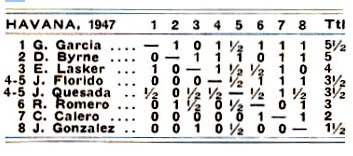
     I found a small tournament in Havana in 1947 that fell through the cracks. Two New Yorkers, 17-year old Donald Byrn e and the 62-year old veteran Edward La sker participated against six locals. 
     Of course Byrne and Lasker were the favorites. The teen-aged Byrne had shared fourth prize in the U. S. Open at Pittsburgh the previous year and Lasker's competitive career began way back in 1910. There was a shock in store for both of them. 
     The unheralded Gilberto Garcia finished first after he started off with a sensational 18 move win over Byrne. Lasker took the early lead by beating Garcia in the third round, but Garcia continued to trail right behind Lasker. Finally, when Lasker stumbled and lost to Byrne and tailender Gonzalez, Garcia passed him to capture first. 
     Byrne got off to a poor start and after four rounds he only had an even score, but by winning his last three games he managed to move into second place. 
     The bad showing of Gonzalez, who had recently returned to Cuba after spending time in New York City, was surprising because he had recently finished 4th in the strong Manhattan Chess Club Championship and he had won the 1946 U.S. Speed Championship.
     Dr. Juan Carlos Gonzalez de Vega was born in 1917 and according to chess historian Bill Wall he died in 1990. Gonzalez was Cuban champion in 1942, 1943, 1951, 1952 and 1955. From Capablanca's death in 1942 until the mid-1950s he was considered the strongest player in Cuba. 
     Before he returned to Cuba, Dr. Gonza;ez was a resident in surgery at Manhattan's West Side Hospital. Whhen he was on call he frequently spent time analyzing openings and playing through games. He emigrated to Florid sometime in the early 1960s. 
 
     Donald Byrne (1930-1976) is pretty well known. He passed away in Philadelphia of complications arising from lupus. He was inducted into the U.S. Chess Hall of Fame in 2003. 
     Here is Byrne’s miniature loss. Not much is known of Byrne’s opponent, Gilberto Garcia except that he was born in 1919 and from the 1940s to the 1960s he was one of the leading Cuban players. 
     In 1963, in Havana, Garcia participated in the Pan American Championship and finished in 12th place. Also in 1963m, he participated in World Chess Championship Central American Zonal tournament and finished in 7th place. His last tournament seems to have been the Havana Radio Rebelde, a 12-player round robin, in 1978 where he finished in 11th place with a 3.5-7.5 score. His rating was 2250. In 2019 there was a Gilberto Garcia in Memoriam tournament held in Havana in his honor.

  A game that I liked (Fritz 17)

[Event "Havana"] [Site "?"] [Date "1947.??.??"] [Round "?"] [White "Gilberto Garcia"] [Black "Donald Byrne"] [Result "1-0"] [ECO "B32"] [Annotator "Stockfish 16"] [PlyCount "35"] [SourceVersionDate "2023.08.14"] {Sicilian Defense} 1. e4 c5 2. Nf3 Nc6 3. d4 cxd4 4. Nxd4 e5 {The Kalashnikov Variation is a close relative of the Sveshnikov Variation (4...Nf6 5.Nc3 e5) and and is also referred to as the Neo-Sveshnikov. The move 4...e5 has had a long history that dates back to de La Bourdonnais in the 1830s.} 5. Nf3 { My database has plenty of examples of this move, but none at the GM level. That's not to say that the following play is bad, but only that there is no theory on anything other than the far more popular 5.Nb5} (5. Nb5 {is the modern way...the threat is 6.Nd6+ gaining the two Bs after 5...Bxd6} d6 6. c4 { Also popular is 6.N1c3} Be7 7. N1c3 a6 8. Na3 Be6 9. Nc2 {etc.}) 5... Nf6 6. Bg5 {The alternative is to defend the e-Pawn with 6.Nc3, but the text is much more interesting!} Qa5+ {Black could also play the equally good 6...Bc5. Instead he moves the Q out of the pin and at the same time threatens the e-Pawn.} 7. Bd2 Qb6 {Things are already interesting as both the e-Pawn and the b-Pawn are attacked. Which P should white let go?} 8. Bc4 {This is risky. Which P should black take?} (8. Nc3 Qxb2 9. Rb1 Qa3 10. Nb5 {is clearly not going to go well for black.}) (8. Nc3 Bc5 9. Qe2 {is equal, but black has a wide choice of moves: 9...Nd4, 9...Qxb2 and 9...d6 are all equally good.}) 8... Qxb2 {While mot really bad, this allows white to gain the initiative...call it risky.} (8... Nxe4 {This is a better choice.} 9. Qe2 Nxd2 10. Nbxd2 Be7 { This sets a nice trap that it would be easy for white to fall into.} 11. O-O-O (11. Nxe5 Qxb2 {forking the R and N} 12. Bxf7+ (12. Rb1 Qxe5) 12... Kf8 13. O-O Qxe5 {Black has a won position.}) 11... Qc7 {with a solid position.}) 9. Nc3 Qb6 {Black has lost time grabbing the b-Pawn...a somewhat questionable course.} 10. O-O Be7 11. Nd5 Qd8 {Another loss of time. Still, his position can hardly be considered inferior.} 12. Ng5 {Black's next move must be the right one or he will be in real trouble!} O-O {Byrne does not fall for white's trick.} ( 12... Nxd5 {is a mistake.} 13. Nxf7 Kxf7 14. exd5 {The threta is 15.d6+} b5 15. Bb3 (15. Bxb5 Nd4 {favors black.}) 15... Nd4 16. d6+ Nxb3 17. dxe7 Qxe7 18. Qf3+ Qf6 19. Qxb3+ (19. Qd5+ Qe6 20. Qf3+ {would draw.}) (19. Qxa8 {only results in equality.} Nxa1 20. Qd5+ Qe6 21. Qf3+ Qf6 {Here a draw by repetition is also possible. If instead...} 22. Qxf6+ gxf6 23. Rxa1 {Even with Bs of opposite color black is better.}) 19... d5 {White is better.}) 13. Nxf6+ Bxf6 14. Qh5 {White's attack looks very dangerous, but black's position is, in spite of all the time he ha lost with his Q maneuvers amazingly resilient.} Bxg5 {The only correct move.} (14... h6 15. Nxf7 Rxf7 16. Bxf7+ {wins.}) 15. Bxg5 Qe8 {This move creates a logjam on the K-side and so a better move would have been 15...Qc7} (15... Qc7 16. f4 d5 17. Bxd5 Nb4 {This is a complicated position in which the chances are equal.}) 16. Rad1 {[%mdl 1024] White has strong pressure for his P.} Na5 {[%mdl 8192] It's understandable that Byrne wants to get rid of the B that's eyeing f7, but this is a fatal mistake because he has overlooked Gacia's surprising riposte.} (16... d5 {is his only hope of staying in the game.} 17. exd5 (17. Bxd5 Nb4 18. Bb3 Be6 {and black has equalized.}) 17... Nd4 18. Bd3 e4 19. Rfe1 exd3 20. Rxe8 Rxe8 21. cxd3 Re5 {and with any luck black may be able to survive, but it's not likely. In Shootouts white scored +3 -0 =2}) 17. Bf6 {[%mdl 512] A nasty surprise!} h6 { A lame defense, but there wasn't anything that was really better.} (17... Qe6 18. Bxe6 fxe6 19. Bxg7 Kxg7 20. Rd3 Rf6 21. Rg3+ Rg6 22. Rh3 {and there is nothing for black to do except resign.}) 18. Qg6 {Black resigned. It's mate next move. A fine game by Garcia.} 1-0