Random Posts

Wednesday, May 13, 2015

Paul Keres Studies

     It's hard to believe that Keres has been gone 40 years! Keres (born January 7, 1916) was among the world's top players from the mid-1930s to the mid-1960s and narrowly missed a chance at a world championship match on five occasions. He won the 1938 AVRO tournament, which led to negotiations for a title match against champion Alexander Alekhine, but the match never took place due to World War II. After the war Keres was runner-up in the Candidates' Tournament on four consecutive occasions. 
     His health started declining in 1973 and he didn't play in any major events in 1974. He died of a heart attack in Helsinki, Finland, at the age of 59, while returning to Estonia from a tournament in Vancouver, which he had won. Over 100,000 attended his state funeral in Tallinn, Estonia. 
     Reshevsky described why Keres never became world champion: "Well, I believe that Keres failed in this respect because he lacked the killer instinct. He was too mild a person to give his all in order to defeat his opponents. He took everything, including his chess, philosophically. Keres is one of the nicest people that I have ever had the pleasure of meeting. With his friendly and sincere smile, he makes friends easily. He is good natured and kind. Yes, he loves chess, but being a human being is his first consideration. In addition to chess, Keres was interested in tennis, Ping-Pong, swimming, and bridge." 
     In addition to authoring several books, few people are aware that Keres, who was a great attacking genius and, also, a superb endgame player, published 180 problems and 30 studies. 
    In the following position, published in Magyar Sakkvilág in 1936, white is a queen up but his K looks doomed on account of the threat of 1...b2+ followed by 2...b8=Q.


     The following study won First Prize in the USSR Composers' Contest in 1947. White's task seems impossible, but the win is there. In fact, when I let Komodo 8 analyze the ending, it did not suggest any improvements. It's a fine example of a R and P ending that is worth studying. I would recommend going to the 6-piece Shredder Endgame Database after move 5 and trying out different moves to see how to play the ending.
 

Tuesday, May 12, 2015

Caruana to Join U.S. Chess Federation


I commented recently on the attempt to entice Caruana to return to the U.S. and it has finally happened. Read the post.

 SAINT LOUIS (May 12, 2015) - The United States Chess Federation (USCF) today announced that Grandmaster Fabiano Caruana has initiated the application process to change chess federations, which, when approved, will allow him to play for the United States. Fabiano, who has dual citizenship in the United States and Italy, has been playing for the Italian Chess Federation for a number of years. Read more...

Rubinstein's Masterpiece

     Akiba Kiwelowicz Rubinstein (12 December 1882, in Stawiski, Poland - 15 March 1961 in Antwerp, Belgium) was a famous Polish player at the beginning of the 20th century.
     Stawiski is a town in north-eastern Poland situated on the Dzierzbia River. The population as of 31 December 2008 was 2,417. The town was destroyed by fire in 1812 in the course of the French campaign against Russia and rebuilt again and became a trade and commercial center known for its furs, fabrics and hats. It was burned to the ground during the Russian–Prussian war of 1915, soon before the re-establishment of the sovereign Republic of Poland. The Polish army fought a battle with the Bolsheviks there in July 1920 during the Polish-Soviet War and by 1932, over 50 percent of the town's population was Jewish, numbering approximately 2,000. 
     Upon the Soviet invasion of eastern Poland in 1939, the local administration was abolished by the Soviet NKVD and replaced with Jewish communists who declared Soviet allegiance. Ethnic Polish families were being rounded up and deported to Siberia. The Soviet terror lingered until the Nazi took control in 1941. A German command arrived in Stawiski on July 4–5, 1941 and massacred 700 local Jews in nearby Płaszczatka Forest. The Nazis created a Jewish ghetto in Stawiski, then transferred all its occupants to a much larger Ghetto in Łomża, which was annihilated in November 1942. This history accounts for the fact that in the early 1900's Rubinstein actually participated in the Soviet championships.
     His father Kiwe died before he was born and because of his family's poverty, he was raised by grandparents in Bialystok. Akiba married Eugenie Lew around 1917; they moved to Belgium in 1926 and in 1931 his wife opened a restaurant in Brussels at which time Rubinstein he stopped playing chess. His wife died in 1954. 
     His family planned for him to become a rabbi but he chose not to finish his studies but to devote himself entirely to chess. The decision came in 1903 after he won fifth place at a tournament in Kiev. He had been training with Gersz Salwe in Lódz. 
     Rubinstein flourished from 1907 to 1912. Beginning from his win at Karlovy Vary in 1907, through a shared win at St. Petersburg in the same year, he culminated it in a record string of wins in 1912. He won five consecutive major tournaments that year: San Sebastian, Piestany, Breslau (the German championship), Warsaw and Vilnius (although none of these events included Lasker or Capablanca). 
     Some believe that he was better than world champion Emanuel Lasker at this time. Ratings from Chessmetrics support this conclusion, placing him as number one in the world between mid-1912 and mid-1914. Reuben Fine disagreed, believing he was not quite as strong as Lasker and he was eclipsed by Capablanca after 1911. 
     At the time when it was common for the reigning world champion to handpick his challengers, Rubinstein was never given a chance to play Lasker for the world championship because he was unable to raise enough money to meet Lasker's financial demands. His plans were also damaged by a poor showing at the St. Petersburg tournament in 1914 when he failed to finish in the top five. A match with Lasker was arranged for October 1914, but it never took place because of the outbreak of World War I.
     After the war Rubinstein was still an elite player, but his results lacked their previous consistency. He won Vienna in 1922 ahead of the future world champion Alexander Alekhine and was the leader of the Polish team that won the Chess Olympiad at Hamburg in 1930 with a record of thirteen wins and four draws. A year later he won an Olympic silver.
     Known for superb endgame play, particularly in Rook endings, he took the ending into account when playing the opening. After 1932 he withdrew from tournament play, mostly because his schizophrenic tendencies and was suffering from anthropophobia, a fear of people and society. During World War II when the Nazis eventually arrived and deported Rubinstein from his asylum to the death camps, he was so insane that they let him live. Edward Winter details his later years HERE.
     One of the most beautiful games ever played was the following game against Rotlevi. Soltis wrote , "Every great player has a game which became his visiting card to chess history...this was Rubinstein's." Kmoch called it "The Rubinstein Immortal Game," Schlecter called this perhaps the most magnificent combination of all time and Tartakower said it was one of the great games of chess of all time. Even Botvinnik and Flohr said it was a fantastic game adding that it was “perhaps the first game to be played in the scientific method, developed by the Russian chess-players." Irving Chernev wrote, "The great artist of the endgame displays his virtuosity in yet another field. He unleashes an attack with the fire and elegance of a Morphy, and unfolds combinations and brilliant sacrifices that would do honor to Tahl or Alekhine." 
      Rubinstein was a classical player and rarely ventured outside the confines of the double QP openings as Black when he faced 1. d4 and this game has been annotated in dozens of books and magazines over the years. 
 

Monday, May 11, 2015

Reshevsky vs. Fischer, First Encounter

     Reshevsky has long been one of my favorite players and in this game from the 1956 U.S. Championship we see him playing Fischer for the first time. Reshevsky won this game, drew in 1957, lost in 1958 and drew again in 1959. Their next meeting was in Buenos Aires in 1960 and that game was also drawn. 
     Reshevsky was pretty much ignored by biographers until Samuel Reshevsky A Compendium of 1768 Chess Games, with Diagrams, Crosstables, Some Annotations, and Indexes by Stephen Gordon was published in 2010, but at $43 I doubt it was ever a big seller. 
     Then came their match in 1961 which Reshevsky won (7.5 -5.5) when Fischer walked out while the match was tied and ended up forfeiting the last two games. BTW, Jerry Hanken, who knew Fischer personally, opined that Fischer’s anti-Semetism came from his belief that this match was stolen from him. 
Fischer vs. Reshevsky in 1958

     After their 1961 match though Fischer pretty much dominated Reshevsky. Unfortunately out of all the U.S. Championship tournaments I got to witness, Fischer wasn't playing in any of them. So, while I once saw Fischer in a used chess book store in New York City, I never got to see him play. 
     After sharing first place in a tournament in Iceland in 1974 Reshevsky received a letter from his Rabbi congratulating him on his success and for displaying a Kiddush HaShem Barabim, or for “sanctifying God's name in the public square” by “insisting upon your right not to play on the holy Shabbat, and that your stance was recognized and accepted..." 
     At the end of the letter, the Rabbi called to Reshevsky's attention that Fischer did not have the proper Jewish education, which was, in the Rabbi's opinion, probably the reason he was so alienated from the Jewish way of life and the Jewish people. The Rabbi also noted that Fischer, being a Jew, should be helped by whomever possible and asked Reshevsky to, through through his personal efforts or in some other way, try to help Fischer. Reshevsky was happy that the Rabbi had chosen him for this task even though he knew it would not be easy! 
     Soon after receiving the letter Reshevsky was in Los Angeles for the Piatigorsky Cup and he phoned Fischer and related the Rabbi's request to him. It may be surprising, but Fischer immediately agreed to meet Reshevsky. In a three hour meeting Fischer asked a lot of serious questions about Judaism, but, as we all know, Reshevsky's effort was in vain. 
     In this game Reshevsky made defeating Fischer look easy.
 

Friday, May 8, 2015

The Denkers: Mitchell and Arnold


   Mitchell R. Denker (1947-2013) passed away at age 66 on Saturday, August 24, 2013, in Leland, NC. He was born in New York City and lived on Long Island until his college years. When his parents, Arnold and Nina, moved to Florida, he followed and lived in Florida most of his life; he completed college, studied law and practiced in Key West. In 1994 he and his wife Jaye and their sons moved to Belleview, Florida where they lived for over 13 years.
     Chess was one of his passions and at one time he served as a Trustee of the U.S. Chess Trust for several years, honoring his father’s memory with sponsorship of the annual Denker Chess Tournament for High School students, which provides a scholarship to the University of Texas to the winner. During his time in Belleview, Florida he served as the President of the Haas Fund, a charity for children in need of financial support for the arts and athletics, a member of the Belleview Zoning Commission, Chairman of the Grievance Committee of the Florida Bar Association, and as President of Shepherds Lighthouse, a live-in facility for battered women.
     He was also a traveler, taking every chance he could to see the world, particularly places not normally visited by tourists. After moving to Wilmington, North Carolina in 2011 he served at the Cape Fear Volunteer Center for the Big Buddy Program.
     Mitchell also played chess, but, of course, not at the same level as his more famous father. I was unable to find any of his games and, as far as I know, he never had a rating. An interview with Denker can be found here: READ 
     He appears to have had his share of legal troubles and intrigue:  Here is an interesting CNN report that mentions him in connection with a missing person. Additional information from the KMM Blog with true crime writer Robert A. Waters’ analysis of cold unsolved cases and commentary about modern and historical crimes.  Facebook accountReal Crimes. Florida missing persons casesUnited States vs.Mitchell DenkerFlorida Bar vs. Mitchell Denker
 

    His father, GM Arnold Denker (February 20, 1914 – January 2, 2005), virtually disappeared from the U.S. chess scene in the late 1940's and became a millionaire in the business world. Arnold tried being a full-time chess player but after getting married to Nina Simmons in 1936 family responsibilities eventually took precedence. By 1948 he determined that with a wife and two children he could no longer play regularly. He accepted employment offered by a friend who owned a meat-packing company and when his friend died, Arnold took over the company and found that he had a knack for business. He was very successful and when he retired in 1974 the company was doing over $38 million a year in business.
     Denker returned to tournament play in 1971 at the age of 57 and tied for seventh place in the U.S. Open; he continued to play in tournaments into his 80's, tying for sixth place at the U.S. Open in 1995 at the age of 71. An interesting article on Arnold by Don Schulz can be read HERE.

Thursday, May 7, 2015

Bryntse Gambit Game

     I have posted on this gambit before and recently came across another game by one of its strongest adherents, the veteran ICCF Senior Master Wladyslaw Krol. In this game his opponent was FIDE IM Denis Ramboldoni (FIDE 2479). Krol won this game when his opponent lost on time in a completely won position. 
     Denis Rombaldoni (14 March 1989 ) is from Italy. Both of his parents, father Andrea and Hungarian mother, Brigitta Horvath Banki, are strong players. Rombaldoni started taking lessons at age 13 from GM Igor Efimov and in 2002 he won the International Festival of Montebelluna ahead of two GM's. He also won several youth titles. He was awarded the IM title as a result of his performance in January 2008 when he scored 6.5 – 2.5 in a tournament in the Medes Islands in Spain. 
     He practiced football (soccer to US readers) for nine years, also at a competitive level, being selected for the team of Fano Calcio , but then decided to quit to devote himself to chess and studies. His brother Axel (FIDE 2501) was awarded the GM title in 2013. 
     This gambit was invented in the 1960's by the Swedish correspondence player Arne Bryntse. In the 1960's and early 1970's Bryntse was a regular competitor in the Swedish correspondence chess championship, and he won the title in 1972. Krol has also championed the gambit in various forms, but it appears that it's simply not playable in games where engine use is involved. In any case this rather boring game shows how modern engine-assisted correspondence games are...lots of long drawn out games with moves that don't seem to make any sense and in the long run a slight advantage is very slowly increased to the point that it's overwhelming. I'm posting it here just because I enjoyed investigating the opening with Komodo and because it does appear that it would be interesting to play it OTB if one is inclined to try rare and risky gambits. I can see black getting into trouble against it.
 

Wednesday, May 6, 2015

Alekhine vs. Book

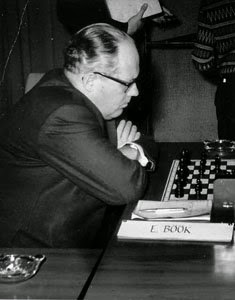
E.E. Book
     I remember the first time I saw this famous game in C.H.O'D. Alexander's book on Alekhine's final games (1938-1945) and the impression it made. Today I took another look at it and it's still impressive. 
    Eero Einar Böök (9 February 1910 – 7 January 1990) was a Finnish IM and engineer. He was a five-time Finnish champion who represented his country six times in the Chess Olympiads.  He was awarded the IM title in 1950 and became an honorary Grandmaster in 1984. His only significant international tournament victory was a tie for first place with Gösta Stoltz in the 1947 Nordic Championship in Helsinki. Perhaps his best tournament finish was sharing eleventh place in the Interzonal at Saltsjöbaden 1948. 
     Böök played many of the world's top players, and had a plus record against Miguel Najdorf (+1 −0 =2). He beat Max Euwe with the black pieces in Dubrovnik in 1950 and Paul Keres in the 1952 Helsinki Olympiad. Böök also wrote several chess books. 

Margate Standings: 
1. Alekhine 7.0 
2. Spielmann 6.0 
3. Petrov 5.5 
=4 Böök 5.0 
=4 Milner Barry 5.0 
6. Golombek 4.5 
7. Alexander 4.0 
8. Sergeant 3.5 
9. Menchik 3.0 
10. Thomas 1.5 

Download all the games HERE
 

Tuesday, May 5, 2015

Fischer vs. Pupols

     Tim Sawyer's Blog gives an interesting game that Bobby Fischer lost in the 1955 US Junior Open Championship to Viktors Pupols. The story goes Pupols had told Fischer that he was going to play the Latvian Gambit against him that evening, but Fischer didn't believe him. The game was riddled with mistakes, but it's still fun to play over. Remember, at the time the game was played neither player had yet reached the master level!
     Viktors Pūpols was a mainstay in tournaments in the Northwest for many years. Pupols victory over Fischer was one of only two games that Fischer ever lost on time. On the December, 1955 rating list Fischer's rating was 1726. 

Fischer scored as follows: 
Rd 1 - Kenneth Warner (1550) of Bakersfield, California (Fischer lost) 
Rd 2 - William Whisler (unrated) of Concord, California (Drawn) 
Rd 3 - Jimmy Thomason (1600) of Fort Worth (Fischer won) 
Rd 4 - David Ames (unrated) of Quincy, Massachusetts (Drawn) 
Rd 5 - Kenneth Stone (1600) of Los Angeles, California (Drawn) 
Rd 6 - John Briska (unrated) of Albany, New York (Drawn) 
Rd 7 - Viktors Pupols (2027) of Tacoma, Washington (Fischer lost) 
Rd 8 - Robert Blair (1650) of Midwest City, Oklahoma (Drawn) 
Rd 9 - John Winkelman (1650) of Lincoln, Nebraska (Drawn) 
Rd 10 - Franklin Saksena (1600) of Ft. Worth, Texas (Fischer won) 

Fischer won a trophy for best player 12 or under by default...he was the only 12 year old and the youngest player in the tournament. 

Charles Kalme (born 15 November, 1939) died in Latvia on March 20, 2002. 
William D. Whisler, MBA, of Danville, Calif., received his Ph.D. in engineering from UC Berkeley in 1965 and spent six years working in industry before joining California State University, Hayward, for 28 years, retiring in 2000 as professor emeritus of business and economics. He received two Fulbright grants and was a professor at the University of the Republic in Montevideo, Uruguay, where he initiated the country's first doctoral program in business. As a Senior Fulbright Scholar in Ecuador, he evaluated the country's graduate business programs. He and his wife, Ruth, and daughter, Lia, lived in Madrid from 1989 to 1990, when he served as resident director of international programs for California State University students abroad. A 1999 article in Chess Life discusses his draw with Bobby Fischer in the 1955 US Junior Chess Championship. Since retiring he has co-authored a textbook used in graduate business schools and traveled on a yearlong trip around the world visiting 40 countries. 
Kenneth Warner won the Fresno, California Junior Chess Championship in 1955. He was the Bakersfield High School chess champion in 1954 and 1955. He tied for 36th-38th place in the 1954 U.S. Junior championship in Long Beach, California. He tied for 11th-21st place in the 1955 U.S. Junior championship in Lincoln, Nebraska. 
Jimmy Thomason (born in 1941). In 1954, he placed 21st-28th in the U.S. Junior championship, held in Long Beach, California. In 1955, he placed 11th-21st in the U.S. Junior championship, held in Lincoln, Nebraska. He is originally from Fort Worth, Texas.
David Ames. In 1955, he took 11th-21st place in the U.S. Junior championship, held in Lincoln, Nebraska. In 1956, he took 21st-24th place in the U.S. Junior championship, held in Philadelphia. In 1960, he took 3rd-6th place in the U.S. Junior championship, held in West Orange, New Jersey. He is a former ICCF U.S. Secretary. 
John Winkleman


Monday, May 4, 2015

An Old Anand-Ivanchuk Blitz Game

OK, so this game isn't all that great but the commentary by Danny King and Maurice Ashley is gripping!


Friday, May 1, 2015

Zhulnichestvo, or as it's known in English "Cheating"

     I just read an article, complete with pictures of the way the guy had his electronics rigged, on Chessbase. A 19-year-old 1500-player beat a GM in a tournament in New Delhi. His opponent noticed the guy was taking about two minutes for every move. It turned out he had two Android phones taped to his legs, a couple of battery packs around his waist and a micro-speaker in his ear. A friend stationed over a hundred miles away was using Fritz to advise him of what moves to play. 
     What amazes me is the guy was so obvious. 1500's are capable of beating 2100's or occasionally a master, but not a GM and certainly not all in one tournament. Also, you can't choose to play an engine's top choice every time. 
     Of course, cheating in one form or another isn't new.  
Confessions of a Crooked Chess Master – Part 1 
Confessions of a Crooked Chess Master – Part 2 
Cheating at Chess - Wikipedia article
Fischer: The Russian Cheated
Vladimir Potkin on coaching and cheating

     I caught an opponent cheating me once in an OTB tournament. He was taking a long time over his move so I went for a walk. After a few minutes I noticed he had left the board and when I arrived back and sat down I noticed something odd about the position but it didn't quite register. After a couple of minutes staring at the position I realized what was wrong...he had made two moves! I think he played his move and while I was away, he decided to play something else and forgot to take back the first move. By the time I figured out what the problem was he returned to the board and I told him he made two moves. His reply was, “Oh! I made a mistake.” and he retracted one of them. 
     I can think of twice when I cheated. Once I cheated a preacher. It was in a postal game and he was pretty low rated. Just about every other move he sent (we were using postcards) was either ambiguous or impossible. In those days I didn't have a diagram stamper so had to sketch out the position by hand and mail it back with a polite note that his last move was impossible. This went on for many moves until I got tired of it. My solution was to send him a slightly altered diagram that set him up for a mate next move. He never knew the difference! 
     Another time in the first round of an OTB tournament I was playing a 1100 and expecting an easy win so didn't put much thought into my moves. After about 20 moves or so the TD walked by, looked at the position, chuckled and walked away. That's when I noticed the guy had a Q move that mated in one!! After several minutes thought he played the Q move and mated me, but he never said anything. I realized he was unaware that I was mated so I bashed out a Q move that offered to trade Q's. He thought for a couple of minutes, made the trade and I went on to win. 
     What can I say?  Every saint was a sinner in his youth!

Who's the Best?


    Would the Grandmasters of today defeat the old timers of a hundred years ago? Back in 2006 there was a Chessbase article showing the percentage of moves played by the top 14 players of all time (up until that time) and how they matched up against engine moves. Capablanca emerged the winner ahead of Petrosian, Karpov and Kramnik.
      Unfortunately Elo ratings can't be used to make comparisons because a 2400 rating of yesteryear does not translate into a 2400 rating of today. The average Elo rating of top players has risen; I remember when a “strong” GM was 2500 and 2600's were referred to as “Super-GM's.” It has something to do with rating inflation...see below. 
      Arpad Elo argued that is was impossible to use ratings to compare players from different eras because ratings measure a player's performance against his contemporaries. Claude Bloodgood is a good example. He became one of the highest rated players in the U.S. by playing “tournaments” in prison where he routinely defeated very poor players, even rank beginners. If you only gain one point per game, win enough games and you'll eventually be rated very high. 
     Jeff Sonas of Chessmetrics also says it is impossible to compare the strength of players from different eras because, like Elo said, a rating only indicates the level of dominance of a player against contemporary peers; it says nothing about whether the player is stronger or weaker in actual technical skill than a player far removed from them in time. That means you can't compare Fischer to Capablanca as to who was the better player. 
      Back in 2007 a project was conducted using Rybka 2.3.2 and the players with the best 15-year averages were Capablanca, Karpov and Kramnik, Smyslov and Kasparov, Fischer, Botvinnik and Spassky and Petrosian, Anand, Tahl, Alekhine and Lasker, Euwe followed by Steinitz. 
     What do the GM's themselves think? In 1964 Bobby Fischer listed his top 10 in Chessworld magazine as: Morphy, Staunton, Steinitz, Tarrasch, Chigorin, Alekhine, Capablanca, Spassky, Tahl, Reshevsky. He considered Morphy the best, saying "In a set match he would beat anyone alive today." In 1970 Fischer altered his list a bit, listing Morphy, Steinitz, Capablanca, Botvinnik, Petrosian, Tahl, Spassky, Reshevsky, Svetozar Gligorić and Bent Larsen as the greatest players in history. 
     In a 1992 GM Miguel Quinteros thought Fischer was the greatest of all time. In 2000 Anand's list was Fischer, Morphy, Lasker, Capablanca, Steinitz, Tahl, Korchnoi, Keres, Karpov and Kasparov.
      In 2001 a poll of Chess Informant readers for the ten greatest of the 20th century were Fischer, Kasparov, Alekhine, Capablanca, Botvinnik, Karpov, Tahl, Lasker, Anand and Korchnoi. 
     In a 2012 interview, Levon Aronian stated that he considered Alekhine the greatest player of all time and Magnus Carlsen said that Kasparov is the greatest player of all time, adding that while Fischer may have been better at his best, Kasparov remained at the top for much longer. 
     The question is, can some kind of rating adjustment be made so that players of different eras can be compared? Mark Glickman of the United States Chess Federation’s ratings committee said, “It is possible to say how much better Capablanca was than his contemporaries,” adding “If it were possible to put Capablanca in a time machine and transport him to this time, it would be virtually impossible to predict how strong he would be.” Glickman pointed out that because today's players have access to computers and databases they know more than their predecessors and so are better, but what would happen if Capablanca were transported to modern times and allowed time to “catch up.” There's no way of knowing how he'd react. 
     In the United States, instead of rating inflation, ratings are deflating. Blame the kids for it!! Young players (who make up more than half of the USCF membership) drag average ratings down because they improve faster than the rating system can keep up. 
     On the other hand FIDE ratings are inflating. According to Glickman it's because it used to be that players needed to have a rating of at least 2200 to be rated, but not any more. In fact, it used to be that Swiss System tournaments were not rated, only international round robins. The result is that higher-rated players feast on the lower-rated ones just like Bloodgood was doing in prison. 
     According to Glickman Garry Kasparov was pretty close when he wrote that the rating difference between the No. 1 player and the No. 2 player was a good determinant of who was the most dominant player ever. By that measure, since ratings began, Bobby Fischer was No. 1, and Kasparov himself was No. 2.   But again, this only tells us how much better than their peers a player was, not how they compare across time. 
     However, in a 2002 paper Glickman used statistical analysis to rank the best players of all time and came up with the following ranks: 1-Lasker, 2-Capablanca, 3-Fischer, 4-Alekhine and 5-Kasparov. 
     So, you just can't say who was better, but for me, the games played by the old timers are a whole lot more interesting.