In a KGD, my opponent managed to work up what appeared to be a strong K-side attack while I was lacking any real chances on the other side of the board. His play on the K-side was making me nervous despite the fact that the engines were saying his advantage was only minimal. I had to do something though so made an incursion into his Q-side with my Q, all the while disbelieving the engine output saying I was OK. You know how it is? Your opponent is massing his pieces against your King and all you’ve got is a lone Q harassing a couple of P’s on the other side of the board. That just can’t be good. The alarming thing was that the evaluations started out about equal but as we went along, they started drifting more and more towards White and when you see a trend like that, it’s not a good sign.
Indeed, by move 35 White was clearly calling the shots and I have no explanation for his 36th move which missed the win. Still, holding the draw required some analysis because I didn’t totally trust the engines. After all, earlier they had been reassuring me everything was OK despite my doubts.
What I’m finding in these games is what I already knew. Against strong players with good positional sense, you can’t totally rely on engine analysis alone. I got lucky…this time.

Thursday, July 14, 2011

Wednesday, July 13, 2011
Philippines requests to include chess in Olympic Games
From the FIDE website:
During a visit of the FIDE President, Kirsan Ilyumzhinov to the Philippines, the Head of the National Olympic Committee (NOC), Mr. Jose Cojuangco Jr., signed an appeal to the Head of the International Olympic Committee (IOC), Mr. Jacques Rogge, and IOC members, requesting the inclusion of chess in the program of the Olympic Games.
During a visit of the FIDE President, Kirsan Ilyumzhinov to the Philippines, the Head of the National Olympic Committee (NOC), Mr. Jose Cojuangco Jr., signed an appeal to the Head of the International Olympic Committee (IOC), Mr. Jacques Rogge, and IOC members, requesting the inclusion of chess in the program of the Olympic Games.
Ilyumzhinov noted: "We are working towards the goal of including chess in the program of the Olympic Games. Following on from our longstanding consultations with the IOC and its Head, Mr. Jacques Rogge, it has become clear that we have good chances, but we need active support from the national federations and Olympic Committees. We set ourselves, as a priority, an ultimate goal to collect letters, containing such a request, from the NOCs of all 170 FIDE member countries. There is no obvious reason why these letters have not yet appeared; I have made great efforts. I would like to express my gratitude to the President of the National Chess Federation of the Philippines, Mr. Prospero A. Pichay Jr., and to the President of the Philippines NOC, Mr. Jose Cojuangco Jr., who were the first to respond to our request."
Isn’t there already a chess Olympiad? Why add it to the Olympics? Is chess a sport like other Olympic games? Why not add poker and blackjack? Adding chess would increase exposure and bring in more money. Ah…there it is…more money. Not that bringing in money is a bad thing. One fly in the ointment for years that has had players in a snit though is the probability of mandatory drug testing. I’m not sure how I feel about the whole idea.
Isn’t there already a chess Olympiad? Why add it to the Olympics? Is chess a sport like other Olympic games? Why not add poker and blackjack? Adding chess would increase exposure and bring in more money. Ah…there it is…more money. Not that bringing in money is a bad thing. One fly in the ointment for years that has had players in a snit though is the probability of mandatory drug testing. I’m not sure how I feel about the whole idea.
Tuesday, July 12, 2011
Wisdom from Fpawn
I was visiting Fpawn’s Blog and reading his post on the recent cheating accusations made against Rybka. He said something there that left an impression on me that is worth repeating:
For you kids out there, this article does contain one moral to learn and follow: Always cite your sources and give credit where it is due.
Panov - Yudovich, Moscow, 1936
I was thumbing through an old book by Irving Chernev the other day titled The Russians Play Chess. The book, originally published in 1947, had 6 games added when it was republished in 1963 making the total games 56. According to Chernev the criteria for the games were that they had to be reasonably short (averaging only 30 moves per game) and enjoyable with the accent on brilliancy. One of the games I chose to look at with an engine was Panov – Yudovich from Moscow, 1936. It turned out the game was brilliant only based on Chernev’s notes which left a lot to be desired. Many of his notes were so inaccurate as to be meaningless.
That’s not to say the game wasn’t interesting and it’s a good example of what you would see in a typical game played between journeyman masters. The fact is most games you see in print aren’t typical and only appear in print because they have something special to offer.
That’s not to say the game wasn’t interesting and it’s a good example of what you would see in a typical game played between journeyman masters. The fact is most games you see in print aren’t typical and only appear in print because they have something special to offer.
Saturday, July 9, 2011
Frustrating Incident on Lechenicher SchachServer
Actually I should say crazy opponent. No, I take that back, he's not crazy.. .just a snot-faced dirtbag. We reached a K and P ending that had been an obvious draw for 10 moves or so but because he outrated me by 100 points, I thought it was only good etiquette to allow him to offer the draw. When it became apparent he wasn't going to make the offer, I offered one, but he refused. I figured it did not matter because as soon as we reached an ending with lone Kings it would be an automatic draw. Here's the position:
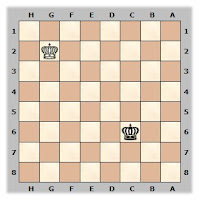
Apparently the system does not recognize this as a draw and my opponent will not accept a one. What I am tempted to do is 1) Send him a derogatory e-mail and 2) reveal his real name here and on the site forum so that thousands of people will know what a jerk he is. But, I won’t. Instead I sent a complaint to the TD. Now I just have to Wait to see what happens.

Friday, July 8, 2011
Nigel Robson
The now defunct IECG World Championship 2006 was won by “IECG Grand Master” Nigel Robson (2682) from England. As of December, 2010 the IECG, which was e-mail only, closed down and everything was transferred to Lechenicher SchachServer where he remains the top rated player. Anatoli Sirota (2561) of Australia finished in the second place. Sirota is the former Ukraine Correspondence Champion and earlier this year came out of a 13 year retirement to play in the Melbourne club championship

Robson had this to say of his game in which he defeated the runner up: There were no killer moves or deep tactics in this game, just the gradual accumulation of small strategic advantages that is the staple of much correspondence chess. While we were playing this game, unknown to us, another correspondence game was being fought out between Szczepankiewicz and Kozlowski with some similar themes, and can be found in the Chessbase online database. There White controlled the only open a-file but Black avoided b4 and secured a draw through counterplay on the f-file.

As for Robsom, he began playing chess when he was about 5 and discovered he was gifted at the game and at the age of 10 defeated an English IM and played successfully in the upper levels of chess while at school. After that he pursued a career in finance and had no time to play chess but did problem solving to pass the time while travelling to many parts of the world. He resumed play again in the early 1990's and in 1998 qualified for the final of the British Chess Solving Championship. He began play CC with the IECG in 2000. Here’s an interview with Robson that appeared on the IECG website shortly after he won the championship.
Let us talk about your successes. You won the IECG Cup 2000, you have been at the top of IECG's rating list for a long time, and you are the IECG's second and only active Grandmaster. Now by adding the WC Final at your third attempt, you have completed a list of successes. What are your feelings?
Very happy and satisfied, if a little tired, but perhaps my dominant feeling is one of surprise. When I joined the IECG I was still very rusty after a long break from the game. I felt that over time I could become very competitive again, but if you had told me that I would win these tournaments and achieve my rating I do not think I would have believed you.
The tournament was decided in January when you won against Frank Bendig and Anatoli Sirota drew with Horacio Rocca. But when did you know that the final result would favour you?
I started the tournament very badly with two clerical errors on one of my first visits to the server. It was just my third move against Milan Chovanec and my second against Jaroslav Fiala! I had intended to play a Ruy Lopez and King's Indian and found myself in a Scotch and a Nimzo-Indian! Not disastrous, but a bad day because I felt I could probably do no better than draw either of them. Then Anatoli Sirota claimed three early victories and I felt my chance of winning the tournament had probably gone. But of course it is a long tournament and I gradually made up ground and sometime in the middle of 2008 I became confident that I would score 10.5 points. In the later months of 2008 it was apparent that both Anatoli Sirota and Horacio Rocca could match but not beat that score if they won their remaining games. Then Horacio dropped half a point so I just had to worry about Anatoli, but my win against him had given me a good SB advantage. Certainly before Christmas I realised that whatever the final results of other games, Anatoli would not be able to overcome my SB. Of course I did not know until that last draw in January that I would have a clear lead, and that is much more satisfying than having to rely on the tie-break.
Looking at the tournament crosstable your win against the second placed Anatoli Sirota is easily identified as the most important game. It started as a calm Ruy Lopez and has a nice twin, your game with Dinesh De Silva. Would you like to tell us something about these games?
It was surprising that both Anatoli and Dinesh chose the same rather obscure defence ECO C84 against my Ruy Lopez. I managed to channel both games along the line followed in an earlier 2006 drawn game between Khairullin v Khalifman which I had studied quite carefully. I had two ideas to give white an improvement and I tried them both. 16.Be3 against Anatoli that appears in my commented game and later 17.Qb3 (getting a grip on d5, but not an original idea) against Dinesh. In retrospect I feel 16.Be3 is the better move. Against Dinesh my play was coloured by the fact that he was in very considerable time trouble and my chosen variation was perhaps more demanding of short term accuracy from black than was the case against Anatoli. Dinesh had a number of further brushes with the time control and in the end that allowed me to win quite comfortably.
Which of your other games of this final deserves our special attention and why?
In the 2005 Final I was taught a lesson as black in the English Attack by Sergei Bubir. On that occasion I escaped with a draw, but I was lucky. I was fortunate in being able to pass the same lesson on to John Claridge and Brigiliana Perez and claim two wins. I have to say I enjoy playing against John because he likes aggressive Sicilian setups as I do. The line in question used to be one of my favourites with the black pieces. A Najdorf with 6.Be3 e6 7.f3 b5 8.Qd2 Nbd7 9.g4 Nb6 10.a4 Nc4 11.Bxc4 bxc4 12.g5! (very aggressive and rarely played) ... Nd7 13.f4! I analysed this position in great depth after my game with Sergei and resolved never to play it with black again! Of course f5 is coming and white has enough attacking options that I have been unable to find a satisfactory black response.
Your score with the White pieces is simply brilliant: 6 wins and only one draw! What do you think is the reason - maybe your playing style? How would you describe it?
We have already spoken about my two wins in the same line of Ruy Lopez and two wins in the same line of the Najdorf. To complete the symmetry I had two wins against the Richter-Rauzer attack. The Sicilians are fighting defences often producing complex dynamic positions which suit my natural game with both white and black pieces. As an over the board player I was very strong tactically. I had a limited opening repertoire outside the Sicilian, but relied on introducing complications where I could generally out-calculate my opponents. I find correspondence chess is a much more measured game where the knockout blow is rarely available and I have to discipline myself to be more patient, accumulating small advantages and most important, avoiding mistakes. But I still look for the aggressive move, though from an unnatural conservative mindset - a sort of chess schizophrenia!
You have played the 9th, 10th and 11th WC Final in a row. The 9th and 10th finals were won by players whose ratings at the beginning were clearly below the average of the tournament. The 11th final was dominated by the two most successful players attending. Can you please compare the three tournaments from your point of view? And how did your earlier experiences affect your approach to this tournament?
I found them all very difficult! There is a big step up in standard from the candidate finals. I made the mistake in the 9th WC Final of underestimating the eventual winner Andreas Strangmueller. I grabbed a pawn that I knew was risky, but felt with a 200 point rating advantage I would be alright. Well I deservedly lost the game and the Championship with that one bad move! So lesson one is to treat all your opponents with respect regardless of rating, after all anyone reaching the Final is going to be a strong player. For me the 10th WC Final was characterised by the high number of draws. If we exclude withdrawals only the two leading players scored more than two wins. I had nine draws and nearly all were hopeless draws, by which I mean I never saw a glimpse of a possible winning idea. So lesson two is the obvious one, you have to win six or seven games to have a chance of winning the Title and therefore you need a playing strategy which is geared to that objective. Choice of opening is very important, sufficiently aggressive to give winning opportunities but sufficiently solid to avoid losses. It is a dilemma we all know well.
Following the two previous WC Finals, I realised the need to score more wins, so I took a bit of a gamble in the 11th WC Final, like last years winner Miguel Canovas Pordomingo, and chose the King's Indian as my main defence against 1.d4, and it gave me that extra win against Frank Bendig for my last point. Fortunately none of my opponents took me into the darker corners of the defence which might have exposed my inexperience, though I had a few nervous moments against David Gordh when my knights got in a tangle. Carlos Pappier worried me a lot too, because I know from previous encounters just how talented he is, and he was clearly very comfortable as he raced through the first twenty moves or so at a dizzying pace. I wondered what might be waiting for me but in the end I think Carlos was content with a half point.
In truth there is a lot of luck in winning one of these WC Finals. Several of my opponents played into my strengths when they might have played safe. There were also ninety-one other games over which I had no influence, and if they had turned out differently another challenger might now be the Champion.
What are your chess plans for the future? Are you going to defend your title?
I think three Finals in a row enough for anyone, and for my opponents too who will be spared having to put up with me again! I also believe it is right and fair to let others have a chance at winning this Championship. But I will return to the World Championship (I need to check the qualification rules) subject of course to health, and at my age, the little grey cells continuing to function!
I am presently playing an ICCF WC semi-final. It is only my second ICCF tournament and I am keen to establish an ICCF rating. I expect to be playing again at IECG shortly. As you can see from my photograph I might experiment with 1.d4 - someone has told me it is not such a bad first move!
Thank you very much for this interview!
This interview was made by IECG correspondent Thomas Niessen.
Thursday, July 7, 2011
Moving On
Having pretty much beaten the correspondence and engine horses to death in this Blog, I think it is time to move on to something else. I enjoy playing over games and this one between Kosteniuk and Kosintseva was fun to watch. I've also included it in a replayable form so it is easier to see what was going on.
Some Views on Correspondence Chess
The Endings in Modern Theory and Practice
I was recently browsing and came upon one site where CC was being discussed and some of the comments were interesting. One player, rated around 2100 OTB, stated he had given it up because he was not good enough to take advantage of any “weak” moves played by engines, adding that no matter how much time he spent on the game, even using his own engine, he simply could not tell a “good” engine move from a “bad” one. He added that an OTB master and 2400 rated CC player had the same problem. His opinion was that in order to successfully play CC you have to be strong enough to know when an engine generated move is not the best and for that you need to be rated at least 2300. That lets most of us out.
In response, one FM replied that endgames are still the engines Achilles Heel but you need to be a master of endgames to succeed against engines. That lets most of us out.
He also pointed out that in closed middlegames an experienced strong player can come up with a better plan than engines which often do nothing but shuffle pieces. That lets most of us out
Additionally he felt that in order to take advantage of an engine’s opening book, you need to be rated about 2300 OTB. That lets most of us out
This FM, and many other strong CC players think that to be successful in CC these days, it’s the openings where games are won or lost. You need to find a line with long term strategy or an endgame the engine can't understand or play an opening innovation where the advantage of the move is over the engine’s horizon. That lets most of us out.
I have to agree with this FM. In fact everything he said is in agreement with CCGM Robin Smith’s statements in his book, Modern Chess Analysis.
Another interesting observation of this player was that the rating difference between an 1800 rated and a 2000 rated CC player was practically zero and the difference between an 1800 and 2400 is quite small…probably the only difference was endgame knowledge. He went on to add that CC still remains a good way to improve because it requires a LOT of study, but if all you’re looking for is wins and a rating then you will find it very frustrating.
It’s quite clear to me after returning to CC in 2004 after an absence of about 12 years that with the proliferation of engines, legal or not, I am facing the same problems as the original poster. I’m simply not good enough to outsmart a chess engine in the opening, or force the game into a closed middlegame where I can plan a winning strategy 20 moves in advance while the engine twiddles its thumbs, aimlessly shifting pieces nor am I an endgame expert. Oh, I can play K and P and R and P endings pretty good because years ago Basic Chess Endings and Peter Griffith’s Modern Chess Endings were my best friends, but that’s not good enough because I still lack a 2300’s understanding of these things.
The short version is that if you aren’t 2300 OTB you are reduced to 1) playing only engine generated moves which is no fun or 2) trying to find another move that probably won’t work and likely will lead to losing the game which is no fun either. Since I am not good enough to play CC at the top level and am not looking to improve my game, only have fun, why bother with this form of chess at all? I don’t know why I do it.
I was recently browsing and came upon one site where CC was being discussed and some of the comments were interesting. One player, rated around 2100 OTB, stated he had given it up because he was not good enough to take advantage of any “weak” moves played by engines, adding that no matter how much time he spent on the game, even using his own engine, he simply could not tell a “good” engine move from a “bad” one. He added that an OTB master and 2400 rated CC player had the same problem. His opinion was that in order to successfully play CC you have to be strong enough to know when an engine generated move is not the best and for that you need to be rated at least 2300. That lets most of us out.
In response, one FM replied that endgames are still the engines Achilles Heel but you need to be a master of endgames to succeed against engines. That lets most of us out.
He also pointed out that in closed middlegames an experienced strong player can come up with a better plan than engines which often do nothing but shuffle pieces. That lets most of us out
Additionally he felt that in order to take advantage of an engine’s opening book, you need to be rated about 2300 OTB. That lets most of us out
This FM, and many other strong CC players think that to be successful in CC these days, it’s the openings where games are won or lost. You need to find a line with long term strategy or an endgame the engine can't understand or play an opening innovation where the advantage of the move is over the engine’s horizon. That lets most of us out.
I have to agree with this FM. In fact everything he said is in agreement with CCGM Robin Smith’s statements in his book, Modern Chess Analysis.
Another interesting observation of this player was that the rating difference between an 1800 rated and a 2000 rated CC player was practically zero and the difference between an 1800 and 2400 is quite small…probably the only difference was endgame knowledge. He went on to add that CC still remains a good way to improve because it requires a LOT of study, but if all you’re looking for is wins and a rating then you will find it very frustrating.
It’s quite clear to me after returning to CC in 2004 after an absence of about 12 years that with the proliferation of engines, legal or not, I am facing the same problems as the original poster. I’m simply not good enough to outsmart a chess engine in the opening, or force the game into a closed middlegame where I can plan a winning strategy 20 moves in advance while the engine twiddles its thumbs, aimlessly shifting pieces nor am I an endgame expert. Oh, I can play K and P and R and P endings pretty good because years ago Basic Chess Endings and Peter Griffith’s Modern Chess Endings were my best friends, but that’s not good enough because I still lack a 2300’s understanding of these things.
The short version is that if you aren’t 2300 OTB you are reduced to 1) playing only engine generated moves which is no fun or 2) trying to find another move that probably won’t work and likely will lead to losing the game which is no fun either. Since I am not good enough to play CC at the top level and am not looking to improve my game, only have fun, why bother with this form of chess at all? I don’t know why I do it.
More on Analyzing with an Engine
I’ve mentioned in previous posts the necessity of using more than one engine to analyze a position AND the necessity of, after completing the analysis, skipping to the end of the variation and backtracking through the analysis in order to see if the engine missed anything in its calculations. This post will show how the technique works.
In the following position taken from one of my old correspondence games, Black overlooked a mate threat and lost immediately. I tested three engines, Houdini, Stockfish and FireBird just to see what they came up with. In most of my analysis the engines were allowed one to three minutes per move to examine the positions.
After they reached what seemed like a reasonably reliable conclusion on the best move, I pasted the analysis into the game then went to the end of the line and started backing up. You will notice that the engine’s evaluation of the final position often changed, sometimes significantly, and in the process of backtracking through the line, other improvements were occasionally suggested. Each of those had to be checked out. This takes a lot of time and patience to do it thoroughly…something I don’t have. Well, I have the time but not the patience which may explain why my success at Lechinicher SchachServer has been modest at best. I’m in too big a hurry to see who wins to spend days and days to properly analyze my games with an engine. But, that’s what the big boys do and as you will see if you go through the game, it’s why they say you should not simply trust what the engine is telling you.
Beyond all that though, it also serves as a reminder that when letting an engine analyze your own games, you should not just plug in the game and let it analyze at some give time per move and then believe you have the absolute best analysis. Everything has to be checked out!
In this piece of analysis, all three engines immediately saw that Black had to play 23…Rg8 All three were allowed to ponder the position three minutes. Houdini wanted to play 24.Rxd4 and thought White was better by 0.65 and when skipping to the end of its main line it still considered White’s advantage to be only 0.54. Backing up a move at a time from the end of the line though showed something quite different.
When it was Black’s 35th move, instead of 35…f6 in the main line, Houdini suggested 35…Rxh4 instead with the position about equal. Skipping to the end of that line and backtracking through the moves did not reveal any significant changes in the evaluation, so it could be assumed that by playing 23...Rg8 24.Rxd4 Rg5 25.Qf3 Be7 26.Rxd7 Qxd7 27.Re1 Kg8 28.h4 Rb5 29.Re3 Kf8 30.Qf4 Rh5 31.Kg1 Kg7 32.Rg3+ Kf8 33.Qe4 Bd8 34.Rf3 f5 35.Qe5 Rxh4 36.g3 f6 37.Qxf5 Rd4 38.Qxd7 Rxd7 39.Kg2 Kg7 40.Nf4 Kf7 41.Re3 Bc7 42.Rd3 Rxd3 43.Nxd3 a5 44.Kf3 Ke6 45.Ke4 f5+ 46.Kf3 b5 47.Ke3 Bb6+ 48.Ke2 a4 49.Nf4+ Ke5 Black likely would have been able to hold the game.
FireBird 1.0 x64 followed Houdini’s analysis up to move 27 when it wanted to play 27.Nf4 instead of Houdini’s 27.Re1. Checking out 27.Nf4 with Houdini revealed it wanted Black to meet the move with 27…Qc7 and Firebird’s reply for Black didn’t even make Houdini’s top three recommendations although its numerical evaluation was pretty close to Firebird’s.
Stockfish 2.0.1 JA 64bit also quickly played 23...Rg8 but wanted to play 24.Rh4 instead of 24.Rxd4 as suggested by the other two engines. Checking Stockfish’s play with the Houdini engine didn’t reveal anything significant but I did notice that Houdini’s evaluations were not quite as optimistic as Stockfish’s.
SO, the question is, after 23…Rg8, can Black hold the game? Apparently he can if he follows Houdini’s analysis.
In the following position taken from one of my old correspondence games, Black overlooked a mate threat and lost immediately. I tested three engines, Houdini, Stockfish and FireBird just to see what they came up with. In most of my analysis the engines were allowed one to three minutes per move to examine the positions.
After they reached what seemed like a reasonably reliable conclusion on the best move, I pasted the analysis into the game then went to the end of the line and started backing up. You will notice that the engine’s evaluation of the final position often changed, sometimes significantly, and in the process of backtracking through the line, other improvements were occasionally suggested. Each of those had to be checked out. This takes a lot of time and patience to do it thoroughly…something I don’t have. Well, I have the time but not the patience which may explain why my success at Lechinicher SchachServer has been modest at best. I’m in too big a hurry to see who wins to spend days and days to properly analyze my games with an engine. But, that’s what the big boys do and as you will see if you go through the game, it’s why they say you should not simply trust what the engine is telling you.
Beyond all that though, it also serves as a reminder that when letting an engine analyze your own games, you should not just plug in the game and let it analyze at some give time per move and then believe you have the absolute best analysis. Everything has to be checked out!
In this piece of analysis, all three engines immediately saw that Black had to play 23…Rg8 All three were allowed to ponder the position three minutes. Houdini wanted to play 24.Rxd4 and thought White was better by 0.65 and when skipping to the end of its main line it still considered White’s advantage to be only 0.54. Backing up a move at a time from the end of the line though showed something quite different.
When it was Black’s 35th move, instead of 35…f6 in the main line, Houdini suggested 35…Rxh4 instead with the position about equal. Skipping to the end of that line and backtracking through the moves did not reveal any significant changes in the evaluation, so it could be assumed that by playing 23...Rg8 24.Rxd4 Rg5 25.Qf3 Be7 26.Rxd7 Qxd7 27.Re1 Kg8 28.h4 Rb5 29.Re3 Kf8 30.Qf4 Rh5 31.Kg1 Kg7 32.Rg3+ Kf8 33.Qe4 Bd8 34.Rf3 f5 35.Qe5 Rxh4 36.g3 f6 37.Qxf5 Rd4 38.Qxd7 Rxd7 39.Kg2 Kg7 40.Nf4 Kf7 41.Re3 Bc7 42.Rd3 Rxd3 43.Nxd3 a5 44.Kf3 Ke6 45.Ke4 f5+ 46.Kf3 b5 47.Ke3 Bb6+ 48.Ke2 a4 49.Nf4+ Ke5 Black likely would have been able to hold the game.
FireBird 1.0 x64 followed Houdini’s analysis up to move 27 when it wanted to play 27.Nf4 instead of Houdini’s 27.Re1. Checking out 27.Nf4 with Houdini revealed it wanted Black to meet the move with 27…Qc7 and Firebird’s reply for Black didn’t even make Houdini’s top three recommendations although its numerical evaluation was pretty close to Firebird’s.
Stockfish 2.0.1 JA 64bit also quickly played 23...Rg8 but wanted to play 24.Rh4 instead of 24.Rxd4 as suggested by the other two engines. Checking Stockfish’s play with the Houdini engine didn’t reveal anything significant but I did notice that Houdini’s evaluations were not quite as optimistic as Stockfish’s.
SO, the question is, after 23…Rg8, can Black hold the game? Apparently he can if he follows Houdini’s analysis.
Tuesday, July 5, 2011
Dunce

In my last two correspondence tournament sections I’ve managed to get one losing position through carelessness in both of them. After thoroughly analyzing both games where I had equal positions, I went on the site and played my move then confirmed it. When I got my opponent’s reply is when I realized I had played a move from a sideline and not the main line…the result in both cases were blunders; one lost my Queen and the other took me from equality in a position on the Black side of a Ruy Lopez, Marshall Counterattack to a position where I have little, if any, chances. I will hang in there and hope he misplays the Q-R and P ending…anything can happen (I hope). I am thoroughly disgusted with myself...feel free to hurl insults at my stupidity!
Elmārs Zemgalis

In 1951, he emigrated to the United States, where he became a mathematics professor. By 1952, Zemgalis had settled in Seattle, Washington. He was the top player in the Pacific Northwest for the next fifteen years. In 1952, he won (3:1) a match against Olaf Ulvestad in Seattle. In 1953 and 1959, he won the Washington State championships. In 1962, he won (4.5: 3.5) a match against Viktors Pupols.
Zemgalis was a teenager when the war began and by 1940 had also won “the championship of Riga’sprestigious First High School four years running.” Zemgalis had
opportunities to play quick chess with Vladimir Petrov, another exceptionally talented Latvian player, who shared first place with Flohr and Reshevsky at the very strong Kemeri 1937 tournament.
Later, in 1944, the Soviets returned to Latvia where Mikhai Tal, at age eight,would eventually be absorbed in the Soviet system, nurtured in his growth as a player, and allowed the opportunity to develop his talent under the auspices of a state supported system. Zemgalis, older, along with other Latvian chess players, saw the return of the Soviets as reason enough to flee West. In 1946 “the West,” for Zemgalis and many others like him, displaced persons, was Germany. There during the second half of the 1940s he met the likes of Bogoljubow, Ortvin Sarapu, and Fritz Saemisch.
Oldenburg 1949 was his greatest achievement. In a seventeen round event, he finished tied for first with Bogoljubow at 12-5 ahead of such stars as Rossolimo, Sarapu, Unzicker, and O’Kelly. In this game he demolishes a another player who also ended up in the US.
Morphy Trivia
Dr. Daaim Shabazz’s site, The Chess Drum, is an interesting site with current chess news and is primarily devoted to information on Black chess players that is not available anywhere else. One essay I discovered on the site was written by a player of the 1800’s named James Smith in which he discusses subjects pertaining to the 19th century chess era including Paul Morphy and his battle with Howard Staunton. It’s interesting reading and I suggest you check it out. Read Article
Sunday, July 3, 2011
More on Rybka’s Disqualification
Extreme Tech "If Rajlich did plagiarize Crafty and Fruit, the reasons are probably financial: Rybka is a commercial piece of software, and its accolade as the best chess program in the world must surely bring in a few dollars. It’s a tricky situation, though: with Rybka now outlawed from the WCCC, and with the ICGA asking other tournaments to block its entry, the only real way Rajlich and the rest of the Rybka team can clear their names is to show their source code — a financially untenable move. In short, Rybka is stuck between a rock and a hard place."
Chess Vibes "The news is obviously a huge blow for the Rybka team. The impact in the computer chess world must be comparable to arguably the most famous example of doping in athletics: the positive drug testing of Canadian sprinter Ben Johnson in 1988."
Saturday, July 2, 2011
More Advice on Analyzing with an Engine
Robin Smith examined this position in his book, Modern Chess Analysis and made some interesting observations.

Believing this analysis without further investigation leads to a whole different conclusion. One needs to jump ahead to position at the end of the line:

What’s the point? Besides (1) Smith’s interesting observation about why the initial position is strategically won for White even though engines, even today, think the advantage is only minimal, (2) it shows that evaluations by very strong engines can be misleading, (3) it shows why the backward-stepping analysis is essential, (4) it shows that correspondence play at high levels is beyond most of us simply because we would look at the engine evaluation and believe it. Even if we didn’t believe it, how many of us would look at the initial position and evaluate it as strategically won for White? I guess that’s why we are such bad players…lack of understanding. (5) Finally, the real danger is you can easily get lead down a false path by following moves that the engine says lead to an OK position, but eventually you see its evaluation jump from your having a relatively meaningless half P deficit to it showing your position is so bad you can resign.

Back in Smith’s day he observed that many engines saw the position as roughly equal or as White having a slight advantage while the more popular ones, Shredder, Hiarcs and Crafty evaluated it as a slight advantage for Black and none saw the position as White having a winning advantage even though White has a strategically won position.
According to Smith the problem the programs have is that the weakness of the P’s on e6 and h7 are difficult to write into the program because they aren’t doubled, isolated, backward or on an open file. As a result the engines did not regard them as particularly weak. Additionally, the P’s are well defended and will remain so for a long time. Only in the ending will the engine realize their weakness.
I ran my own test using the Fire 1.5 xTreme x64 engine and after 10 minutes evaluation it determined White had a slight advantage (0.37) and gave the following line as best:1.Rd3 Rfc8 2.Nd4 Na5 3.Nce2 Nc6 4.Nxc6 Bxc6 5.Nd4 Kf7 6.b3 a5 7.Rhh3 b5 8.Rc3 Bd7 9.Rxc5 Rxc5 10.Kb2 b4 11.Nf3 Kg8 12.Ng5 a4 13.c3 axb3 14.cxb4 Rc2+

The engine immediately shows an evaluation of 4.75 in White’s favor. What happened? As Smith points out, never believe analysis all the way to the end. When the engine has generated what it thinks is the best move, it is absolutely essential that you go to the end of the variation and step backwards. When the engine sees a large advantage for one side, back up a move and often you will find it will vary from the main analysis and then you must do the same thing with side variations. Following this technique in the above position we see a drastic change at move 7 where the engine thinks if Black plays either 7…Be8 or 7…Bb5 White’s advantage is only a half P. So, you would look for an improvement for Black at this point, checking both moves.
Going back to the initial position, Smith gives the following analysis which initself is instructive: 1.Rd3 (keeping the N from going to e3 and then g4 from where it would tie White to the defense of his h-Pawn.) Rfc8 2.g3 (Inching towards an ending. This move clears the 2nd rank so the weak square c2 can be guarded by placing the R on h2. This is an interesting note because it shows a part of the game most of us are oblivious to but plays a very important role in high level chess…weak squares. Of its top choices the Fire engine only places this move at about 5 or 6 with an almost completely equal position. Fire recommends as better 2.Nd4 and 12 moves later shows an evaluation of 0.33. Going to the end of the analysis reveals it thinks White’s advantage is not 1/3 of a P, but nearly 4 P’s! So much for 2.Nd4 being better than 2.g3!) 2…a5 3.Rh2 b5 4.Ne2 (The two ideal squares for the N’s are d4 and g5, so White prepares to occupy both.) b4 5.Ned4 (Even at this stage, the engine fails to recognize that Black is totally lost, evaluating the position at 0.54 in White’s favor.) e8 (Smith calls this a mistake because the passive nature of the R here will be permanent. He recommends 5…Rb8 and …Rb6 from where the R guards e6 from a more active square. Fire wants to play 5…a4 but then meets 6.Ng5 with …Re8 and still believes White is only a half-P better.) 6.Ng5 Rcc8 7.c3 Re7 8.Rc2 Ra8 9.cxb4 axb4 10.b3 Na5 11.Rc7 and at this point the engine finally realizes White’s advantage is 3 P’s.
Rybka Banned for Plagiarism
The International Computer Games Association (ICGA) has conducted an investigation into allegations that, in the chess program Rybka, the programmer Vasik Rajlich plagiarized two other programs: Crafty and Fruit. The result: By a unanimous 5-0 decision they were convinced that the evidence against Vasik Rajlich was overwhelming and beyond reasonable doubt.
On five occasions, 2006, 2007, 2008, 2009 and 2010, he violated rules by claiming other programmers’ work as his own and as a result was unfairly been awarded one shared and four World Computer Chess Championship titles. Rajlich has repeatedly denied plagiarizing the work of other programmers.
As a result Rajlich has been stripped of past titles and the titles now go to the next program in line. So, the new champions are 2006 2nd place goes to Shredder, 2007 Zappa (World Champion), 2008 Hiarcs (World Champion), 2009 tie between Junior, Shredder and Deep Sjeng, and the 2010 champion was a tie between Rondo and Thinker. Rybka was also stripped of its blitz titles for 2009 and 2010.
Vasik Rajlich is banned for life from competing in the World Computer Chess Championship or any other event organized by or sanctioned by the ICGA and they have demanded that he return the trophies and prize money. FULL STORY
It will be interesting to see what develops from all this.
On five occasions, 2006, 2007, 2008, 2009 and 2010, he violated rules by claiming other programmers’ work as his own and as a result was unfairly been awarded one shared and four World Computer Chess Championship titles. Rajlich has repeatedly denied plagiarizing the work of other programmers.
As a result Rajlich has been stripped of past titles and the titles now go to the next program in line. So, the new champions are 2006 2nd place goes to Shredder, 2007 Zappa (World Champion), 2008 Hiarcs (World Champion), 2009 tie between Junior, Shredder and Deep Sjeng, and the 2010 champion was a tie between Rondo and Thinker. Rybka was also stripped of its blitz titles for 2009 and 2010.
Vasik Rajlich is banned for life from competing in the World Computer Chess Championship or any other event organized by or sanctioned by the ICGA and they have demanded that he return the trophies and prize money. FULL STORY
It will be interesting to see what develops from all this.
Friday, July 1, 2011
Subscribe to:
Posts (Atom)