Random Posts

Monday, April 17, 2017

Ragozin at Saltsjobaden 1948

  
   The FIDE system of Zonal and Interzonal tournaments was not yet firmly established so most participants in this event, the first Interzonal, were selected by ballot. The twenty participants competed in a round robin in Saltsjobaden from July 16 to August 15, 1948.
     The tournament was won by David Bronstein, followed by Laszlo Szabo, Isaak Boleslavsky (who did not move on to the Budapest Candidates due to illness), Alexander Kotov, Andor Lilienthal, Miguel Najdorf, Igor Bondarevsky, Salo Flohr and Gideon Stahlberg. These players were joined in Budapest by Vasily Smyslov and Paul Keres. 
     The United States was invited to send two players and it was assumed that Samuel Reshevsky and Reuben Fine would be selected, but the USCF decided to send the top two players from the 1946 US Championship. Fine didn't play in the 1946 championship because of his studies, nor was he interested in an invitation to Saltsjobaden. Reshevsky won the tournament 2.5 points ahead of Kashdan, so they were the qualifiers, but both ended up declining their invitation to advance. That left Arnold Denker next in line, but he also declined. I.A. Horowitz was then selected, but he, too, declined. So, no American players were included in the Saltsjobaden Interzonal. Part of the problem with the American players was no doubt that either the players themselves or their federations were required to finance their own travel and accommodations. 
     Among the other qualifiers, Albrec O'Kelly and Eric Eliskases also withdrew.  Najdorf was the pre-tournament favorite at Saltsjobaden, however he was in bad form, drawing a won ending in round 4 against Kotov and in the next round losing a brilliancy prize game to Lilienthal. 
     Szabo led for most of the tournament but in the final round lost to tailender Eric Lundin and allowed Bronstein to move ahead of him. 
     Born in St. Petersburg, Vyacheslav Ragozin's chess career first came to the fore with a series of excellent results in the 1930s. He received the coveted title of Soviet Master in 1930 when he defeated Ilyin-Zhenevsky in a match and was himself awarded the title of Soviet master. At that time, the only way one got the Master titled was to defeat a recognized Master in a match which, given the strength of Societ Masters in those days was no easy task. 
     At Moscow 1935, he won the best game prize for his victory against Lilienthal. At the very strong Moscow tournament of 1936, he beat Flohr and Lasker and came very close to defeating Capablanca, but the game ended in a draw thanks to Capa's resourceful play. At the 1939 Leningrad-Moscow tournament, he finished third equal, behind Flohr and Reshevsky. Success continued into the 1940s with first prize at Sverdlovsk in 1942 and a repeat triumph at the Leningrad Championship of 1945. In 1946, he finished outright first at Helsinki and beat Bondarevsky in a match. His greatest achievement in over-the-board chess then followed at the Chigorin Memorial (Moscow) tournament of 1947, where he placed second, a half-point behind Botvinnik, but notably ahead of such luminaries as Smyslov, Boleslavsky and Keres. 
     By the 1950s, he and most of his generation had been overtaken by the new wave of players emerging from the Soviet chess schools, but Ragozin continued participating in the Soviet Championships. From 1934-1956, he took played in eleven championships. He rarely played in tournaments after 1950, but in 1956 in the Marianske-Lazne Steinitz Memorial he finished second behind Filip, ahead of Flohr, Pachman, StÃ¥hlberg and Wolfgang Uhlmann.
     He was awarded the GM title in 1950 and in 1951 he became an International Arbiter. From 1956–1958, his focused on correspondence chess and won the second ICCF World Correspondence Champion in 1959 with a score of +9 -1 =4. For that achievement he was awarded the CGM title. 
     Because of his creative play and analytical ability Botvinnink chose Ragozin as his sparring partner and they played many training matches. Ragozin's style was experimental and risky and he had a unique ability to sacrifice of Ps for the initiative. For that reason Botvinnik, who was attempting to put together a solid opening repertoire, found Ragozin a good partner against whom he could test his openings. 
     From 1946 to 1955, Ragozin edited the magazine Shakhmaty v SSSR. He was Vice-President of FIDE from 1950 through 1961. Throughout his chess career, Ragozin maintained his career as a civil engineer. He died in Moscow while putting together a collection of his best games, which his friends completed for publication in 1964. 
     His opponent in this game is Igor Bondarevsky (May 12, 1913 in Rostov-on-the-Don, Russia – June 14, 1979 in Pyatigorsk, Soviet Union), an economist by profession, a Soviet GM in both over-the-board and correspondence chess, an International Arbiter, trainer, and chess author. Bondarevsky shared the 1940 Soviet title, and later coached World Champion Boris Spassky.
 

Thursday, April 13, 2017

Fiji Chess

Manoj Kumar
     Quick...name some chess players from Fiji. Officially known as the Republic of Fiji, it is an island country in the South Pacific Ocean about 1,300 miles northeast of New Zealand's North Island. An archipelago of more than 330 islands, of which 110 are permanently inhabited, it consists of two major islands, Viti Levu and Vanua Levu; the capital Suva. Fiji has one of the most developed economies in the Pacific due to an abundance of forest, mineral, and fish resources and its main sources of foreign exchange are its tourist industry and sugar exports. 
     Chess has been played in Fiji for a long time, but it was the 1972 Fischer-Spassky match that sparked the popularity of chess in the country. In 1979 the Fiji Chess Federation was established. In 1986 the Federation sent its first team to the 27th Chess Olympiad in Dubai. The team was made up of Surjeet Singh, Damodara Naidu, Jaiwant Singh, Dr Virgilio De Asa and Dr Jasvinder Singh, with Surjeet Singh as the Captain. 
     A military coup in 1987 put restrictions on chess games on Sundays and by the end of the year, the president and treasurer had resigned due to work commitments. The leadership of the Federation passed onto Surjeet Singh, who reorganized the Fiji Chess Federation with the establishment of some new clubs and lessons were provided free of charge and efforts were made to promote chess through the media. 
     At the end of 1989, Surjeet Singh resigned as President to reside overseas, but other members stepped in and the Federation continued to function smoothly with teams being sent to most of the Chess Olympiads. 
     Manoj Kumar (born 1977) is a FIDE Candidate Master with a current rating of 1947, but judging from the following game, I think Kumar's current rating is a bit low; he's probably closer to a master at 2200. The title of Candidate Master (CM) was introduced in 2002 and in order to be awarded the title a rating of 2200 or more must be achieved. Candidate Master ranks below other FIDE titles, but above the WFM and WCM titles. 
     List of active players from Fiji can be found HERE
 

Monday, April 10, 2017

The New Houdini Chess Engine

     When Houdini 5 was released November 7, 2016, nearly 3 years after the previous version, it was advertised as being vastly improved to the tune of about 200 Elo stronger than previously. The main improvement was to its positional evaluation function. Then in November 15, 2016, Houdini 5.01 was released with minor bug fixes and improvements.
     There's also a Houdini Pro version that's intended for power users with high-end hardware. The Pro version supports up to 128 threads, 128 GB of hash memory, large memory pages, the use of Nalimov end game table bases and it is NUMA-aware. For most users the plain old Houdini 5.1 will be the engine of choice. 
     The redesigned evaluation function is supposed to take better take king safety and piece play into account which gives it a combination of an aggressive playing style plus sound positional and strategic understanding. Supposedly, when other engines see no way to make progress, or head for a draw, Houdini sometimes comes up hidden resources. The ads state that the preliminary release version of Houdini 5 won convincingly ahead of all other top programs in the recent “TCEC Season 9 Rapid” tournament, scoring 50 wins and 12 draws and the final release of Houdini 5 surpassed this performance by another 30 Elo points. I noticed this was a “rapid” tournament and some programmers tune their engines to perform well in these rapid events, but that's not what interests us. We want to know how good does the engine perform at slow setting and how does it do against Stockfish and Komodo? 
     On the IPON rating list games played at 5 minutes plus 3 seconds per move (mean game length is abou6 16 Minutes), Stockfish 8 (rated 3390) is still first. It's followed by Komodo 10.4 (3387) and Houdini 5.01 (3281) 
     On the CCRL 40/40 rating list Stockfish 8 is also rated number on at 3390. Houdini 5.01 is second at (3387) and Komodo 10.4 is third at 3383. 
     In head to head competition on CCLR, Stockfish holds the edge over Komodo, scoring +7 -4 =41 and against Houdini it has a more modest +14 -3 =123. Houdini 5.1 has the edge on Komodo 10.1 by a score of +8 -4 =40. 
     So, it appears that Stockfish 8 is still the best deal. Houdini 5.1 costs about $40 and the Pro version about $64. Komodo 10.1 costs about $60 and with the cost for the 3-5 updates per year is about $100. Stockfish 8 costs $0.00, and it seems like both Houdini and Komodo have a ways to go to catch up, especially since Stockfish is free. 
     Here is a game in which Stockfish defeated Houdini 5.01. Even to my amateurish eye it looks like Stockfish is still the better engine. 
 

Friday, April 7, 2017

Potpourri

Back in January I failed to mention the passing of Hans Berliner at the age of 87. 
New York Times Obituary 
ChessBase Tribute 
Carnegie-Mellon University Tribute 


Yet another cheating incident was uncovered at the Dubai Open last month, this time by a player rated 1764!

Borislav Ivanov got arrested for selling fake drivers licenses and fake university degrees.

Thursday, April 6, 2017

Ratmir Kholmov

     Kholmov (May 13, 1925 – February 18, 2006 in Moscow) was not well known outside the Soviet Union, but inside the country he was known as a dangerous attacking player and at the same time a strong defensive player. In his career he collected the scalps of the likes of Keres, Tahl, Petrosian, Spassky, Fischer and Kasparov. 
     Kholmov learned the game at the age of 12 and by 14 he was the champion of Archangelsk. From 1960 to 1970 he was one of the strongest GMs in the Soviet Union, qualifying for the Soviet Championship seventeen times. 
     After moving to Moscow in 1967 his state pension amounted to $50 a month which wasn't enough to live on, so he supplemented his income playing chess in the clubs around Moscow. In an interview near the end of his life Kholmov stated he didn't care for the new, faster, FIDE time controls, but felt they benefited the older players because they didn't have to play for long hours which was very tiring. On the other hand, he believed rapid controls were bad because they spoiled the game. His best solution was to let players choose between what type of tournament they wanted to play in, rapid or long games. 
     During his career Kholmov won many international tournaments in Eastern Europe.  Kholmov made his international debut at Bucharest 1954 with a tied 3rd–4th place; Viktor Korchnoi won. Probably the best result of his career was when he tied for 1st–2nd with Smyslov at the Moscow International 1960. As a result he was awarded the GM title that same year.  He tied for the Soviet Championship in 1963, but lost the playoff between him, Boris Spassky and Leonid Stein.
     His biggest disappointment was the the Soviet Zonal tournament in Moscow in 1964, where he scored 6 -6 and finished in 4th place. Only the top three qualified for advancement to the Interzonal. His single appearance on the USSR team was when he played board ten at the European Team Championships in 1970 where he won the board gold medal with a score of +3 =3 −0. 
     In 2000 Kholmov tied for the World Senior Championship with Mark Taimanov, Janis Klovans and Alexander Chernikov.  Then he placed 2nd–4th in the same event in 2001, tying with Klovans and Vladimir Karasev. 
     Kholmov played competitive chess virtually right up until his death in early 2006 at age 80. He appeared in a Senior event in Dresden, 50 years after he won a tournament there.
     Kholmov came from a family that was politically suspect and because of that and other black marks on his record, for political reasons he was allowed to participate only in a few tournaments abroad, all of them in Socialist countries; he never got to play in a Western country until 1990 when he was 65 years old. 
     His father defected to the Communists during the Russian Civil War and joined the party in 1918 and then served in various government positions. In the late 1920s he was arrested and shipped off with other convicts to build the White Sea-Baltic Canal. Although many prisoners died horrible deaths, he managed to survive and made it home where he obtained another government job. But then in 1938 he was arrested again during the Great Purge, a political campaign from 1936 to 1938 which involved a large-scale purge of the Communist Party and government officials, repression of peasants and the Red Army leadership, and widespread police surveillance, suspicion of saboteurs, imprisonment, and executions. Nobody knows what happened to him...he was never heard from again. 
     Kholmov was a sailor in the merchant marines and spent World War Two in a Japanese prison camp after his ship was seized.
 

Wednesday, April 5, 2017

Nanny McPhee of Chess

     It's been a while since I have posted one of my games and I know readers are just dying to see a recent example. The main reasons for not presenting one is because I haven't been playing a lot online and when I do then go over them with Stockfish, the games remind me of Nanny McPhee. She was ugly with mottled skin, a large tooth sticking out of her mouth and a large potato-like nose with hairy warts. Just like Nanny McPhee, my games look disgusting. In the end Nanny became beautiful, but my chess seems destined not to duplicate her experience. This game is so full of warts that only a toad could love it, but it was a lot of fun. 

Your Actual Mistakes – Exeter Chess Club 
     I was going to post a couple of links to some excellent articles by Dan Heisman. When I visited his site here's what I saw...Members enjoy access to all archived content, including thousands of PDFs and hundreds of Ebooks - all free! To join: make a $25 (or more) tax deductible donation to ChessEdu.org and we will send your log in details for one-year access. (It may take up to 72 hours to receive your log in.). Interesting...“all free” but it costs you $25. Sounds like Mr. Heisman has been watching too many televangelists!
 

Tuesday, April 4, 2017

A Recent Example of the Classic B Sacrifice

     I don't often post recent games, but the following game which was played in the recently concluded St.Petersburg tournament caught my attention. The event, a 12-player round robin, was played from March 18th to March 23rd. 

Final standings: 
1) Evengy Alekseev 8.0 
2) Evengy Levin 7.0 
3-4) Ilya Duzhakov and Alexei Saveliev 6.5 
5) Ilya Azimov 5.5 
6-7) Sergei Lobanov and Kirill Alekseenko 5.0 
8-12) Vasily Usmanov, Dmitry Fraiman, Artur Dilmukhametov, Maksim Schekachikhin and Denis Pershin 4.5 

     First of all, the opening was an old favorite, the Winawer variation of the French Defense and secondly, there was a Bishop sacrifice on h7. You don't often see a sacrifice like that in modern games, especially in games between 2400s; modern players are just too alert to the possibility. 
     The old Bxh7+ trick is one of the oldest and most explored of all the sacrifices and it illustrates the weakness of h7 and f7. Max Euwe called it a “break up combination” because the King is deprived of its Pawn protection and he pointed out that these combinations will only be successful if the number of attacking pieces greatly exceeds the number of defending pieces. After the sacrifice the number of pieces left must be sufficient to either mate or gain some other decisive result. It is particularly important for the attacker to have at least one Rook on an open file which can quickly join the attack. In the case of a sacrifice on h7 the following conditions must be present: 

1) a Rook must be immediately available 
2) the enemy must be unable to defend his King 
3) the King cannot escape via f8 
4) the refusal of the sacrifice must have serious disadvantages 
5) the attacker must be able to get a Knight to g5 
6) the material situation at the end of the combination must be favorable. 
 

Monday, April 3, 2017

Free Download - Weird Opening Database

  Bonus post!  ChessbaseUSA has some free downloads available and one of my favorites is the database “Weird and Wonderful” which contains 3,368 games (note: they are in .cbv format) of offbeat openings that were played by players rated over 2000 Elo.

Botvinnik-Flohr Match 1933

Flohr vs Botvinnik, probably in 1935

The results:
Flohr         1 ½ ½ ½ ½ 1 ½ ½ 0 0 ½ ½ 6.0 
Botvinnik 0 ½ ½ ½ ½ 0 ½ ½ 1 1 ½ ½ 6.0 

     Shortly after the Soviet Championship in 1933 Botvinnik was informed that a match between him and Salo Flohr had been proposed.  This was big news because at the time Flohr was near his peak and according to Chessmetrics was rated only behind Alekhine and Kashdan. 
     Botvinnik needed to get approval for the match and that was going to be iffy. At the time, Flohr was a citizen of Czechoslovakia and for Botvinnik to lose a match to a foreigner would be disastrous. All the strong Moscow players were of the opinion that Botvinnik would lose the match and suggested a tournament instead. 
     Nikolai Krylenko, on the other hand, claimed that Botvinnik and the new generation of players needed to be tested and that he had faith in Botvinnik. Krylenko was able to convince authorities to release Botvinnik from his work as an electrical engineer and he immediately set about preparing. The authorities gave Botvinnik the use of a rest home for scientists. 
     He managed to find about 110 of Flohr's games from which he concluded that Flohr had originally preferred tactics and attacking play, but by about 1932 he was leaning more towards positional play, exchanges and endings, relying mostly on technique. He also came to the conclusion that psychologically Flohr was not very stable. 
     This psychological observation was probably based on the fact that Flohr, who was born in the Austro-Hungarian Empire, had his parents butchered during World War One. And, as a result, Flohr and his brother were orphans who ended up in Czechoslovakia in 1916. Flohr had trouble with school and problems finding a normal profession. At some point he ended up in Prague where the cafes filled with chess players allowed his talent for blitz to enable him to earn a living playing for stakes. 
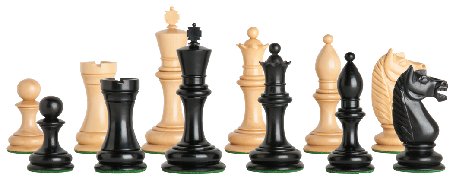
House of Staunton's replica of set used in the match
     By the mid-1920s he began playing in tournaments with considerable success. At the outbreak of World War Two, fearing for his life at the hands of the Nazis, he and his family made their way to safety in Moscow where he remained for the rest of his life. 
     Botvinnik was satisfied with drawing the match and although it was not the result Krylenko had hoped for, it gave the Soviet players and authorities a lot of confidence with the result that they began meeting foreign competition more frequently. 
     The following game, the first game of the match, was won by Flohr who later stated that it was marred by nervousness on the part of both players and he won because or greater experience and tactical preparedness.