Random Posts

Thursday, June 6, 2024

Speelman Attacks

    
Jon Speelman’s Best Games, published in 1997, is the most recent addition to my library. For those who don’t know, Jonathan Speel,am was born in London, England in 1956, and was awarded the IM title in 1978 and the GM title in 1980. He was the British Champion in 1978, 1985 and 1986. 
    After qualifying for the World Championship cycle in the 1987 interzonal tournament held in Subotica, Yugoslavia. He defeated Yasser Seirawan in his first round 4–1, and Nigel Short in the second round 3.5-1.5 and then in the semi-finals he lost to Jan Timman with a 3.5-4.5 score. In the 1990–93 championship cycle, he lost to Nigel Short in the firt round with a 4,5-5,5 score. 
    Speelman has a highly original style and has a wide opening and in the book his comments are quite instructive. All 38 games are fun to play over...here’s one of them. It’s am amazing tactical display by the 15-year old Speelman. 
    In the introduction to the game he modestly calls the game, “some hackery from a county match.” It’s interesting to note that auto-analysis with Stockfish assigns Speelman’s play a Weighted Erro Value of 0.14 which means almost every move he played was Stockfish 16.1’s top choice! 
    Speelman makes what I think is a serious mistake though...he wrote, “...although I blundered in the early middlegame, (the game) is memorable for the spectacular ,if somewhat obvious, sacrificial attack which I was able to whip up after he let me back into the game…” 
    The “blunder” to which he refers is 15...Ng6. While the move might be a “blunder” at Speelman’s level of play, it’s not really one at the level at which most of us play! Stockfish 16 evaluates the position at -0.10 (almost dead equal) before the move and at +0.44 (slightly in white’s favor) after. A swing of about half a Pawn would mean almost nothing to most of us.
  A game that I liked (Fritz 17)
[Event "Cambridge-Middlesex Team Matcj"] [Site "?"] [Date "1971.??.??"] [Round "?"] [White "Rory O'Kelly"] [Black "Jonathan Speelman"] [Result "0-1"] [ECO "E63"] [Annotator "Stockfish 16"] [PlyCount "58"] [EventDate "1971.??.??"] {E63: King's Indian: Fianchetto: Panno Variation} 1. d4 Nf6 2. c4 g6 3. g3 Bg7 4. Bg2 O-O 5. Nc3 d6 6. Nf3 Nc6 7. O-O a6 8. h3 e5 9. d5 Ne7 10. c5 {The standard move here is 10.e4. The text is aggressive and best be described as interesting.} Nd7 (10... b5 11. cxb6 cxb6 12. e4 b5 13. b4 Bd7 {equals. Marovic,D (2475)-Smejkal,J (2575) Vrsac 1977}) (10... e4 11. cxd6 Qxd6 12. Ng5 Nexd5 13. Ngxe4 Nxc3 14. Nxd6 Nxd1 15. Nxc8 Raxc8 16. Rxd1 c6 {with equality. Grabarczyk,B (2260)-Zimmerman,Y (2280) Polanica Zdroj POL 1992}) 11. cxd6 cxd6 12. e4 h6 13. Ne1 f5 14. exf5 gxf5 15. Kh2 Ng6 {According to Speelman this is a blunder that loses a Pawn and should have lead to a deci- sive disadvantage. That assessment seems too harsh as white's advantage is minimal...about half a P.} (15... Nf6 {is slightly better though.} 16. a4 Bd7 {and neither side can claim an advantage.}) 16. Qh5 {After this white does have the initiative, but no distinct way of forcing an advantage.} Kh7 17. Nf3 {Speelman wrote that he probably saw white's last move, but missed this one. While white has no way of forcing a breakthrough on the K-side any misstep by black is likely to gave serious consequences.} Qe8 {This gives white the edge.} (17... Ne7 18. Ng5+ Kg8 19. Ne6 Nf6 20. Nxd8 Nxh5 21. Ne6 Bxe6 22. dxe6 e4 23. g4 Nf6 24. Bf4 {White's piece activity gives him slightly the better of it.}) 18. Ng5+ Kg8 {[%mdl 32]} 19. Ne6 Nf6 20. Nxg7 {Logical as it eliminated the B, but 20.Qxf5 was even better.} (20. Qxf5 {is quite complex and OTB it would also br quite unclear!} Ne7 21. Qc2 Bxe6 22. dxe6 d5 23. Qb3 Qc6 24. Be3 {with a active position.}) 20... Kxg7 21. Qxh6+ {This, not the previous move as suggested by Speelman, is the one that lets black off the hook.} (21. Bxh6+ Kf7 22. Qf3 Rh8 23. Bg5 Nh7 24. Bd2 Nf6 25. Rac1 {White has completed his development and gotten both Rs into play and so here he stands better.}) 21... Kf7 22. Qe3 Rh8 {[%mdl 2048] While theiretically the position might be equal, in practice black is more active.} 23. Qb6 {This puts the Q out of play and so 23.Qe3 woulf have been safer.} f4 {This clears the way for the B.} 24. Qxd6 {This is a serious mistake. In his notes Speelman states that black is now able to launch a vicious attack, but admitted that he played in on instinct and did not remember exactly how he intended to followup the sacrifice.} (24. Rh1 {This prevents the sacrifice on h3.} Bxh3 (24... Qe7 25. Kg1 Bf5 {is black's correct line and here he stands somewhat better.}) 25. Bxh3 Qd7 26. Kg2 f3+ 27. Kxf3 Rxh3 28. Rxh3 Qxh3 29. Qxb7+ {is to white's advantage.}) (24. Qc7+ {This is also a reasonable try.} Bd7 25. Bd2 Qe7 {and with the sacrifice on h3 looming white still has to play his R to h1 and here, topo, black has the more promising position.}) 24... Bxh3 {Black has a winning attack.} 25. Bxh3 Rxh3+ { This is the only followup that results in success. Anything else puts white back on an equal footing.} 26. Kxh3 {This leads to forced mate, so he had to try 26.Kg2. Speelman's original instinctive reaction was to dismiss this move out of hand as "grim'; but white would still be lost.} (26. Kg2 Qh8 27. Rg1 ( 27. Qc7+ Kg8 28. Rg1 fxg3 29. fxg3 Rf8 {is fatal for white.} 30. Qxb7 (30. Kf2 Nxd5+) 30... Rxg3+ 31. Kxg3 Ne4+ 32. Nxe4 Qh4+ 33. Kg2 Qxe4+ {mates in 2}) 27... Re8 28. Kf1 Rh1 29. Rxh1 Qxh1+ 30. Ke2 Qg2 31. Kd1 fxg3 32. Bg5 Qf3+ 33. Kc2 Qf5+ {Black is winning.}) 26... Qh8+ 27. Kg2 {Black could play 26...f3+ and still have a winning position, but there is a mate in 11} Nh4+ {[%mdl 512]} 28. Kg1 (28. gxh4 Rg8+ 29. Kh3 {Now black wins with a Q sacrifice.} (29. Kf3 Qh5#) 29... Qxh4+ 30. Kxh4 Rh8+ 31. Kg5 Rh5#) 28... Nf3+ 29. Kg2 Qh2+ {White resigned.} (29... Qh2+ 30. Kxf3 Qh5+ 31. Kg2 f3+ 32. Kg1 Rh8 {White can only delay mate by giving up material.}) 0-1

Wednesday, June 5, 2024

Ravinsky Stomps the Sicilian

    
Every player who has ever faced the Sicilian remembers seeing a game where white scores a crushing win using numerous sacrifices. That’s exactly what Ravinsky did in the following game. When all of the conditions for a N sacrifice on e6 were in place he conducted a merciless attack that even included additional sacrifices. 
    Grigory Ravinsky 1909-1994, 64 years old) was born in St. Petersburg. When he was 19, he made his debut in the city championship where he met some stiff competition: played against Botvinnik, Romanovsky, Ilyin-Genevsky, Levenfish and Rabinovich. 
    It wasn’t until 1941that he became a Master of Sport and qualified from the Leningrad championship to the semi-final of the USSR championship. This tournament was interrupted by the War. 
    After WWII ended Ravisky lived in Moscow where lived in a communal apartment until the end of his days. He played in several city championships and qualified several times for the USSR Championships. 
    Never married, he loved the theater and the Prague Cafe, famous for its chocolate cake, which was his true home and he visited it regularly. His main calling was that of a trainer. He was described as a kind man who was very strict when it came to chess. 
    Soviet Master Evgeny Gik told of the time he was to play in a simultaneous exhibition Ravinsky was giving and when Gik arrived a few minutes late Ravinsky refused to allow him to play. 
    In 1957, Ravinky became a recognized trainer and two years later he was mage an International Arbiter. In 1965, Ravinsky retired from competition. 
    His opponent, Vasily Panov (1906-1973, 66 years old), was born in Kozelsk, Russia. Awarded the IM title in 1950 he won the Moscow Championship of 1929. As the chess correspondent for Izvestia he contributed much to the theory of the Caro-Kann and the Ruy Lopez.

  A game that I liked (Fritz 17)

[Event "Red Army 25 yr Jubilee"] [Site "Moscow URS"] [Date "1943.02.??"] [Round "?"] [White "Grigory Ravinsky"] [Black "Vasily Panov"] [Result "1-0"] [ECO "B80"] [Annotator "Stockfisj 16"] [PlyCount "71"] [EventDate "1943.??.??"] {B80: Sicilian Scheveningen} 1. e4 c5 2. Nf3 e6 3. d4 cxd4 4. Nxd4 Nf6 5. Nc3 d6 6. g3 {In modern times white usually plays 6.Be2, or, if he is feeling aggressive, 6.g4m the Keres Attack. Of course at the time this game was played the theory on 6.g4 was not known.} Nc6 7. Bg2 Bd7 8. O-O a6 9. Be3 Rc8 10. Qe2 b5 (10... Nxd4 11. Bxd4 e5 12. Be3 Be7 13. a4 O-O {equals. Hernandez Guerrero, G (2551)-Duarte Barahona,R (2082) Aguascalientes 2007}) 11. a3 Ne5 {Black's play here is a bit suspect...he is negelecting to get castled.} (11... Be7 { remains equal.} 12. f4 O-O {is fully equal.}) 12. Rad1 Nc4 13. Bc1 Nxa3 { This tactical idea is faulty. True, it wins a P, but even if white plays 14. bxa3 he would get plenty of compensation for it. However, white has an even better line...the crushing 14.e5!} 14. e5 {This opens up the e-file for white's pieces. Exactly how he will use the e0file will become clear as the game progresses.} dxe5 15. Nc6 {This is the correct way to recapture on e5 because it allows white to eliminate a defender of e6 the importance of which will soon become clear.} Qc7 16. Nxe5 Nc4 {Returning to safety.} 17. Nxd7 Nxd7 18. Nd5 {Attacking the Q with a gain of time for the next phase of his plan.} Qa7 {This is not the optimal square for the Q.} (18... Qe5 {would have kept white's advantage at a bare minimum.} 19. Qg4 {keeping an eye on e6 and g7. In this position black should be able to finmd moves that are good enough to hold on.}) 19. Nf4 {One suspects white has in mind a sacrifice on e6. aiming for Nxe6!} Nce5 {Black is tryinh to shield e6.} (19... Be7 {This blocks the e-dile and, hopefully, will enable him to castle, but it to is ineffective.} 20. Nxe6 $1 fxe6 21. Qxe6 {Black must now prevent Rfe1.} Nce5 22. Bg5 Qc5 23. Rd5 Rc6 24. Rxc5 Rxe6 25. Rc8+ Kf7 26. Rxh8 Bxg5 27. f4 {White is winning.}) 20. Rxd7 { [%mdl 512] Crushing. Now e6 is exposed.} Nxd7 (20... Qxd7 {is no better. After} 21. Qxe5 {Even though white has the more active pieces and black is undeveloped and his K is stuch in the center, how does white capitalize on his advantage?} Qc7 22. Qg5 h5 23. Nxh5 Be7 24. Nxg7+ Kf8 25. Nxe6+ $1 fxe6 26. Qg6 Qe5 27. Bb7 Rc4 28. Bh6+ Rxh6 29. Qxh6+ {and white is winning.}) 21. Nxe6 { [%mdl 512] Of course!} fxe6 22. Qxe6+ Be7 (22... Kd8 {An attempt to flee will prove unsuccessful.} 23. Bg5+ Kc7 24. Qc6+ Kb8 25. Bf4+ {and the K is in a devastating crossfire.} Bd6 26. Bxd6+ Rc7 27. Bxc7+ Kc8 28. Bb6+ Kb8 29. Bxa7+ Kxa7 30. Qb7#) 23. Re1 Qc5 {[This defends against Bg5 and now white must find the one move that keeps his winning advantage. ...Rf8 is the strong threat.} 24. b4 $1 {The only move; black cannot defend the B.} Nf8 25. Qg4 {Avoiding exchanges and keeping an eye on c8 and attacking g7. There is no reason to settle for 25.Qxa6} Qc3 {This defends both the R and g7, but white is not done sacrificing.} 26. Rxe7+ $1 {[%mdl 512]} Kxe7 {Black is way ahead in material, but his K is exposed in the miffle of the board.} 27. Bg5+ Kd6 {Stockfish now informs us that white has a mate in 15.} (27... Qf6 {Giving back some material avoids mate, but black is still lost after} 28. Bxf6+ gxf6 29. Qxc8) 28. Qd1+ Kc7 (28... Ke5 29. Qd5#) (28... Ke6 29. Qd5#) 29. Bf4+ Kb6 30. Qd6+ Ka7 31. Qe7+ Rc7 32. Bxc7 Qa1+ 33. Bf1 Ng6 34. Qc5+ Kb7 35. Ba5 Rf8 36. Qb6+ {Black resigned. White mates a move sooner with 36.Qc7+} (36. Qb6+ Ka8 37. Qc6+ Kb8 38. Bc7+ Ka7 39. Bb6+ Kb8 40. Qc7+ Ka8 41. Qa7#) 1-0

Tuesday, June 4, 2024

Horatio Caro

    
Horatio Caro (July 5, 1862 – December 15, 1920) was born in Newcastle upon Tyne, England, but spent most of his chess career in Berlin, Germany, having moved there when he was two years old. 
    Today he is remembered for the Caro-Kann Defense which he analyzed with Marcus Kann and they published their analysis in a German publication in 1886.
    What is not known is that for a brief period of time Caro was one of the best players in the world! Chessnetrics estimates his highest ever rating to have been 2676 in 1889 making him the world’s 7th best player. 
    In match play he defeated Jacques Mieses (1897) and Moritz Lewitt (1905), drew with Curt von Bardeleben (1892 and 1903) and lost to Szymon Winawer (1892). Between 1888 and 1911 he played in many tournaments and usually finished very well, winning tournaments in Berlin events five times. 
    Caro died in London at the age of 58 where he was confined to a workhouse. In Britain and Ireland, a workhouse was an institution where those unable to support themselves financially were offered accommodation and employment. 
    Here is a good example of the kind of chess Caro played at his best. It was played in the Berlin city championship in 1904. His opponent, is an unknown, but in 1905 he finished last in Barmen Hauptturnier-A Tournament with a score of +0 -15 =0. 
 Hauptturnier is a German word that is freely translated as "candidates tournament." In the early part of the 20th century, it was necessary for amateur to win prizes in small tournaments before they could progress to a higher level, Winning a Hauptturnier earned one the Master title. That was important because it also meant that one could be invited to international tournaments. 
 

  A game that I liked (Fritz 17)

[Event "Berlin City Championship"] [Site "Berlin GER"] [Date "1904.??.??"] [Round "?"] [White "Horatio Caro"] [Black "W Kunze"] [Result "1-0"] [ECO "D05"] [Annotator "Stockfish 16"] [PlyCount "59"] [EventDate "1904.??.??"] [Source "Saturday Westmin"] {D05: Colle System} 1. d4 d5 2. Nf3 e6 3. e3 Nf6 4. Bd3 Bd6 5. Nbd2 O-O 6. e4 { Although white foes not play c2–c3 this opening is still classified as a Colle. In the 19230s and 1930s Colle and Koltanowski won several tournaments and the system gained in popularity. Today the Colle is generally regarded as innocuous but solid.} (6. Ne5 c5 7. c3 b6 8. Qe2 Bb7 9. O-O Qc8 10. Re1 Ba6 11. f4 {The opening has transposed into a Stonewall. Zupe,M (2246)-Gorodetzky,M (2316) Novi Sad SRB 2019}) (6. c3 Nbd7 7. e4 dxe4 8. Nxe4 Nxe4 9. Bxe4 h6 10. g4 {This should have allowed black to get the advantage after 10...f5!} Nf6 11. Bc2 b6 12. g5 hxg5 13. Bxg5 Be7 14. Qd3 g6 15. Ne5 {White has a winning attack. Aliev,K-Nwedo,K (1356) Nakhchivan AZE 2022}) 6... dxe4 7. Nxe4 Nxe4 8. Bxe4 f5 {This creates aan unnecessary weakenig of his K-side.} (8... c5 9. Bxh7+ Kxh7 10. Ng5+ Kg8 (10... Kg6 {is a must. While 9t mayt look prtecariously places, black's K is able to flee to safety.} 11. h4 Kf6 12. h5 cxd4 13. Qxd4+ Ke7) 11. Qh5 Re8 12. Qxf7+ Kh8 13. Qh5+ Kg8 14. Qh7+ {1-0 It's mate in 2 Gordienko, A-Tripolsky,A Kiev 2004}) (8... h6 {guarding g5 is his best move. After} 9. Be3 Nd7 10. Qe2 Nf6 {the position is fully equal.}) 9. Bd3 Nd7 10. O-O e5 {Either 10...Nf6 or 10...h6 would have been better. As it is white can now open up the position to his advantage.} 11. Bc4+ Kh8 12. Ng5 Qe8 {It would have been better to kjeep the center somewhat closed by playing 12...e4} 13. Re1 { A slight lapse...black can still ease his defense a bit by playing 13...e4. For that reason white should have played 13.dxe5 first.} e4 {White's last couple of inaccuracies have transformed the position. It is now black who stands slightly better...his e-Pawn is no longer backward, he has f7 covered and he has more maneuvering space so he can now think about attacking.} 14. Qf3 {This is an elementary tactical mistake! Retreating the N to h3 and then playing Bf4 would assure him of being able to defend himself.} Nf6 {Missinf a golden opportunity.} (14... exf3 15. Rxe8 Bxh2+ 16. Kxh2 Rxe8 {and black has won the exchange.}) 15. Qb3 {Now Nf7+ is a real threat.} Qh5 {A sharp counter-threat.} 16. h3 (16. Nf7+ Rxf7 17. Bxf7 Qxh2+ 18. Kf1 Qh1+ 19. Ke2 Qxg2 20. Be3 f4 {And clearly it's black who is winning.}) 16... h6 {After this defensive move black;s advantage hgas disappeared.} (16... f4 {keeps the attack going.} 17. Nf7+ Rxf7 18. Bxf7 Qh4 19. Be6 Bxe6 20. Qxe6 Re8 {and black has plenty of compensation for the exchange, plus white still has a R and B that are out of play.}) 17. Nf7+ $11 Kh7 {Black would likely have done better to sacrifice the exchange with 17...Rxf7 which would have enabled him to keep his valuable B aimed at h3.} 18. Ne5 {Not bad, but taking the B then playing Bf4 would elimiante the potential threat to h3, blockade black;s P and force black to think about his weak d-Pawn.} Bxe5 (18... Qh4 {is tricky, but it would lead to equality.} 19. Bf7 {Threateming Ng6} (19. Be3 f4 20. Bd2 f3 { Black has what should be a decisive advantage.}) 19... Bxe5 20. dxe5 Nd7 21. e6 Ne5 {is equal.}) 19. dxe5 Nd7 20. Bf4 g5 {Black;s attack has lost its potency and white is now able to defend with ease.} 21. Bh2 (21. e6 {is stronger.. After} Nc5 22. Qa3 Bxe6 23. Qxc5 Bxc4 24. Qxc4 gxf4 25. Qxc7+ Rf7 26. Qxf4 { White is better, but is the extra P going to prove enough to win with all the heavy pieces on the board?}) 21... Nc5 {The N is exposed here so 21...Nb6 was more accurate.} 22. Qb5 (22. Qe3 Ne6 23. g4 fxg4 24. Qxe4+ Qg6 25. hxg4 Qxe4 26. Rxe4 {Technically this is the way white shoukld have played it...he has the better ending.}) 22... Nd7 {[%mdl 8192] The is the wrong square to retreat to.} (22... Ne6 {Back to the same old square, AT least things are equal after, say...} 23. Rad1 Qf7 24. Qb3 Qe7) 23. Rad1 {Not bad, but 23.e6 was a real gut punch!} (23. e6 Nb6 24. Qc5 Qe8 25. Qxc7+ Kg6 26. e7 {and white is winning. If} Rf7 (26... Rf6 27. Rad1 {threatening Rd8}) 27. Bxf7+ Kxf7 28. Rad1 Qxe7 29. Rd8 Qxc7 30. Bxc7 Nd7 31. Rd1 Nf8 32. Bd6 Ng6 33. Rd5 Ke6 34. Rc5 {and the B is lost.}) 23... c6 {[%mdl 8192] Rather pointless.} (23... Qe8 {is more resistant. } 24. e6 Nb6 25. Qe5 Nxc4 26. Qxc7+ Kg6 27. Qxc4 Bxe6 {and it's still a tough fight.}) 24. Rxd7+ {[%mdl 544] An alert finishing touch.} Kh8 (24... Bxd7 25. Qxb7 Rad8 26. e6 e3 27. Rxe3 Qd1+ 28. Bf1 f4 29. Rd3 Qe1 30. Rxd7+ Rxd7 31. exd7 Rd8 32. Qxc6 Qd1 33. Qe4+ Kh8 34. Qe5+ Kg8 35. Qe6+ Kf8 36. Qf6+) 25. e6 { [%mdl 544] Caro finishes the game with precision.} cxb5 (25... Bxd7 26. Be5+ Kh7 27. Qxb7 Rfd8 28. exd7 {with an easy win.}) 26. Be5+ {White mates in 17 moves at mos.} Kg8 27. Rg7+ Kh8 28. e7 Re8 29. Rf7+ Kg8 30. Rf8+ {Black resigned.} (30. Rf8+ Kh7 31. Bg8+ Kg6 32. Bf7+ Kh7 33. Bxh5 Be6 34. Bxe8 Rxe8 35. Rxe8 Kg6 36. Rf8 Bf7 37. Rd1 f4 38. Rd6+ Kh5 39. Rxf7 e3 40. Rf8 exf2+ 41. Kxf2 g4 42. Rf5+ Kh4 43. Rxh6#) 1-0

Saturday, June 1, 2024

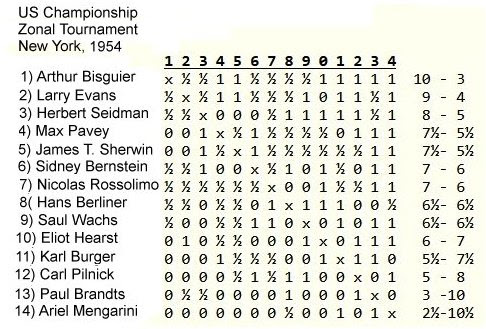
1954 US Championship

Grace Kelly
    
The 1954 US Championship one of the weakest championships ever and it was the probably also the most poorly financed. It was also witnessed by a visiting delegation of Soviet Grandmasters who were to defeat the U.S. by a 20-12 score in a match a few weeks later. 
    The problem was that the US Chess Federation didn't have the money to hold the championship in a hotel exhibition room as it had in the past and as a last resort the Marshall Chess Club offered its rooms to the 14 players. 
    The winner, Arthur Bisguier, was 23 years old and he had just gotten out of the Army and he was attending college classes during the day. At night he ended up sleeping in one of the Marshall's upstairs apartments. 
    The field was relatively weak. At the time Bisguier was only eighth on the USCF's latest rating list, and Larry Evans, the defending champion, was only tenth. None of the five top rated players, Samuel Reshevsky, Robert Byrne, George Kramer, Donald Byrne and Arnold Denker had accepted invitations.
 
 
    Evans and Bisguier were the favorites, but they were expected to get get some competition from French emigre Rossolimo, the Manhattan Chess Club champion Max Pavey and the latest Marshall Chess Club junior star, James T. Sherwin. 
    As it happened, 20-year-old Sherwin, ranked only 24th, did take the early lead after five lively rounds, but he was unable to sustain the pace. Despite his success in many European tournaments Nicolas Rossolimo was not up to the task even though he had scored quite well in the recent US Open. 
    It was a close race though as the championship wasn’t decided until the last round when Evans was held to a draw by Herbert Seidman and Bisguier defeated Ariel Mengarini. 
    It’s hard to believe, but GM Larry M. Evans has been gone 14 years. He passed away on November 15, 2010 in Reno, Nevada from complications from gall bladder surgery. This is rather unusual. The gall bladder is a small sac-shaped organ beneath the liver in which bile is stored after secretion by the liver and before it is released into the intestine. Surgery on it is a safe operation and usually carries only a small risk of complications. In most people incision is small and the patient can go home the same day. 
    Evans was born into a Jewish family on March 22, 1932, in Manhattan. He learned a lot about chess by playing for ten cents an hour on 42nd Street in New York City. A prolific, if controversial, author of chess books, he won or shared the US.Chess Championship five times and the US Open Chess Championship four times. 
    His opponent in this game was Rabbi Saul Wachs who was a very strong Master. In the He lived in Columbus Ohio and in the 1960s was routinely winning events in the Midwest. Unfortunately he gave up chess to pursue his career as an educator. I believe Wachs was born in 1931 and it is possible that he is still with us...he would be 93 years old. 
    The following game is very interesting in that it shows how very difficult it is even for a very strong Master like Wachs to score against a player like Evans who was an IM (awarded in 1952) at the time and would get the GM title just three years after this game. Wachs made no serious errors...he was just outplayed. 
    This game is being presented in a different format that’s available using Fritz 17. I leave it to the reader to play through the variations! 
 

Friday, May 31, 2024

1937 Manhattan CC Championship

    
In 1937, in aviation new Amelia Mary Earhart mysteriously disappeared over the Pacific Ocean and the German airship Hindenburg burst into flames while attempting to moor at Lakehurst, New Jersey. Howard Hughes breaks his own transcontinental flight speed record when he flies from Los Angeles to Newark. 
    In other news the Memorial Day Massacre took place when union steel workers threw a tree branch at police who open fire on the crowd and use clubs to break up the protest. As a result police bullets kill ten people and injure 30 plus another 28 suffer serious head injuries from police clubbing. As we would expect even today, a Coroner's Jury declared the killings to be justifiable homicide and no police were ever convicted. 
    In US chess news George Koltanowski (1903-2000) played 34 simultaneous blindfold games and scored +24 -0 =10. Adele Rivero won the first US Women’s Championship. The US team (Reshevsky, Fine, Kashdan, Marshall,\ and Horowitz) took first place in the Chess Olympiad was held in Stockholm. The Western Chess Association (US Open) in Chicago was won by David Polland. 
    In New York Isaac Kashdan and Albert Simonson tied for first in the Manhattan Chess Club Championship with a convincing 2.5 point lead ahead of Robert Willman, a former club champion, who had been in the lead in the early rounds, but then suffered losses to both Kashdan and Simonson. As a result of the first place tie for the third successive year, a playoff for the title was necessary. Kashdan scored a win and two draws to take the title.
 
 
    The deciding point occurring in the first game where Simonson had a draw in hand when he made an incredible blunder in a fairly simple endgame position.
    Almost nothing is known of Samuel S. Cohen except that in in the 1930s he was an editor for Chess Review magazine and he participated in the 1938 US Championship (won by Reshevsky) where he finished +4 5 =7 and tied for places 12-14 (out of 17) with Milton Hanauer and Fred Reinfeld. He drew with Reshevsky and defeated Kashdan. His opponent, Albert Simonson (1914-1965), was one of the country’s strongest players in the 1930s. 

  A game that I liked (Fritz 17)

[Event "Manhattan CC Champ. New York"] [Site "New York"] [Date "1937.??.??"] [Round "?"] [White "S.S. Cohen"] [Black "Abraham Kupchik"] [Result "1-0"] [ECO "B40"] [Annotator "Stockfish 15"] [PlyCount "61"] [EventDate "1937.??.??"] {A34: Symmetrical English} 1. e4 c5 2. Nf3 e6 3. c4 {The opening has become a Symmetrical English with Sicilian overtones.. Either player may make an early break in the centre with the d-Pawn.} d5 4. exd5 exd5 5. d4 Nf6 6. Nc3 (6. cxd5 Nxd5 7. Bb5+ Nc6 8. O-O Be7 9. dxc5 O-O 10. Bc4 {is equal. Kozak,A (2532) -Aggelis,N (2281) chess.com INT 2022}) 6... cxd4 (6... Nc6 7. Be3 cxd4 8. Nxd4 Bb4 9. Be2 {equals. Rausis,I (2470)-Kirov,N (2445) Cannes 1990}) 7. Nxd4 { [%mdl 32]} a6 {Both 7...Bc5 and 7...Be7 have been played here. Kupchik's move prevents a piece from going to b5 and/or preparing ...b5, but it is not really necessary.} 8. Bg5 dxc4 {This is inaccurate; he had to play 8...Be7 with an equal position.} 9. Bxc4 {White's huge lead in development assures him of the advantage.} Be7 {White is better.} 10. Qa4+ (10. Qb3 {is interesting, bit it's unsound. After} Qxd4 11. Bxf7+ Kf8 12. Bxf6 gxf6 13. O-O Qb4 14. Qd5 {Blacks' K is quite safe and there is no way for white to continue the attack.}) 10... Nbd7 (10... Bd7 11. Qb3 {attacks both f7 and b7}) 11. Nf5 {Clearly trouble is brewing for black.} O-O {He has a threat ...Nb6.} 12. Rd1 Bc5 (12... Qe8 { was his best chance, but white remains quite well. Even so, play can get very tricky.} 13. O-O Nb6 14. Nxe7+ Qxe7 15. Qb3 Nxc4 {And noe 156.Qxc4 only results in eqwal chances, but white has...} 16. Nd5 Qe5 17. Bxf6 gxf6 18. Rfe1 {Now it's black's turn to get clever with} Nd2 19. Qd3 (19. Rxd2 Qxe1#) 19... Qg5 20. Rxd2 Be6 21. Nc7 Rad8 {White onbly has one satisfactory move and that is} 22. Qxd8 Rxd8 23. Rxd8+ Kg7 24. Nxe6+ fxe6 25. Rd6 e5 {Theoretically white is better, but practically thing might turn out differently.}) 13. O-O Qc7 14. Bd3 {A very fine move. Nxg7! is in the atmosphere.} b5 {At first glance it may not look like it, but white has a decisive advantage.} 15. Qh4 Bb7 16. Nxg7 { A stellar finish!} Qc6 17. Nd5 {[%mdl 128] This moce is also pretty nifty! Oc course 17...Qxd5 is met by 18.Bh7+ and if 17...Nxd5 18.Qxh7#} Qxd5 {This loses instantly.} (17... Kxg7 {is a much stouter defense.} 18. Bf5 (18. Bxf6+ Nxf6 19. Qg5+ Kh8 {[%eval 35,19] [%wdl 60,937,3] [%emt 0:00:00]} 20. Qxf6+ Qxf6 21. Nxf6 Bd4 {with equal chances.}) 18... Rg8 {Technically white is winning, but there are still some problems to overcome.} 19. Rd3 {Adding the R to the attack is by far the best way to continue the attack.} Kh8 20. Rg3 Rxg5 21. Qxg5 Rg8 22. Bxd7 Rxg5 23. Bxc6 Rxg3 24. hxg3 Nxd5 25. Bxb7 {with a won ending. }) 18. Bxh7+ Nxh7 19. Rxd5 Bxd5 20. Rd1 {[%mdl 32]} Kxg7 {Resigning was a good alternative.} 21. Rxd5 Rfe8 {With the forlorn hope that white will overlook the mate threat on e1.} 22. h3 Ra7 23. Bd2 Re6 24. Rh5 Nhf8 25. Bc3+ f6 26. Rg5+ Ng6 27. Qg4 Re1+ 28. Kh2 Bd6+ 29. g3 Ndf8 (29... Re7 30. Rxg6+ Kf7 31. Rh6 Rc7 32. Rh7+ Ke8 33. Qh5+ Kd8 34. Rh8+ {finishes it.}) 30. Bxe1 fxg5 31. Qd4+ { Black finally resigned.} 1-0

Thursday, May 30, 2024

Favorite chess books

    
My favorite chess books have always been game collections. My all time favorites are Botvinnik, One Hundred Selected Games, Reshevsky On Chess (reprinted as Reshevsky’s Best Games), Tartakower’s Best Games (2 volumes), My Fifty Years of Chess (by Frank Marshall),Tarrasch’s Best Games and more recently The Art of Bisguier (2 volumes). Even today any one of these books will provide hours of entertainment. 
    If my memory is correct Frank Marshall’s book, My Fifty Years of Chess, was the first one I had. It was published in 1942, which, of course, was before I was born and it was, I think, republished in paperback by Dover. 
    Frank Marshall (1877-1944) was US Champion for 27 years and his games are still a delight to play over. Best known for his great tactical skill, he was famous for the "Marshall swindle" where a tactical trick would turn a lost game around. It’s not remembered today, but in his day Marshall was also known for his endgame skill. 
    There is no question that the 1904 Cambridge Springs International Chess Congress, the first major international tournament in the United States, was Marshall’s greatest success; he finished first by two full points. 
    Other American players, Jackson W. Showalter, Albert Fox, John Barry, Albert B. Hodges, Eugene Delamr, Max Judd and even the legendary Harry N. Pillsbury were no longer able to compete at Marshall’s level. 
    Marshall’s success at Cambridge Springs even resulted in him being considered as a world championship challenger. Unfortunately, he was never able to repeat the great success of Cambridge Springs, nor was he successful in a run at the world championship. In fact, after Cambridge Springs Marshall’s play was inconsistent and his results were not especially impressive. That may have been due more to his personal nature and style of play more than his ability. 
    The July 2, 1896 edition of the Brooklyn Daily Eagle reported on the Continuous tournament, one in which the players played 37to 260 (!) games and the final standing were based on the percentage of wins, draws not counting. 
     “F. J. Marshall, the young player who has been making such rapid strides to the front in local chess circles of late, has again captured first prize in the Brooklyn club's continuous tournament with the high percentage of 80 (percent).”
 
 
    Marshall’s overall score was +40 -10. Close on Marshall's heels was G. W. Jones, a former first prize winner, with a score of 77.8 percent (+35 -10). R. P. Dow secured the highest number of wins with 260 and he also had the highest number of losses, 184. 
    Here is Marshall’s win against the runner up., about whom nothing is known. The only other time his name came up (that I found) was in 1897 when the Brooklyn CC defeated the Chicago CC in a correspondence match 6.5-5.5. 
    In that match Jones, playing on board defeated his opponent. William Napier was on first board for Brooklyn followed by Herman Helms and Frank Marshall. 
    In the game Jones was facing some pressure in the form of a K-side attack, but he was holding his own until move 20 when he took the precaution of playing a defensive move. It turned out to be a fatal mistake after which Marshall unleashed a vicious attack against which there was no defense. As far as I know this game does not appear in any books on Marshall. 

A game that I liked (Fritz 17)

[Event "Brooklyn CC Continuous Tournament"] [Site "Brooklyn, NY USA"] [Date "1896.??.??"] [Round "?"] [White "G W Jones"] [Black "Frank Marshall"] [Result "0-1"] [ECO "C50"] [Annotator "Stockfish 16"] [PlyCount "50"] [EventDate "1896.??.??"] [Source "Brooklyn Daily E"] {C54: Giuoco Piano} 1. e4 e5 2. Nf3 Nc6 3. Bc4 Bc5 4. O-O d6 5. c3 Bg4 6. d3 Nf6 7. Be3 Bb6 8. Nbd2 Qe7 {The alternative is 8...O-O} 9. b4 Rd8 10. a4 d5 11. exd5 Nxd5 (11... Bxe3 12. dxc6 Bxd2 13. Qxd2 Bxf3 14. gxf3 bxc6 {is a slightly more accurate continuation.}) 12. Bxb6 (12. Bxd5 {would give white the advanyage after} Rxd5 13. c4 Rxd3 14. c5 e4 15. cxb6 exf3 16. Qc2 Nxb4 17. Qc4 Be6 18. bxc7 O-O 19. Bc5 Qxc7 20. Qxb4) 12... axb6 13. Qb3 Nf4 14. Rae1 O-O 15. h3 (15. d4 {was more accurate, but it would allow black to draw.} Bxf3 16. Nxf3 Qd7 17. Nxe5 Nxe5 18. Rxe5 Qg4 19. g3 Nh3+ 20. Kg2 {and black can draw by repeating moves.}) 15... Bh5 (15... Bxh3 16. gxh3 Rd6 17. Re4 Nxh3+ 18. Kh1 { Best} (18. Kg2 Nf4+ 19. Rxf4 {otherwise black has a mating attack..} Rg6+ 20. Kh2 exf4 21. Rg1 Rxg1 22. Kxg1 g5 {and black has reason to be optimistic.}) 18... Rh6 19. Nh2 {Here, too, black has a good position, In Shootouts white scored +1 -3 =1}) 16. d4 Rd6 {This is a slight inaccuracy. It would have been better to get the Q off the line of the R with 15...Qf6} 17. Kh2 {This defensive move was unnecessary.} (17. dxe5 {gives black the initiative after} Rg6 18. g3 Nxh3+ 19. Kh1 Rh6 20. Kg2 {but white's defensive resources should prove adequate.}) (17. d5 Nb8 18. Rxe5 {with slightly the better of it.}) 17... Qd7 18. Nxe5 Nxe5 19. Rxe5 {White has won a P, but black has good attacking prospects and that's all Marshall needs.} Rh6 {[%mdl 32] White must now prevent ...Bg6.} 20. Re3 {[%mdl 8192] This looks like a good defensive move, but there is absolutely no time for such precautions!} (20. Rfe1 {had to be played. Then after} Bg4 21. Kg1 Bxh3 22. g3 {White is completely safe...there is simply no way black can dig out white's K.} (22. Bxf7+ {is a fancy defense.} Qxf7 23. Qxf7+ Rxf7 24. Re8+ (24. gxh3 Nxh3+ 25. Kg2 Rxf2+) 24... Rf8 25. Rxf8+ Kxf8 26. gxh3 Nxh3+ 27. Kg2 {and, theoretically at least, white should be able to draw.})) 20... Bg4 {The attack on h3 is overpowering.} 21. Rh1 Bxh3 { [%mdl 128]} 22. gxh3 (22. Kg1 {allows white to put up a manly defense.} Qc6 23. Ne4 Bxg2 24. Rxh6 Qxh6 25. Ng3 {Clearly black is better, but how does he win?! According to Stockfish the best line is} g6 26. Qb1 Qh4 27. Qe1 Bc6 28. f3 Bxa4 29. Ne4 Qh3 30. Bf1 Qf5 31. c4 Bc2 32. Qf2 Bxe4 33. fxe4 Qg5+ {and black has a decisive advantage because of his passed Ps on the K-side.}) 22... Rxh3+ { Black now has a mate in 8.} 23. Kg1 Qg4+ 24. Rg3 Rxg3+ 25. Kf1 Rxc3 {[%mdl 512] Pretty, but not the most efficient! White resigned} (25... Re8 26. fxg3 Qxg3 27. Bxf7+ Kf8 28. Qe6 Rxe6 29. Bxe6 Qg2+ 30. Ke1 Qe2#) (25... Rxc3 26. Qb1 Qg2+ 27. Ke1 Re8+ 28. Kd1 Qxh1+ 29. Bf1 Re2 30. f3 Rxf3 31. Kc2 Rxd2+ 32. Kxd2 Qh2+ 33. Ke1 Rxf1+ 34. Kxf1 Qe2+ 35. Kg1 Qg2#) 0-1

Wednesday, May 29, 2024

A Clever Finish by Euwe

    
The following game is a bit boring, but it's redeeming point is the clever finish by the former World Champion. The game was played in an international tournament in Gijon, a large coastal city in northern Spain. 
    From between 1944 and 1951, then between 1954 and 1956, and, finally, in 1965, small tournaments with 8 to 12 players were held there. The original purpose was to focus on the recovery of chess in Spain and Europe after World War II. 
    The strength of the tournaments which featured local players and prominent ones varied. They featured the rapid decline of World Champion Alekhine, the rise of Spanish child prodigy Arturo Pomar and such greats as Euwe, Rossolimo, Prins, Medina, Darga, Donner, O’Kelly. And, a young Larsen played in 1956. 
    Today’s game was played in 1951. In the U.S> that was the year I Love Lucy debuted on television and Pabst Blue Ribbon was the first ever television beer commercial. It was also the year the first baseball game was televised in color. It' was between the Brooklyn Dodgers and the Boston Braves. 
    In other happenings, Tupperware was invented, the first direct-dial coast to coast telephone call was made, the first commercial computer, UNIVAC, was put into use at the U.S. Census Bureau. It was also the year the U.S. government began nuclear bomb testing at a test site in Nevada. Also, it was the year that birth control pills were developed. 
    In the chess world problem composer Alain C. White, Alain (1880-1951) died in April in Sumerville, South Carolina. In Budapest Geza Maroczy (1870-1951) died on May 29th. 
    Mary Bain won the US women's championship. Samuel Reshevsky won the Wertheim Memorial in New York, Larry Evans won the US Championship, also held in New York and Larry Evans won the US Open, held in Fort Worth, Texas. 
    A 7-year old kid named Bobby Fischer played one of the boards against in a simultaneous exhibition given by Max Pacey at the Grand Army Plaza Library in Brooklyn. Within 15 minutes Fischer lost his Queen and burst into tears. 14-year old Edmar Mednis also played in the exhibition and he held Pavey to a draw. 
    The big international news was the World Championship match in Moscow. Mikhail Botvinnik retain the title when he drew with David Bronstein. Was Bronstein warned not to win? 
    The World Junior Championship held in Birmingham, England was won Borislav Ivkov, age 17, of Yugoslavia. With the exception of Bent Larsen and Fridrik Olafsson, most of the players seem to have vanished. For example, who was the second place finisher Malcolm Barker? 
    With everything going on in the world in 1951, it’s no surprise that nobody remembers the tournament at Gijon or Euwe’s nice victory over Rossolimo. 

A game that I liked (Fritz 17)

[Event "Gijon"] [Site "Gijon ESP"] [Date "1951.07.19"] [Round "?"] [White "Nicolas Rossolimo"] [Black "Max Euwe"] [Result "0-1"] [ECO "C53"] [Annotator "Stockfish 16"] [PlyCount "68"] [EventDate "1951.??.??"] {C53: Giuoco Piano} 1. e4 e5 2. Nf3 Nc6 3. Bc4 {Rossolimo was one of the rare proponents of this anciet opening.} Bc5 4. c3 Qe7 5. d4 Bb6 6. O-O d6 7. h3 Nf6 8. Re1 O-O {This N is headed for e3 where it will have more influence than on c3.} 9. Na3 Kh8 {The purpose of this odd looking move will soon become clear... Euwe intends ...f6; The expected move here is 9...h6} 10. Nc2 Nd8 11. b3 { You might think he is making room for jhis B on b2, but if he was, it never gets there. In fact, the B is not going to move for a long, long time.} Be6 ( 11... Ng8 {This undeveloping move leads to an inferior game.} 12. a4 (12. Ne3 f6 13. a4 {is also possible.}) 12... a6 (12... c6 13. Ba3 c5 14. b4 {and white is clearly better.}) 13. Ne3 Nf6 (13... f5 14. Nd5 Qe8 15. exf5 Bxf5 (15... Nc6 16. Ba3 {and white is much better.}) 16. a5) 14. Ba3 {with the better game. Sperber,G (2200)-Eslon,J (2200) Skelleftea 1972}) 12. Bd3 Ng8 {The fact that black has to play this move anyway is evidence that his position is not so great. It's surprising that Euwe, a great theortician, has gotten himself into this situation.} (12... c6 13. Ba3 {Threatening dxe5, so...} c5 14. Ne3 { and black has a passive position with little prospects of doing anything but defening.}) 13. Ne3 f6 {Clearly black has few prospects of attacking and there is not much else he can do.} 14. Nd5 Qf7 {It's at this point that a couple of less than optimal moves lets Euwe off the hook and it is he who gains the initiative.} 15. c4 (15. Qc2 {forces black to be careful.} Ne7 16. a4 c6 17. Nxe7 Qxe7 18. a5 Bc7 19. b4 {White, who must now switch his attention to the Q-side is better, but not by much.}) 15... Bxd4 16. Nxd4 exd4 17. Bc2 c6 18. Nf4 (18. Qd3 g6 (18... cxd5 19. exd5 g6 20. dxe6 Nxe6 21. Bb2 {is ghood for white/}) 19. Bf4 Qd7 (19... cxd5 20. cxd5 Bd7 21. Bxd6 Re8 22. Bc5 Rc8 23. Bxd4 {with the better game.}) 20. Qxd4 cxd5 21. cxd5 g5 22. Bd2 Bxh3 23. gxh3 Qxh3 24. Re3 {A sharp position with chances for both sides/}) 18... c5 19. Qd3 g5 { All of a sudden it's black who is calling the shots.} 20. Nd5 Nc6 21. Qg3 Ne5 22. h4 gxh4 23. Qxh4 Qg6 24. Kh1 Bxd5 25. cxd5 Ne7 {At long last the N is going to join in on the attack.} 26. f4 Rg8 27. Qh3 Ng4 28. Kg1 Nxd5 29. Bd3 ( 29. exd5 Qxc2 30. Qf3 Rg7 {and doubling the Rs on the g-file spells the end of the game.}) 29... Nde3 30. Bd2 {This allows an elegant finish, but eliminating one of the Ns would not have helped.} (30. Bxe3 Nxe3 31. Re2 Qg4 32. Qxg4 Rxg4 33. Rae1 (33. Rb1 Rag8 34. Rbb2 Rxf4 35. Rf2 Rxf2 36. Rxf2 Kg7 {and black has a won ending.}) 33... Rag8) 30... Nf2 {A finish worthy of Rossolimo himself!} 31. Kxf2 Qxg2+ 32. Qxg2 Rxg2+ 33. Kf3 Rag8 34. e5 R8g3+ {White resigned; it's mate next move.} 0-1

Tuesday, May 28, 2024

A Successful Stonewall and a King Hunt

    
The post of Mat 23rd (and a few past posts) was critical of the Stonewall Attack, but here is one that succeeded! It goes way back to the 1800s. 
    In those days it was a rare thing tp find Americana playing in Europe, but Preston Ware participated in Vienna in 1882 (see CROSSTABLE). It was one of the strongest tournaments ever with 18 of the best players of the day meeting in a double round event. 
    It was a bad tournament for the American representative Preston Ware, but he did score a win against the World Champion Wilhem Steinitz and he won the following King Hunt game against Max Weiss of Hungary. 
    Preston Ware Jr. (1821 – 1890, 68 years old) was a leading Boston player . He served as e President of the Boston Chess Club from 1868 to 1873. Ware and as President of the American Chess Foundation in 1872. 
    Ware made few few tournament appearances and they were mot especially successful, due in part to an offbeat opening repertoire. For example, in New York 1880 he played 1...a5 in all nine games with black and 1.a4 in two of his games with white. However, in his one international tournament (Vienna 1882), he defeated Steinitz. In that game Ware, as white, played the same opening as in the game below; it went 113 moves, Ware having a R+B+P vs. Steinitz’ R+P. 
    His opponent in the following game was Max Weiss (1857 – 1927, 69 years old), of Austria who had a short, but brillaint career. Chess metrics estimates his highest ever rating to have been 2727 in 1889 which place him at #4 in the world behind Steinitz, Gunsverg and Chigorin. 
    At New York in 1889 which was held to determine a challenger to Steinitz for the World Championship, Weiss tied for 1st with Mikhail Chigorin. Weiss drew the subsequent play-off match (+0 -0 =4), but then he quit chess for a banking career. In 1895, he did play a match against Georg Marco and won decisively (+5 -1 =1) , =1, -1). Also in 1895, he tied for first with Carl Schlechter in a tournament. 

A game that I liked (Fritz 17)

[Event "Vienna"] [Site "Vienna AUH"] [Date "1882.05.10"] [Round "?"] [White "Preston Ware"] [Black "Max Weiss"] [Result "1-0"] [ECO "D00"] [Annotator "Stockfish 16"] [PlyCount "75"] [EventDate "1882.05.10"] {D00: Stonewall Attack} 1. d4 d5 2. f4 {Thos is a rather inusual way of reaching the Stonewall and Ware used it to win a marathon game against Steinitz in the same tournament.} e6 3. Nf3 Nf6 4. e3 Bd6 5. Bd3 c5 6. c3 Nc6 7. O-O a6 (7... Qc7 8. Ne5 b6 9. Nd2 Bb7 10. Qe2 O-O 11. g4 {Black has sufficient defensive resources against white's attack. The chances are equal. Schwan,W-Przepiorka,D Barmen 1905 ½-½ (41)}) (7... Ne4 8. Ne5 cxd4 9. exd4 O-O 10. Nd2 f5 11. g4 {Black has a very slight advantage. Harriott,T (1892)-Al Tarbosh,W (2283) chess.com INT 2023}) 8. Bd2 {It's strange that with white having 6 Ps on black squares that this bad B which seems to have no prospects actully finds a useful position outside the P-chain. Also, very often in the Stnewall white plays Bbd2 to prevent black from playing ...Ne4, but Ware has an interesting idea in mind.} O-O 9. a3 b6 10. h3 Bb7 11. Be1 Ne4 12. Nbd2 Nxd2 13. Qxd2 Na5 {This is a wasste of time...the threat of ...Nb3 is an empty one.} (13... Ne7 {keeps the N handy for defense and is much more useful. According to Komodo 14 (Human) play might continue...} 14. g4 c4 15. Bc2 Qe8 16. Bg3 f6 17. Rfe1 Bc6 18. a4 Qd7 19. Kg2 g6 20. Qf2 b5 21. axb5 axb5 22. g5 Nf5 { with a completely equal position.}) (13... Ne7 {and Stockfish 16 continues} 14. Rd1 a5 15. g4 Qd7 16. Qc2 Kh8 17. Qe2 f6 18. Rf2 Bc6 19. Rg2 Ba4 20. Rc1 c4 21. Bb1 b5 22. h4 f5 {and white is slightly better.}) 14. Rd1 Nc4 15. Qe2 Na5 16. Bh4 {Finally white has solved the problem of his Dark squared B and he is now prepared to launch a powerful K-side attack. However, Preston and at least one pre-engine annotator mussed an even better move.} (16. Bxh7+ {[%mdl 512] leaves black in dire straits. However, working out the complications OTB would be extremely difficult.} Kxh7 (16... Kh8 17. dxc5 bxc5 18. Ng5 Qf6 19. b4 Nc4 20. Bd3 {and white is winning.}) 17. Ng5+ Kg6 {The K is surprising safe here, but white still has a very strong attack.} 18. e4 f5 19. Nxe6 Qf6 20. exf5+ ( 20. Nxf8+ Rxf8 21. e5 Qe6 {with good defensive possibilities.}) 20... Kh7 21. Qg4 Rf7 22. Ng5+ Kg8 23. Qh5 Qxf5 24. g4 g6 25. Qh4 Qf6 26. Nxf7 Qxf7 27. f5 { with a strong attack.}) 16... Qc7 (16... Qe8 {offers stiffer resistance.} 17. Ng5 (17. Bxh7+ Kxh7 18. Ng5+ Kh6 {White has no effective way to continue the attack and so it is black who stands better.}) 17... f5 (17... h6 18. Nh7) 18. g4 {and black;s defense should hold.}) 17. Ng5 {He could still sacrifice on h7, but the text is superior.} h6 18. Qh5 Nc4 {For all the moves this N has made it has accomplished nothing. Somewhat better would have been 18...Bc8 to defend e6.} 19. Nxe6 fxe6 20. Qg6 Rf5 21. Qxe6+ Rf7 22. Qg6 $1 {Now the threat is 23 Q-R7ch, K-Bl; 24 Q-R8 mate.} Kf8 23. Qh7 Ke8 {Fleeing for his life in an attempt to avoid mate.} 24. Bg6 {[%mdl 32]} Bf8 {This protects the g-Pawn, but now the white f-Pawn threat­ens to complete the destruction of black's position by moving to the 6th rank. Since the R cannot be saved, black's K continues its flight.} 25. f5 Kd7 26. Bxf7 Nxe3 27. Be6+ Kc6 28. Qg6 Bd6 { Weiss is desperately trying to improvise a shelter for his homeless K.} 29. Rfe1 Nxd1 {The desired effect of his 18th move has finally been achieved, but to no avail.} 30. Rxd1 c4 {Black is only a P down and he has fended off mate and so now he attempts to close up the Q-side.} 31. Bxd5+ {[%mdl 512] Ware continues his relentless King hunt.} Kxd5 (31... Kb5 32. Bxb7 Qxb7 33. Qxd6 a5 34. Qe6 a4 35. d5 {and it's clear that white is winning.}) 32. Qe6+ {White mates in 16!.} Kc6 33. Qxc4+ Kd7 34. Qe6+ Kc6 35. d5+ Kb5 36. Qe2+ Ka4 37. Qc2+ Kb5 38. a4+ {Black resigned} (38. a4+ Ka5 39. b4+ Bxb4 40. cxb4+ Kxb4 41. Rb1+ Ka5 42. Be1+ Qc3 43. Bxc3# {It's paradoxical that the once bad looking B delivers the mate!}) 1-0

Friday, May 24, 2024

The Penguin is Mightier Than the Swordfish

    
Who first said, 'The pen is mightier than the sword”? The words were first written by novelist and playwright Edward Bulwer-Lytton in 1839, in his historical play Cardinal Richelieu. 
    Who first said, “The penguin is mightier than the swordfish”? I always thought it was a silly pun by the player/author/publisher Al Horowitz, but he wasn't the first. 
    There are a number of children's books with the title, but it apparently is from a children’s poem by Oliver Herford. 


A Penguin Poem 
The Penguin sits up-on the shore 
And loves the little fish to bore; 
He has one enervating joke 
That would a very Saint provoke: 
"The Penguin's mightier than the swordfish";
He tells this daily to the bored fish, 
Until they are so weak, they float 
With-out resistance down his throat. 
 
    Oliver Herford (1860 - 1935) was an Anglo-American writer, artist, and illustrator known for his witty remarks and skewed sense of humor. He was born in Sheffield, England and his family moved to Chicago in 1876 and to Boston in 1882. His sister Beatrice Herford was also a humorist, delivering comic monologues on stage. 
    In any case, I just happened to think about the pun when I came across a game played by Boris Spassky that appeared in Czech GM Ludek Pachman’s classic book Modern Chess Tactics. 
    Pachman devoted a lot of space discussing Restricting the Effectiveness and Co-ordination of the Pieces. He wrote, “Striving to make the effectiveness of one's own pieces as great as possible naturally always involves restricting the effectiveness of the opponent's pieces.” To demonstrate the point he used a lot of examples showing tactical means which can serve to achieve the goal. 
    The following smartly played game by Spassky is an object lesson on pins. Boris Spassky (born 1937) was the tenth World Champion, holding the title from 1969 to 1972. His opponent was a Candidate Master named Sergey Avtonomov. About all that I known of him is that he was born in 1931 and he was educated as a lawyer. In his school years he was part of the youth team of Leningrad. 
 

A game that I liked (Fritz 17)

[Event "Soviet Junior Qualifier"] [Site "Leningrad URS"] [Date "1949.??.??"] [Round "?"] [White "Boris Spassky"] [Black "Sergey Avtonomov"] [Result "1-0"] [ECO "D28"] [Annotator "Stockfish 16"] [PlyCount "41"] [EventDate "1949.??.??"] {D28: Queen's Gambit Accepted} 1. d4 d5 2. c4 dxc4 {Seldom seen, the QGA's success rate is statisticallt is about the same as declining it with either 2.. .e6 or 2...c6. The Queen's Gambit is not a true gambit, because the Pawn is either regained or can only be held in a way that is not favorable to black. By accepting the P black surrenders the center and white will try to seize space and use it to launch an attack. Forid part, black will try to weaken white's center with the hope of gaining an advantage in the ending. This usually involves moves like ..c5 and ...cxd4. White either ends up with an isolated d-Pawn or his will disappear and the position will be one of little promis.} 3. Nf3 Nf6 4. e3 c5 5. Bxc4 e6 6. O-O a6 7. Qe2 Nc6 8. Nc3 b5 9. Bb3 { The standard move.} (9. Ne5 {is wrong because after} Nxe5 10. dxe5 Nd7 11. Bd3 Nxe5 {black has recocered his P and he has the more active position.}) (9. Bd3 c4 10. Bb1 {If (when) black plays ...O-O white can set up a Q+B battery with Qc2 attacking h7. But, even more to the point is white aims for e4.} Be7 11. Rd1 Bb7 12. e4) 9... cxd4 {Apparently black hopes to get play against the isolated d-Pawm...almost always a questionablecdecision.} (9... Bb7 10. Rd1 Qc7 11. d5 {Here black almost always takes 11...exd5, but that's not the correct move.} Nb4 12. dxe6 c4 13. a3 (13. Bc2 fxe6 {is equal.}) 13... fxe6 14. e4 cxb3 15. axb4 Qc4 16. Qe3 Bxb4 17. Qb6 Qc8 18. Nxb5 {is equal. Gowever, it should be noted that there are very few example of this line starting at move 9 and 11...Nb4 would very difficult to spot OTB!}) 10. Rd1 {This first pin has us a tactical element that will have a decisive bearing on the further course of play.} Bb7 (10... Na5 {This is black's best try.} 11. Nxd4 Qc7 12. e4 Bb7 13. Bg5 Nxb3 14. axb3 Bd6 15. Bxf6 gxf6 {with equal chances. Yakovich,Y (2570) -Savchenko,S (2595) Maikop 1998}) (10... e5 {It should be notes that lack cannot defend the d-Pawn with this.} 11. exd4 Qe7 12. dxe5 Ng4 13. h3 Ngxe5 14. Nd5 {and white has a decisive advantahe.}) 11. exd4 Nb4 {From the positional standpoint this move is correct, but at this point it comes too late to blockade the d-Pawn.} (11... Na5 {is the best that black has, but white will still have a clear advantahe after} 12. d5 Nxb3 13. dxe6 Qc8 14. exf7+ Kxf7 15. axb3) 12. d5 {Well plyed by the future Wotrld Champion!. White pins the black pieces in three ways and obtains an irresistible attack. His advantage is alresy decisive/} (12. Ne5 {This was played in Kaluga,S (2227)-Dolsonov,A (2095) Novokuznetsk 2008 and while it yields white a slear adbanatge it is not nearly as good as Spassky's move.} Bd5 13. Nxd5 Nbxd5 14. a4 b4 15. Bg5 Be7 16. Nc6 {with yje better game.}) 12... Nbxd5 13. Bg5 {Pins....1)Black's e-Pawn is pinned by the Q, 2) his N on d5 by the R and 3) his N on f6 by the B. Black's problem is that he cannot get rid of these pins without gravely weakening his Ps.} Be7 14. Bxf6 {Forcing a P weakness.} gxf6 (14... Bxf6 {loses a piece.} 15. Bxd5 Bxd5 16. Nxd5) 15. Nxd5 {Forcing an additional weakness.} Bxd5 (15... exd5 {This is actually a better choice because at least he can use the B to defend the d-Pawn. But after} 16. Nd4 Qd7 17. Rac1 {there is nothing about black's position that would cause one to want to play it.}) 16. Bxd5 exd5 17. Nd4 { Besides weak Ps, black is now unable to complete his development..} Kf8 { Black needs to get out of the pin on the B. but it's too late to repair the damage.} (17... O-O {is out of the question.} 18. Nc6 Qd7 19. Nxe7+) 18. Nf5 h5 {There is no longer an adequate defence for black.} (18... Bc5 19. Rac1 Rc8 20. b4 Bxb4 (20... Bb6 21. Rxc8 Qxc8 22. Qe7+ Kg8 23. Nh6+ Kg7 24. Qxf7+ Kxh6 25. Qxf6+ Kh5 26. Rxd5+ {mates}) 21. Qg4 Rg8 22. Qxb4+ {mates in 3}) 19. Rxd5 $3 { [%mdl 512]} Qxd5 (19... Qe8 20. Qd2 Rd8 21. Re1 {Yet another pin on the B.} Rxd5 22. Qxd5 {and the B is lost.}) (19... Kg8 {[%eval 641,22] [%wdl 1000,0,0] [%emt 0:00:00]}) 20. Qxe7+ Kg8 21. Qxf6 {Facing mate or the loss of his Q black resigned.} (21. Qxf6 Rh7 22. Ne7+) 1-0

Thursday, May 23, 2024

An Average Player vs. a Grandmaster

    
The 1992 US Open was held in Dearborn, Michigann, a suburb of Detroit. The tournament was won by GM Gregory Kaidanov ahead of John Fedorowicz, Benjamin Finegold, Ray Stone and David J Strauss who were tied for second. 
    The following entertaining game was played in that event and it features a mismatch where a 1775 rated player confidently launched an attack against his 2325 rated opponent, the 78-year old GM Arnold Denker. 
    The opening was the Stonewall Attack, one of those “systems” that was first advocated by Al Horowitz and Fred Reinfeld back in 1971 in their book How to Think Ahead in Chess: The Methods and Techniques of Planning Your Entire Game. The book deals with one opening for white, the Stonewall Attack, and for black the Sicilian Dragon against 1.e4 and Lasker's Defense against the Queen's Gambit. The Dragon has a whole lot more theory than ever presented in the book, but Lasker's Defense is a solid and fairly easy way to meet 1.d4. 
    The Stonewall Attack seems simple enough, but for some reason when you play it black never seems to roll over and died like the examples in the book. 
    Later on, in 1993, Andrew Soltis published The Stonewall Attack in which he proclaimed it to be, “one of the simplest to play and yet it is one of the rarest to be found in tournaments...at least on the master level.” 
    The problem is that in real life your opponents do not obligingly fall in with your plans. You cannot play the Stonewall by simply posting your pawns on c3, d4, e3, and f4 and then deploying your pieces in typical Stonewall fashion with Bd3, Nf3-e5, Nbd2, Qe2 or Qf3, O-O, etc. Even in the Stonewall you have to pay attention to your opponent's plans and act accordingly. 
    in the following game the average player got a reasonably good position, but then like we average players do, he managed to lose. At any level though a 550 point rating difference is just too much to overcome.

  A game that I liked (Fritz 17)

[Event "US Open, Dearborn"] [Site ""] [Date "1992.08.02"] [Round ""] [White "Azziem Mohammed"] [Black "Arnold Denker"] [Result "0-1"] [ECO "D00"] [WhiteElo "1775"] [BlackElo "2325"] [Annotator "Stockfish 16"] [PlyCount "63"] [EventDate "1992.08.02"] {Stonewall Attack} 1. d4 Nf6 2. e3 d5 3. Bd3 e6 (3... Nc6 4. f4 {4.c3 to prevent ...Nb5 would allow 4...e5!} Bg4 (4... Nb4 5. Nf3 {English Master F.J. Lee and Jackson W. Showalter preferred 5.Bd2 with the idea of clearing the c-file for the R at c1 and prepare b2-b4 which restricts black's main break ... c5.} Nxd3+ 6. cxd3 {is an entirely different gane that what white expects when he plays the Stonewall.}) 5. Nf3 Nb4 {is dead level. There is little merit to having the B on g4 because after Nbd2 and h3 white has a good position.} 6. Nbd2 e6 7. O-O a5 {Komodo 8 64-bit: 1)} 8. a3 Nxd3 9. cxd3 { Tartajubow-opponent, Correspondence, 2015. The game was eventually drawn.}) 4. Nd2 {A precaution against the possibility of ...Ne4} (4. f4 Ne4 5. Bxe4 (5. Nf3 c5 6. c3 Nc6 7. Nbd2 f5 {and this is not what white is looking for when he plays the Stonewall.}) 5... dxe4 {and white's plans have been rendered impossible.}) 4... Nbd7 5. f4 c5 6. c3 b6 (6... Bd6 7. Qe2 b6 8. Ngf3 Bb7 9. Ne5 Ne4 10. Nxe4 dxe4 11. Bb5 Bxe5 12. dxe5 {is equal. Sharbaf,M (2362) -Lavasani,J (2032) Dubai UAE 2006, Note that white did not get the K-side attack as is generally expected when the Stoewall is played.}) (6... a6 7. Ngf3 Be7 8. O-O b5 9. Ne5 Bb7 10. Ndf3 h6 11. f5 exf5 12. Bxf5 O-O 13. Bd2 {Neither side can claim any advanrage. Campagnolo,F (1714) -Guara Neto,A (2060) Florianopolis BRA 2022}) 7. Qf3 (7. Ngf3 Bb7 8. O-O c4 9. Bc2 Be7 10. Ne5 O-O { This is the typical setup that white expects to reach when playing the Stonewall.} 11. Rf3 Ne8 {This should have lost at once!} 12. Rh3 (12. Bxh7+ { Unlike in the game, this scores the point.} Kh8 (12... Kxh7 13. Rh3+ Kg8 14. Qh5 Bh4 15. Rxh4 Qxh4 16. Qxh4 {and white is winning.}) 13. Rh3 Nef6 14. Qc2 g6 15. Bxg6+ Kg8 16. Rg3 {wins for white.}) 12... f5 13. Ndf3 b5 14. Nxd7 Qxd7 15. Ne5 {White has only slightly better chances. Sushko,V-Kuznetsov,V Kiev 2004}) 7... Bb7 8. Ne2 {In spite of all the glowing promises of those advocating the Stownwall Attack, white has no real prospects of overwhelming blac's solid defensive setyp.} (8. g4 {looks good, but it doesn't lead toi anything.} g6 9. g5 Nh5) (8. Nh3 h6 9. g4 Bd6 10. g5 hxg5 11. Nxg5 Qe7 {followed by ...O-O-O is slightly in black's favor.}) 8... Be7 9. Bc2 {Harmless and rather pointless.} ( 9. g4 {was worth a try, but after} h6 10. h4 h5 11. g5 Ng4 12. Ng3 g6 {This closed position is completely equal.}) 9... Rc8 10. O-O Rc7 11. g4 {[%mdl 32]} Qa8 {A pecular move. The point seems to be to make ...Ne4 possible in the event of 12.g5} 12. Ng3 {Now ...Ne4 loses a P.} (12. g5 Ne4 13. Nxe4 dxe4 14. Qh3 O-O 15. Ng3 {favors black after} f5 16. gxf6 Rxf6 17. Qg2 Rg6 {The e-Pawn is safe and black is better.}) 12... O-O 13. g5 Ne8 {In this position white has equality, but no more. On his next move he confidently sacrifices a B, but unfortunately it's unsound. There is no really promising continuation for white, so he has to just keep amneuverubg and wait. A switch to the Komodo Human engine did not reveal anything special...only maneuvering...} 14. Bxh7+ { [%mdl 8192] Unsound...it's only good if black does not accept it.} Kxh7 $19 ( 14... Kh8 15. Bd3 {Now the threat of Qh5+ and mate on h7 is very real, so...} ( 15. Qh5 {This looks lkogical, but it's nit quite good enough to force the win.} Ndf6 16. gxf6 Nxf6 17. Qe5 Ne8 18. Nf3 Kxh7 19. Qh5+ Kg8 20. Ng5 Bxg5 21. fxg5 Qd8 22. Rf4 g6 23. Qh6 f6 {The defense has succeeded and the chances are equal. }) 15... g6 16. h4 Nd6 17. h5 {with a cery dangerous attack.}) 15. Qh5+ Kg8 16. Nf3 g6 17. Qh6 Ng7 18. Ne5 Nxe5 19. fxe5 {Now id white can get in Rf4 he will have a winning attack.} Qd8 (19... a6 {A pass to show white's threat.} 20. Rf4 Bxg5 (20... Nf5 21. Nxf5 gxf5 22. Rh4 {mate next move.}) 21. Qxg5 Qd8 22. Qh6 { with a decisicve advantage.}) 20. Rf6 Re8 21. Bd2 Bf8 22. Qh3 Ba6 {This prevents white from getting his other R into play... not that Raf1 would actually have caused black any serious problems.} (22... a6 23. Raf1 Bc6 24. R1f4 Nf5 25. Nxf5 exf5 26. Rh4 Bg7 27. Rh7 Re6 28. Qh4 Qf8 {White is a piece down anf there is no way to continue his attack.}) 23. a4 Bd3 24. e4 Bxe4 25. Rf4 Nf5 {White is now quite lsot.} 26. Rxe4 (26. Nxf5 Bxf5 {anf there is no way white can get the R to the h-file.}) 26... Nxg3 (26... dxe4 {wins, but it could get a bit tricky.} 27. Nxe4 Bg7 28. Nf6+ Bxf6 29. gxf6 cxd4 {This P has a great future!} 30. Rf1 dxc3 31. Rxf5 (31. Bxc3 Rxc3 32. bxc3 Qd2 {Prevents the Q from reaching h6.}) 31... cxd2 32. Qh6 d1=Q+ 33. Kg2 Qg4+ 34. Kf2 Rc2+ { mates}) 27. hxg3 (27. Rh4 {was his only chance.} Nh5 28. Rxh5 gxh5 29. Qxh5 { vut even here there is no attack and so after} cxd4 30. Rf1 dxc3 31. bxc3 Bc5+ 32. Kh1 d4 33. g6 fxg6 34. Qxg6+ Rg7 {the game is over.}) 27... dxe4 28. Be3 cxd4 29. cxd4 Rc4 30. Rd1 (30. Rf1 Rxd4 31. Bxd4 Qxd4+ 32. Kh1 Qxe5 {is hopeless for white.}) 30... Bg7 31. Kg2 Rc2+ 32. Bf2 {Black resigned. 32...e3 is next.} 0-1

Wednesday, May 22, 2024

Celso Golmayo

 
Golmayo
`
Celso Golmayo y Zúpide (April 24,1820 - April 1, 1898) was a Spanish born Cu;am player and was the first Cuban player to participate in European tournaments. 
    He was the de facto Cuban champion since his 1862 match defeat of Felix Sicre (1817-1871) who became the first Cuban champion in 1860 and lost the title yo Golmayo in 1862. Sicre lost all games to Paul Morphy, during his two visits in Havana in October 1862 and February 1864. 
    Golmayo participated in the infamous Paris 1867 tournament where he tied for 7th-8th. In matches, he defeated Paul Morphy 3-2 in Havana 1864...Morphy was playing blindfolded gave odds of a Knight. 
    He lost matches to Gustav Neumann (0-3 in Paris in 1867), twice to Wilhelm Steinitz (2-9 in1883 and 0-5 in 1888). 
    In 1887 he defeated Andrés Clemente Vázquez 7-0 and again in 1890 by a score of 7-4. He lost three matches George Mackenzie (3-6 and 0.5-5.5, both in 1887 and 4.5-7.5 in 1888). 
    He lost to J.H. Blackburne (4-6 in 1891 and to Emanuel Lasker (0.5-2.5 in 1893). All these too place in Havana. 
    He is also known as Capablanca’s teacher and his two sons, Celso Golmayo y de la Torriente and Manuel Golmayo y de la Torriente were Spanish Masters.
    Golmayo’s opponent in the following game was Eugen Rousseau (1805-1877), who was born in Saint Denis, France and died in Paris. Rousseau came to the United States in 1841, settling in New Orleans. 
    He played a match against Charles H. Stanley at the Sazerac Coffee House in New Orleans for a stake of $1,000, winner-take-all. It was the first organized chess event in the United States and the first chess event held for the purpose of recognizing the best player in the Unites States. 
    The term US Champion did not exist at the time and the match was to be won by the first to win 15 games, draws not counting. There was no time. Rousseau lost the match (+8-15=8). Eight year old Paul Morphy attended the match and as a result he became interested in chess. 
    The tournament in Paris in 1867 was held during the World Fair. Thirteen participants played in a double round-robin tournament. Draws did not count and the time control was ten moves an hour. There were no rounds and players simply agreed to play each other when it was convenient, alternating colors. 

    Golmayo's opponent was Martin From (1828-1895) of Denmark. He is most famous for the From’s Gambit (1.f4 e5) which he first played in 1852. 
    From was an inspector of the penitentiary of Christianshavn, Denmark. He was born at Nakskov in SW Denmark and was saod to have been gifted with a rare intelligence and he made rapid progress in his studies. However, his strongly independent nature resulted in a dispute with his teachers,\ and he left school without passing his University exams. 
    Soon after, of the out break of a war with Germany for the possession of Schleswig, the northernmost state in Germany, he entered the army as a volunteer and saw action in combat. 
From

   
At the end of the war he settled at Copenhagen, where he was employed in the Statistical Bureau and eventuall he was emplyed in prison management. From the year 1890 he was inspector of the penitentiary of Christianshavn. 
 While in the Statistical Office From made the acquaintance with the strongest chess player of Copenhagen who taught him the game. It was soon apparent that From possessed considerable talent. 
    Both players have estimated rating by Chess metrics. Golmayos’ highest rating is estimated to have been 2612 in 1894 ranking him #26 in the world. From’s highest ever rating 2427 un 1870 ranking him #18 in the world. 

A game that I liked (Fritz 17)

[Event "Paris"] [Site ""] [Date "1867.06.09"] [Round "?"] [White "Celso Golmayo"] [Black "Martin From"] [Result "1-0"] [ECO "C45"] [Annotator "Stockfish 16"] [PlyCount "47"] [EventDate "1867.06.04"] {C45: Scotch Game} 1. e4 e5 2. Nf3 {[%cal Bg1f3,Bf3d4,Bd4b5,Bb5c7,Bc7a8][%mdl 32]} Nc6 3. d4 {This ancient opening dates back to the mid-1700s. By 1900 it had lost favour among top players because it was thought to release the central tension too early and allow Black to equalise without difficulty.} exd4 4. Nxd4 Qh4 {Normal are either 4...Bc5 or 4...Nf6. The eare text move has a surprising success rate! It was an idea of Steinitz. It wins a P but at the cost of allowing white a lead in development and attacking chances.} 5. Nb5 Qxe4+ 6. Be2 {[%mdl 32] Trading Qs with 6.Qe2 would be in black's favor. White must play aggressively. Black is already facing a question...how to best continue in view of the threat Nxc7+} Qe5 {This is also a poor move.} (6... Qxg2 7. Nxc7+ Kd8 8. Bf3 Qh3 9. Nxa8 {is obviously unsatisfactory.}) (6... Kd8 7. N1c3 Bb4 8. O-O Bxc3 9. Nxc3 Qd4 10. Bd3 Nf6 11. Bg5 {White is better. Vyskocil,N (2318)-Paldus,P (2077) Liberec CZE 2005}) (6... Bb4+ {keeps the damage to a minimum.} 7. N1c3 Bxc3+ 8. bxc3 {White must accept the doubled Ps or accept equality after 8.Nxc3 Qxg2 which is now safe to play.} (8. Nxc3 Qxg2 9. Qd5 (9. Bf3 Qg6) 9... Qxd5 10. Nxd5 Kd8 11. Rg1 g6 12. b3 h6 13. Bb2 Rh7 14. O-O-O d6 15. c4 {An interesting position. Black has a two P advantage, but he is badly cramped. The chances are about even. In Shootouts white scored +1 -0 =4})) 7. f4 Qe4 (7... Bb4+ $16 8. c3 Qc5 9. Nxc7+ Kd8 10. Nxa8 b6 11. cxb4 Qxb4+ 12. Bd2 Qxb2 13. Bc3 {Black resigned. Kaula,I-Van Steenwinckel,I Szeged 1994}) 8. Nxc7+ Kd8 9. Nxa8 {Curously the N remains here for the rest of the game as black has no time to capture it.} Qxg2 (9... b6 10. Nc3 Qxg2 11. Bf3 Qg6 12. Be3 Bb7 13. Nxb6 axb6 14. Bxb6+ {Blacm is the exchange and a P down.}) 10. Bf3 Qg6 11. Be3 Qe6 12. Qe2 Nf6 13. a3 Bd6 14. Bxc6 {Completing his development with 14. Nc3 was also good.} Re8 (14... bxc6 15. Bxa7 Qxe2+ 16. Kxe2 Ba6+ 17. Kd1 Bxf4 18. Bb6+ {and black is a R down.}) 15. Bf3 Qxe3 16. Qxe3 Rxe3+ 17. Kf2 Bc5 (17... Bxf4 {was worth a try.} 18. Nc3 Re5 19. Rhd1 Rf5 20. Nd5 Be5 21. Kg2 Rg5+ 22. Kh1 Rf5 23. Nxf6 Rxf6 24. Rd3 {Black simply does not have enough compensation for his material deficit, but who knows?}) 18. Kg2 d5 19. h3 Bf5 20. Nc3 {Getting his pieces into play is more important than the P. Golmayo finishe off his opponent in a very efficient mnner.} Bxc2 21. Rac1 Be4 22. Nxe4 dxe4 23. Rhd1+ Ke7 24. Rxc5 {Black resigned. Playing on is futile.} ( 24. Rxc5 exf3+ 25. Kf2 Ne4+ 26. Kxe3 Nxc5 27. Nc7 {Finally! White is a clear R ahead.}) 1-0