Random Posts

Friday, October 27, 2023

Harold Morton

     Harold Morton (January 10, 1906 - February 17, 1940, 34 years old) was a strong from Providence, Rhode Island. 
     Even though he was a strong payer, Morton had dismal performances in the two US Championships in which he participated. In the first modern 1936 championship which marked Frank Marshall’s retirement Morton finished last with a +1 -10 =4 score. His result in the 1938 championship was a bit better; he scored +3 -9 =4 and finished next to last. 
     I. A. Horowitz and Morton frequently traveled together giving tandem simultaneous exhibitions in which they would alternate making moves. On February 17, 1940 while enroute to Minneapolis, Minnesota after touring in the south and west, they were involved in a car accident on highway 30 about seven miles west of Carroll, Iowa when the car apparently skidded on a curve and collided with a van driven by Frank S. Robbins of Denver, Colorado. 
 
 
     Robbins was uninjured. Morton, who was driving, was thrown from the car and killed outright. He had the dubious distinction of being the county’s first traffic fatality of the year. 
     Horowitz was taken to St. Anthony's Hospital in Carroll where he was able to give his name. He had, among other injuries, a skull fracture and he was initially not expected to recover.. He was hospitalized for some time and during his stay in the hospital his brother, Irving, went to Iowa to be with him. The US Championship was held in April in 1940, but Horowitz still had not recovered sufficiently to play in it. 
     Morton’s opponent in the following game was Augustus N, Towsen (1905-1991, 85 years old). He was champion of Central Pennsylvania in 1930. He was a medical technician in the Abraham Lincoln Brigade. During the Spanish Civil War (1936-39), almost forty thousand men and women from fifty-two countries, including 2,800 Americans, volunteered to travel to Spain and join the International Brigades to help fight fascism. The US volunteers served in various units and came to be known collectively as the Abraham Lincoln Brigade. 
     Towsen was born in Harrisburg, Pennsylvania and attended Albright College and possibly Millerville University in the summer of 1927. He received passport on May 17, 1937 which listed his address as 264 North Street, Harrisburg, Pennsylvania. On May 19, 1937 he sailed aboard the Normandie and arrived in Spain on May 29, 1937 and began serving with Medical Services. He returned to the US on August 14, 1938. 
     After WWII he served as an urban renewal activist. Urban renewal was a nationwide program in which the Federal government cities in the 1950s and '60s. The federal government gave cities billions of dollars to tear down blighted areas and replace them with affordable housing. At least, that's what was supposed to happen. Towsen died in Spalding, Georgia. 

  A game that I liked (Fritz 17)

[Event "ACF Congress. Prelim A, Milwaukee"] [Site "Milwaukee, WI USA"] [Date "1935.??.??"] [Round "?"] [White "Augustus Towsen"] [Black "Harold Morton"] [Result "0-1"] [ECO "D95"] [Annotator "Stockfish 16"] [PlyCount "50"] [EventDate "1935.??.??"] {Gruenfeld Defense} 1. d4 Nf6 2. c4 g6 3. Nc3 d5 4. e3 Bg7 5. Nf3 O-O 6. Qb3 c6 7. Bd3 b6 {Both 7...e6 and 7...dxc4 can be considered the main lines.} 8. cxd5 (8. O-O Be6 9. Bd2 h6 10. cxd5 cxd5 11. Rfc1 {White stands well. Cvek,R (2517) -Walek,M (2350) Czechia 2010}) 8... cxd5 9. Bd2 Bb7 10. Rc1 Ne4 11. Rc2 { Castling was to be preferred. Oddly enough white never doubles Rs on the c-file. And, eventually this R on c2 will be a problem for white.} e6 (11... e5 {Grabs the initiative. After} 12. Nxe5 Bxe5 {This is perfectly safe because white's K-side attacking prospects are zero.} 13. Bxe4 (13. dxe5 Nc5 {Black wins heavy plastic.}) 13... dxe4 14. dxe5 Nd7 15. O-O Nxe5 {Black can claim a slight advantage.}) 12. Ke2 {[%mdl 8192] This strange move leaves his K vulnerable even though it is not yet apparent exactly how.} (12. O-O Nc6 13. Rfc1 {with a perfectly even position.}) 12... Nc6 13. a3 e5 {[%mdl 32]} 14. Nxe4 dxe4 15. Bxe4 Na5 16. Qd3 Bxe4 17. Qxe4 f5 18. Qh4 e4 19. Ng5 {This loses the N!} (19. Qxd8 {is the only way for white to try and stay in the game.} exf3+ 20. Kxf3 Raxd8 21. Bxa5 bxa5 22. Rhc1 f4 {Black is clearly better.}) 19... h6 20. f4 hxg5 21. fxg5 Rc8 22. Bc3 (22. Rhc1 {would have hels out longer, but he would still be lost.} Rxc2 23. Rxc2 Qd7 24. Bxa5 bxa5 25. Qf4 Rc8 26. Rxc8+ Qxc8 27. Kd2 Qa6 28. Qb8+ Bf8 29. Qb3+ Kg7 30. d5 a4 31. Qc3+ Kh7 32. Qd4 Bg7 33. Qc5 Qd3+) 22... Qd5 {Notice how vulnerable the R on c2 is.} 23. Qf2 (23. Qf4 {prevents black's next move, but after} Qa2 24. Rd2 (24. Rhc1 Nb3 25. Rd1 Rxc3 {wins easily.}) 24... Nb3 25. Rhd1 Nxd2 {with an easy win.}) 23... f4 24. exf4 Bxd4 (24... Nb3 {was also good...} 25. Rd1 e3 26. Qf3 Qf5) 25. Qg3 (25. Qxd4 Qxd4 26. Bxd4 Rxc2+ {That vulnerable R again.}) 25... Qb5+ {[%emt 0: 00:33] White resigned.} (25... Qb5+ 26. Kd2 Bxc3+ 27. bxc3 Nb3+ 28. Ke1 Nc5 29. Qe3 (29. Rd2 e3 30. Rd1 Nd3+) 29... Nd3+ 30. Kd2 Rxf4 {and black's pieces are swarming all over white.}) 0-1

Thursday, October 26, 2023

Russell Chauvenet

  
     Besides being an Expert chess player Louis Russell Chauvenet (February 12, 1920 – June 24, 2003) was one of the founders of science fiction fandom. 
     He was the US Amateur Champion in 1959, as well as state champion for Virginia in 1942 through 1948 and for Maryland in 1963, 1969 and 1976. He also wrote columns for Chess Life. When he won the title in 1963, his son also took the state's Junior title.
     In 1991, Chauvenet won the National Deaf Championship in Austin, Texas. In 1992, at Edinburgh, Scotland, the International Committee of Silent Chess awarded him its Grandmaster title. 
     Chauvenet represented the US at the World Individual Deaf Championship four times: (1980, 1984 where he won the Silver medal, 1988 where he won the Silver medal and 1992. In addition, he also won three US National Tournaments of the Deaf: 1980, 1983 and 1987. 
     Besides chess, Chauvenet was an award winning runner. After his retirement, he resumed his college running career with the Montgomery County (Maryland) track club. He was honored in the Washington D.C. area and recognized as a "1,000K Man" when he completed his 100th 10K race (all between the ages of 62-75). 
     He was the founder of Boston's The Stranger Club, a science fiction club active during the 1940s. He also co-founded the National Fantasy Fan Federation. 
     It was Chauvenet who coined the terns “fanzine” (in 1940) and “prozine, a term for professionally published magazines containing science fiction stories.
     Chauvenet was also a sailor and even built his own Windmill class sailboat and participated in regattas. The Windmill is a recreational sailboat, built predominantly of plywood or fiberglass in the form of a double hull with a foam core, resulting in an unsinkable boat. In addition to other positions he served as editor of the Windmill Class Association newsletter. 
     Born in Knoxville, Tennessee, he became completely deaf in 1930 at age 10 after suffering cerebro-spinal meningitis. He attended a special school for the deaf before graduating from Belmont Hill Preparatory School in Belmont, Massachusetts and then went on to Harvard, Boston College and the University of Virginia, receiving a Bachelor of Science in biology in 1943 and a Master of Science in chemistry in 1948. 

     From 1943-1946 he was employed by the Calco Chemical Company in New Jersey, after which he worked with computers as a civilian employee of the US Department of Defense from 1948 until his retirement.
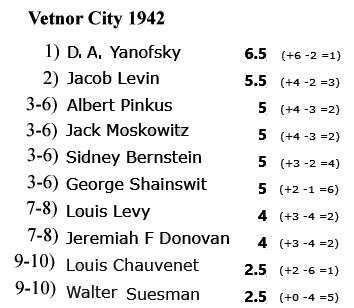
     In the following game he defeated Walter Suesman (1918-1984) who once played in the US Championship in 1938; he finished last (17 players) with a +1 -13 =2. He defeated Isaac Kashdan (!) and drew with George Treysman and George Shainswit. Reshevsky won the tournament a half point ahead of Fine. Suesman, a solid Master, won the 1960 Rhode Island state championship. 

A game that I liked (Fritz 17)

[Event "Ventnor City"] [Site "Ventnor City, NJ USA"] [Date "1942.06.22"] [Round "?"] [White "Walter B. Suesman"] [Black "L. Russel Chauvenet"] [Result "0-1"] [ECO "D10"] [Annotator "Stockfish 16"] [PlyCount "81"] [EventDate "1942.??.??"] {D12: Slav Defense} 1. d4 d5 2. c4 c6 3. e3 Nf6 4. Nc3 Bf5 5. Nf3 e6 6. Qb3 Qc7 7. Bd2 b6 {An inferior continuation. Correct is 7...Nbd7} 8. Rc1 {The threat is 9.cxd5 exd5 10.Nxd5 sso now the Q has to move to an ineffective square.} Qb7 9. Qa4 {Rather pointless. Simply 9.Nh4 gaining the two Bs was satisfactory.} Bd6 10. Be2 {Here or next move he should still try Nh4} O-O 11. O-O a6 12. Ne5 dxc4 {This should worj out to be in white's favor.} (12... b5 13. Qb3 Bxe5 14. dxe5 Nfd7 15. cxd5 cxd5 {keeps things even.}) 13. Nxc4 $16 Bc7 14. Qb3 Nbd7 { White now has the more active position.} 15. f4 (15. Na5 {Interestiong, but tricky!} Bxh2+ 16. Kxh2 Qc7+ 17. Kg1 bxa5 {White should be OK because of all black's weak Ps.}) 15... b5 16. Ne5 Nxe5 {Taking with B was a little more precise because his Ns would do better in the closed position.} 17. fxe5 { By capturing with the f-Pawn white hopes to use the open f-file to cocnduct a K-side attack.} Ne4 18. Be1 {Too passive.} (18. Nxe4 Bxe4 19. Bd3 Bxd3 20. Qxd3 {and there doesn't seem to be any way for white to take advantage of black's backward c-Pawn.} a5 21. Qe4 Ra6 22. Rc5 Rc8 23. Rfc1 Bd8) 18... Bb6 19. Bf3 { After this the position is only equal, so white should have played 19.Nxe4 and he would have had slightly the better of it.} (19. Nxe4 Bxe4 20. Bb4 Rfd8 21. Bd3 c5 22. Bxc5 Bxc5 23. Bxe4 Qxe4 24. Rf4 Qb7 {and either way white takes on c5 he has a very slight advantage.}) 19... Ng5 20. Be2 c5 {[%mdl 32] Black commences his counterplay.} 21. Bh4 {He simply cannot afford to ignore blak's Q-side activity.} (21. dxc5 {and white has nothing to worry about.} Bxc5 22. Nxb5 Qb6 (22... axb5 23. Rxc5 {and white has the advantage.}) 23. Nd4 Bxd4 24. exd4 Qxd4+ 25. Bf2 Qxe5 {with an equal position.}) 21... Ne4 (21... cxd4 { This takes advantage of white's slip.} 22. exd4 Bxd4+ 23. Kh1 Be4 24. Nxe4 Qxe4 25. Bxg5 Qxe2 26. Be7 (26. Rfe1 Qxb2 27. Qxb2 Bxb2 {with a won ending.}) 26... Rfc8 {Black has a active and theefore promising position.}) 22. Nxe4 Qxe4 23. Rf4 {After this white quickly finds himself in hot water.} (23. dxc5 { Neutralizes black's Q-side play and after} Bxc5 24. Rxc5 Qxh4 {neither side can demonstrate an advantage.} 25. Qc3) 23... c4 {Of course the Q cannot retreat.} (23... Qb7 24. Bf3 Qa7 25. Bxa8) 24. Qc3 (24. Rxe4 cxb3 25. Rf4 bxa2 26. Ra1 Bb1 {is not at all good for white.}) 24... Ba5 {[%mdl 512] A well played followup to his last move as his Q still cannot retreat.} 25. Rxe4 Bxc3 26. Rxc3 Bxe4 27. Bf3 {Trading off his good B only makes things worse, but in the long run black would still be winning after, say, 27.Be7} Bxf3 28. gxf3 { [%mdl 4096]} Ra7 {White's mass of center Ps will prove no match for the exchange.} 29. Kf2 Rc8 30. e4 b4 31. Rc2 Rac7 32. d5 Rd7 33. d6 f6 {Excellent! Black undermines white’s P’s and makes inroads for his R’s.} 34. Bg3 (34. exf6 gxf6 35. Bxf6 Rxd6 {and black is in full control.}) 34... Rc5 35. f4 Kf7 36. Ke3 c3 37. bxc3 $2 (37. Kd4 {is also insufficient, but it would hold out longer.} Rc8 38. bxc3 Rxc3 39. Rxc3 bxc3 40. Kxc3 fxe5 41. fxe5 Rb7 {wins the endin. For example...} 42. Bf4 Rb1 43. Bg5 Ke8 44. h4 Ra1 45. Kb3 Kd7 46. Be7 Re1 47. Kb4 Rxe4+ 48. Ka5 Kc6 49. a3 Re3 50. d7 Kxd7 51. Bf8 Kc6 52. Kxa6 g6 53. Ka5 Rxe5+ 54. Kb4 Re4+ 55. Kb3 Rxh4) 37... Rxc3+ 38. Rxc3 bxc3 39. Kd3 Rb7 40. Kxc3 {This position is very similar to the one reached after move 40 in the the note to move 37.} Ke8 41. Kc4 {White resigned. His resignation is possibly a little premature, but in the long run his position is lost.} (41. Kc4 fxe5 42. f5 {As has been seen, fxe5 leads nowhere.} exf5 43. exf5 Kd7 44. Bxe5 Rb5 45. Kd4 g6 46. fxg6 hxg6 47. Bg3 Ra5 {Black wins. One example...} 48. Kc4 Rxa2 49. Kb3 Rg2 50. Be5 Re2 51. Bf4 Rf2 52. Be5 Rf5 53. Bd4 {White cannot allow the sacrifice of th exchange because the K+P ending is lost.} (53. Bg3 Rf3+ 54. Ka4 Rxg3 55. hxg3 Kxd6) 53... Rh5 54. Bg1 Kxd6 55. Kb4 Rh4+ 56. Kb3 ( 56. Ka5 Kc6 57. Ba7 (57. Kxa6 Ra4#) 57... Rxh2) 56... Kc6 57. Ka3 g5 58. Kb3 g4 59. Kc3 Kd5 60. Kb3 Ke4 61. Kb4 Rh5 62. Kb3 Kf3 63. Ba7 Rxh2 {and wins}) 0-1

Wednesday, October 25, 2023

Dentist to the (Chess) Stars

     Here is an interesting article by Howard Langer about his grandfather Dr. Samuel Greenberg, a New York dentist, that appeared in Tablet Magazine, a conservative online magazine focused on Jewish news and culture. Read article...
     There seems to be very little information available about Dr. Greenberg, but I did find the following game played in 1962 in the Manhattan Chess Club Championship Preliminaries that he lost against William Goichberg. It features a pleasing mating attack by Goichberg. 
     Dr. Greenberg’s name appeared in the USCF’s 1964 rating list...it was Class A (Elo 1905). National Master Bill Goichberg (born November 11, 1942) is a tournament organizer and director. He founded the Continental Chess Association which runs the annual World Open and other large tournaments. He is also a former president of the United States Chess Federation. A game that I liked (Fritz 17)
[Event "Manhattan CC Prelims, New York"] [Site "?"] [Date "1962.??.??"] [Round "?"] [White "William Goichberg"] [Black "Dr. Samuel Greenberg"] [Result "1-0"] [ECO "D46"] [Annotator "Stockfish 16"] [PlyCount "57"] [EventDate "2023.10.24"] [SourceVersionDate "2023.10.24"] {D46: Semi-Slav} 1. d4 d5 2. c4 e6 3. Nc3 Nf6 4. Nf3 c6 {In the Semi-Slav black's Ps sre a mixture of the Orthodox Q-Gambit (...e6) and the Slav (...c6). Black is threatening to capture the c-Pawn and hold it with ...b7–b5. White can avoid this in a number of ways.} 5. e3 Nbd7 6. Bd3 Bd6 7. O-O O-O 8. e4 { Aggressive and somewhat risky. Solid is 8.Qc2} dxe4 9. Nxe4 Nxe4 10. Bxe4 Nf6 11. Bc2 g6 {This weakens the K's position. He should play 11...h6 or even 11... c5} 12. Bg5 (12. b3 {is also good.} Qc7 13. Bb2 Rd8 14. Qe2 Nh5 15. Rad1 { and white went on to win in a handful of moves in Duong,T (2415)-Hj,S (2339) Bandar Seri Begawan BRU 2010}) 12... Be7 13. Qe2 Qc7 14. Rad1 Bd7 {This turns out to be too passive. For what it was worth he should have tried 14...b5} ( 14... b5 15. c5 Nd5 16. Bh6 Rd8 17. h4 {with a promising attack.}) 15. a3 Nh5 { This leads to a lost position...immediately! He should still have tried ...b5} 16. Bh6 {White must have blitzed this one out otherwise he would have simply played 16.Bxe7} Ng7 17. Rfe1 Bf6 18. Ne5 Rfe8 19. Qf3 Bxe5 20. dxe5 Nf5 21. Bg5 c5 22. g4 {This turns out to be a key move!} Ng7 (22... Nd4 {puts up a bit of a fight. For example...} 23. Qf6 Qd8 24. Qxd8 Rexd8 25. Bxd8 Nxc2 26. Rxd7 Nxe1 27. Bf6 {and white should win the ending.}) 23. Bf6 {Mate is on the horizon.} h6 24. Qh3 Kh7 25. Re3 {Moving in for the kill.} Rh8 {This allows a nifty finish, but he was lost anyway.} 26. Qxh6+ {[%mdl 512]} Kxh6 27. Rh3+ Nh5 28. Rxh5+ $1 {[%mdl 512]} gxh5 29. g5# {His 22nd move paid off!} 1-0

Tuesday, October 24, 2023

Kashdan Conjures Up an Attack

     Back in 1930m between April 19th and May 4th a match in which the first player to win five games, draw not counting, was played in the Manhattan Chess Club. 
     One contestant was 26-year-old Lajos Steiner who had come to the United States to participate in the 1929 Bradley Beach (located in New Jersey) tournament. There Steiner had finished second to world champion Alexander Alekhine. 
     His opponent was 24-year old Isaac Kashdan, a the 1929 Manhattan Chess Club champion and a rising star. He had been the first board of the American team at the 1928 Chess Olympiad where he scored an impressive +12 -1 =2.
     Lajos Steiner (1903-1975) was born in Hungary. One of four children, his elder brother Endre Steiner was also a master. 
     Lajos was educated at the Technical High School in Budapest and graduated in 1926 with a diploma in mechanical engineering from the Technikum Mittweida in Germany. He emigrated to Australia in 1939, and won the Australian Championship in 1945, 1946/47, 1952/53, and 1958/59. He also won nine of his ten attempts at the New South Wales title (1940–41, 1943, 1944, 1945–46, 1953, 1955, 1958).
     Isaac Kashdan (1905-1985) was twice U.S. Open champion (1938 and 1947), but even though he was once considered world championship material he never won the US Championship. On the November 1932, Chess metrics estimated his rating to have been 2738 placing him at number 2 on the list behind Alekhine (estimated rating 2826). 
     He was called der Kleine Capablanca (German for The little Capablanca) in Europe because of his ability to extract victories from seemingly even positions. Watch him conjure up a winning attack from almost nothing in the following game and you’ll see what they meant. Alekhine named him one of the most likely players to succeed him as World Champion. 
     Kashdan’s peak year coincided with the Great Depression and so for financial reasons he was unable to make chess a career. Then later he moved to California because the climate was better for his son’s health. 
     Besides the Steiner-Kashdan match, in 1930, an international tournament was held in San Remo; it was won by Alexander Alekhine. 
     On May 2, 1930, former German champion Isidor Gunsberg (1854-1930) died in London. On August 17, 1930, former Hungarian champion Leo Forgacs died in Hungary at the age of 48. 
     The 3rd Tournament of Nations (aka the Chess Olympiad) was held in Hamburg, Germany. It was won by Poland (Rubinstein, Tartakower, Przepiorka, Frydman). Jungary was second and Dermany third. The US team (Isaac Kashdan, Frank Marshall, Harold Phillips, Herman Steiner and James Anderson) finished 6th (out of 18 teams). 
     The 2nd Women’s World Championship took place during the Olympiad and Vera Menchik successfully defended her title. 
     The Western Chess Association (forerunner of the US Open) was held in Chicago. Norman Whitaker and Samuel Factor tied for 1st. 
     On December 29, 1930, Alekhine almost killed himself when he fell asleep with a lit cigarette in his mouth in a hotel bed in Esseg, Yugoslavia. The cigarette fell out of his mouth onto the bed which caught fire. Alekhine awoke and tried to get out of the room, but passed out on the floor. A hotel clerk responding to the fire managed to get Alekhine out of the room and extinguish the fire. 
 

     Kashdan considered this game, the third game in his match with Steiner, to be one of his best.

  A game that I liked (Fritz 17)

[Event "Match, New York"] [Site "New York, NY USA"] [Date "1930.04.22"] [Round "3"] [White "Isaac Kashdan"] [Black "Lajos Steiner"] [Result "1-0"] [ECO "D52"] [Annotator "Stockfish 16"] [PlyCount "67"] [EventDate "1930.04.19"] {D52: Queen's Gambit Declined: Cambridge Springs Variation} 1. d4 d5 2. c4 c6 3. Nf3 Nf6 4. Nc3 e6 5. Bg5 Nbd7 6. e3 Qa5 {This is te Cambridge Springs Defense and even today is the most popular reply in the QGD.} 7. Qb3 {The usual reply is 7.Nbd2 is the usual reply with 7.cxd4 a close second. The text avoids the more complicated attacks, but it allows black to obtain easy development.} Ne4 8. cxd5 (8. Bh4 Bb4 9. Rc1 Nb6 10. Bd3 dxc4 11. Bxc4 Nxc4 12. Qxc4 Nd6 {equals. Werle,J (2481)-Gurevich,M (2641) Zwolle 2002}) 8... exd5 9. Bd3 Bb4 {Kashdan was of the opinion that this B belongs on e7.} (9... Nxg5 10. Nxg5 Be7 11. Nf3 O-O 12. O-O {with complete equality. Djukanovic,S (2294) -Blagojevic,D (2532) Tivat MNE 2011} Re8 {½-½ (38)}) 10. Rc1 Nxg5 $11 11. Nxg5 h6 12. Nf3 O-O 13. O-O Re8 14. a3 Bxc3 {The main option was 14...Bd6 and while there is nothing really wrong with the move played Kashdan thought it gives white the advantage because of his better development and also because of the mobility of his Q-side Ps, which threaten to advance and create weaknesses in black's position. Hence Kashdan felt it was better to retreat.} 15. Qxc3 Qxc3 16. Rxc3 Nf6 17. b4 Be6 18. Rfc1 Ne4 19. Bxe4 {Several years after this game Kashdan said that if he were "playing this position today (i.e. in 1936) he would prefer 19.R(3)-b2 because his B would be useful to enforce b4-b5 and black's N can always be gotten rid of anyway. Engines prefer 19.Bx35, but only by a hair's breadth.} dxe4 20. Nd2 Bd5 21. Rc5 {Perhaps initiating a Minority Attack with 21.a4 followed by b4-b5 was more accurate, but Kashdan played the text in order to induce 21...b6 which he judged would be weak for black.} b6 {A sounder idea was 21...f5 followed by ...f4} 22. R5c3 a5 23. Nc4 { Kashdan judged that now black's Ps are seriously weakened and subject to attack, whether his N is exchanged or not. According to Stockfish the position id dead equal.} axb4 24. axb4 Ra6 {Played with the (correct) belief that he can set up a sufficient defense.} (24... Bxc4 {is inferior. It's main practical advantage is that the resulting double R ending would by difficult to play for both sides.} 25. Rxc4 Ra4 26. h4 Kf8 27. Rxc6 Rxb4 28. Ra1 f5 29. Ra6 Rb1+ (29... Rb8 30. Rc7 f4 31. Raa7 {White is winning.}) 30. Kh2 Rb2 31. Kg3 b5 32. Rc5 {White is better.}) 25. Ne5 Re6 {Excellent defense by Steiner. Defending the P, which cannot yet be taken because of the mating threat, and intending ...b5 after which everything would be secure. If Kashdan wants to win he cannot untake it quickly.} 26. b5 {Very interesting and innovative. The P sacrifice had to be accurately calculated because if Kashdan's attack fails the P will become a Q!} ({But not} 26. Nxc6 $2 Bxc6 27. f4 Bd7 $19) 26... cxb5 27. Rc8+ {Kashdan is attacking with opnly two Rs and a N...will it succeed?} Kh7 28. Rd8 {[%mdl 1024] An excellent move! It gains an important tempo and it's an essential patt of his idea.} (28. Nxf7 {does not accomplish anything as after} b4 29. h4 (29. R8c7 b3 30. Rb1 b2 31. Rc2 Rc6 32. Rbxb2 Bxf7 { and black wins}) 29... b3 30. Kh2 Ra8 31. Rxa8 Bxa8 32. Ne5 Bd5 33. Rb1 { with a likely draw.}) 28... Bc4 {Seemingly the most natural square as it blocks the open file, but the move allows white q slim advantage...something Kashdan was famous for exploiting. In fact, Kashdan claimed the move loses quickly!} (28... f6 {This is actually the best move as it does not allow white to really accomplisj anything. For example...} 29. Rxd5 fxe5 30. dxe5 Rc6 31. Rb1 Rc5 32. Rd2 Rxe5 {and neither side will be able to make any headway.} 33. h3) 29. Nd7 {[%mdl 2048] Threatening to win the exchange, which strangely enough cannmbe avoided despite the mobilty of black's R.} Kg6 (29... Rc6 30. Nf8+ Kg8 31. Nd7+ Kh7 32. Nb8) (29... Rd6 {This is best. The ensuing ending is extremely complicated!} 30. Nf8+ Kg8 31. Nd7+ (31. Rxd6 Kxf8 {and black has compensation for the exchange.}) 31... Kh7 32. f3 exf3 33. Nf8+ Kg8 34. Rxd6 Kxf8 35. e4 fxg2 36. d5 Ke7 37. Rc6 f5 38. Rc7+ Kd8 39. Rxg7 fxe4 40. Kxg2 Ra2+ 41. Kg3 e3 42. d6 e2 43. Kf2 e1=Q+ 44. Kxe1 Rxh2 45. Rh7 {Theoretically at least, this position is drawn.}) 30. d5 {[%mdl 32] Gaining time, as the R still cannot escape. Very instructive.} Re7 (30... Bxd5 31. Nf8+ Kf6 32. Rxd5 { wins easily.}) 31. d6 Rxd7 32. Rxd7 {Kashdan has made something out of nothing. } Bd3 {This loses at once.} (32... Ra3 {keeps fighting...} 33. Re7 Rd3 34. Rxe4 Rxd6 35. h4 Kf6 36. Ra1 Rd2 37. Ra7 Be6 {and the gane could go on forever.}) 33. Rb7 Kf6 {White has more than one way to skin the cat!} 34. f3 {Black resigned} (34. f3 Bc4 35. Rd1 Ra8 36. Rxb6 exf3 37. gxf3 Rd8 {and the enbding is hopelss.}) (34. d7 {also wins.} Ke7 35. f3 Bc4 36. Rd1 Bd3 37. fxe4 Ra3 38. e5 b4 39. Rxb6 Kxd7 40. Rd6+ Ke7 41. R6xd3 {etc.}) 1-0

Monday, October 23, 2023

James Allan Anderson, a Long Forgotten Player

  
     If you never heard of James Allan Anderson (June 28, 1906 – December 23, 1991, 85 years old), a three-time St. Louis Chess Champion who defeated Alexander Alekhine in a simultaneous exhibition in 1929, you are not the only one.
     In the 1929 Western Chess Association Championship (US Open) Finals held in St. Louis, Missouri, Anderson tied for second with stalwarts Herman Steiner and Norman Whitaker behind Harold Hahlbohm.
     In 1930, at reserve board in the 3rd Chess Olympiad in Hamburg, won by Poland (Rubinstein, Tartakower, Przepiorka, Frydman), Anderson scored +3 -7 =7. The US team consisted of Isaac Kashdan, Frank Marshall, Harold Phillips, Herman Steiner and Anderson; the team finished 6th (out of 18 teams). 
     The Brooklyn Daily Eagle (July 31, 1930 edition) mentioned that in view of the fact that Anderson lost all of his last five games it was clear that “the severe strain of the long grind was too much for him.” Is that a hint at the reason he disappeared two years later
 
     Anderson finished fourth (score 5.5-3.5) at the 1931 Western Chess Association Championship in Tulsa, Oklahoma. The event was won by Samuel Reshevsky followed by Samuel Factor and Norman Whitaker. Anderson lost only to Reshevsky and Factor. 
     Anderson won the St. Louis championship in 1932 with an5.5-0.5 score and then he seems to have disappeared at the age of 26. 
     His opponent in the following game was Ilmari Rahm (1888-1939) a Finnish doctor, chess player and journalist. Somerime in the 1890s Rahm’s parents moved to Helsinki, where he spent most of his life. After receiving his medical degree he served in the Finnish army as a navy medical captain from 1918 until 1921. After Rahmi's health began to falter during 1929, he gradually had to give up all things associated with chess. As a result of his poor health he only scored 3.5-10.5 at Hamburg. 

  A game that I liked (Fritz 17)

[Event "Hamburg Olympiad"] [Site "Hamburg GER"] [Date "1930.07.15"] [Round "3"] [White "Ilmari Rahm"] [Black "James Allan Anderson"] [Result "0-1"] [ECO "D37"] [Annotator "Stockfish 15"] [PlyCount "74"] [EventDate "1930.07.13"] {D37: Queen's Gambit Declined} 1. d4 Nf6 2. c4 e6 3. Nc3 d5 4. Nf3 Nbd7 5. e3 Be7 6. Qc2 O-O 7. Bd3 dxc4 8. Bxc4 c5 9. O-O a6 {This is considered best even today.} (9... cxd4 10. exd4 Nb6 11. Bd3 Bd7 12. Bg5 h6 13. Be3 Nbd5 {was quickly drawn in Kurajica,B (2520)-Cvetkovic,S (2470) Cetinje YUG 1991}) 10. a4 b6 11. Rd1 Bb7 12. Ng5 {This move serves no purpose and only loses time.} (12. dxc5 {also favors black after} Bxc5 13. b3 Qc7 {Better was 13...b5 with a slight advantage.} 14. Bb2 Ne5 15. Nxe5 Qxe5 16. Nd5 {equals. Dzhumaev,M (2428) -Malygin,V (1995) Almaty KAZ 2019}) (12. d5 {results in equal chances after} exd5 13. Bxd5 Nxd5 14. Nxd5 Bxd5 15. Rxd5) 12... h6 {Evidently white thought he has induced black into weakening his K's position with this move, but that is not the case because white is in no positiob to take advantage of it after the better 13.Nf3} 13. Nh3 {The N is badly misplaced here.} Qc7 14. Be2 { Another time wasting move, but his position is already showing that he has difficulties.} (14. d5 Ne5 15. b3 Nxc4 16. bxc4 exd5 17. cxd5 Bd6 {leaves white in difficulties.}) (14. Qe2 Bd6 15. f4 cxd4 16. exd4 Rfe8 17. Be3 Ng4 { with the initiative.}) 14... Bd6 15. f4 cxd4 16. Rxd4 {Recapturing with the P was not much bvetter...black would also have had a very active position.} Bc5 17. Rc4 {Thgis is a gross oversight. Retreating to d1 was better although black would still have had the upper hand.} Bd5 18. Nxd5 exd5 {[%mdl 32]} 19. b4 (19. Rc3 {is met by} Ne4 20. Nf2 (20. Rd3 Bxe3+ {winning the Q}) 20... Nxc3 {winning the exchange.}) 19... dxc4 20. bxc5 Qxc5 21. g4 {Black has a R+P against a B so it's obvious that he is winning. Therefore white throws everything into a desperate attack.} Nd5 22. Qf5 (22. Qxc4 Rfe8 23. f5 Rac8 24. Qxc5 Nxc5 {is hopeless for white.}) (22. g5 Nxe3 23. Bxe3 Qxe3+ 24. Kg2 Nc5 25. gxh6 Rad8 26. Ng5 (26. hxg7 Rd2 27. gxf8=Q+ Kxf8 28. Qxc4 Rxe2+ {wins immediately.}) 26... Nd3 {and white's attempted attack is over.}) 22... Nc3 23. Qxc5 Nxc5 24. Bxc4 {White has managed to reach an ending the exchange down, but his position is devoid of any counterplay and so he is lost as long as black plays carefully.} b5 25. Ba3 (25. axb5 axb5 26. Rxa8 Rxa8 27. Bxb5 Ra1 { wins the B}) 25... Rfc8 26. Bb4 (26. axb5 axb5 27. Bb2 (27. Bxc5 Rxa1+ 28. Bf1 Rxc5) 27... bxc4 {Black is a full R up.}) 26... N5xa4 (26... bxc4 27. Bxc3 Re8 {would also secure the win.}) 27. Bd3 a5 28. Ba3 b4 29. Bf5 (29. Bc1 Nc5 30. Bf5 Nb3 {wraps it up.}) 29... bxa3 30. Bxc8 Rxc8 31. Rxa3 Rc5 32. Nf2 Nb2 { Prevents Nd3.} 33. Kg2 a4 {[%mdl 32]} 34. h4 Nb5 35. Ra2 a3 36. Ne4 Rc4 37. Kf3 Rxe4 $1 {This finally convinced white to resign. to resign.} (37... Rxe4 38. Kxe4 Nc3+) 0-1

Friday, October 20, 2023

RIP Tom Wozney

Wozney circa 1966
      It was with sadness that I learned that veteran master Thomas Wozney of Parma, Ohio, a Cleveland suburb, passed away at the age of 82 on March 1st this year. He was retired from East Ohio Gas Company after many years of service. 
     Chester Thomas Wozney, born April 20, 1940, was a US Army Specialist 4th Class when he won the US Armed Forces Championship in 1966. At that time he was with the 51st Signal Battalion, Company A, stationed in South Korea. For those not familiar with Army ranks, he was the equivalent rank of a Corporal except specialists are not considered a Non-commissioned Officer; the specialist's job is focused on technical expertise and they normally have less personnel leadership responsibilities than Corporals. 
     Besides having many Midwest tournament victories to his credit, in 1964 Wozney tied for first in the Ohio Championship (with Richard Kause, George Kellner, James Harkins and David Presser). 
     He won the title won outright in 1967 and in 1969 he eked out a tiebreak victory over Robert H. Burns, Jr and Richard Garber. 

     Then in 1971 he again tied for first with Robert Burns and Ross Sprague, Burns getting the title on tiebreaks. 
     In 1972 he won the State title on tiebreaks over Ross Sprague, Richard Kause and Jerry Fink. In 1974 he again tied for first with Robert Burns, Jerry Fink, James Voelker and Arthur Keske with Burns again gaining the title on tiebreaks. 
     I never met Wozney persoanlly, but saw him many times at tournaments in the 60s and 70s and he struck me as being a pleasant, quiet and reserved individual. This game features a snazzy win by Wozney from the 1973 US Open. 

  A game that I liked (Fritz 17)

[Event "US Open, Chicago"] [Site "?"] [Date "1973.??.??"] [Round "?"] [White "Marvin Rogan"] [Black "Thomas Wozney"] [Result "0-1"] [ECO "B80"] [Annotator "Stockfish 16"] [PlyCount "54"] [EventDate "1973.??.??"] [SourceVersionDate "2023.10.20"] {B80: Sicilian Scheveningen} 1. e4 c5 2. Nf3 e6 3. d4 cxd4 4. Nxd4 Nc6 5. Nc3 a6 6. Be3 Nf6 7. g3 {This line is not difficult to meet and is not very challenging to black. 7. Bd3 is the main line.} Be7 8. Bg2 O-O 9. O-O Qc7 10. Qe2 {White might actually served better by 10.f4} (10. f4 d6 11. Kh1 Bd7 12. Nb3 b5 13. a3 b4 14. axb4 Nxb4 15. g4 {with equal chances. Guseinov,G (2625) -So,W (2640) Khanty-Mansiysk RUS 2009}) 10... d6 {[%mdl 32]} 11. Rad1 Bd7 { [%mdl 32]} 12. f4 Rac8 13. g4 {This allows a tactical shot that wins a Pawn.} ( 13. f5 b5 14. fxe6 fxe6 15. Bh3 Nxd4 16. Rxd4 {Black is slightly better. Honfi, K (2390)-Ribli,Z (2590) Baden-Baden 1981}) (13. Kh1 b5 14. Nxc6 Bxc6 15. a3 Qb7 16. Bd4 {equals. Markosian,D (2406)-Bairachny, R (2442) Tula 2000}) 13... Nxd4 14. Bxd4 {This move looks logical, but he actually does better by capturing with the R. In any case, black wins a Pawn.} (14. Rxd4 e5 15. Rd2 Bxg4 16. Qe1 Be6 17. f5 Bc4 18. Rf3 Rfd8 19. Rg3 {Theoretically black should be able to defend himself, but in Kamishov,M-Baturinsky,V Moscow 1945, he couldn't manage it anbd lost.}) 14... e5 {Picking off the g-Pawn.} 15. fxe5 dxe5 (15... Bxg4 { would be less effective.} 16. exd6 Bxd6 17. Bf3 Bxf3 18. Rxf3 Be5 19. Bxe5 Qxe5 20. Rdf1) 16. Be3 Bxg4 17. Bf3 Be6 {Threatening a pin with ...Bc4} 18. Qg2 Bc5 19. Bxc5 Qxc5+ 20. Kh1 Rfd8 21. Rg1 {This attack on g7 is harmless...white simply has no way to follow it up.} g6 22. Rdf1 Qe3 {Plunging right into the guts of white’s position and generating tactical threats. Hoping for ...Rd2.} 23. Be2 {Attacking the N on f6, but missing a pretty continuation.} (23. Qg3 { was no better though.} Rd2 24. Qxe5 Nd7 25. Qg3 Rxc2 {Black's advantaghe will prove decisive.}) 23... Rxc3 {Black is clearly winning.} 24. bxc3 Nxe4 25. Rf3 Qc5 (25... Bd5 {is cute...if} 26. Rxe3 Nf2#) 26. Rd3 {This loses immediately to a nifty little combination, but there wasn’t much else.} Rxd3 27. cxd3 Nf2+ {White resigned. Near flawless play by Wozney.} (27... Nf2+ 28. Qxf2 Qxf2 29. Bf1 Bd5+ 30. Bg2 Bxg2+ 31. Rxg2 Qf1+ 32. Rg1 Qxd3) 0-1

Thursday, October 19, 2023

Dog Fight!

     1895...that was the year legendary baseball player Babe Ruth and a silent film star named Buster Keaton were born. Jell-O was invented. Irish poet, novelist and playwright Oscar Wilde was arrested for "sodomy and gross indecency" and sentenced to prison. 
     Mintonette was invented in Holyoke, Massachusetts. We known it by its later name, volleyball. The first automobile race took place in France. The winner traveled 732 miles in 48 hours and 47 minutes. 
     A Sears catalog from 1895 shows you could get a shirt for as little as 50 cents. A carpenter made around 32 cents an hour and an unskilled laborer made about half of that. 
     That was the year World Champion Lasker moved back to England, first to London and later to Manchester. In the US, Jackson W. Showalter won the 5th US championship by defeating Samuel (or Salomon) Lipschultz in a match by a score of 7-4. 
     In March the leading English player of the 1870s, William Potter died. In May Martin From died in Copenhagen. He was an analyst and is remembered for the Fromn Gambit (1.f4 e5). Problem composer and the 1886 Scottish champion Georges Barbier died in France. 
    In 1895, in December, Harry N. Pillsbury contracted syphilis in Russia and in June of 1906, he died from it. Back in those days mercury was the treatment of choice for syphilis. In the early stages of the disease topical applications may have occasionally aborted the infection, but it was undoubtedly ineffective in curing secondary syphilis. Besides that, the problem was mercury’s toxicity to the central and peripheral nervous systems. It could produce harmful effects on the nervous, digestive and immune systems, lungs and kidneys and it could be be fatal. 
     Before his trip to Russia, the Hastings international tournament was won by Pillsbury. At that time the tournament was not played over Christmas and New Year; it was played from August 5th to September 2nd. 
 

     Today’s’ game was played in that tournament. I remember when I first saw this game (probably back in the early 1960’s) how much I enjoyed it. Recently I played through it again and nothing has changed. The game won Second Brilliancy Prize despite Tarrasch’s rather inept conduct of most of the game. However, his brilliant combination at the end after Walbrodt mishandled the attack, allowed Tarrasch to redeem himself. 
     Tarrasch's opponent, Carl Walbrodt (November 28, 1871 - October 3, 1902), was a leading German master of the period who participated in many tournaments and matches and wrote several chess columns. In real life he and his brother owned a pantograph factory. He was diagnosed with tuberculosis in the early 1890's and ultimately died from it. 
     Enjoy the complications! 

A game that I liked (Fritz 17)

[Event "Hastings"] [Site "Hastings ENG"] [Date "1895.08.09"] [Round "?"] [White "Siegbert Tarrasch"] [Black "Karl Walbrodt"] [Result "1-0"] [ECO "C77"] [Annotator "Stockfish 16"] [PlyCount "75"] [EventDate "1895.08.05"] {C77: Ruy Lopez} 1. e4 e5 2. Nf3 Nc6 3. Bb5 a6 4. Ba4 Nf6 5. Nc3 d6 6. d4 { Black has a wide choice here: 6...Bd7, 6...Nd7, 6...Bd7 and 6...exd4} Bd7 { This transposes into the Steinitz Defense Deferred. It's an interesting and still relatively unexplored system. It appears somewhat passive, but it is extremely solid and flexible.} 7. Bxc6 $16 Bxc6 8. Qe2 exd4 9. Nxd4 Bd7 10. O-O Be7 11. b3 O-O 12. Bb2 b5 {[%mdl 32] One early annotator dubbed this a sly move threatening...c5, ...b4 and ...Bb5 winning the exchange. Not true.} (12... Re8 13. Rad1 Bf8 14. Qd3 Qe7 15. Rfe1 Rad8 {was played in Marco,G-Taubenhaus,J Ostende 1905. The position is equal.}) 13. a4 (13. Rad1 c5 {Not the best move. Both 13...Re8 and 13...h6 are good.} 14. Nf5 b4 {Taking the N is a little better.} 15. Na4 Bb5 {This loses. 15...Bxf5 leaves white slightly better.} 16. Qf3 Ne8 (16... Bxf1 17. Kxf1 c4 18. e5 {is decisive. Hust va samplke line...} Ne8 19. Nxe7+ Qxe7 20. Qxa8) 17. Qg3 Bg5 18. Rfe1 g6 19. h4 Bf6 20. e5 Bg7 21. exd6 Bxb2 22. Ne7+ Kh8 23. Nxb2 Qd7 24. c4 bxc3 25. Qxc3+ f6 26. a4 Bc6 27. Nxc6 Qxc6 28. d7 Ng7 29. b4 {White is winning.}) 13... b4 {This not only drives back the N, but it also gains space.} 14. Nd1 (14. Nd5 c5 15. Nf3 (15. Nxe7+ Qxe7 16. Nf3 Qxe4 {black has won a P.}) 15... Nxd5 16. exd5 Bf6 17. Bxf6 Qxf6 18. Rae1 Rfe8 {Black stands slightly better.}) 14... c5 15. Nf3 (15. Nf5 { was better.} Bxf5 16. exf5 d5 17. Ne3 d4 18. Nc4 {with about equal chances.}) 15... Bc6 {[%mdl 2048] In spite of having a backward d-Pawn, black has a nice position.} 16. Nd2 d5 17. e5 {With this move Tarrasch is striving for a closed position where Walbrodt’s two B’s don’t have a lot of scope, but the idea fails.} (17. exd5 {This has been recommended.} Nxd5 18. Nc4 Re8 19. Nde3 Bf6 20. Bxf6 Nf4 21. Bxd8 Nxe2+ 22. Kh1 Raxd8 {Black has the more active position.}) 17... Ne8 18. Ne3 Qd7 19. Rad1 d4 {This move gives white’s N a good outpost on c4, but is gives black's light-squared B a great diagonal plus it also shuts white’s B out of the game. The real surprise is that it is the buried B on c7 that is going to win the game for Tarrasch!!} 20. Nec4 Qe6 21. f4 {This looks right...it's part pf Tarrasch's pan to keep the game closed.... but it's actually a poor move.} (21. Rde1 {keeps the game about equal.} Bd5 22. Qd3 Qc6 23. f3 {and it's hard to see how either side can make any headway.}) 21... f5 {Excellent! The position is closed, but Walbrodt's position has a lot of freedom and he uses it to build up a promising attack.} 22. Na5 Bd5 23. Qd3 Kh8 {This is the kind of move that engines do not readily find. Black’s plan is to open up the g-file for an assault on White’s K.} 24. Qg3 {In view of black's plan the Q is not well placed here and so 23.Nac4 was better.} Ra7 { Another great move. Because he in control of the game Walbrodt is preparing to bring the R over to the K-side before undertaking an immediate attack.} (24... g5 {This immediate assault is also extremely good!} 25. Nf3 gxf4 26. Qxf4 Rg8 { with good attacking chances.}) 25. Nac4 Rg8 26. Rde1 g5 27. Re2 Bd8 28. Qd3 Rag7 29. g3 gxf4 {This move was criticized as a mistake by Tarrasch and Reinfeld. Tarrasch recommended ...g4 followed by the advance of the h-Pawn, saying it would have lead to a quick win, but that does not appear to be the case. In fact, 29...gxf4 is the best move in thsi position and it leaves black with a clear advantage.} (29... g4 30. Nd6 Rf8 (30... Nxd6 31. exd6 Qxd6 32. Qxf5 {with equal chances.}) (30... h5 {is bad for black...} 31. Nxf5 Rf7 32. Nd6 {with a significant advantage.}) 31. Qxa6 Re7 32. Rff2 h5 {and black's advantage is minimal.}) 30. Rxf4 {[%mdl 32] White's pressure on the f-Pawn is not quite enough to equalize.} Rg5 {This defends the f_Pawnm but it is a small slip that loses some of his advantage.} (30... Rg4 31. Qxf5 Rxf4 32. Qxf4 (32. Qxe6 Bxe6) 32... Nf6 33. Nd6 Nh5 34. Qf2 Bg5 35. Qf5 Qxf5 36. Nxf5 Rf8 { positionally black has the advantage. White has a nifty tactical shot here...} 37. Nxd4 cxd4 38. Bxd4 Ng7 39. e6 Be7 40. Ne4 {but his chances are only marginally improved.}) 31. Ref2 Ng7 32. Nd6 Qxe5 {This is probably not the most effective move. That said, suggesting anything a lot better is a challenge!} (32... Bc7 {was recommended without futyher comment by Reinfeld.. After} 33. Nf3 Bxf3 34. R4xf3 Bxd6 35. exd6 Qxd6 36. c3 bxc3 37. Bxc3 {Black is a P up, but it's hard to see how he will make further progress.}) (32... Rg6 {is the engine suggestion, but it only keeps the advantage while noit undertaking anything concrete.} 33. Nf3 Rf8 34. Kf1 Be7 35. Qxa6 Bxf3 36. R4xf3 Qxe5 37. Nc4 Qd5 38. Qb5 f4 39. Nb6 Qh5 40. Bc1 Ne6 41. Qe2 Qh3+ 42. Ke1 Ng5 43. Rxf4 Re6 44. Rxf8+ Bxf8 45. Bxg5 Rxe2+ 46. Rxe2 {Black is clearly better... theoretically at least, but the position is very difficult.}) 33. Nxf5 Nh5 { [%mdl 8192] This is a blunder that loses immediately.} (33... Ne6 {keeps a slight advantage.} 34. Re4 Bxe4 35. Qxe4 Qxe4 36. Nxe4 R5g6 37. Nxc5 Nxc5 38. Bxd4+ Rf6 39. Bxc5 Rc6 40. Bd4+ Bf6) 34. Rxd4 {[%mdl 512] An amazing change of fate!} Nxg3 {Perhaps this was the move Walbrodt was relying on, but it is insufficient.} 35. Nxg3 {Rh4 is the strong threat.} Rxg3+ 36. hxg3 Rxg3+ 37. Kf1 Rxd3 38. Rg4 {This is the winner...it leads to mate in 9, so Walbrodt resigned.} (38. Rxd3 {would have been a horrible mistake!} Qxb2 39. Rxd5 Be7 40. Ne4 {and black should be able to draw.}) (38. Rg4 h5 (38... Qxb2 39. Rf8+ { mate next move.}) 39. Bxe5+ Bf6 40. Bxf6+ Kh7 41. Rg7+ Kh6 42. cxd3 c4 43. Nxc4 h4 44. Rh2 Bf7 45. Rxh4+ Bh5 46. Rg5 a5 47. Rhxh5#) 1-0

Tuesday, October 17, 2023

A Rook Lift Goes Wrong

   
     Today’s game features a common maneuver, the Rook Lift. Rook handling is always a difficult task, especially for beginners and average players.. 
     C.J.S. Purdy pointed out that one of the goals in the opening should be to connect R’s. Most players beyond the beginner level know that. They know the rules about open files, but in many cases find difficulty in answering the question, which R? How do you decide which R goes on the open file? How often have moved the wrong one? They also know the importance of R’s on the 7th (or 2nd) rank and Rooks belong behind passed Pawns, etc. 
     Ludek Pachman wrote that R handling requires a great understanding of the strategy suited to a particular position. There’s that word, strategy...something that seems despised by many average players these days. 
     Another part of Rook handling is the R-lift where Rooks are actively placed in front of its own Pawns to attack the opponent’s King. 
     In fact, sometimes the Rook can even be placed in front of its own Pawns even when there is no thought of attacking the King. The reason for this is that Pawn advances are generally necessary to open files and in a closed, positional type of game players often try to keep Pawns on their original squares as long as possible. So, if the Rools are to operate they must do so in front of their own Pawns. This is a good idea to keep in the back of your mind when the normal methods of using them on open files is ineffective or not available. 
     I was looking for some examples of Rooks in front of its own Pawns and came across the following game in which Eperjesi did just that. However, when I saw that he lost, I was going to move on to another game, but this game has redeeming qualities. Just check out Farago’s 35th and 42nd move. 
     The game also illustrates the point that even after you have established a good position, the game will not win itself. After about 25 moves Eperjesi had a really great position but a series of weak moves let the game slip away. We all know from experience how easily that can happen! 
 

      Laszlo Eperjes (born May 16, 1943) is an International Master and International Arbiter. Ivan Farago (Aoril 1, 1946 – December 12, 2022) was born in Budapest. The Hungarian Chess Federation declared him a master in 1964. He was awarded the IM title in 1974 and the GM title in 1976. 

  A game that I liked (Fritz 17)

[Event "Hungarian hamp, Budapest"] [Site ""] [Date "1977.12.11"] [Round "?"] [White "Laszlo Eperjesi"] [Black "Ivan Farago"] [Result "0-1"] [ECO "D55"] [WhiteElo "2400"] [Annotator "Stockfish 16"] [PlyCount "86"] [EventDate "1977.??.??"] {D55: Queen's Gambit Declined} 1. d4 Nf6 2. c4 e6 3. Nf3 Bb4+ 4. Bd2 Be7 5. Nc3 d5 6. Bg5 O-O 7. e3 b6 8. Rc1 Bb7 9. cxd5 exd5 10. Bd3 Nbd7 11. O-O c5 12. Ne5 Nxe5 (12... a6 13. Bb1 Re8 14. Nxd7 Qxd7 15. Na4 {equals. Sulava,N (2479) -Cavalcanti,F (2280) Nice 2003}) (12... h6 13. Bf4 Rc8 14. Bf5 {White has the advantage. Goncalves,D (2282)-Leiva,G (2381) chess.com INT 2023}) 13. dxe5 Ne8 14. Bf4 Nc7 (14... f6 15. Qh5 g6 16. Bxg6 hxg6 17. Qxg6+ Kh8 18. Qh5+ Kg8 19. Bh6 fxe5 {White has no more than a draw. Forgacs,L-Swiderski,R Barmen 1905}) ( 14... g6 15. Bh6 Ng7 16. f4 f5 {White is much better. Vidmar,M-Martinolich,G Vienna 1907}) (14... f5 {This is black's best move.} 15. Qc2 g5 16. Bg3 f4 { This loses. Correct was 16...Ng7 with equal chances.} 17. Bxh7+ Kh8 18. Qg6 Nf6 19. exf6 Rxf6 20. Qh5 {and white went on to win. Schlechter,C-Lasker,E Cambridge Springs 1904}) 15. Qc2 g6 16. Rcd1 {The R has no future on c1 and so White places it on a square from which it is in line with the Black Q.} Qc8 17. Bh6 Re8 18. f4 {The attacking method in this game has been known since the days of Pillsbury. White is going to play a R-lift, placing it in front of his P’s and attacking Black’s K.} c4 19. Be2 Bc5 20. Rf3 Qe6 21. Na4 {Before continuing his attack white wants to drive the B back, but he could have press on with his attack.} Be7 22. Rg3 b5 (22... Bh4 {was slightly better as after} 23. Rh3 Bd8 {white is better, but he will have to come up with a different plan of attack. For example...} 24. Bf3 Rb8 25. Nc3 b5 26. Ne2 Qb6 27. Nd4 { and now strive to play g2-g4.}) 23. f5 {Pressing on with his attack at the cost of a P. However, more preparation with moves like Ng4 and Nc3 would have offered better chances of success.} Qxe5 24. Bf4 Qg7 (24... Qe4 {was better as it shuts down white's attack.} 25. Qxe4 dxe4 {and black has equalized.}) 25. Bxc7 {With this move white's advantage slips away...there is no longer an attack and black now stands better.} (25. Nc3 Bc5 26. Bh5 {is promising. For example...} Kh8 27. Kh1 Re7 28. fxg6 fxg6 29. Bxg6 hxg6 30. Rxg6 Qf7 31. Rf1 Rxe3 32. Ne2 Rf8 33. Ng1 {White is slightly better.}) 25... bxa4 26. Bf3 { A tactical error that allows black to take advantage of the undefended e-Pawn. 26.Bf4 would have been better.} Bc5 27. fxg6 {He still should have tried 27. Bf4. After this white's attack just does not have sufficient force.} Bxe3+ 28. Kh1 hxg6 29. h4 Rac8 30. Qxa4 Qf6 (30... Qxb2 {would also win, but it invites unnecessary complications after} 31. Bg4 {and noiw black's best line is} Re4 32. Bxc8 Bxc8 33. Rf1 Qe2 (33... Bf4 34. Bxf4 Rxf4 35. Rxf4 Qc1+ {only draws}) 34. Rgf3 Bg4 {Black wins as white gains nothing on} 35. Rxf7 Bf5 36. R7xf5 gxf5 37. Qd1 (37. Rxf5 Rxh4+ 38. Bh2 Qe1+ 39. Rf1 Qxf1#) 37... Qxd1 38. Rxd1 c3 { etc.}) 31. h5 Kg7 32. Ba5 Bc6 33. Qa3 d4 34. Be1 $2 (34. Bxc6 Rxc6 35. Rxe3 Rxe3 36. Qxe3 dxe3 37. Bc3 gxh5 {withg a won ending.}) 34... Qh4+ {Black’s continuation is absolutely brilliant!} 35. Rh3 Qxh3+ {[%mdl 512]} 36. gxh3 Bxf3+ 37. Kh2 Bxd1 {Black has more than enough compensation for the Q.} 38. Bg3 Bxh5 39. Qd6 c3 40. bxc3 dxc3 {[%mdl 32]} 41. Be5+ Kg8 42. Qf6 {...a very forlorn hope.} Rxe5 $1 {Another fine move to finish off his opponent.} 43. Qxe5 c2 {White resigned.} 0-1

Monday, October 16, 2023

Vladas Mikenas

     Vladas Mikenas (April 17, 1910 – November 3, 1992) was a Lithuanian player and journalist. He held the IM title as well as an Honorary GM title. Chessmetrics assigns him a high rating of 2669 in 1945 placing him at number 14 in the world.
     His last name is pronounced Meek-an-us. He was born in Tallin, Estonia and quickly became one of the country’s strongest players. When Mikenas was ten years old, his father died and he had to help contribute to the family’s livelihood, but he continued to play chess in his spare time. 
     He played in his first tournament at the age of 15 in the Tallinn Chess Club and actually finished first. By 1929, he was strong enough to be giving simuls and that was the year he lost a game to a 13-year-old Paul Keres who left a favorable impression on Mikenas. 
     In 1930, Mikenas officially became the master and won the championship of Estonia. In December 1930, a tournament was organized in Talinn in which seven local players plus Efim Bogoljubow took part. Mikenans defeated Bogoljubow and finished first. 
     In 1931, Mikenas won the Helsinki Chess Club championship and received an invitation to the Baltic Championships in the Lithuanian city of Memel (today: Klaipeda). While there he visited the home of his father (a Lithuanian) for the first time and despite initially not being able to speak Lithuanian, he stayed in the country and set himself the goal of becoming the Lithuanian Champion. 
     To that end, in 1932, he faced Alexander Macht in a match. Macht would order tea and start sipping it loudly when it was Mikenas’ turn to move. Mikenas countered by asking for an empty glass which he would stir with a spoon from time to time and Macht got the message. Mikenas failed to win the match and had to wait another year. 
     This tea anecdote reminded me of the 1975 US Championship in Oberlin, Ohio. When Reshevsky met the popular Cleveland, Ohio player Milan Vukcevich, every time it was Vukcevich’s move Reshevsky would cough and loudly unwrap a stick of gum. I was in the vending area when Vukcevich came out to get a cup of coffee and he was having a good chuckle at Reshevsky’s antics. Vukcevich eventually won the game. 
     In 1933, Mikenas defeated the seven-time Lithuanian champion and became the new Lithuanian champion. In the next few years before the war he defended his title several times, in 1934, 1937 and 1938 against Paul Vaitonis (who eventually moved to Canada) and in 1935, against Isakas Vistaneckis. 
     Macht and his family had emigrated to Palestine where he became a very successful banker. He promoted the arts and was a member of the Chess Federation of Israel, but no longer played tournament chess. 
     Mikenas’ career spanned five decades and he met all the World Champions from Lasker to Kasparov, defeating Alekhine, Botvinnik, Petrosian, Smyslov and Tal in the process. 
     Throughout his career he was a fan of the Alekhine Defense and was one of the few players who had an equal score against Alekhine. He represented Lithuania on top board at five Olympiads and played in ten USSR Championships. He was also a theoretician, coached Keres and was an arbiter at the 1984 Kasparov – Smyslov Candidates Tournament final match and the 1985 World Championship match between Karpov and Kasparov. 
     When Lithuania was annexed by the Soviet Union in August 1940; Mikenas became eligible to play in the Soviet Championships. The following game was played in the 13th Soviet Championship which was held in Moscow from May 21st to June 17th, 1944.
 

     Twelve of the Soviet Union's best chess masters qualified from three semifinal tournaments played earlier in the year. It was the first USSR championship since the USSR Absolute Championship that was held in 1941. It was Botvinnik’s third consecutive title (counting the absolute championship) and his fourth Soviet crown, out of an eventual total of six. 
     The war had interrupted Botvinnik's chances for a world championship with Alekhine and his performance in this and the 1945 USSR Championship were attempts to prove that he remained the rightful challenger. 
     Note that Mikenas’ opponent in this game is NOT Abram Khasin, but Abram Khavin...two different people. Abram L. Khavin (1914-1974) was also a Ukrainian master. 
     GM Lev Alburt has long played Alekhine’s Defense. So does IM Igor Khmelnitsky, but after looking at the statistics Khmelnitsky wrote, “one may conclude – the Alekhine is good, just don’t play it against GMs, even if you are a GM yourself. Well, I would make a different statement - play the Alekhine Defense against anyone if you like the positions you are getting, but make sure you are well prepared!” 

A game that I liked (Fritz 17)

[Event "USSR Championship, Moscow"] [Site "Moscow URS"] [Date "1944.06.12"] [Round "?"] [White "Abram Khavin"] [Black "Vladas Mikenas"] [Result "0-1"] [ECO "B02"] [Annotator "Stockfish 16"] [PlyCount "64"] [EventDate "1944.??.??"] {Alekhine's Defense} 1. e4 Nf6 2. Nc3 {GM Lev Alburt, an expert on the Alekhine, says this is a logical if unambitious continuation. White doesn't accept the challenge to chase the N, but prefers to support the center with a developing move. Black can play the Pirc (2...d6) or the Vienna (2...e5), but the move he chooses is the most principled because it contests the center immediately.} d5 {This leaves white with two choices: 3.exd5 and 3.e5. White should not try to transpose into the dangerous, but speculative; Blackmar Gambit with 3.d4 because then 3...Nxe4! favors black.} 3. e5 {If 3.exd5 Nxd5 then according to Alburt white has 5 reasonable moves to choose from, but none are dangerous to black. After this move black has three choices: 3...Ng8 (not recommended), 3..Nfd7and 3...Ne5! (This has Alburt's stamp of approval and he calls it the most interesting).} Nfd7 {Alburt says the main problem with this move is that black must be prepared to play the French Defense after 4.d4. I am not sure why playing the French Defense would be a problem, but Alburt thinks it is. In any case, he thinks any move by white other than transposing into the French causes black no problems.} 4. e6 {Alburt assigns this old move of Spielmann's a ?! and says it has insufficient positional justification, but it does really cause black some problems. Of course 4.d4 and 4.NxNxd4 are both quite satisfactory.} fxe6 5. d4 c5 {Playable, but Alburt prefers 5...g6 to which he attaches a !} (5... g6 6. h4 {The most aggressive reply.} Bg7 7. h5 Nc6 8. hxg6 hxg6 9. Rxh8+ Bxh8 10. Qd3 Nf8 {with what can only be described as a interesting position.}) 6. dxc5 Nc6 7. Bd3 {In addition to this move white has tried 7. Nf3, 7.Be3 and 7.Bb5 here.} Nf6 $146 8. Nf3 g6 {This move seems rather ineffective.} (8... e5 9. Bb5 Bg4 {Black has the classical center and white's only compensation seems to be the two Bs which he can get after...} 10. h3 Bxf3 11. Qxf3 e6 {Black's position is preferable.}) 9. O-O Bg7 10. Qe2 O-O 11. Bg5 Kh8 12. a3 e5 {Clearly something has gone wrong for white, but what? Going back it looks like the decision to play 4.e6 might be the culprit.} 13. Nd2 e4 14. Bb5 Nd4 15. Qd1 Nxb5 (15... Bf5 {was an excellent alternative. After } 16. Ba4 Ne6 17. Bxf6 Rxf6 18. c6 Nf4 19. cxb7 {Black is in complete control of the ganme.} Rb8) 16. Nxb5 a6 17. Nc3 Be6 18. Nb3 h6 (18... Ng4 {was somewhat better.} 19. Ne2 Qc7 20. Ng3 h6 21. Bd2 h5 {with a strong attack brewing.}) 19. Bh4 Bg8 {It appears the purpose of this move is to advance the e-Pawn, but he never does} 20. Na4 Rc8 (20... e5 21. Nb6 Rb8 22. Bxf6 Bxf6 23. Qe2 Qc7 24. c4 {White has sufficient pressure on black's immobile center Ps to have equalized.}) 21. Bg3 Nh5 22. Qg4 Nxg3 23. hxg3 Qe8 24. Nb6 Rd8 {Keeping the R on the c-file with pressur eon white's c-Pawn was a good alternative.} ( 24... Rc7 25. c3 h5 26. Qe2 Qc6 27. Rad1 Bh6 {Black has an active position.}) 25. Na5 Qb5 (25... Rf5 {is an interesting alternative.} 26. Rad1 Bxb2 27. c4 { with equal chances.}) (25... Bxb2 {was also an interesting but not quite satisfactory alternative.} 26. Rab1 Bd4 27. Nxb7 Rb8 28. Nd7 h5 29. Qh3 Rxb7 30. Rxb7 Rxf2 31. Rxf2 Qf7 32. Rb1 Qxf2+ 33. Kh2 Qxc2 {with a wild position.}) 26. b4 {Very nice as white's gob of Ps on the Q-side offset the loss of the exchange. Over the last few moves white has somehow managed to equalize as black has failed to press home the advantage he enjoyed a few moves back.} Bxa1 27. Rxa1 Rf6 28. Nxb7 {Logical, but it's a costly mistake and after this white; s collapse is sudden and complete.} (28. Re1 Rxb6 29. cxb6 Qxb6 30. Qf4 { Here the chances are equal.}) 28... Rdf8 29. c4 {Ignoring the attack on f2 is fatal.} (29. Rf1 Kh7 30. c4 dxc4 31. Qe2 {White has managed to defend f2, but black's position should prove decisive according toi the engines. OTB may ne another matter!} Be6 32. Qxe4 c3 33. f4 Bf5 34. Qxe7+ R8f7 35. Qe3 Qd3 36. Qxd3 Bxd3 37. Rc1 Rxb7 38. Rxc3 Bb5 {Stockfish blitzed out 5 wins.}) 29... dxc4 30. Qxe4 Rxf2 31. Qxe7 (31. Rc1 c3 32. Kh2 (32. Rxc3 Qf1+ 33. Kh2 Rxg2+ {wins}) 32... Rb2 33. Nd8 Qe2 34. Qxe2 Rxe2 {and the gane is over.}) 31... Qc6 32. Qe5+ R8f6 {White resigned.} (32... R8f6 33. Nd5 Qxd5 34. Qxf6+ Rxf6 35. Nd6 Qd4+ 36. Kh2 Qxa1 37. g4 Qe5+ 38. Kh3 Rf1 39. Nf7+ Bxf7 40. g5 hxg5 41. g4 Bd5 42. b5 Rh1#) 0-1

Friday, October 13, 2023

Smooth Sailing for Reshevsky

     In1957, an international tournament directed by Isaac Kashdan was held in Dallas, Texas from November 30th through December 16th. The venue was the Grand Ballroom of the Hotel Adolphus. 
     By the way, the hotel is still there. For more than 100 years it has been a Dallas icon.
     It was hand built by European craftsmen in the early 20th-century, The Adolphus was the passion project of Anheuser-Busch co-founder Adolphus Busch.
     Busch had made his brewing fortune in St. Louis throughout the late 1800s, but saw Dallas as the city of the future. He began investing in the booming Texas real estate market in the early 1900s. And in 1912, he debuted the city’s first true luxury hotel, modeling the building on a Germanic castle, only taller. The 22-story tower was the state’s tallest building for a decade. 
     It was unfortunate that the US State Department refused to allow Soviet GM David Bronstein to come to Dallas for the tournament. The reason? It was in retaliation for the Soviet Union’s recent refusal re to permit American travelers from visiting certain areas in Russia. Larry Evans was invited to take Bronstein’s place. 
     The tournament turned out to be a closely contested event with all players who finished in the top half sharing the lead at some point. 
     Bent Larsen of Denmarl took the early lead and remained at least tied for first until he lost to the Yugoslav GM Svetozar Gligoric in round 9. 
     Hungarian Laszlo Szabo was part of the four-way tie for first at the end of round 8, but he drew all of his remaining games and so was unable to keep up with the leaders. Gligoric had an early loss in round 3 to Szabo while Reshevsky had a loss in round 12 to Abe Yanofsky of Canada. 
     Once Larsen and Szabo fell back it was a race between Gligoric and Reshevsky for the second half. Both won their round 13 game and drew their final game, so they shared first place. 
     Besides Botvinnik, Reshevsky has long been my favorite player. I’m not sure why, but perhaps it’s because his games always seemed to me to be easy to understand. And, it was a chess thrill of a lifetime when in 1979 I drew a postal game with him. What I liked was when auto-annotating the game with Fritz using the Stockfish 15 engine I receive a score of 0.15 from the engine with the comment “very precise. Reshevsky’s score was a “very precise “0.11”. 
     In the following game by Reshevsky he makes defeating Najdorf look so easy! Reshevsky just plopped his N down on d6 and the rest looks pretty simple…just a couple of moves that gave him play on both sides and the point dropped in his lap. Why don’t my games ever go as smoothly? 

A game that I liked (Fritz 17)

[Event "Dallas"] [Site ""] [Date "1957.12.02"] [Round "?"] [White "Samuel Reshevsky"] [Black "Miguel Najdorf"] [Result "1-0"] [ECO "E42"] [Annotator "Stockfish 16"] [PlyCount "65"] [EventDate "1957.11.30"] {E42: Nimzo-Indian: Rubinstein: 4...c5 5 Ne2} 1. d4 Nf6 2. c4 {[%mdl 32]} e6 3. Nc3 Bb4 4. e3 {Moves like 4.Qc2, 4.Qc3 and 4.a3 have, at one time or another, all been popular. Both 4.Qc2 and 4.e3, the Rubinstein Variation, are the most frequently seen. White continues his development before committing to a definite plan of action. In reply, black has three main moves to choose from: 4...0-0, 4...c5, and 4...b6 In addition, black sometimes plays 4...d5 or 4... Nc6.} c5 5. Nge2 {Reshevsky was a firm believer in the text, but 5.Bd3 is seen more often.} cxd4 6. exd4 d5 7. c5 Ne4 {The old move here was 8.a3, but today it is rarely seem.} 8. Bd2 Nxd2 9. Qxd2 b6 10. a3 Bxc3 11. Nxc3 {[%mdl 32]} bxc5 12. dxc5 a5 {This prevents white from supporting his passed P with 13.b4} 13. Bb5+ (13. Rc1 Nc6 {Correct is either 13...a4 or 13...O-O} 14. Bb5 Bd7 15. O-O O-O 16. Na4 Ne5 17. Bxd7 {and after 17...Nxd7 18.Qf4 white would stand better. Magnussen,H (2119)-Plump,D (2258) Berlin 2010}) (13. Rb1 O-O 14. b4 axb4 15. axb4 {This position is known to be equal even though white's connected passed Ps look very dangerous. Magnussen,H (2119)-Plump,D (2258) Berlin 2010}) 13... Bd7 14. O-O O-O {Black can also play 14...a4 which is equally good.} 15. b4 Bxb5 {This allows white to get his N to the beautiful outpost on d6, but the alternative was not without its disadvantages.} (15... Nc6 16. Bxc6 Bxc6 17. b5 {with an excellent position.}) 16. Nxb5 Na6 17. Nd6 { Clearly white has the advantage here and it is instructive to watch how Reshevsky plays the position.} Qd7 18. f4 {Nice! Reshevsky is switching his attention to the K-side.} Rab8 {For what it's worth, black might have tried to prevent the advance of white's f-Pawn by playing 18...f5, but that also give rise to other deficiencies in his position.} 19. f5 exf5 {White has three main alternatives here. He can continue with the logical 20.Rxf5 which is quite satisfactory as does 20.Qxd5. Or he can gain a decisive advantage with 20.Nxf5! } 20. Rab1 {White's position is so strong that this, too, yields him an excellent position.} (20. Nxf5 {This is the move materialistic engines like; the idea is to threaten mate with Qd4} f6 (20... a4) (20... axb4 21. axb4 (21. Qd4 f6 22. c6 Qd8 {Of course taking the P allows a fork on hos Q and K with Ne7+} 23. axb4 Rxb4 24. c7 Qxc7 (24... Rxd4 25. cxd8=Q Rxd8 {white is a R up.} 26. Nxd4) 25. Qxd5+ Kh8 26. Rxa6 {and white is a N up.}) 21... Nxb4 22. c6 Nxc6 23. Qc3) 21. Qd3 Nc7 22. c6 Qd8 23. Qg3 g6 24. Rfe1 {White is winning. For example...} Re8 25. Rac1 Re4 26. Rcd1 Re6 27. Rxe6 Nxe6 28. Re1 Qb6+ 29. Kh1 Re8 30. Nd6 Rf8 31. Rxe6 Qxc6 32. b5 Qd7 33. Re1 Rd8 34. b6 {Black is helpless against the P's advance.}) 20... axb4 21. axb4 Kh8 {This move is explained by the fact that there really isn't much black can do except wait and see what his opponent does and then try to defend against it.} 22. Qc3 {A very fine move by Reshevsky. From here the Q is operating on both sides of the board; it prevents black from defending his P by ...g6 and at the same time it defends his Q-side Ps and threatens the advance of the c-Pawn. It's much better than taking the d-Pawn!} (22. Qxd5 Nxb4 23. Qxf5 Qxf5 24. Nxf5 {with a likely draw.} ) 22... Nc7 23. Nxf5 Ne6 {Black’s last two moves have centralized his N.} 24. Nd6 {Returning home!} f6 {This undermines the support of his own N, but there wasn't anything that could be be considered a whole lot better.} 25. Qh3 { Pinning the N and threatening to pile up on it.} Rfd8 {Protecting the Q and freeing the N but his position is already lost.} 26. Rfe1 Nd4 {This allows White to win the Q, but he was lost in any case.} (26... Nf4 {is met by} 27. Qf3 Ng6 28. Qxd5 Ne5 29. b5 {and black would have no qualms about resigning.}) 27. Re8+ {[%mdl 512]} Qxe8 28. Nxe8 Rxe8 {There was no reason not to resign.} 29. b5 {Another fine move by Reshevsky. By giving up this P he disorganizes Black’s pieces} Nxb5 30. Qd7 Nc3 31. Rxb8 Rxb8 32. c6 Ne4 {No doubt hoping Reshevsky will play 33.c7 when 33...Rb1 is mate. It was a very forlorn hope, but stranger things have happened.} 33. h4 {Najdorf finally gave up.} 1-0

Thursday, October 12, 2023

Sometimes Greed Pays

 
     The first official Belgian championship was played in 1921. Two titles were awarded: Champion of Belgium and Champion of the Belgium Chess Federation.
     The championship of Belgium was for players of Belgian nationality, whereas non-Belgians could win the championship of the federation. A championship for women was established in 1938. 
     In 1970 the Federation Belge des Echecs was renamed the Federation Royale Belge des Echecs and from then on there is only one title, the Champion of Belgium. 
     In 1936 there were three Belgian championships because some players did not agree with the way things were organized and they decided to hold their own championship events, one where only Belgian players were allowed and one “international” Belgian championship. 
     The winner of the 1951 championship was Alberic O'Kelly de Galway and the women’s title was won by Simone Bussers 
     This event was for the championship of the federation and so foreign players (van Seters and Soultanbeieff) were allowed to play. O’Kelly was the main favorite, of course, and he did win by scoring victory after victory although he did suffer one defeat at the hands of van Seters. 
 

     Theorists generally frown on the idea of holding on to a gambit Pawn and often contemptuously dismissed as pointless greed that deserves punishment and that is often exactly what happens. But, this game is different as the tables are turned. The way that O’Kelly does it here is imaginative and surprising. 
     O’Kelly’s opponent was Georges Pierre Joseph Thibaut (November 25. 1920 - November 10, 2018) was one of Belgium's leading players form the end of 1940s to the early 1960s. He participated in all the Belgian Championships from 1948 up to 1961, finishing third three time, in 1951, 1952 and 1953. In 1961. After a traffic accident in 1961 he stopped participating in tournaments. 
     Alberic Joseph Rodolphe Marie Robert Ghislain O'Kelly de Galway (May 17, 1911 - October 3, 1980, was a chess writer, GM in both otb and correspondence chess. He won the third ICCF World Champion (1959–1962). As a youth, he took lessons from the legendary Akiba Rubinstein. 

A game that I liked (Fritz 17)

[Event "Belgian Championship, Vervires"] [Site "?"] [Date "1951.??.??"] [Round "?"] [White "A. Thibaut"] [Black "A. O'Kelly"] [Result "0-1"] [ECO "A00"] [Annotator "Stockfish 16"] [PlyCount "54"] [EventDate "1951.??.??"] {D30: Queen's Gambit Declined} 1. d4 Nf6 2. Nf3 d5 3. c4 e6 4. Bg5 Bb4+ 5. Nbd2 {Strangely enough, after this move black can capture the gambit Pawn and hold onto it...something he cannot do after 5.Nc3.} dxc4 $1 6. Qa4+ Nc6 $15 7. Ne5 { This is a waste of time.} (7. e3 Qd5 8. Bxf6 b5 9. Qc2 gxf6 10. a3 {and black has only a nominal advantage.}) 7... Qd5 (7... Bd7 {aiming for ...Bxd2+ is slightly more accurate.} 8. Nxc6 (8. Nxc6 {[%eval -85,26] [%wdl 0,626,374] [%emt 0:00:06]}) 8... Bxd2+ 9. Bxd2 Bxc6 10. Qxc4 Ne4 {Black is slightly better.}) 8. Nxc6 Bxd2+ 9. Bxd2 Bd7 {This is the point...black does not want to be a P ahead if he has triple, isolated c-Pawns.} (9... Qxc6 10. Qxc6+ bxc6 11. e3 {and it's white who enjoys a slight advantage.}) 10. Rc1 b5 {This interpolation holds the Pawn.} 11. Qc2 (11. Qa5 Qxc6 12. b3 O-O 13. bxc4 bxc4 14. e3 Rfb8 {Slightly better was 14...Ne4} 15. f3 Rb5 16. Qc3 Qd6 (16... Nd5 { was better. Then after} 17. Qxc4 Qd6 18. e4 Re8 {the chances are about equal because white cannot play...} 19. exd5 exd5+ 20. Qe2 Rb2 {and wins}) 17. Bxc4 Rh5 18. g3 {½-½ Movsziszian,K (2528)-Suba,M (2503) Albacete 2004}) 11... Bxc6 12. b3 {It looks like white is going to recover his Pawn.} cxb3 {O'Kelly is playing sharp, tactical chess...interesting stuff!} (12... Qxd4 {This is actually more accurate as after} 13. bxc4 Ne4 14. Be3 Qxc4 15. Qxc4 bxc4 16. Rxc4 Kd7 {Black is slightly better.}) 13. axb3 Bd7 14. Bb4 {Played in order to prevent black from castling, but it's an inaccuracy that results in black getting a much better position.} (14. Qb2 {keeps white in the game. After} Ne4 15. Bf4 b4 $1 {It's best to return the P.} 16. Rxc7 g5 17. Bg3 Ke7 18. e3 Nxg3 19. hxg3 Rhc8 20. Rxc8 Rxc8 {Theoretically the game is equal, but black's position is the more active.}) 14... a5 {Well played because it gains a tempo which, as we shall see, is important later on.} (14... Qxd4 {is less active because after} 15. Bc5 Qe4 16. Qb2 {It's amazing that even though white is two Ps down his position is preferable.} b4 17. f3 Qb7 18. Kf2 Bb5 19. e4 Bxf1 20. Rhxf1 a5 21. Rfd1 {Even though black is two Ps up, his K is caught in the center and his R on h8 is out of play. As a result his position is difficult.}) 15. Bc5 {Watch white's position completely fall apart.} Ne4 16. Qb1 (16. Ba3 { keeps fighting.} a4 17. b4 Nd6 (17... Qxd4 {is also playable, but the text is even better} 18. e3 Qd5 19. Be2 (19. Qxc7 Qd2#) 19... f5 20. f3 Nf6 21. Bb2 O-O {and white is still in the game.})) 16... Nxc5 17. Rxc5 Qb7 (17... Qxd4 $19 { has better winning chances.} 18. Qc1 a4 19. bxa4 Rxa4 {Threatening ...Ra1} 20. e3 Qb4+ 21. Qc3 Ra1+ 22. Kd2 Qb1 {and black is winning.}) 18. Qc2 {A critical moment has arisen, but white was not up to the challenge.} (18. e3 {keeps black's advantage at a minimum. For example...} a4 19. bxa4 Rxa4 20. Bxb5 Bxb5 21. Qxb5+ Qxb5 22. Rxb5 Ra1+ 23. Ke2 Rxh1 24. Rb8+ Kd7 25. Rxh8 Rxh2 26. Kf3 { White should be able to draw.}) 18... O-O {O'Kelly returns the Pawn for an enduring initiative, but now white should have been able to get right back in the game.} (18... a4 {should prove decisive as after} 19. f3 a3 20. Qa2 b4 21. Kf2 Qb6 22. e3 Ra5 {and black should be able to squeeze out the win.}) 19. Rxc7 {[%mdl 8192] Natural...and bad.} (19. e3 {Surprisingly, this equalizes.} a4 20. Bd3 h6 21. b4 Rfc8 22. Bh7+ Kh8 23. Be4 c6 24. O-O {and even though he has an extra P black will have a hard time making progress because of his bad B.}) 19... Qd5 {Black has a lead in development that results in an attack against whites' King which is still in the center.} 20. Qc5 {Of course black cannot take the b-Pawn...or can he?} (20. e4 {was a better defense, but even so, after } Qxd4 21. Be2 Rfc8 22. O-O Qd6 23. Rc3 Qb4 {Black still has a decisive advantage.}) 20... Qxb3 {Yes, he can!} 21. Rxd7 a4 {[%mdl 32] White's pieces are either undeveloped or misplaced...he has little in the way of defensive resources. Black is clearly winning.} 22. e3 a3 23. Kd2 Rac8 24. Rc7 Qb2+ 25. Qc2 Rxc7 26. Qxb2 axb2 27. Bxb5 Rfc8 {White resigned.} (27... Rfc8 28. Bd3 Rc1 29. Rd1 R8c3 30. Ke2 Rxd3 {wins easily.}) 0-1