
Friday, December 20, 2013
Speaking of Bad Sacrifices on f7…
Not too long after posting on unwarranted sacrifices on f7, I played an online game where my opponent did just that.

Hey, Art! Give back that trophy!

1953 US Open Champion Donald Byrne was leading until he lost to Fischer in round 9 and dropped into a tie with brother, Robert. He overtook Fischer the next round though, with Robert Byrne and Arthur Bisguier a half-point behind.
Both Fischer and Donald Byrne won in round 11; Donald defeating his brother. Bisguier was a half-point behind going into the last round where he defeated Donald Byrne while Fischer was only able to draw with Walter Shipman, thus Fischer and Bisguier tied for first with Bisguier being awarded the title on tiebreaks. But that wasn't the end of it!
Bisguier was driving back to New York with the first place trophy when a recalculation of the tiebreaks gave the title to Fischer. Bisguier later wrote an article for Chess Review magazine where he tried to put forth his usual gentlemanly and sportmanslike demeanor and praise Fischer’s play, but his bitterness with the tournament officials (the event was directed by Georges Koltanowski) was apparent. What got Bisguier so riled up?
After the tournament, one unidentified player claimed that his 8th round opponent had cheated by taking back a move. Even though he had won the game, he insisted that it be scored a forfeit! He found two witnesses who backed him up and the organizers were unable to talk him out of changing his result from a win to a win by forfeit and gave in. This caused the tiebreaks to have to be recalculated and as a result, the title was awarded to Fischer who, by the way, had won his first round game on a forfeit when his opponent did not show up. This sounds incredulous, but there was a precedent!
In the 1955 US Open held in Long Beach, California, Nicolas Rossolimo and Samuel Reshevsky tied for first with Rossolimo being awarded first prize, a new car, on tiebreaks.
NM James Bolton defeated NM Ronald Gross in their 7th round game and then afterwards was informed by a spectator that, while he was away from the board, Gross had made a move, taken it back, and substituted another one.
This upset Bolton who then went to the tournament director and demanded that he be awarded a win on forfeit, even though he had won over the board. The directors, the Senior TD was a fellow named Orlo M. Rolo, decided to let Bolton have his way. So, what was the problem?
Bolton played Reshevsky in round 2, so by counting the game with Gross as a forfeit win it lowered Bolton's adjusted score which lowered Reshevsky's tiebreak score, which gave Rossolimo the car. At least that’s the way the story went, but Kenneth Harkness wrote a report for Chess Life proving that Bolton's action did not cost Reshevsky the car. Had the game been scored as a regular win, the first two tiebreak systems would have wound up tied, but Rossolimo would have been awarded the title and the car on the third tiebreaking system.
Top scores in the 1955 event: 1-2-Robert Fischer and Arthur Bisguier (10), 3-Donald Byrne (9.5), 4-7-Robert Byrne, Edmar Mednis, Anthony Santasiere, Walter Shipman (9), 8-12-Gilbert Ramirez, Ivan Theodorovich, Paul Brandts, Anthony Saidy and Saul Wanetick (8.5)
Wednesday, December 18, 2013
Two Minor Pieces or Rook and Pawn...which to choose?!
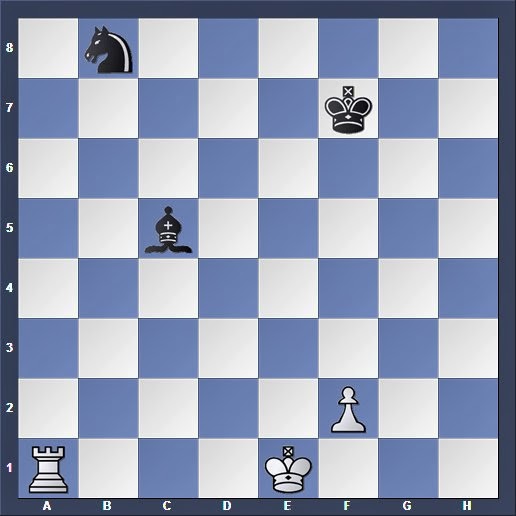
I can’t tell you how many times I’ve run into Internet opponents willing, even eager, to sacrifice B and N on f7 (or f2) for a R and P. Apparently their thinking runs two minor pieces are worth about 6 pawns and so are a Rook and a pawn, so it’s an even trade, plus they are weakening the enemy King’s position. However, in reality, is it a good idea? For example, the position below shows the skeleton of White’s having sacrificed two minor pieces on f7 for a R and P. What’s the result?

GM Zaitsev wrote “… experience shows that in endgames, especially if a passed pawn exists, the player who has a Rook has a better position. It is a different situation in the complicated middle game. Here it is much easier to create an attack having two minor pieces."
GM Mark Dvoretsky wrote, "In the endgame a Rook is frequently stronger than two minor pieces. It happens when the Rook penetrates into the opponent's camp and wins some material or when there is an opportunity to create a passed pawn." From reading these quotes it would seem that in the middle game two minor pieces are better and a Rook is better in the ending.
Tahl wrote, "I have to confess that it is my favorite sacrifice to give up two minor pieces for a Rook. If an exchange sacrifice can be treated as an admission that a Rook can be weaker than a minor piece, then in this case we have a statement that a Rook is frequently stronger than two minor pieces. This paradox is valid in an endgame too, especially when the Rook fights against a Bishop and a Knight and they are not cooperating very well in that particular situation. This paradox stays true in a middle game, providing that a Rook has an open file (or better yet, files!)."
It is common knowledge (though apparently not among a lot on online players) that in the opening it is generally not a good idea to give up two minor pieces for a Rook and a pawn because there are usually no open files for the Rook so the sacrifice is usually unsound; the minor pieces are better for attacking purposes.
Sometimes endings are different. A passed pawn is practically always a decisive factor. But two minor pieces can sometimes stop a passed pawn, the lone Rook is helpless in most cases.
GM Greg Serper wrote, “Just look at the resulting position and if you have better placed pieces and the initiative…(you will be better regardless of which combination of pieces you have.)”
World Correspondence Champion Hans Berliner gives the following valuations, based on experience and computer experiments:
The R has the least value in the opening and Purdy observed that the biggest jump happens “with the last exchange of pieces just before the ending.” He said that if you add a piece to each side, the minor pieces increase in value.
Purdy gave the following breakdown:
Playing around with different positions in the Shredder Endgame Database reveals that in most cases the two minor pieces draw against a R and P if they are the only pieces on the board. In fact the position at the beginning of this post is drawn.
Are you confused yet? GM Arthur Bisguier said that against a weaker opponent he could win with either side! Maybe that’s the best rule concerning this situation…be the stronger player!
In the following ending I recently played online, while not a two minor piece vs. R and P ending, it has some interesting points.
GM Zaitsev wrote “… experience shows that in endgames, especially if a passed pawn exists, the player who has a Rook has a better position. It is a different situation in the complicated middle game. Here it is much easier to create an attack having two minor pieces."
GM Mark Dvoretsky wrote, "In the endgame a Rook is frequently stronger than two minor pieces. It happens when the Rook penetrates into the opponent's camp and wins some material or when there is an opportunity to create a passed pawn." From reading these quotes it would seem that in the middle game two minor pieces are better and a Rook is better in the ending.
Tahl wrote, "I have to confess that it is my favorite sacrifice to give up two minor pieces for a Rook. If an exchange sacrifice can be treated as an admission that a Rook can be weaker than a minor piece, then in this case we have a statement that a Rook is frequently stronger than two minor pieces. This paradox is valid in an endgame too, especially when the Rook fights against a Bishop and a Knight and they are not cooperating very well in that particular situation. This paradox stays true in a middle game, providing that a Rook has an open file (or better yet, files!)."
It is common knowledge (though apparently not among a lot on online players) that in the opening it is generally not a good idea to give up two minor pieces for a Rook and a pawn because there are usually no open files for the Rook so the sacrifice is usually unsound; the minor pieces are better for attacking purposes.
Sometimes endings are different. A passed pawn is practically always a decisive factor. But two minor pieces can sometimes stop a passed pawn, the lone Rook is helpless in most cases.
GM Greg Serper wrote, “Just look at the resulting position and if you have better placed pieces and the initiative…(you will be better regardless of which combination of pieces you have.)”
World Correspondence Champion Hans Berliner gives the following valuations, based on experience and computer experiments:
• pawn = 1
• knight = 3.2
• bishop = 3.33
• rook = 5.1
• queen = 8.8
Berliner also made adjustments for the rank and file of the Pawns and adjustments for the pieces depending on how open or closed the position is. Bishops, rooks, and queens gain up to 10 percent more value in open positions and lose up to 20 percent in closed positions. Knights gain up to 50 percent in closed positions and lose up to 30 percent in the corners and edges of the board.
The R has the least value in the opening and Purdy observed that the biggest jump happens “with the last exchange of pieces just before the ending.” He said that if you add a piece to each side, the minor pieces increase in value.
Purdy gave the following breakdown:
In the opening:
2 minor pieces = R + 2P’s
2B’s = R + 2-1/2 P’s
In the ending (with P’s, but no additional pieces):
2 minor pieces = R + 1/2 P
2B’s = R + 1-1/2 P’s
Playing around with different positions in the Shredder Endgame Database reveals that in most cases the two minor pieces draw against a R and P if they are the only pieces on the board. In fact the position at the beginning of this post is drawn.
Are you confused yet? GM Arthur Bisguier said that against a weaker opponent he could win with either side! Maybe that’s the best rule concerning this situation…be the stronger player!
In the following ending I recently played online, while not a two minor piece vs. R and P ending, it has some interesting points.
Monday, December 16, 2013
Vladimir Liberzon

Known for his disciplined professionalism, Liberzon played in several Soviet championships, his best result being fourth at the 36th Championship, Alma-Ata 1968/69. Other results were less notable; his first entry led to a lowly finish at Tbilisi 1966/67, but he achieved solid mid-table performances at Moscow 1969 and at Riga 1970.
He was first in the Central Chess Club Championship in Moscow in 1963, 1964, and 1965, fourth at Kislovodsk 1964, fifth at Yerevan 1965, second at Leipzig 1965, first at Zinnowitz 1967, first at Debrecen 1968, second at Amsterdam 1969, third at Dubna 1971 and third equal at Luhačovice.
After moving to Israel he scored well in international tournaments finishing first at Venice 1974, first at Lone Pine 1975, second equal at Netanya 1975, second equal at Reykjavík 1975, first equal at Beer-Sheva 1976, first equal at Netanya 1977, 3rd at Amsterdam 1977, first equal at Lone Pine 1979, and fourth equal at Beer-Sheva 1984.
He was a leading member of the Israeli teams in the Olympiads between 1974 and 1980. During his career he scored victories over Mikhail Tal, Paul Keres and Tigran Petrosian. Botvinnik was luckier; twice he barely escaped defeat.
For many years Liberzon worked as a chess trainer and authored two chess books in Hebrew. In one of his books he posed the question, "What is the best variation of Alekhine's Defense?" Answer: "They are all bad." Liberzon was not considered a cultured man and William Hartston tells the story that when he first met Liberzon in a tournament in Iceland in 1974, Liberzon walked over to him before they had been introduced, grinned broadly and asked Hartston in Russian: "Do you speak Hebrew?" Hartston replied "nyet", but told him that he did speak a little Russian. Liberzon then told Hartston that people with noses as big as his usually spoke Hebrew. Liberzon spent the rest of the tournament telling Hartston dirty jokes in Russian.
Liberzon died in 1997 at the age of 59.
His opponent in this game is FM Robert Sulman (born 1961) who is a USCF Life Master (meaning he played over 300 rated games and maintained a rating over 2200) who had a rating high of 2406 in 1992, but it has since fallen below 2200.
This 1979 tournament held from the 25th of March to the 4th of April was the ninth in the series of annual events. The lead changed hands a number of times in this nine round Swiss Tournament but in the end four players; Liberzon, Gheorghiu, Gligoric and Hort shared top honors. They each received $8,875 and Gligoric and Liberzon made history by becoming the first players to win twice at Lone Pine.
Liberzon was the sole winner of the 1975 event and Gligoric was a joint winner in the 1972 event. Hans Ree could have joined the leaders but an oversight in a winning rook ending against Sahovic in the last round cost him a GM norm and dropped him into the group which included Larsen, Gruenfeld, Lombardy, Sahovic and Sosonko. They each received $1008.
Another notable performance in this tournament was that of 19-year-old Yasser Seirawan who played all four winners and in the process he defeated Miles and Larsen as well. Seirawan and the four winners scored the only GM results. Seirawan, along with DeFirmian and van der Sterren earnt IM titles. Morris, Bradford, Peters and Odendahl achieved IM norms and Root and Strauss achieved FM norms. Oleg Romanishin and Vitaly Tseshkovsky were slated to play but when it was discovered that Korchnoi would also be playing the Soviet authorities cancelled their entries.
Top finishers were:
Florin Gheorghiu 6.5/9 (+4 -0 =5) Svetozar Gligoric 6.5/9 (+4 -0 =5) Vladimir Mikhailovich Liberzon 6.5/9 (+4 -0 =5) Vlastimil Hort 6.5/9 (+4 -0 =5)
Bent Larsen 6/9 (+4 -1 =4) Hans Ree 6/9 (+4 -1 =4) Dragutin Sahovic 6/9 (+5 -2 =2) William James Lombardy 6/9 (+3 -0 =6) Gennady Sosonko 6/9 (+3 -0 =6) Yehuda Gruenfeld 6/9 (+4 -1 =4)
Mark Diesen 5.5/9 (+3 -1 =5) Samuel Reshevsky 5.5/9 (+3 -1 =5) Julio P Kaplan 5.5/9 (+3 -1 =5) John A Peters 5.5/9 (+3 -1 =5) Walter D Morris 5.5/9 (+3 -1 =5) Arthur Bisguier 5.5/9 (+3 -1 =5) Viktor Korchnoi 5.5/9 (+4 -2 =3) Anatoly Lein 5.5/9 (+4 -2 =3) James E Tarjan 5.5/9 (+4 -2 =3) Ludek Pachman 5.5/9 (+4 -2 =3) Yasser Seirawan 5.5/9 (+3 -1 =5) Leonid Alexandrovich Shamkovich 5.5/9 (+3 -1 =5)
Anthony Miles 5/9 (+3 -2 =4) Helgi Olafsson 5/9 (+3 -2 =4) Peter Biyiasas 5/9 (+3 -2 =4) Gert Ligterink 5/9 (+3 -2 =4) Gudmundur Sigurjonsson 5/9 (+2 -1 =6) Pal Benko 5/9 (+3 -2 =4) Nick DeFirmian 5/9 (+3 -2 =4)
Sunday, December 15, 2013
Nelson Mandela and Chess

As reader Peter pointed out, there is a connection between Nelson Mandela and chess. Here in are some links: Chessbase, Chess, Kevin Spraggett
Also, here is a link to U.S. Presidents who played chess by Bill Wall.
Friday, December 13, 2013
As promised: a Nezhmetdinov Game
I have seen this game annotated in a couple of different books, always with some disagreement as to the merits of the play of both players, so not only is playing over the game fascinating, so is trying to figure out the best lines. GM Andy Soltis thinks it’s a great game despite the fact he thinks Black’s defense was not very good. Alex Pishkin in Super Nezh puts it the “Masterpiece” section. Enjoy the tactics…
Thursday, December 12, 2013
Back…at least occasionally
For the past few weeks it’s been cold as a booger outside (this is first day the sun has shown in about 3 weeks) so there hasn’t been much to do and with all of my correspondence games are over except one, I have been busy playing over games from Super Nezh: Rashid Nezhmetdinov, Chess Assassin by Alex Pishkin. Nezh was an early version of Tahl. His combinations were fantastic, if not always entirely sound. Every time I play over his games I get to thinking I could play like that, but, of course, I can’t. I know because I have been frittering away the time playing 15 minute games on Instant Chess.
Instant Chess is a nice site; you sign in anonymously and play games against random opponents at random time limits, mostly 15 minutes per game, but on rare occasions you’ll be given a G1 or G30. The opposition ranges from beginners to fairly decent players; mostly the latter. It looks like it would be pretty nice site to join, but the $7.99 per month (join for 10 months and get 2 months free, that’s $80 per year) seems overpriced.
Jessica Fischer has done a very entertaining bio of Nezh on Youtube HERE.
The other book I’ve been looking at is Najdorf’s Zurich, 1953. Most everybody says Bronstein’s is better, but I prefer Najdorf’s annotations. John Watson does an in depth review of Najdorf’s book HERE.
The other book I’ve been looking at is Najdorf’s Zurich, 1953. Most everybody says Bronstein’s is better, but I prefer Najdorf’s annotations. John Watson does an in depth review of Najdorf’s book HERE.
The problem with playing anonymous games on Instant Chess is that there is no game score so you don’t have any record of them. The solution I’ve used is to simply use a scoresheet and record the games manually. I suppose you could also open a chess program in another window and use it to record your games, but the temptation with that might be to use the engine which would defeat the purpose of playing.
Anyway, after playing over Nezhmetdinov’s games the temptation to play gambits and jump at the chance to make any reasonable looking sacrifice has been overwhelming and since you are probably dying to see one of my Instant Chess games, I have attached one. Over time, I may offer up some of Nezmetdinov’s games and/or some games from Zurich that are especially entertaining.
Anyway, after playing over Nezhmetdinov’s games the temptation to play gambits and jump at the chance to make any reasonable looking sacrifice has been overwhelming and since you are probably dying to see one of my Instant Chess games, I have attached one. Over time, I may offer up some of Nezmetdinov’s games and/or some games from Zurich that are especially entertaining.
Sunday, October 27, 2013
Thinking of Retiring!

I have also thought about playing on one or other of the servers I’ve played on in the past, but it seems that all sites have a whole lot more engine users than they are willing to admit, so that’s out.
OTB tournaments are out, too. To tell the truth, for quite a few years now I’ve found myself “chessed out” after about an hour and not wanting to play anymore. There’s an informal meeting of chess players at a local coffee shop on Saturday afternoons and a couple players aren’t bad. The last guy I played was an older gentleman who was tactically very wily and it took be an hour and a half, but after avoiding a lot of his clever traps, I finally managed to nip him in a R and P ending. He said his rating back in the 1970’s was around 2000, but he doesn’t play anymore. A couple of players were in the 1600-1700 range twenty-some years ago. I don’t visit the place much because it always seems like there’s something else to do on Saturday afternoon and you never know if a chess player is going to show up or not and I don't like sitting there all by myself drinking a $1.90 cup of coffee then driving back home.
Since beginning to play chess in 1959, I gave found my interest in it waxed and waned over the years, including a couple of 10-12 year periods where I did not even look at a chess set. Now my interest is waning again and I have decided it’s time to put the pieces back in the box and I am even toying with the idea that it’s time to cease blogging and do something else with my spare time. Since beginning this blog in March of 2010 after my first one got hacked, Tartajubow on Chess II has had 1037 posts and 0ver 200,000 views while my other two blogs averaged between 10,000 to 12,000 views, so all-in-all it has been pretty successful and I have had fun blogging, but maybe it’s time to quit.
If I don’t make any more posts, thanks for visiting; if I do make more posts, disregard this post.
Saturday, October 26, 2013
Halloween Gambit Revisited

New Chess Server
The Amateur Chess Organization, headquartered in Prievidza , Slovakia, is an organization for amateur chess players up to 2400 ELO. This organization, with no ties to FIDE, claims to exclusively represent the interests of amateur chess players. They sponsor the World Amateur Championship where all players below 2400 rating are allowed to participate.
Actually the organization began in 2011, but their server is now in Beta. On the server they offer Live Chess where the time control ranges between one minute and 3 hours and Online Chess (correspondence chess) with time controls ranging between 1 to 14 days per move. The Glicko-Rating-System is used.
They also sponsor OTB events and offer an interesting concept called “Couch Surfing.” Players offer their home to players all over the world. The idea is if you would like to take part in a tournament in another country, but you don’t have enough money for accommodations, you can stay in somebody’s home. These days I’m not so sure that would be a good idea on the part of either party, but you never know.
Currently the site does not appear to show a lot of activity. i.e. the forums are mostly empty and because I did not want to register on yet another chess site, I can’t tell you how much activity there is in the games section, but for anyone that’s interested, you can sign up HERE.
Actually the organization began in 2011, but their server is now in Beta. On the server they offer Live Chess where the time control ranges between one minute and 3 hours and Online Chess (correspondence chess) with time controls ranging between 1 to 14 days per move. The Glicko-Rating-System is used.
They also sponsor OTB events and offer an interesting concept called “Couch Surfing.” Players offer their home to players all over the world. The idea is if you would like to take part in a tournament in another country, but you don’t have enough money for accommodations, you can stay in somebody’s home. These days I’m not so sure that would be a good idea on the part of either party, but you never know.
Currently the site does not appear to show a lot of activity. i.e. the forums are mostly empty and because I did not want to register on yet another chess site, I can’t tell you how much activity there is in the games section, but for anyone that’s interested, you can sign up HERE.
Tuesday, October 22, 2013
Chess Auctions

Tuesday, October 15, 2013
Edith Price and The Gambit

In 1898 she founded the Gambit Chess Room for men only except for waitresses. The club was open every day except for two days in 1940 when it was bombed during a Nazi raid. It was located on Budge Row in London. You can view a 1946 video of the Gambit Room HERE.
According to Leonard Barden there were normally around 30 people there, 50 at lunchtime, and Kriegspiel was popular. The policy used to be no female customers, but this was relaxed by the mid-forties and Barden remembered playing Eileen Tranmer in a tournament game in the basement, which was reserved for serious chess. It was also the site of the Britain v USSR 1946 radio match.
The high point of the Gambit week was the Saturday 'Gambit Guinea'. I find British money rather confusing but I think a Guinea is a value a little over one pound rather than a coin or note. Anyway a Guinea was the first prize in lightning tournaments played at ten seconds per move with the timing done by striking a cup with a spoon. These events came to be quite strong with several British championship players and strong amateurs taking part.
Eventually The Gambit was demolished by developers who built the headquarters of Legal and General; the building was regarded as an architectural eyesore and eventually was itself rebuilt and as a result Budge Row no longer exists.
Google lists a book about her at $42!

Saturday, October 12, 2013
Kasparov For President

Kasparov founded the Humanity Foundation a Free Choice group of Russian freedom advocates with the stated purpose of working for fair, democratic elections in Russia. He retired from chess in 2005 to devote himself fulltime to writing and human rights advocacy and as an outspoken critic of Russian President Vladimir Putin, Kasparov created the United Civil Front, a social movement with a mission to prevent Russia from returning to totalitarianism. He is a frequent contributor to the Wall Street Journal, the New York Times, and various other news publications.
He is the chairman of the Human Rights Foundation’s International Council, a nonpartisan organization devoted to defending human rights globally, with an expertise in the Americas. The Humanity Foundation BD was incorporated in 2005, and opened its offices in New York in August of 2006. His Kasparov Chess Foundation promotes chess in education.
Kasparov's Official Site
Kasparov plans to unseat 18-year incumbent Kirsan Ilyumzhinov in the election that takes place in August 2014. Kasparov sees FIDE as a social network that can be used to create communication for millions and millions of chess fans and he wants to use FIDE to” elevate chess from the grassroots level, to spread the game in education and as a cultural touchstone as well as a successful commercial sport.” Kasparov’s platform has six points:
1. Serve and support the national federations. FIDE should provide for its members instead of being supported by them.
2. Increase the FIDE budget by 100% in the next two years via corporate sponsorship. He wants to use a professional marketing approach that will make chess and FIDE attractive to corporate and public sponsors.
3. Universal rating system and expansion of online services: include every game of chess played on the planet, from world championship matches to online blitz.
4. FIDE will provide benefits to the huge base of chessplayers by offering services to the federations such as online news and training, a social media platform, direct support for organizers and journalists, and assistance with fundraising and finding sponsorship.
5. Develop the next generation of chessplayers around the world by promoting and establishing chess-in-education programs. Having chess be included in the school.
6. Review FIDE regulations to protect the integrity of chess by collaborate with players and organizers on a common-sense implementation of the zero-tolerance rule that will preserve dignity and professionalism. This will be accomplished by taking steps to test, and implement strong anti-cheating measures, including severe penalties for violators as well as the adoption of anti-short-draw rules.
It was Kasparov himself that initiated the split in chess in 1993, by creating the PCA (Professional Chess Association). Ilymzhinov took over FIDE in 1995 and successfully reunified the world title in 2006 but he has failed to raise corporate sponsorship.
The question Kasparov and election watchers are asking is, “If he gets elected, will he be more successful in maintaining gains than he was with Intel, IBM, Microsoft, GMA, PCA or any of the other organizations he lured into chess or helped create?” Good question. I suspect much of the problem lies with Kasparov whose personality has been known to rub people the wrong way.
I don’t know about the rest of the world’s chess federations, but in the US things are run by a bunch of good old boys who like a status quo. Throw in the fact that FIDE likes to throw money around come election time (who is NOT guilty of this?) and I don’t think Kasparov has much of a chance.
Monday, October 7, 2013
Greatest Feat in Chess History

GM Maxim Dlugy claimed that Ivanov was possibly cheating with his feet. Getting moves from a device in his shoe is somehow possible I suppose, but wouldn’t he still need an assistant? Without an assistant, he would have to have incredibly dexterous toes. Anyway, I gave this a lot of thought and decided it would have been better to plant the device in his butt crack. If any input from him was required he could just do butt crunches which seems easier than using your toes.
I really don’t know what to make of this. It seems pretty clear that Ivanov had a very high matchup rate with engines in some of his games, and apparently tried to avoid suspicion by losing games to much lower rated players on occasion. While the evidence against him is circumstantial it is still admissible as proof of cheating. Circumstantial evidence is described as “Information and testimony presented by a party in a civil or criminal action that permit conclusions that indirectly establish the existence or nonexistence of a fact or event that the party seeks to prove.” Much scientific evidence (evidence that is produced from scientific tests or studies) is circumstantial because it requires a jury to make a connection between the circumstance and the fact in issue. In Ivanov’s case the scientific evidence would be the matchup rate against Houdini in many of his games.
So the guy probably did cheat in a lot of games and is now apparently out of chess, but what fascinates me, like everyone else, is how did he do it?
Thursday, October 3, 2013
A ‘Real’ GM tries Correspondence Chess

Also, while perusing the rating list, I noticed a lot of correspondence names I recognized but not one was a recognizable OTB name. Out of curiosity, I checked to see what the top 40 players with LSS had for OTB and ICCF ratings. What I discovered was that on LSS, 21 had ICCF ratings that were, for the most part, near their LSS ratings. But…what about OTB ratings with FIDE? Most players were inactive OTB or were unrated. Four had low master ratings, four had Expert ratings (2000-2199), five were rated in the 1900’s and one top-rated LSS player who had no ICCF rating was rated 1661 with FIDE.
After returning to chess in 2004 after a vey long absence I joined the CCLA with a rating of around 2060 and quickly discovered many (but not all) players around the master level were using engines even though it is not allowed. That’s what prompted me to play on LSS; at least there is no doubt. It’s a different kind of chess and I have not mastered winning consistently using an engine. Obviously, those guys in the top 40 know something more about how to use them to win than I do.
So, exactly what does it take to reach 2400 on ICCF or LSS. It’s hard to say because top CC players don’t say much about how they manage to beat all the other guys who are also using an engine. According to one article I recently read, it can be done.
First be prepared to spend a lot of time because ICCF tournaments can take a couple of years. Actually this isn’t much different than it was back in the days of post cards, but in this age we are used to things moving along at a faster pace.
You will need to know a fair bit about computer software, you will need an opening repertoire program so you can stay organized, check transpositions, discover promising lines, find novelties and it must be kept up to date.
Many players on ICCF specialize in anti-computer strategies by steering for solid positions where they won't need to calculate a lot and one side has a slight positional advantage that can be utilized in the ending, so you will need to be something of an expert in knowing which positions are likely to lead to a won ending. You will play a lot of long games.
Good hardware is helpful. The better the hardware the more positions you are capable of analyzing. Two cores minimum; 4 cores is better and more than that even greater. You will need Houdini 3, Fritz 13 or Aquarium and an opening software program like Bookup.
They say that opening preparation will make up half of your strength on ICCF so you download all the archived games from ICCF and LSS. After that you use the backsolving feature on Bookup. I have never owned this so know nothing about it. Anyway, after you have enough games backsolved (apparently to find winning lines) then you start analyzing, or rather, the engine does. The author recommended using Aquarium’s IDeA analysis, but that’s a program of which I am not fond. Other programs, like DPA in Fritz, should also work. The author also suggested using both Fritz 13 and Aquarium IDeA running at the same time so that if Fritz (the faster engine) found a strong move, you can instruct Aquarium to analyze it in IDeA. At least I think that's what he was saying; I’m no computer guru and remember you need to know a fair bit about how to use your programs.
It is also recommended that you download all the tablebases your computer will handle. There is also a program called FinalGen that’s available for free download that will supposedly allow you to generate your own endgame tablebases of up to seven pieces. It will take 30 minutes to 3 hours to solve a position. I downloaded it once just to play around with it, got bored waiting on it, decided it wasn't needed and deleted it.
It is also recommended that you always play to win. As to how many games to play, one tournament at a time is the recommended number. I see it quite often on LSS that some players have 20, 30 or more games running at a time. When your opponent is on line a little green light is next to his name and I have seen some players stay online for a long time. They are likely running through their games spending a minute or two on it then playing whatever the engine suggests. I like playing them because they are the easiest to beat because engines don’t play their best moves that way. Tournaments should be selected so that you are playing against opponents with the highest rating available. That is, don’t play in open tournaments where you will meet lower rated players because a loss would be disastrous to your rating.
Be prepared to face opening novelties from highly rated players. How do you find novelties? One recommendation is to join Chess Publishing for $19.50 a year and analyze, analyze and then when you’re done, analyze some more.
All this sounds like a lot of tedious work so I probably won’t reach 2400 any time soon. ICCF offers GM, SIM and IM titles. I think they should have one other title that would reflect the level of my ability...BM.
Tuesday, October 1, 2013
Fritz 12 vs. ChessOK 2011
I have been using Fritz 12 for quite some time and back in March (I think it was) bought ChessOK 2011 because I was interested in using IDeA for analysis. As it turned out, I didn’t like ChessOK 2011…too klutzy for my taste and and not user friendly. So, after the old laptop’s motherboard crapped out and I bought a new one with Windows 8 I dug out the Fritz 12 CD and installed it on the new laptop and it works fine. Yesterday I searched through my old e-mails and found the download link and serial number for ChessOK 2011 and downloaded it. Why would I do that if I don’t like the program anyway? Because I paid for it. After the download was complete, I installed it, or rather tried to. Got a message that it won’t run, apparently because I’m using Windows 8. All I can say is Fritz 12 does, but ChessOK 2011 won’t…
Subscribe to:
Posts (Atom)