Random Posts

Showing posts sorted by relevance for query rook minor pieces. Sort by date Show all posts

Wednesday, December 18, 2013

Two Minor Pieces or Rook and Pawn...which to choose?!

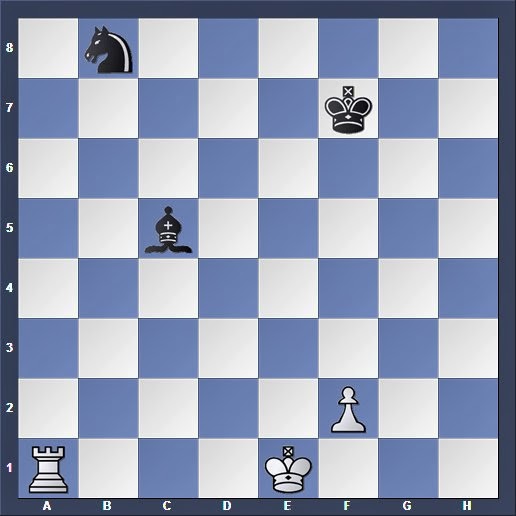
     I can’t tell you how many times I’ve run into Internet opponents willing, even eager, to sacrifice B and N on f7 (or f2) for a R and P. Apparently their thinking runs two minor pieces are worth about 6 pawns and so are a Rook and a pawn, so it’s an even trade, plus they are weakening the enemy King’s position. However, in reality, is it a good idea? For example, the position below shows the skeleton of White’s having sacrificed two minor pieces on f7 for a R and P. What’s the result?

     GM Zaitsev wrote “… experience shows that in endgames, especially if a passed pawn exists, the player who has a Rook has a better position. It is a different situation in the complicated middle game. Here it is much easier to create an attack having two minor pieces."
     GM Mark Dvoretsky wrote, "In the endgame a Rook is frequently stronger than two minor pieces. It happens when the Rook penetrates into the opponent's camp and wins some material or when there is an opportunity to create a passed pawn." From reading these quotes it would seem that in the middle game two minor pieces are better and a Rook is better in the ending.
     Tahl wrote, "I have to confess that it is my favorite sacrifice to give up two minor pieces for a Rook. If an exchange sacrifice can be treated as an admission that a Rook can be weaker than a minor piece, then in this case we have a statement that a Rook is frequently stronger than two minor pieces. This paradox is valid in an endgame too, especially when the Rook fights against a Bishop and a Knight and they are not cooperating very well in that particular situation. This paradox stays true in a middle game, providing that a Rook has an open file (or better yet, files!)."
     It is common knowledge (though apparently not among a lot on online players) that in the opening it is generally not a good idea to give up two minor pieces for a Rook and a pawn because there are usually no open files for the Rook so the sacrifice is usually unsound; the minor pieces are better for attacking purposes. 
     Sometimes endings are different. A passed pawn is practically always a decisive factor. But two minor pieces can sometimes stop a passed pawn, the lone Rook is helpless in most cases.
     GM Greg Serper wrote, “Just look at the resulting position and if you have better placed pieces and the initiative…(you will be better regardless of which combination of pieces you have.)”
     World Correspondence Champion Hans Berliner gives the following valuations, based on experience and computer experiments:
• pawn = 1
• knight = 3.2
• bishop = 3.33
• rook = 5.1
• queen = 8.8
     Berliner also made adjustments for the rank and file of the Pawns and adjustments for the pieces depending on how open or closed the position is. Bishops, rooks, and queens gain up to 10 percent more value in open positions and lose up to 20 percent in closed positions. Knights gain up to 50 percent in closed positions and lose up to 30 percent in the corners and edges of the board.
     The R has the least value in the opening and Purdy observed that the biggest jump happens “with the last exchange of pieces just before the ending.” He said that if you add a piece to each side, the minor pieces increase in value.
     Purdy gave the following breakdown:
In the opening:
2 minor pieces = R + 2P’s
2B’s = R + 2-1/2 P’s
In the ending (with P’s, but no additional pieces):
2 minor pieces = R + 1/2 P
2B’s = R + 1-1/2 P’s

     Playing around with different positions in the Shredder Endgame Database reveals that in most cases the two minor pieces draw against a R and P if they are the only pieces on the board. In fact the position at the beginning of this post is drawn.
     Are you confused yet? GM Arthur Bisguier said that against a weaker opponent he could win with either side!  Maybe that’s the best rule concerning this situation…be the stronger player!
    In the following ending I recently played online, while not a two minor piece vs. R and P ending, it has some interesting points.


Saturday, June 12, 2010

Revisiting Minor Pieces for a Rook - Part 1

I’ve posted on this before as to why it’s generally not a good idea to trade 2 minor pieces (usually a B and N) for a R and P early in the game. The person trading the 2 minor pieces most likely won’t have enough pieces left to conduct a winning attack. The R’s gain a little in strength in the ending though. Of course a lot depends on the number of Pawns.

Purdy can explain it far better than I can and I’m going to let him do so. It’s a little hard to grasp on the first reading and will require some careful thought. Anyway, the reason I’m posting it again is because I just played a 10 minute game where my opponent sacrificed a B and N for a R and P then quickly succumbed to an attack against his K.

When I went over the game with Fritz, it didn’t really suggest any major improvements for me, but in practical play, I kind of disagree with its evaluation as being over 3 points in my favor. I’m not Fritz and it’s entirely possible my play would not have held up in the ending if White had found the correct defense. I give the game because it shows how difficult these positions are to play even if you know how things should shake out!

First Purdy’s explanation, then the game.

The main facts are:

1) In the opening, two Minor Pieces (excluding two B’s) are normally equivalent to a R and two P’s. Two B’s are roughly equal to 2 and a half P’s.

2) In an end-game with P’s but no additional pieces the superiority of the two Minor Pieces (excluding two B’s) over the R’s is less than one P. For two mobile B’s, add nearly a P

So the difference in value (except for two B) decreases by more than a P as exchanges proceed!

The R has least worth in the opening because he is hard to develop. To induce the enemy to give up two pieces for a R and two P’s is usually fairly good business in the opening.

But the biggest jump occurs with the last exchange of pieces just before the ending described in 2) is reached. In other words, add even one piece to each side and the minor pieces' faculty for combining with other forces will appreciably increase their value. Indeed, Fine says in Basic Chess Endings:

"Three pieces versus two Rooks (equal pawns) is normally a draw, but in favor of the pieces because they have more play."

That is true for two B’s and N, the only combination that Fine gives by way of illustration. Two N’s and B are not quite so good; but even if they are barely equal to two R’s in an endgame, that shows that the third piece strengthens its fellows by appreciably more than the endgame value of one minor piece (three P’s). In other words-and this is the great point to remember-

B and N or two N’s without other pieces, are usually a poor team. The two Minor Pieces are much better in combination with at least one other piece.

In BCE, Fine makes the following statements which do not quite tie up.

A) "In the ending, two minor pieces are approximately equivalent to Rook and one pawn."

B) "Rook vs. two minor pieces (equal pawns) will usually be a draw, but tbe two pieces will win more often than the Rook."

If the difference were really about equal to a P on the average, Fine would have to say the ending is usually a win for the pieces. Clearly, a draw might occur fairly often; but a win for the R would be so infrequent as to make the second clause of B) a manifest understatement.

Which statement is slightly out, A) or B)? Probably both-i.e. A) slightly overstates the value of the pieces, whereas B) slightly overstates the value of the R. All of Fine's other remarks and his illustrative positions would tie up better had he changed A) and B) to A1) and B1). Thus:

A1): Substitute our Proposition 2) at the beginning of this article.

B1) R vs. two minor pieces (excluding two B’s) with equal P’s (P’s on both wings) ends in a draw or in a win for the two pieces with about equal frequency. The R may win in very favorable circumstances.

One cannot, of course, reduce chess to arithmetic. In all this, we are speaking in averages. Weak P’s on either side, badly placed pieces, and so forth, are likely to turn the scale; but nevertheless, a knowledge of the average values is a necessary starting point for forming a judgment in any given position.

Got all that? Good! The short version is: it's hardly ever a good idea to trade a B and N for R and P early in the opening. Now take a look at the game in Part 2.

Friday, February 21, 2014

Rooks and Minor Pieces

     Tahl decisively won his first match for the world championship with a score of 12.5 – 8.5. In my opinion these two matches were the most exciting I have ever witnessed because it was a clash of styles. The matches paired the strategist Botvinnik against the tactician Tahl. The truth is though that, as world champion caliber players, they were both good at all phases of the game and they bashed away at each other with all the weapons available regardless of their preferred style. Botvinnik played tactical chess when needed and Tahl played positional chess and endings when he had to.
     As you know, I have posted in the past that I have a healthy distrust of engines when evaluating positions with unbalanced material so found this position quite interesting.
     Generally speaking, if you have two minor pieces the essential elements are 1) coordinate your pieces against the Rook and 2) security. When playing with minor pieces against a Rook it is always good policy to pay particular attention to the general security of your position.
     Remember that the Rook is adept at picking off stray Pawns but in the absence of targets it loses a lot of its strength. By the way, this also applies to playing assorted minor pieces against a Queen. The Rook usually comes into its own in the ending and its value increases relative to the other pieces so that winning with two minor pieces against a Rook is often much harder than it would be in the middlegame.
     In the position below, Botvinnik has just made an oversight where he traded two N’s for a R and got into an ending that is an exception to the rule. The resulting ending illustrates the necessity of coordinating the minor pieces which Tahl did extremely well. Botvinnik’s Rook was unable to offer any resistance.
 

Wednesday, November 25, 2020

Was Arthur Bisguier right?

     In online games one of my favorite openings is the Four Pawns Attack against the King's Indian; in fact, sometimes I go overboard and play the Five Pawns Attack where I play g2-g4 (after h2-h3 if necessary) right in the opening. Seriously, there is no such thing as the Five Pawns Attack; I made it up. I just really like the Four Pawns Attack which was played in the following game. 
     Many times I've run into online opponents willing, even eager, to sacrifice B and N on f7 (or f2) for a R and P. Apparently their thinking is that in doing so they are playing tactically and justify the "sacrifice" because two minor pieces are worth about six Pawns and so are a Rook and a Pawn and that makes it an even trade, plus they are weakening the enemy King’s position. Is such a trade a good idea? 
     According to GM Lev Zaitsev in endgames a Rook is better especially if the side with the Rook also has a passed Pawn, but in a complicated middle game it is much easier to create an attack with the two minor pieces. 
     GM Mark Dvoretsky wrote that in the endgame a Rook is frequently stronger than two minor pieces. It happens when the Rook penetrates into the opponent's camp and wins some material or when there is an opportunity to create a passed Pawn.   
     So, generally speaking we can conclude that in the middle game two minor pieces are better and in the ending a Rook is better. 
     On the other hand Tal confessed his favorite sacrifice was to give up two minor pieces for a Rook. i.e. he preferred the Rook! He claimed this paradox is valid in an endgame especially when the Rook fights against a Bishop and a Knight that are not cooperating very well. The paradox is true in a middle game, too, providing that a Rook has an open file, or better yet, files. 
     For most of us the most accurate evaluation of the situation comes from GM Arthur Bisguier who believed that against a weaker opponent he could win with either side. Thus, the answer as to which is to be preferred can be determined by answering the question, "Am I the stronger player?" 
     Case in point...in the following game which was played online just before Christmas last year I opened with the Four Pawns Attack and we ended up in an ending where I had a R+3Ps vs. a B+N+3Ps. As it turned out, Bisguier was right...the stronger player won.

Tartajubow - Opponent

Result: 0-1

Site: Online G10

Date: 2019.12.23

King's Indian Defense, Four Pawns Attack

[...] 1.e4 d6 2.c4 ♘f6 3.♘c3 g6 4.d4 ♗g7 5.♗g5 This is commonly known as the Averbakh System; he played it with Be2. The Bisguier System is coupled with Bd3 and f4. 5...c6 6.f4 O-O
6...h6 7.♗h4 ♘h5 8.♘ge2 a6 9.h3 b5 10.g4 Love this! The game ended in a hard fought draw. Beliavsky,A (2646)-Lopez Martinez,J (2540)/Budva 2009
7.h3 Preventing the annoying ...Bg4 and toying with the idea of g4.
7.♕d2 a6 8.a4 ♕a5 9.♖a3 e5 10.fxe5 dxe5 11.d5 is equal. Sherwin,J-Panno,O/Portoroz 1958
(7.♘f3 ♘bd7 8.♗e2 ♘e8 9.O-O is even. Burkart,R-Struth,E/Germany 1993 ) 7...a6 8.a4 Hindering black's ...b5.
8.♗d3 As in the Bisguier system. 8...b5 9.e5 with equal chances.
8...♘h5 Instead of this crude threat (... Mg3) black should either develop with 8...Nbd7 or perhaps even better play 8... d5 9.♘ge2 f5 This doesn't look very good, but maybe he wanted to hinder g4.
9...♘d7 and I would have played 10.g4 but black could have at least equalized with 10...h6 11.♗h4 ♘xf4 12.♘xf4 g5 13.♗xg5 hxg5 14.♘h5
10.e5 Still thinking of playing g4, but this allows black to get slightly the better of it.
10.exf5 was correct as black is forced to recapture with the P. 10...gxf5 11.g4 and white has a promising position. 11...fxg4 12.hxg4 ♗xg4 13.♕d3 Black needs to watch out for his N. 13...♕e8 14.♗h3 ♗d7 15.♕f3 ♘f6 16.O-O-O with good attacking possibilities.
10.exf5 gxf5 11.g4 ♘f6 is correct. Then after 12.♕c2 d5 white can only claim a slight advantage.
10...dxe5 11.dxe5
11.fxe5 would be a mistake as after 11...h6 12.♗h4 c5 White's center is under attack plus his Ks position is looking a little insecure.
11...♕c7 12.♕c2 h6 13.g4 This turns out to be a mistake. (13.♗h4 g5 14.fxg5 hxg5 15.♗xg5 ♕xe5 16.O-O-O is unclear.) 13...fxg4 Fortunately for me black fails to take advantage of the opportunity to gain the advantage.
13...hxg5 14.gxh5 gxf4 15.♘xf4 ♕xe5+ 16.♘ce2 gxh5 17.♖g1 (17.♘xh5 ♗h6 leaves white in dire straits.) 17...♔h7 with the advantage.
14.♕xg6 ♗f5 A gross blunder. All he had to do was play 14...hxg5 with equal chances. 15.♕xh5 hxg5 16.hxg4 ♗d3 17.♕xg5
17.O-O-O Packs an even bigger punch...the threat is to eliminate the defender of h7. 17...♕d7 18.f5 Cutting off the B. 18...♖d8 19.♖xd3 ♕xd3 20.e6 And black is without any defense against Qf7 mate.
17...♘d7 18.♕xe7 Being three passed Ps up it seems that white has an easy win, but in fact with his K in the center black has sufficient play.
18.O-O-O would have left black helpless against threats on the h-file. 18...♗xe2 19.♗xe2 ♘xe5 (19...♘c5 20.♗d3 ♘xd3+ 21.♖xd3) 20.fxe5 ♕xe5 21.♕g6
18...♖ae8 Komodo informs us that this position is nearly equal! 19.♕h4 Renewing threats on the h-file. 19...♘c5 This does not deal with the threats adequately.
19...♘xe5 20.O-O-O Best. 20...♘g6 21.♕h7+ ♔f7 22.♕h2 ♗xe2 23.♘xe2 ♖h8 with an unclear position.
20.♗g2
20.♖d1 was better. 20...♗c2 21.♗g2 (21.♖d2 ♘d3+) 21...♗xd1 22.♗e4 ♗xe2 23.♕h7+ ♔f7 24.♗g6+ ♔e7 25.♕xg7+ and wins.
20...♖xf4 Surprise! It looked too risky to take the R, but that's what I should have done. 21.♗e4 The losing move as they say.
21.♘xf4 ♕xe5+ 22.♘fe2 and I am a R and a P ahead, but Komodo says black is better by a P and a half. How can that be?! 22...♕e3 Threatening to remove the guard from the N on e2 with ... Bxc3+ 23.♗f1 ♘b3 24.♖a3 The only safe square. 24...♘d4 with the nasty threat of ...Nf3+ 25.♖h3 A slaughter ensues. 25...♕c1+ 26.♘d1 ♗xe2 27.♔f2 ♕f4+ 28.♖af3 ♗xf3 29.♔g1 ♗xd1
21...♗xe4 (21...♗xe2 Nails it down 22.♕h7+ ♔f8 23.♔xe2 ♘xe4 24.♘xe4 ♕xe5) 22.♘xe4 ♕xe5 23.♕h7+ ♔f8 24.♘xf4 ♕xe4+
24...♕xf4 is also playable. 25.♖f1 ♖xe4+ 26.♕xe4 ♕xf1+ 27.♔xf1 ♘xe4
25.♕xe4 ♖xe4+ (25...♘xe4 is a blunder. 26.O-O) 26.♔d2
26.♘e2 leads to a really messy position after 26...♗xb2 27.♖a2 ♗f6 28.♖h5 ♖xc4
26...♖xf4 27.♖af1 ♖xf1 28.♖xf1+ Both sides have emerged from the complications unscathed and now a new phase of the game begins. 28...♔e7 29.g5 Played based on the principle that passed Ps must be pushed. 29...♘e4+ (29...♘xa4 30.b4 ♘b6 31.♖e1+ ♔f7 32.♔d3 with about equal chances.)
29...♗xb2 30.a5 ♗e5 31.g6 ♗f6 is also about equal.
31...♘b3+ 32.♔d3 is OK as long as black doesn't get greedy and grab another P. 32...♘xa5 33.♖e1
30.♔e3 Believe it or not this is a mistake. The K needs to stay close to the Ps so 31.Kd3 was correct. 30...♘xg5 This looks like it could be a draw, but it isn't. Every engine there is going back to Fritz 5.32 gives black the edge here. The R has no target so white is going to be on the defensive. 31.b4 ♘e6 32.♔d3
32.♖d1 cuts the K off but after 32...a5 33.bxa5 (33.b5 cxb5 34.cxb5 ♘c5 black is winning.) 33...♘c5 34.♖g1 ♗c3 wins because white loses his Ps.
32...♗e5 33.♖f5 ♔d6 This is a subtle mistake that should have allowed me to equalize. Simply moving the B away was correct. 34.c5+
34.♖f7 would have been considerably better. It can get tricky! 34...b6 35.a5 bxa5 36.c5+ ♘xc5+ (36...♔d5 37.♖d7+ wins) 37.bxc5+ ♔xc5 38.♖f5 is unclear, but a draw looks likely.
34.♖f7 ♘d8 is best. Then 35.c5+ ♔e6 36.♖h7 ♘f7 37.a5 with a likely draw.
34...♔d5 35.♖f7 Now with black's K able to penetrate this is not good...in fact it loses.
35.a5 should hold. 35...♘f4+ 36.♔e3 ♘g6 37.♖g5 ♘e7 38.♔d3 Cutting off black's K from going to c4 after which a draw is probable.
35...♘f4+ 36.♔c2 After this black's K penetrates and ther is no way to save the game.
36.♔e3 is no help. 36...♔c4 37.♖xb7 ♘d3 38.♖b6 ♗d4+ 39.♔d2 ♘xb4 40.♖b7 ♗xc5 wins
36...♔c4 37.♖xb7 ♘d5 38.♖a7
38.b5 Technically this is no good either, but practically it was worth a couple of exclamation marks. 38...cxb5 39.axb5 axb5 and black's b-Pawn advances. However, all is not lost! 40.♖xb5 ♔xb5 and I could have made black prove he could mate with a B and a N!. Black mates in 28. Here is how: 41.♔d3 ♘c3 42.c6 ♔xc6 43.♔e3 ♔d5 44.♔f3 ♘e4 45.♔e3 ♘g3 46.♔f3 ♔d4 47.♔f2 ♔e4 48.♔g2 ♔e3 49.♔g1 ♔f3 50.♔h2 ♗d4 51.♔h3 ♗g1 52.♔h4 ♘e4 53.♔h5 ♗d4 54.♔h4 ♗e5 55.♔h3 ♘g5+ 56.♔h4 ♔f4 57.♔h5 ♔f5 58.♔h4 ♗f4 59.♔h5 ♗g3 60.♔h6 ♘e6 61.♔h5 ♘g7+ 62.♔h6 ♔f6 63.♔h7 ♘f5 64.♔h8 ♗d6 65.♔g8 ♔g6 66.♔h8 ♗c5 67.♔g8 ♘h6+ 68.♔h8 ♗d4#
38...♘xb4+ 39.♔d2 ♔xc5 I could resign here, but we were both getting short of time. 40.♖e7 ♗d6 41.♖e4 ♘d5 42.♖g4 ♔b6 43.♖e4 ♗b4+ 44.♔c2 c5 45.♔b3 ♔a5 46.♖e5 ♘b6 47.♖e4 ♘xa4 48.♖c4 White exceeded the time limit in this lost position although it's not at all easy for black to demonstrate the win. Some engine analysis showed that the game could easily have gone on for another 40-50 moves.
Powered by Aquarium

Friday, December 16, 2011

R vs B and N

I recently played over an interesting ending from Donaldson-Bisguier that relates to a  couple of previous posts I made concerning minor piece against Rook endings.

Minor Piece for Rook - Part 1
In the below position (White to move) Bisguier stated that he felt he could win the game with either color.  I take that to mean he felt that, as the stronger player, he could win it from either side.   Regardless of generalities these endings are very difficult and we are speaking of averages so many other factors are likely to influence the results.
To sum up: 
In the opening:
2 minor pieces = R + 2Ps 
2B’s = R + 2-1/2 P’s 
In the ending (with Ps, but no additional pieces):
2 minor pieces = R + 1/2 P
2B’s = R + 1-1/2 P’s
 
The R has the least value in the opening and Purdy observed that the biggest jump happens “with the last exchange of pieces just before the ending.”  He said that if you add a piece to each side, the minor pieces increase in value.
In Basic Chess Endings, Fine wrote, “Three pieces versus a Rook (with equal P’s) is normally a draw, but in favor of the pieces because they have more play.”  Purdy observes that this is true but 2N’s and a B aren’t as good as a N and 2B’s because a B+N or 2N’s, without other pieces, are generally not a good team.

If all this sounds complicated and difficult to remember, it is.  This is why I think Bisguier said that against a weaker player, he could win with either color.
In the starting position, which is complicated even more because of the extra material, the engine evaluation was about 1-1/2 P advantage to White, Black is about to win another P leaving a highly unbalanced material situation that is very difficult to play.