Random Posts

Thursday, December 14, 2023

1934 Ohio Championship

    
Down near Black Lake, Louisiana in 1934, FBI agents ambushed and killed bank robbers and murderers Bonnie Parker and Clyde Barrow. Another criminal, bank robber John Dillinger, died after a shootout with police in St. Paul, Minnesota. 
 
 Correction: As caught by alert reader Paul Gottlied, Dillenger was killed in Chicago, but he escaped a shootout in St. Paul. Read/listen to article HERE
 
The kidnapper/murderer of Charles Lindbergh’s baby was arrested. Bruno Hauptmann maintained his innocence right up until the last minute that he was executed by electric chair on April 3, 1936. 
    July of 1934 was the hottest month ever recorded in Ohio with a record temperature of 113 degrees being set on the 21st about four miles northwest of Gallipolis in southern Ohio. 
    Air conditioning was still in the future and the estimated death toll in Ohio was about 160 dead just during the week of July 20-26. The oppressively warm nights led many people to seek relief by sleeping on porches, roofs, and even on their lawns. See Also 
    In May of 1934, before the heat wave hit, two prominent Ohio players who are virtually unknown today played a match for the state championship. They were P.G. Keeney and John O. Hoy. 
    Dr. Palmer Gunkel Keeney (March 25, 1877 - October 14, 1959, 82 years old) was, like his father, a medical doctor and composer of chess problems. 
    Keeney graduated from the Medical College of Ohio which was founded in Cincinnati in 1819 in Cincinnati. Prior to the Medical College's establishment, most doctors learned their profession through an apprenticeship system. Private doctors trained their students. In 1896, the college merged with the University of Cincinnati. He served his internship at Speers Memorial Hospital in Dayton, Ohio and practiced in Newport and Bellevue, Pennsylvania. Keeney also served served in WWI. 
    As a chessplayer Keeney was a noted problem composer. He was considered a chess prodigy after having composed his first problem at the age of 13. 
    He is not well-known today, but was a very successful chess editor and he was a two-time State Champion. His chess column in the Cincinnati Enquirer was widely regarded as one of the best in the world. His editorial career lasted into the 1950s, when he was the first problem editor for Chess Life. 
    Keeney liked to illustrate his problems with stories and his most famous problem was illustrated with a fabricated story by another author, Emil Ramin. Ramin, in Im Wunderland des Schachproblems, wrote of a crazy problem tourney that never existed and was supposedly won by Keeney. In reality, the problem was a Christmas original in Keeney's column in the Cincinnati Times-Star, and had a different story there; in the Times-Star the story was about the potential re-birth of man.
    In a match for the 1934 state title, Keeney, the1934 Southern Ohio champion, crushed a well-known local player named John O. Hoy of Cleveland the 1934 Northern Ohio Champion who was also the 1933 State Champion. You can see a photo of Hoy taken by the newspaper Cleveland Press in 1948 HERE. Virtually no information is available on Hoy. 

A game that I liked (Fritz 17)

[Event "Match Championship, Cincinnati"] [Site "Cincinnati, OH USA"] [Date "1934.05.08"] [Round "2"] [White "Dr. P.G. Keeney"] [Black "John O. Hoy"] [Result "1-0"] [ECO "B02"] [Annotator "Stockfish 16"] [PlyCount "59"] [EventDate "1934.05.07"] [Source "Cincinnati Enqui"] {B02: Alekhine's Defense} 1. e4 Nf6 2. e5 Nd5 3. c4 {[%mdl 32] White does better with the standard 3.d4 because the text does not yield favorable results in practice.} Nb6 4. c5 (4. d4 {is much more popular and actually gives white better results.} d6 5. exd6 exd6 6. Nc3 Be7 7. Bd3 Nc6 8. Nge2 { equals.}) 4... Nd5 5. Nc3 Nxc3 (5... e6 6. d4 d6 7. cxd6 cxd6 8. Nf3 Nc6 9. exd6 Bxd6 10. Bd3 O-O 11. O-O {1/2-1/2 (11) Durarbayli,V (2628) -Mamedyarov,S (2757) Shusha AZE 2022}) 6. bxc3 (6. dxc3 {is considered to be slightly more accurate.} e6 7. Bd3 Bxc5 8. Qg4 g6 9. Bh6 f5 10. exf6 Qxf6 11. Nf3 Nc6 12. O-O-O {with equal chances. Ginzburg,Y (2405)-Jaskolka,T (2216) chess.com INT 2022}) 6... d6 7. cxd6 exd6 (7... cxd6 8. exd6 Qxd6 9. d4 g6 10. Nf3 Bg7 11. Be2 O-O {equals. Gal,J (2325)-Bogdan, D (2410) Szeged 1998}) 8. exd6 Bxd6 9. d4 O-O 10. Be3 Qe7 11. Bc4 c5 12. Nf3 Bg4 13. O-O Nc6 14. dxc5 (14. h3 {is more complex.} cxd4 15. cxd4 Bh5 16. Re1 {Oddly, black's Q is safe from discoveries for the moment.} Rae8 17. Be2 Bb4 18. Bd2 Bxd2 19. Qxd2 Qf6 {with equal chances.}) 14... Bxh2+ 15. Kxh2 Bxf3 16. Qxf3 Qh4+ 17. Kg1 Qxc4 18. Rab1 { Neither side can boast of any advantage here, but Hoy's next move allowing a R on the 7th rank is a serious mistake. He should have played 18...Na5 or even 18...Nd8} f5 19. Rxb7 f4 {Black simply does not have enough compensation to justify his last move.} 20. Qg4 (20. Qxc6 {This move would have given black enough play...} fxe3 21. Rb4 (21. f3 Rad8 22. Re1 Rfe8 23. Rxa7 {loses as follows...} Qh4 24. Qa4 (24. Re2 Rd1+ {mate next move}) 24... Qxe1+) (21. Qd6 exf2+ 22. Rxf2 Rxf2 23. Kxf2 Qh4+ {White's K is so exposed that black should draw with little difficulty.}) 21... Qxc3 22. Qd5+ Kh8 23. Re4 exf2+ 24. Rxf2 Rfd8 25. Rfe2 Qc1+ 26. Kh2 Qh6+ 27. Kg1 Qc1+ {draws}) 20... Qxc3 21. Bxf4 (21. Bd4 {is hard to see, but it would prove decisive.} Qxd4 22. Rd1 Qf6 23. Rdd7 g5 24. Qh3 Qf7 (24... h6 25. Qb3+ Rf7 26. Rxf7 {wins}) 25. Rxf7 Rxf7 26. Rxf7 Kxf7 27. Qf5+ Ke8 28. Qe4+ Kd7 29. Qd5+ Kc7 30. Qd6+ Kb7 31. Qd7+ Kb8 32. Qxc6) 21... Qf6 22. Bd6 Rfe8 (22... Rf7 {is best met by} 23. Rb3 {The R has accomplished all it can on the 7th rank and so it's time to relocate it.} Qf5 24. Qa4 Qd7 25. Re3 Rd8 26. Rfe1 {White's advantage should prove decisive, but the win will still require a lot of work.}) 23. Rfb1 Re6 {This allows a very nice finish, but his position was already badly compromised.} 24. Rxg7+ { [%mdl 512] Nice!} Qxg7 25. Qxe6+ Kh8 (25... Qf7 26. Qe4 Qe8 (26... Rc8 27. Qg4+ {wins the R}) 27. Qd5+ Kh8 28. Rb7 Rd8 29. Qg5 Qg6 30. Be5+ Kg8 31. Rg7+) 26. Bg3 (26. Bb8 {was a slick move!} Nxb8 27. Qe8+ Qg8 28. Qe5+ Qg7 29. Rxb8+ Rxb8 30. Qxb8+ {wins the ending.}) 26... Qg6 27. Be5+ Nxe5 28. Qxe5+ Kg8 29. Qd5+ Kg7 30. Rb3 {An excellent choice. Black resigned.} (30. Qxa8 {is less precise because it leads to a very difficult Q+P ending! Watch...} Qxb1+ 31. Kh2 Qxa2 32. Qb7+ Kf8 33. c6 Qxf2 34. Qb8+ (34. c7 Qh4+ {draws}) 34... Kf7 35. Qc7+ Ke8 (35... Kg8 36. Qg3+) 36. Qd7+ Kf8 37. Qd8+ Kf7 38. Qd5+ Ke7 39. Qe5+ Kd8 40. Qd6+ Ke8 41. Qe6+ Kf8 42. Qe5 Qh4+ 43. Kg1 Qb4 44. c7 Qb6+ 45. Kh2 Qh6+ 46. Kg3 Qg6+ 47. Kf4 Qh6+ 48. Ke4 Qc6+ 49. Kd4 Qd7+ 50. Kc5 Kf7 51. g4 a6 (51... Qxg4 52. Qd5+ Kf6 53. Qd4+) 52. Qf5+) (30. Rb3 Qf6 31. Rg3+ Kf8 (31... Kh8 32. Qxa8+ ) 32. Rf3) 1-0

Tuesday, December 12, 2023

Wendell John Lutes

    Once upon a time, some 30 years ago or maybe it was more, I entered a postal tournament with the Correspondence Chess League of America and was pleased to find one of my opponents was Wendell John Lutes (January 2, 1938 – January 3, 2013, 75 years old). Unfortunately, after a few moves he sent me a post card saying that due to health reasons he was unable to continue. 
     Lutes es was a bibliophile and chess openings editor. Born in Indianapolis, Indiana, he contracted Osgood-Schlatter's Disease at age eight and during his long convalescence his grandfather taught him how to play chess. 
    The condition is one that affects the knee and causes a painful bump and swelling on the shin bone below the knee. It typically affects kids during their preadolescent growth spurt between the ages of 10 to 13 for girls and the early teens (12 to 14) for boys. 
    Lutes passed away in Peoria, Illinois at 1:40 am on Thursday, January 3, 2013, in the Proctor Hospital. Lutes was born in Indianapolis, Indiana. He married Virginia Miller in Sandusky, Ohio on May 7, 1966. She passed away at the age of 79 at 8:58am on Saturday, March 9, 2013 in the same hospita.
    He graduated with a Bachelor's of Science degree from Ohio State University and during that time he was a well known player throughout the state. During his working career Lutes was a neurological respiratory therapist. 
    Lutes is best known by chess players as, the way Lutes put it: a student of the Apostle of Aggression, Weaver W. Adams of East Orange, New Jersey and later Stepan A. Popel (who was originally from the Ukraine which at the time of his birth was the Austria-Hungary Empire) who eventually wound up living in Fargo, North Dakota. Lutes was known for his exploration of openings of questionable repute. 
    His best OTB rating was 2245 after winning the 1961 Indiana Championship and the 1966 Pennsylvania State Open Championship. Lutes also won the Indianapolis City Championship many times, the Columbus, Ohio Championship and the Springfield, Illinois Championship. He eventually gave up OTB chess due to his job requirements and only rarely returned to it. 
    Lutes authored nine booklets on the openings which are of the rather romantic variety and are better played OTB than in correspondence play. Lutes became known worldwide for his exhaustive research in chess and his two best known books were Compendium of the King's Gambit and Petrov Defense: Cochrane Gambit. 
     Today’s game is one Lutes played against Bobby Fischer during the latter’s simultaneous exhibition in Dayton, Ohio on May 18, 1964, at the Central YMCA Auditorium. 
    Fischer arrived 45 minutes late and the acerbic master James R, Schroeder (1927-2017 and pronounced Sch-A-der) introduced him and said that before he had previously met Fischer in Cleveland, Ohio, he had a low opinion of him, but after meeting him in person, hearing him speak before a group and seeing him in action over the boards, Schroeder change his mind. He added that we could be proud of Fischer because he was a kind man and a good representative for the US. 
    I considered Schroeder a friend and once helped him on one of his books, typewritten pamphlets really, by proofreading the games and he gave me a book (a real one) of Karpov's games for my efforts. 
    One day he approached me at a tournament and asked if I had a car and could I give him a ride to his apartment to pick up some chess books to bring back and sell. His apartment was in an older building and was sparsely furnished with a small portable black and white TV with a coat hanger antenna. Chess books were piled all over the place. On the way back we stopped for lunch at an out of the way Chinese restaurant where we were the only non-Chinese in the place, but Schroeder seemed to be pretty well known. 
    Back to the subject at hand...After giving a brief account of his tour the exhibition began and one of Fischer’s opponents was Wendell John Lutes who, at one point was actually winning, but misplayed it and only managing to draw. The match was finished by 11:45pm and Fischer had won 48 games and drawn with Lutes and Ed Lense, a seminary student from Dayton. 

  A game that I liked (Fritz 17)

[Event "50 board simul, Columbus, Ohio"] [Site "Columbus, OH USA"] [Date "1964.05.18"] [Round "?"] [White "Robert Fischer"] [Black "Wendell J. Lutes"] [Result "1/2-1/2"] [ECO "B01"] [Annotator "Stockfish 16"] [PlyCount "84"] [EventDate "1964.??.??"] {B01: Scandinavian Defense} 1. e4 d5 {Back in the days of yesteryear this was called the Center Counter Defense. Ir's the oldest opening by black recorded in modern chess. The general goal of the defense is to prevent white from controlling the center with Pawns plus it forces an open game, while allowing black to build a strong P-structure. Considering who his opponent was and the fact that it was a simul, it was pronanly a good a choice as any for Lutes to play...plus he knew the defense very well.} 2. exd5 {White normally continues with this and now black has two main continuations: 2...Qxd5 and 2... Nf6 (the Modern Scandinavian). The rare gambit 2...c6 (the Blackburne-Kloosterboer Gambit) is almost never seen at the master level play. White normally continues with this and now black has two main continuations: 2...Qxd5 and 2... Nf6 (the Modern Scandinavian). The rare gambit 2...c6 (the Blackburne-Kloosterboer Gambit) is almost never seen at the master level play.} Qxd5 {The Modern Variation is 2...Nf6 with the idea of delaying capturing the d5-Pawn for another move and avoiding the loss of time that black suffers in the 2...Qxd5 lines 3.Nc3.} 3. Nc3 {Black has three main choices: 3...Qa5, 3... Qd8 and 3... Qd6.} Qa5 {This the old, classical move and it's still the most popular even though statistically it seems to make little difference which move black plays.} 4. d4 (4. b4 {This odd move has been described by GM Nigel Davies as an ancient gambit and that was been played by Lasker, Capablanca and Keres. Of course it's not really good but its success can be attributed to the strength og those three players and for lesser lights, good luck. This odd move has been described by GM Nigel Davies as an ancient gambit anfd it haa been played by Lasker, Capablanca and Keres. Of course it's not really good but its success can be attributed to the strength og those three players and for lesser lights, good luck.} Qxb4 5. Rb1 Qd6 6. Nf3 Nf6 7. d4 c6 8. Bd3 b6 9. O-O e6 10. Qe2 {White has sufficient play for his P. Leonhardt,P-Mieses,J Prague 1908}) 4... c6 {It's interesting that while 4...Nf6 is far more popular and yields much etter results for black, this move is evaluated by engines as being nearly on a par with 4...Nf6} 5. Nf3 Nf6 6. Bc4 Bg4 {By far the most popular option is 6...Bf5. With the text black intends eliminating the N so it can't eventually land on e5 which would give white better chances of whipping up an attack. By far the most popular option is 6...Bf5. With the text black intends eliminating the N so it can't eventually land on e5 which would give white better chances of whipping up an attack.} 7. h3 Bxf3 8. Qxf3 e6 {Black's setup is reminiscent of the Caro-Kann} 9. Bd2 Qc7 10. O-O-O Nbd7 11. Kb1 (11. Bb3 Bd6 12. g4 O-O 13. Ne2 c5 14. g5 c4 15. gxf6 cxb3 16. axb3 {Kotronias,V (2590)-Ricardi,P (2575) Buenos Aires 1997 with equal chances.}) (11. Rhe1 O-O-O 12. Bb3 Bb4 13. Kb1 Bd6 14. g4 Nb6 15. g5 {White's position is much more promising. Della Morte,P (2300)-Lopez Rebert, P (2093) Villa Ballester 2006}) 11... O-O-O {[%mdl 32]} (11... Nb6 12. Bb3 O-O-O 13. Bg5 Be7 14. Rhe1 Rd7 15. g4 Nfd5 {is about equal. Kholmov,R (2445)-Shvedchikov, A (2395) Moscow 1991}) 12. g4 Nb6 13. Bf4 (13. Bb3 {is an interesting P offer. After} Rxd4 14. g5 Nfd5 15. Ne4 Qe5 16. Rhe1 Qf5 17. Qe2 Nf4 18. Ng3 Qxg5 19. Qe3 e5 20. Ne2 Rd7 21. Nxf4 Qxf4 22. Qxf4 exf4 23. Bxf4 Rxd1+ 24. Rxd1 Nd5 (24... f6 {trying to develop his B runs into} 25. Be6+ Nd7 26. Rxd7 {[%emt 0:00:04] mates in} Bd6 27. Bxd6 a5 28. Rxg7+ Kd8 29. Rxb7 Ke8 30. Rb8#) 25. Bxd5 cxd5 26. Rxd5 { with an equal position.}) 13... Bd6 14. Bxd6 Rxd6 15. Bb3 Rhd8 $1 16. Ne2 c5 { Lutes has managed to completely equalize...quite an accomplishment considering he has played a once discredited defense. Some modern GMs (Bent Larsen, Anatoly Karpov, Curt Hansen,Ian Rogers, Viswanathan Anand and Magnus Carlsen) have rediscovered it.} 17. c3 c4 {An aggressive player, Lutes has no interest in trading Qs with 17...Qc6 even against Fischer.} 18. Bc2 $14 Nbd5 19. Ng3 Ra6 20. Ne2 (20. g5 {Why did Fischer noit play this?} Nd7 21. Rhe1 {Who knows? In any case, here too white's advantage is minimal.}) 20... Rd7 21. Nc1 Qa5 22. Ka1 {Fischer probably should have played g5 at some point...his last two rather passive moves have allowed black to gain the inititive. Fischer probably should have played g5 at some point...instead, his last twi rathger passive moves have allowed black to gain the inititive.} b5 {The threat is ... b4 ripping open the position of white's K.} 23. a3 (23. Rhe1 b4 24. cxb4 Nxb4 25. Bb1 Nfd5 {White has no productive move.} 26. Re2 Rc7 27. Rde1 Rb6 28. Qe4 Nc6 {threatening ...Nc3. Black is clearly winning.}) 23... Ne8 {This move aining at transferring the N ro the Q-side is unfortunate because it allows his opponent to equalize.} (23... b4 {This is a tough move to meet, especially in a simul.} 24. cxb4 Nxb4 25. Bb1 Rb7 26. Na2 Nc6 (26... Nd3 {fails competely. fails compketeky.} 27. Bxd3 {Here's the catch...black can't recapture.} Qb6 ( 27... cxd3 28. Rc1+ Rc7 29. Nb4 Rb6 30. Rxc7+ Kxc7 31. Rc1+ Kd8 32. Qg3 { and black position is very difficult.}) 28. Rd2 Rxa3 29. Rc1 Rxa2+ 30. Kxa2 Qa5+ 31. Kb1 Qxd2 32. Rxc4+ {with the advantage.}) 27. Qe2 Qb6 {White is under a lot of pressure, but black can't force an immediate win.} 28. Rhg1 Na5 29. Rg3 Nb3+ 30. Rxb3 Qxb3 31. Rc1 Kd8 32. Rxc4 Nd5 {In Shootouts black scored 5 out of 5, but they were long, arduous endings,}) {As miserable as white's position looks there is no way for black to crack it!} 24. Na2 Nec7 {As intended...the transfer of the N, but the whol;e plan is too slow! Black needs to be super- aggressive. As intended...the transfer of the N, but the whol;e plan is too slow! Black needs to be super- aggressive.} (24... b4 25. Nxb4 Nxb4 26. cxb4 Qxb4 27. Kb1 Qb7 28. Be4 Qb5 29. d5 Rb6 30. Qc3 Nf6 31. Rd4 Nxe4 32. Rxc4+ Kd8 33. Rxe4 Qxd5 {with complete equality.}) 25. h4 {There was no reason to avoid 25.Bxh7} (25. Bxh7 g6 {This does not accomplish anything, but it understandable that Fischer avoided it because with no more than a glance it looks wrong. Instead of 25... g6 black should play 25...b4!} 26. h4 b4 27. cxb4 Nxb4 28. h5 Nxa2 29. Kxa2 {White extricates his B and then enjoys a small advantage.}) 25... b4 26. cxb4 Nxb4 27. Nxb4 Qxb4 28. Rc1 {[%mdl 8192]} (28. Bb1 Nb5 29. Ba2 Nxa3 30. bxa3 Rxa3 31. Qe2 Rd5 32. Rd2 c3 33. Rb1 Qa4 34. Rc2 { and there does not seem to be any way for black to breakthrough. At the same time white can't do much except wait.}) 28... Nb5 {This should give black a nearly decisive advantage.} 29. Qc6+ {Fischer hopes the trade of Qs lessens his defensive burden, but it should not have. Fischer hopes the trade of Qs lessens his defensive burdenm but it should not have.} (29. Bxh7 {This is completely wrtong at this point} Nxa3 30. Rc3 Rb7 {...and wins. White has to surrender his Q to avoid mate.}) 29... Rxc6 30. axb4 Rxd4 31. Kb1 c3 32. bxc3 Nxc3+ 33. Kb2 Rxb4+ {Who could resist this check? Unfortunately it throws away the win.} (33... Ne2 34. Rcd1 Rxb4+ 35. Ka3 Rxg4 {and white has no inkling of hope.}) 34. Bb3 Na4+ 35. Ka3 {Unlike in the previous note, black cannot grab the g-Pawn. Instead he has to give up the exchange. Unlike in the previous note, black cannot grab the g-Pawn. Instead he has to give up the exchange.} Rxb3+ (35... Nc5 {is a wily trap.} 36. Bxe6+ (36. Kxb4 Nd3+ 37. Ka3 Nxc1 { with good winning chances.}) 36... fxe6 37. Rxc5 Ra4+ 38. Kxa4 Rxc5 {White might be able to hold the draw. In any case, black has his work cut out trying to win the ending.}) 36. Kxb3 {[%mdl 4096]} Nc5+ 37. Ka2 {[%mdl 1024] This unbalanced material situation is probably one of those positions in which the stronger player would win. 5 Shootouts ended in R vs N draws.} Kc7 38. Rh3 e5 39. Rhc3 Kd6 40. Rd1+ Ke6 $1 41. Rdc1 Kd5 42. Rd1+ Ke6 {A draw was agreed upon. A good effort by Lutes that fell just short. A draw was agreed upon. A good effort by Lutes that fell just shor.} 1/2-1/2

Monday, December 11, 2023

Ludwig Bachmann

    
Ludwig Bachmann(August 11,1856 – June 22, 1937, 80 years old) was a German chess author and chess historian. He worked for the Bavarian railway as a senior official. In his spare time, he collected information on chess events and put them in yearbooks (Schach-Juhrbuch), from 1891 to 1930. 
    He wrote 44 volumes of chess events and yearbooks and he was the first person to issue a yearbook on chess. He authored several textbooks in chess history, including biographies of Steinitz, Anderssen, Pillsbury, and Charousek. 
    He was born in Kulmbach in Bavaria, where his father practiced law, After completing his education, Bachmann, at the age of 21, entered the employ of the Railways Administration. As he was promoted he was successively stationed in several German cities before finally settling in Ludwigshafen where he was director of the railway system. On January 1st, 1923, Bachmann retired from service and moved to Munich, where he remained. 
    Backmann learned chess at the age of 14 from a comrade. His ardor for the game was stimulated when he became acquainted with the German Schachzeitung magazine and the games of Adolf Anderssen, with whom he actullay kept up a correspondence. Anderssen encouraged historian admirer by occasional presents of chess books. 
    As a player, Bachmann won many first place prizes in club tournaments in the cities in which he was stationed, but he was unable to participate in more important tournaments because of his professional duties. Because of his official duties, Bachmann decided early on to concentrate his interest in chess to the fields of chess literature and historical research and began collecting a large chess library. As a chess author, Bachmann also wrote a successful beginner's book and he also published some endgame studies and chess problems around the turn of the century. 
     Besides being an honorary member of several German chess clubs, Bachmann was awarded a Medal of Honor, a distinction which the German Chess Federation bestowed for exceptionally meritorious services to chess. 

  A game that I liked (Fritz 17)

[Event "Simul, Nuremberg"] [Site "?"] [Date "1887.12.08"] [Round "?"] [White "Ludwig Bachmann"] [Black "Dr. Siegbert Tarrasch"] [Result "1/2-1/2"] [ECO "C25"] [Annotator "Stockfish 16"] [PlyCount "64"] [EventDate "1887.??.??"] {C25: Vienna Game: Steinitz Gambit} 1. e4 e5 2. Nc3 Nc6 3. f4 exf4 4. d4 { This is not for the faint of heart..just watch what happens to white's King. That said, statistically (in my database) white has a win percentage of 57 percenmt while losing 29 percent (based on a scant 28 games).} Qh4+ {It's hard to imagine black playing anything else!} 5. Ke2 {This is only move that does not lose.} (5. Kd2 Nxd4 6. Nf3 Qf2+ 7. Be2 Bb4 8. Qe1 Qxe2+ 9. Qxe2 Bxc3+ 10. bxc3 Nxe2 11. Kxe2 {Black has a decisive advantage.}) 5... d5 {Black has also played 5...b6 and 5...d6} (5... Qh5+ {This is the engine recommended move. 0-1 (41) Maes,W (2318)-Hammer,J (2095) Vlissingen 2004 continued} 6. Nf3 g5 7. Nd5 {Now with 7....Kd8 black would have had a small advantage.}) 6. exd5 (6. Nf3 Bg4 7. Nxd5 {Taking with the P would have kept things equal. Now white loses quickly.} O-O-O 8. Bxf4 Nf6 9. Bg3 Qh6 10. Bxc7 Nxd5 11. exd5 Re8+ 12. Kf2 Kxc7 13. dxc6 Qe3+ 14. Kg3 Bd6+ 15. Kxg4 h5+ {0-1 (15) Sarkar,J (2350)-Tanenbaum,Z (2157) chess.com INT 2022}) 6... Bg4+ 7. Nf3 O-O-O {In spite of appearances if white replies properly he will have no mire than a slight advantage..} (7... Nce7 {Results in equality after} 8. Bxf4 O-O-O 9. g3 Qh5 10. Bg2) 8. Kd3 { [%mdl 8192] While this gets out of he pin it should lose.} (8. dxc6 {is the correct move.} Bc5 9. cxb7+ Kb8 10. Nb5 Nf6 11. Kd3 Qh5 12. Kc3 {Steinitz, W-Zukertort,J London 1872}) 8... Nb4+ (8... Qf6 {was even stronger.} 9. Qd2 Bxf3 10. gxf3 Qxd4+ 11. Ke2 Qe5+ 12. Kd1 Nf6 13. Qxf4 Nxd5 14. Qxe5 Nxc3+ 15. Ke1 Nxe5 16. bxc3 Nxf3+ {Black's advantage is decisive.}) 9. Kc4 (9. Kd2 { isn't any better.} Qf6 10. a3 Bxf3 11. Qxf3 Qxd4+ 12. Bd3 Nxd3 13. cxd3 Nf6 14. Rf1 g5 {and black is winning.}) 9... Qh5 10. h3 {White's K is doomed, but black's next move lets him off the hook.} Nxd5 {It's hard to believe, but after this move white's K is quite safe.} (10... Bf5 {is another story.} 11. Ne1 Qg6 12. a3 Nxd5 13. Nxd5 Rxd5 14. Kb3 Qb6+ 15. Ka2 Rxd4 16. Bd3 Be6+ 17. Kb1 Nf6 {White is helpless; all he can do is wait for the end.}) 11. hxg4 Nb6+ 12. Kb3 Qxh1 13. Bxf4 {With black's Q out of play and his K-side pieces unmoved his material advantage of only the exchange is meaningless. White's chances are at least equal.} Bd6 14. Bxd6 Rxd6 15. Nb5 {It seems obvious that white's only hope is to play for an attack, but 15.g5! was more promising.} ( 15. g5 Qh5 (15... Ne7 16. Ne4 Qh5 (16... Rdd8 17. Ng3 {Traps the Q.}) 17. Nxd6+ cxd6 {and white has somewhat better chances.}) 16. Ne5 Qxg5 17. Nxf7 Qf4 18. Qf3 Rxd4 {with equal chances. In Shootouts white scored +1 -1 =3.}) 15... Rd8 16. a4 a6 17. a5 Nd5 (17... axb5 {loses after} 18. axb6 cxb6 19. Ra8+ Kc7 20. Rxd8 Kxd8 21. Ne5 Nh6 (21... Ke7 22. Qf3 Nh6 23. Qxb7+ Kf6 24. Qf3+ Ke7 25. g5) 22. Qf3 Kc8 23. g5 Ng8 24. Qc3+ Kd8 25. Nxf7+) 18. Ne5 {This is as ggod a move as white has.} axb5 {This lets white off the hook.} (18... Nge7 {Black must get his remaining pieces into play/.}) 19. a6 bxa6 {[%mdl 8192] Allowing the a-file to be opened will prove fatal.} (19... b6 20. a7 Kb7 21. a8=Q+) (19... Kb8 {This defensive move is also satisfactory. White is held up on the a-file and has no really clear plan of attack, so the chances are even.} 20. Qe2 Nge7 21. Qxb5 b6 {This is safe because c6 is defended.} 22. Nc6+ Ka8 23. Re1 (23. Nxd8 {is a fatal trap.} Rxd8 {White is a piece down.}) 23... Rd6 24. Nxe7 Qh4 25. Nxd5 Qxe1 26. Qc4 Rc8 {with equal chances.}) 20. Rxa6 Ngf6 {[%emt 0:00:08] White now has a mate in 8.} (20... c5 {avoids mate, but still loses.} 21. dxc5 Qh2 22. Ra8+ Kb7 23. Rxd8 Qxe5 24. Qxd5+ Qxd5+ 25. Rxd5 Kc6 26. Re5 {with a won ending.}) 21. Qa1 (21. Qa1 Qh3+ 22. c3 Qxc3+ 23. bxc3 c5 24. dxc5 Nc7 25. Rc6 Kb8 26. Rb6+ Kc8 27. Qa7 Nd7 28. Qb7#) 21... c6 {[%emt 0:00:05] Allowing a mate in 5} 22. Ra8+ Kc7 23. Qa7+ (23. Ra7+ Kd6 24. Nxf7+ Ke6 25. Qe1+ Ne3 26. Qxe3+ Ne4 27. Qxe4+ Kf6 28. g5#) 23... Kd6 24. Nxf7+ Ke6 25. Rxd8 Rxd8 26. Nxd8+ {White has a win, but generously let Tarrasch off with a draw!} Kd6 27. Nf7+ Ke6 28. Bd3 {[%csl Gg4][%cal Rd3f5]} (28. Ng5+ Kd6 29. Bd3 g6 30. Nf7+ Ke6 31. Nd8+ Kd6 32. Qc5+ Kd7 33. Nxc6 Qxg2 34. Ne5+ Ke6 35. Qc6+ Ke7 36. Qb7+ Ke6 37. Qf7+ Kd6 38. Qf8+ Ke6 39. Bxb5 Qg3+ 40. c3 {Black can only delay mate but giving away his remaining pieces. For ir...} h5 41. Qf7+ Kd6 42. Nc4#) 28... g6 29. Nd8+ Kd6 30. Nf7+ Ke6 31. Nd8+ Kd6 {This is white's last chance to win.} 32. Nf7+ (32. Qc5+ Kd7 33. Nxc6 Qe1 34. g5 Qe6 35. Ne5+ Kd8 36. gxf6 Nxf6+ 37. Kb4 {etc.}) 32... Ke6 {[%mdl 32768] Draw} 1/2-1/2

Friday, December 8, 2023

One of the BEST GAMES EVER PLAYED?!

    Back in 2006 Andrew Soltis published a book titled The 100 Best Chess Games of the 20th Century in which games were judged on 1) overall aesthetics quality, 2) originality, 3) level of opposition, 4) soundness, 5) accuracy and 6) difficulty. The games were played between 1900 and 1999 and had already gained some attention in books and magazines. While you may not agree with Soltis’ selections, it’s still a great book. 
    While today’s engines will uncover some flaws both in the games and the analysis, let’s not get too picky! Playing over them is just plain enjoyable. 
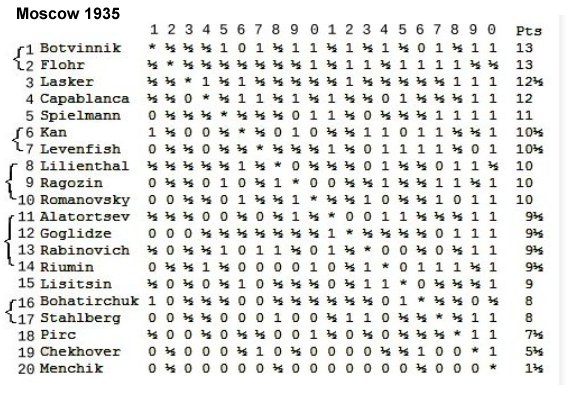
    Let’s take a look at one of the games...the one Soltis considers the sixth best game ever played. It’s Lilienthal vs. Ragozin, Moscow 1935. 
    After the 1925 Moscow tournament and the 1933 Botvinnik - Flohr match, Nikolai Krylenko, head of Soviet chess, wanted to test the Soviet players against the best Western players. To that end eight foreign players, including two former World Champions, were invited to play against 12 Soviet players.
 

    How great was the 1935 tournament? When Max Euwe's book Strategy and Tactics was published back in 1937 he used as examples seven games from the event, but this game was not one of them, probably because it did not fit the themes Euwe was discussing. 
    In the featured game, Ragozin sacrificed the exchange, not once, but twice and Soltis correctly thinks it was impressive. Botvinnik wrote that Ragozin played an extremely fine combination, perhaps one of the finest on record. Dutch GM Ham Timman wrote that it was, "One of the best games and one of the finer combinations ever recorded." 
    How great is the game, really? Stockfish 16’s long shadow dims the brilliance some, but not much. 

A game that I liked (Fritz 17)

[Event "Moscow"] [Site "?"] [Date "1935.02.16"] [Round "?"] [White "Andre Lilienthal"] [Black "Viacheslav Ragozin"] [Result "0-1"] [ECO "E24"] [Annotator "Stockfish 16"] [PlyCount "94"] {Nimzo-Indian} 1. d4 Nf6 2. c4 e6 3. Nc3 Bb4 4. a3 {At the time this game was played this, the Saemisch Variation, was the most popular continuation. Black cedes the two Bs, but gives white doubled Ps. For his part white hopes to establish a strong center. 4.e3 is preferred by modern players.} Bxc3+ 5. bxc3 c5 {Even today this is the main line, but it’s not the only choice black has. } 6. f3 {White’s strategy is to build up a strong center with the hopes of launching a K-side attack.} d5 7. e3 O-O 8. cxd5 exd5 {This is the choice of humans; engines prefer 8...Nxd5} 9. Bd3 Nc6 10. Ne2 Re8 11. O-O a6 {The beginning of a plan to expand on the Q-side.} (11... h6 {lead to an interesting idea by white.} 12. Ra2 {There's a point to this seemingly pointless move!} Be6 13. Nf4 Rc8 14. g4 Nd7 15. Qe1 Na5 16. Rg2 Nf8 17. h4 { and in Bratanov,Z (2332)-Acs,P (2542) Budapest 2000 white scored a quick win.}) 12. Qe1 {It's been suggested that white should have met black's Q-side expansion with 12.a4, but that seem unnecessary.} (12. g4 {didn't yield much in Erdogan,H (2282)-Ataman,A (2209) Antalya 2008 which continued} b5 13. Ng3 Qb6 14. Kh1 Ra7 15. g5 Nd7 16. Nf5 Nf8 17. Nd6 Rd8 18. Nxc8 Rxc8 {with a completely equal position.}) (12. a4 Bd7 13. Rb1 Na5 14. e4 dxe4 15. fxe4 cxd4 16. Bg5 Bg4 17. Bxf6 gxf6 18. cxd4 Bxe2 19. Qxe2 Qxd4+ {with equal chances.}) 12... b5 {A struggle is beginning to shape up over white’s intention to advance his e-Pawn.} 13. Qf2 Be6 (13... c4 {was played in Ochkoos,J (2240) -Walker,B (2265) Toronto 1993} 14. Bc2 Ra7 15. Ng3 Rb7 16. e4 {White has achieved his desired advance, but...} dxe4 17. fxe4 Ng4 18. Qf4 {Black has the clever} Nxd4 19. Rd1 (19. cxd4 {loses} Qxd4+ 20. Kh1 Qxa1) 19... Nxc2 20. Rxd8 Rxd8 21. Ra2 Rd1+ 22. Nf1 Ne1 23. Rd2 {Black put up a tough fight, but eventually lost.}) 14. h3 {A necessary precaution for when he advances his e-Pawn.} Ra7 {What sn interesting strategic move. The R can now move anywhere on the 7th rank to occupy whatever file it might be needed on.} 15. Bd2 { Just a simple developing move, but he might have considered 15.a4} (15. e4 { looks OK here as after} dxe4 16. fxe4 cxd4 17. cxd4 Bc4 18. Bxc4 bxc4 19. e5 Nd5 {Chances are about even as white's a-Pawn is at least as weak as black's c-Pawn.}) (15. a4 {At this point this seems to lead to a favorable position for white after} c4 16. Bb1 b4 17. cxb4 Nxb4 18. e4 {with the better position.} ) 15... Qb6 16. Rfb1 {Not bad because it restrains black's Q-side Ps, however, the best continuation was the aggressive 16.e4!} (16. e4 {and now black's best continuation is} Nd7 17. Nf4 Ne7 18. Be3 c4 19. Bc2 Rb7 20. Rfe1 a5 21. Nh5 Kh8 22. Qg3 Rg8 23. Rab1 {with a clearly more active position.}) 16... Rae7 { This hinders the advance of the e-Pawn.} 17. a4 {White has succeeded in undermining black’s Q-side.} (17. e4 dxe4 18. fxe4 Bc4 19. Bxc4 Nxe4 20. Qf4 cxd4 21. Kh1 Qd8 22. Ba2 Nxd2 23. Qxd2 Rxe2 {with a decisive advantage.}) 17... c4 18. Bc2 Bc8 19. Ng3 {Having restrained black on the Q-side, white now switches his attention to the K-side.} h5 {Why this move? It prevents white from expanding on the K-side. What about the fact that it weakens the position of black’s K? It doesn’t because white is in no position to take advantage of it...at least noit just yet.} 20. Ne2 (20. e4 {Black can safely meet this, but things can get really, really wild!} h4 21. Nf1 dxe4 22. fxe4 Nxe4 23. Qxh4 Bf5 24. axb5 axb5 25. Ne3 {Here black has the clever} Nxd4 26. cxd4 Qxd4 27. Qf4 {Watch this!} Bxh3 28. gxh3 g5 29. Qf5 Re5 30. Qg4 Qxd2 31. Qf3 Nf6 32. Nf1 Qxc2 33. Qxf6 Qd3 {and all the winning chances belong to black.}) 20... Nd8 21. Ra2 Bd7 22. axb5 axb5 23. Rba1 {An interesting situation has arisen. White, it seems, is clearly better, but exactly how can white exploit his advantage? The answer is far from clear.} Bc8 24. Rb2 {With nothing to be accomplished on the a-file he concentrated on the b-Pawn.} Bd7 {Defending the P so white's last move didn't accomplish much.} 25. Qh4 {Turning his attention back toi the K-side.} Ne6 26. Kh1 (26. e4 {is met by} dxe4 27. fxe4 Nf8 28. Nf4 (28. e5 Rxe5 ) 28... N8h7 29. Nd5 Nxd5 30. exd5 Qd6 31. Bxh7+ Kxh7 32. Qxh5+ Kg8 33. Rf1 f6 34. Rf2 Re4 35. Rb1 Rd8 36. Rbf1 Be8 {Black has successfully defended against all threats and established equality.}) 26... Nf8 27. Ng3 {Hoping to support the advance of his e-Pawn.} Rxe3 {This move has been called all kinds of superlatives and give a ! or two and practically so. Unfortunately, the coldblooded Stockfish still prefers white’s position by two Ps! Still, you have to like it.} (27... Qd6 {Prosaic and unimaginative. This is the move Stockfish likes.} 28. e4 dxe4 29. Nxe4 Nxe4 30. fxe4 Bc6 31. d5 {with the advantage.}) 28. Bxe3 Rxe3 29. Nxh5 {With this move all white's advantage slips away because there is no attack left.} (29. Rba2 {Back to the other side where black no longer hasd any pieces.} Qe6 30. Bf5 Ng6 31. Qg5 Re1+ 32. Kh2 Rxa1 33. Rxa1 Qc6 34. Nxh5 Bxf5 35. Qxf5 Nxh5 36. Qxh5 {with a clear (winning) advantage.}) 29... Nxh5 30. Qxh5 Bc6 {This doesn't hurt anything, but there was no reason to avoid capturing the c-Pawn.} 31. Qg5 (31. Rba2 {is better.} Rxc3 32. Qe5 {Black must exercise extreme care.} Rxc2 (32... Ne6 33. Ra8+ Bxa8 34. Rxa8+ Nf8 35. Qe7 Rxc2 36. Rxf8+ Kh7 37. Qxf7 Rc1+ 38. Kh2 c3 (38... Qf6 39. Qg8+) 39. f4 c2 40. Qg8+ Kg6 41. f5+ Kh6 42. Qh8+ Kg5 43. Qxg7+ {wins}) 33. Rxc2 b4 {and black can fight on.}) 31... Rxc3 {Excellent! It looks like black has trapped his own R, but this is the equalizing move. Yes, equalizing, not winning.} (31... Re2 {is a dud.} 32. Rba2 Qb8 33. Bf5 Rxa2 34. Rxa2 b4 35. cxb4 Qxb4 36. Ra7 g6 37. Qg3 Qb6 38. Rc7 Ba4 39. Rc8 Qxd4 40. Qd6 Qg7 41. Bb1 { Black's c- and d-Pawns fall leaving white with a tough, but technical, win. In Shootouts white scored 5-0., but they were long (70-80 move) games.}) 32. Qd2 Rxc2 33. Rxc2 Ne6 {This should have turned the advantage over to white again had he doubled Rs on the a-file.} (33... b4 {was essential.} 34. Rb2 b3 (34... c3 35. Qxc3) 35. Rbb1 Ne6 36. Rd1 Qb8 {and white can make no progress.}) 34. Rd1 (34. Rca2 Qxd4 35. Qxd4 Nxd4 36. Rd1 Ne6 37. Ra6 Be8 38. Rxd5 Nc7 39. Re5 Nxa6 40. Rxe8+ Kh7 41. Rc8 {Black's Ps are held up and white is free to activate his K so he does have some winning chances. In Shootouts white scored +4 -0 -1, but some of the games went nigh on to 100 moves.}) 34... b4 35. Rb2 b3 36. Qc3 {The Ps are held up, but it takes all of white's pieces to do it, so his material advantage means little.} Nc7 {[%mdl 1024] Black has compensation.} 37. Re2 Qa7 38. Qb4 {Threatening the winning 39.Re7 or 39.Qd6} Nb5 (38... Kh7 39. Qd6 (39. Re7 Bb5 40. Qd6) 39... Ba4 40. Re7) 39. Re7 Qa3 { The exchange of Qs would give black a significant advantage.} 40. Qe1 (40. Qxa3 Nxa3 41. Rc7 Ba4 42. Ra7 c3 43. Rxa4 c2 44. Rg1 b2 45. Rxa3 b1=Q 46. Rxb1 cxb1=Q+) 40... c3 {[%mdl 32] As bad as things look for white there is still no win available for black!} 41. Re8+ (41. Ra1 {is also quite good.} Qd6 42. Re8+ {A must play move.} Bxe8 43. Qxe8+ Kh7 44. Qxb5 {This position ius drawn. For example...} b2 45. Qd3+ Qg6 46. Qxc3 bxa1=Q+ 47. Qxa1) 41... Bxe8 42. Qxe8+ { [%mdl 4096] As precarious as white's position looks it's still possible to hold it.} Kh7 43. Qxf7 {A very fine move. Grabbing the N would lose.} (43. Qxb5 c2 44. Re1 c1=Q 45. Qd3+ g6 46. Rxc1 Qxc1+ 47. Kh2 b2) 43... Qa8 44. Re1 { [%mdl 8192] As many annotators have pointed out this threatens to win with 44. Qh5+, but they all missed that it's the losing move!!} Nd6 {And wins.} (44... c2 45. Qh5+ Kg8 46. Re8+ Qxe8 47. Qxe8+ Kh7 48. Qh5+ Kg8 49. Qxd5+ Kh8 50. Qh5+ Kg8 51. Qc5 {and white wins from this position...the best line being...} Nxd4 52. Qc3 Kh7 53. Kh2 Kh8 54. Qxd4 c1=Q 55. Qh4+ Kg8 56. Qd8+ Kh7 57. Qd3+ Kh8 58. Qxb3) 45. Qc7 c2 46. Qxd6 b2 47. Qf4 {This is white's last hope.} Qc6 { White resigned} (47... b1=Q {would ve a terrible mistake!} 48. Qf5+ {and now black has only one move that does not lose} g6 (48... Kg8 {Watch what happens!} 49. Rxb1 cxb1=Q+ 50. Qxb1 Qc6 51. Qb8+ Kh7 52. Qe5 {with a won Q+P ending}) 49. Qf7+ Kh8 (49... Kh6 50. Qf4+ Kh7 51. Qf7+ {draws}) 50. Qf6+ Kh7 51. Qf7+ Kh8 52. Qf6+ Kh7 53. Qf7+ $11) (47... Qc6 48. Qf5+ Kg8 49. Kh2 c1=Q 50. Rg1 Q1c2 { wins easily}) 0-1

Wednesday, December 6, 2023

Bashed By Mugridge

    
The 37th American Chess Federation Congress (the forerunner of the US Open) was held in Philadelphia, Pennsylvania from August 15-30, 1936 with a record turnout of fifty players who braved a Philadelphia heat wave. The temperatures approached 100 degrees. Back on July 8th and 10th the temperature had been 106 and 107 degrees! 
     The players had to play two games a day for two weeks. The players were seeded into four preliminary sections, from which the first three qualified for the Championship, the next three for the Consolation Masters, the next three for a Class A tournament. 
    Reuben Fine and Samuel Reshevsky were unavailable as they were participating in the big international tournament in Nottingham. A number of players withdrew rather than play in the final sections. The strong master George Treysman qualified for the Championship, but retired due to illness and was replaced by Milton Hanauer. 
    The Final turned out to be a three-way race between I.A. Horowitz, Arthur Dake and Arnold Denker and in the end, Horowitz prevailed to take the title just a half point ahead of Dke and Denker. 
    In the finals the players featured in today’s game from the preliminaries drew each other. Mugridge finished 7th with 4.5-6.5 and Hanauer finished tied for places 9-11 with 3.5-7.5. 
    The winner of this game was the little known Donald H. Mugridge (April 23, 1905 – November 3, 1964, 59 years old) who was born in Chicago, Illinois, but spent most of his adult life in Washington DC where he worked for the Library of Congress. 

    He was educated in the Chicago public schools and received his B.A. and M.A. degrees from the University of Southern California and at the Harvard Graduate School where he completed his graduate work in history. In his and college days he was a Harvard and District of Columbia chess Champion. He also won the Massachusetts Championship in 1932. 
     Before joining the Library of Congress in 1933, Mugridge served as a teaching fellow at the University of Southern California and as a research assistant. For 30 years he was a specialist in American History in the General Reference and Bibliography Division of the Library of Congress and was a leading authority in his specialty. In that capacity he was widely known to scholars throughout the country. Also, he was the author of a number of articles and book reviews on historical journals. 
     Mugridge edited and contributed extensively to the monumental Guide to the Study if the United States of America, an annotated bibliography of books on the development of American life and thought. The book was published by the Library of Congress in 1960. In recognition of the significant contributions to research the Library honored him in April of 1961 with a Superior Service Award. 
    The third USCF rating list was published in November, 1951. Reshevsky(2747) topped the list of 22 Masters followed by Fine (2711). Mugridge was ranked 17th at 2359. 
    An October 1937 article in Chess Review on the mannerisms of Masters had this to say about him: "Mugridge is a head-holder and chin-nurser par excellence. Being of a more restful nature than Winter, he does not seek to find out whether his head can be screwed on or off." Mugridge died prematurely in his home on Tuesday, November 3, 1964 of a coronary thrombosis. He left no immediate survivors.

  A game that I liked (Fritz 17)

[Event "ACF Congress, Philadelphia"] [Site "Philadelphia, PA USA"] [Date "1936.08.??"] [Round "?"] [White "Donald Mugridge"] [Black "Milton Hanauer"] [Result "1-0"] [ECO "D26"] [Annotator "Stockfish 16"] [PlyCount "57"] [EventDate "1936.??.??"] {D26: Queen's Gambit Accepted} 1. d4 d5 2. c4 dxc4 3. Nf3 Nf6 4. e3 {This seemingly slow continuation sometimes contains more venom that it would appear} e6 5. Bxc4 Be7 6. O-O c5 7. Qe2 cxd4 (7... O-O 8. dxc5 Bxc5 9. a3 a6 10. b4 Be7 11. Bb2 {is equal. Naumkin,I (2480)-Barlov,D (2460) Gioiosa Marea 1996}) (7... Nc6 {is less favorable for black.} 8. Rd1 Qc7 9. Nc3 O-O 10. e4 {White has an active position. Unuk,L (2110)-Bajlo,K (2096) Opatija CRO 2014}) 8. Rd1 O-O 9. Nxd4 Qb6 10. Nc3 e5 11. Nb3 Nc6 12. Bd2 Bg4 13. f3 {Wrong retreat...better would have been either 13...Bf5 or 13...Bd7} Bh5 14. Na4 (14. g4 {was a promising alternative.} Bg6 15. Rac1 a5 16. Na4 {followed by e4}) 14... Qc7 $14 15. e4 Nd4 {After this white has slightly the better game, but it’s hard to suggest an active plan for black.} 16. Nxd4 exd4 17. Rac1 {Threatening 18. Bxf7+ winning the Q.} Qe5 18. Be1 {The immediate 18.g4 was plausible.} Rfd8 ( 18... Bd6 19. Bg3 Qe7 20. e5 {wins}) 19. b4 Rac8 {This prevents white from playing Nc5} 20. g4 {[%mdl 2048]} Qg5 {It has become increasingly difficult to suggest anything really promising for black, but after this move white gets a decisive advantage.} (20... b5 {sacrificing a P which helps ease the pressure is his best try.} 21. Bxb5 Rxc1 22. Rxc1 d3 23. Bxd3 Bg6 {but here, too, black would lose in the long run.}) 21. Bd2 Qg6 {White still has to be very careful+/ - The immediate threat is ...Nxg4} 22. h3 (22. Nc5 {A pass to demonstrate the threat.} Nxg4 23. fxg4 Bxg4 24. Qg2 Bxd1 25. Qxg6 hxg6 26. Rxd1 b6 27. Rf1 Rf8 28. a4 bxc5 29. bxc5 Bxc5 {and black is winning.}) 22... Rxc4 {This move sets a clever trap which Mugridge does not fall for.} 23. Rxc4 {[%mdl 32]} (23. Qxc4 {loses the game!} Nxg4 24. hxg4 Bxg4 25. fxg4 Qxg4+ 26. Kh1 Qf3+ 27. Kg1 Rd6 28. Qc8+ Bd8 29. Bg5 Qg3+ 30. Kf1 Qxg5 {Materially speaking black only has 3 Ps for the R, but he has a winning position. Black won 5 Shootouts...here is the continuation at 17 plies...} 31. e5 Qf4+ 32. Ke1 Qe3+ 33. Kf1 Qf3+ 34. Ke1 d3 35. Kd2 Qe2+ 36. Kc3 Rc6+ 37. Qxc6 bxc6 38. Rxd3 Bc7 39. Rcd1 h5 40. Kb3 Bxe5 41. R3d2 Qg4 42. Nc5 h4 43. Ka4 h3 44. Rf1 Bd4 45. Rc1 Be3 46. Rcc2 Bxd2 47. Rxd2 g5 {and the game is over.}) 23... b5 (23... Nxg4 {The above trick doesn’t work now because White’s Q covers g4.} 24. hxg4 Bxg4 25. fxg4) 24. Rc5 {[%mdl 512]} bxa4 25. Rg5 Qh6 26. Rxh5 Qg6 27. Rg5 Qh6 28. Re5 Qh4 29. Be1 {This leaves black helpless; he loses a Rook and so black resigned.} (29. Be1 Qh6 (29... Qxh3 30. Rxe7 h5 31. e5 {White is winning here also.}) 30. Rxe7 Rd7 31. Rxd7 Nxd7 32. Rxd4) 1-0

Tuesday, December 5, 2023

A Fatal King Walk


     Before the Elo system, the Soviets, as explained in the November 28th post, Short, Ultra-Sharp Game by Nezhmetdinov, had a rating system in place. 
     Because they had millions of players as compared to a mere handful in the US for example, they had hundreds, if not thousands, of players who by today's standards were of Master strength. Even after the Elo system, which is based on the Bell curve, was adopted the Soviets dominated the scene, but the number of Master’s in the Soviet Union had nothing to do with “secret” training methods.
     Many things have been said about the Soviet School of Chess and how it produced legions of good players due to the elaborate system of chess education.
     As a former member of the Soviet System, American GM Alex Yermolinksy wrote that there was no building with a sign, 'The Soviet School of Chess”. He also emphasized that there were no secret methods of teaching chess. His highly decorated teacher was Vladiimir Zak, who had a real knack for judging talent, but once a player reached the 1800 level Zak’s training methods weren’t much help.
     During the 1940’s or 1950’s until the Bobby Fischer era there’s no doubt that the Russians had established a hegemony and dominated the field. And why not? The Russian government, acting as sponsors, promoted a huge program of chess activity and subsidized its top players. During the Fisher Boom chess became more popular and with the increase in the number of players worldwide, more non-Soviet talent emerged. 
     The following game was played in the 1949 Bolshvik Chess Club Championship in Odessa. It was a strong event as can bee seen from the crosstable...most of the top finishers are, or in their day were, well known. The Soviets were big on opening theory and, as you can see, the opening line in this game was, even in 1949, quite modern as it was still being used in games in the 2000’s.
 

     What makes the game unique is that on move 20 Grechkin’s King was setting fairly safely on g7, but on move 28 it began a journey to c4 where it sat in front of its own pieces and met its doom. 

  A game that I liked (Fritz 17)

[Event "Bolshevik CC Champ, Odessa"] [Site "Odessa (Ukraine)"] [Date "1949.??.??"] [Round "?"] [White "Vasily Panov"] [Black "Dmitri Grechkin"] [Result "1-0"] [ECO "B80"] [Annotator "Stpckfish 16"] [PlyCount "69"] [EventDate "1949.??.??"] {B80: Sicilian Scheveningen} 1. e4 c5 2. Nf3 e6 3. d4 cxd4 4. Nxd4 Nf6 5. Nc3 d6 {The d6–e6 Pawn center is a solid, flexible defensive setup that affords black the possibility of a center break with either ...d5 or ...e5.} 6. g3 { This is mot played very often, but it actually yeilds good results for white. The main moves are 6.Ne2 and 6.g4} a6 7. Bg2 Qc7 8. O-O Be7 9. Be3 O-O 10. Qe2 Nc6 11. Rad1 Bd7 12. Nb3 b5 13. a3 Bc8 {Black has tried several moves here, but the most active choice is 13...Ne5} 14. f4 Bb7 {The fact that black's time wasting B maneuver has not cost him anything is a good example of how limited white's attacking chances are and how solid black's position is. how limited} 15. g4 Nd7 16. g5 Nb6 {Not bad by any means, but the rock solid 16...Rae8 was to be preferred.} (16... Rae8 {This renders white's next move harmless. For example...} 17. f5 exf5 18. Nd5 (18. exf5 Bxg5) 18... Qc8 19. Bf4 f6 {seizing the initiative.}) 17. f5 {uddenly white's position is starting to look very promising.} Nc4 (17... exf5 18. exf5 Rae8 19. f6 Bd8 20. fxg7 Kxg7 21. Nd4 Nc4 22. Nd5 Qc8 23. Nf5+ {with the better psoition.}) 18. f6 Bd8 19. Bc1 N6e5 20. fxg7 {After thins white's advantage is minimal.} (20. Qh5 {packs a real punch.} Re8 21. Nd4 Rc8 22. fxg7 Qe7 23. Rf6 {and black is in very serious trouble. A smple line...} Ng6 24. Rd3 Kxg7 25. Rh3 Rh8 26. Qh6+ Kg8 27. Nxe6 fxe6 28. Rxg6+) 20... Kxg7 21. Nd4 Nc6 {Retreating the N from the center is the wrong strategy.} (21... Rg8 {leaves white unable to mount a decisive attack.} 22. h4 Ng6 23. h5 Nh4 24. Rd3 Kh8 25. Rg3 Rg7 26. Qf2 Nxg2 {and black should be able to hold his position.}) 22. Nxc6 (22. Qh5 {is no longer so powerful. After} Nxd4 23. Rxd4 Ne5 24. Bf4 {White is better, but the win is still a long way off.}) (22. Nxe6+ {This sacrifice packs a wallop.} fxe6 23. Rxf8 Kxf8 24. Rf1+ Ke7 25. Qh5 Kd7 {White now has another strong blow at hos disposal...} 26. Nd5 Qa5 (26... exd5 27. Bh3+ Ke7 28. Qf7#) 27. Qxh7+ Ne7 28. Nxe7 Bxe7 29. g6 { White's advantage is decisive.}) 22... Qxc6 23. Rd3 {A typical Rook lift.} Bb6+ 24. Kh1 Ne5 25. Rh3 {Qh5 is the strong threat.} Rh8 26. Qh5 Ng6 27. Ne2 { [%mdl 32] Watch this N!} f5 {He could have put up seriosu resistance with 27... Kf8} (27... Kf8 {was the best he had, but after} 28. Rhf3 Qc7 29. Bd2 Rd8 30. Qh6+ Ke8 31. Rxf7 Qxf7 32. Rxf7 Kxf7 {Technically white is winning, but in practice things could be different!}) 28. gxf6+ Kf7 29. Nf4 {Intending Qxh7+! and mate.} Rag8 ({A oass to demonstrate the threat.} 29... a5 30. Qxh7+ Rxh7 31. Rxh7+ Ke8 32. f7+ Kd8 33. Nxe6+ Kc8 34. f8=Q+ Nxf8 35. Rxf8+ Qe8 36. Rxe8+ Bd8 37. Rxd8#) (29... Qxe4 {This avoids white's next move, but it should still lose, it makes white work for the point after...} 30. Bxe4 Bxe4+ 31. Ng2 Rac8 32. Qh6 e5 33. Rg3 Bd4 34. c3 Bc5 {White may be winning, buty he has a long row to hoe.}) 30. Qxh7+ {[%mdl 512] Very nice!} Rxh7 31. Rxh7+ Kxf6 32. Nd5+ Ke5 33. Rh5+ Kd4 34. Be3+ Kc4 35. b3# {A captivating finale.} 1-0

Sunday, December 3, 2023

Jonkoping 1958/59

     The year 1958 started off with Raymond Weinstein winning the US Junior championship in Homestead, Florida and 14-year old Bobby Fischer winning the US Championship which was also a Zonal. 
     In early May, Mikhail Botvinnik defeated Vasily Smyslov, 12.5 to 10.5 to regain the world championship. 
     Two players were lost that year. On January 19, 1958, Edmund Adam (1894-1958) died in Frankfurt, Germany at the age of 63 on January 19eth. He was a correspondence Master and served as as president of the German Correspondence Chess Association from 1946 to 1956. 
     On September 11, 1958, IM Carl Carls (1880-1958) died at the age of 77 in Bremen, Germany. He was German champion in 1934. In October the 13th Olympiad began in Munich, Germany. 
     Of course, the Soviet team (Botvinnik, Smyslov, Keres, Bronstein, Tal, Petrosian) won again. The US team (Reshevsky, Lombardy, Bisguier, Evans and Rossolimo) finished fourth behind Yugoslavia and Argentina. 
     A long-forgotten tournament in Jonkoping, Sweden began on December 27, 1958 nd ended January 4, 1959. Jonkoping is in southern Sweden and today it’s home to 112,766 inhabitants. It’s situated on the southern shore of Sweden's second largest lake, Vattern. Only three titled players participated: Kotov and Rgozin were GMs and Barda was an IM.
 

     The winner of the below game was Olaf Barda (August 17, 1909 – 2 May 2, 1971). He was the first Norwegian awarded the International Master title which he received in 1952. Barda won the Norwegian Championship six times, 1930 (only then under the bame of Olsen), 1947, 1948, 1952, 1953 and 1957. He also wrote a chess column. His eldest son Yngvar Barda (1935–1999) also was chess master.
     Barda was a strong correspondence player, winning the Norwegian correspondence championship in 1946 and 1949/1950. He received the title of Correspondence GN title in 1953 and finished fourth in the First World Correspondence Championship. His opponent was Hans Ek (1928-2014) who won the Swedish Correspondence Championship in 1967. 
     Most of the game is pretty boring, but the finish is pleasing.

  A game that I liked (Fritz 17)

[Event "Jonkoping"] [Site "Jonkoping"] [Date "1958.??.??"] [Round "?"] [White "Olaf Barda"] [Black "Hans Ek"] [Result "1-0"] [ECO "A10"] [Annotator "Stockfish 16"] [PlyCount "77"] [EventDate "1958.??.??"] {A26: English Opening vs King's Indian} 1. c4 d6 2. g3 g6 3. f4 Bg7 4. Nf3 e5 5. d3 Ne7 6. Nc3 Nbc6 7. Bg2 O-O 8. O-O Bd7 (8... exf4 9. gxf4 d5 10. cxd5 Nxd5 11. Nxd5 Qxd5 {Neither side has much to brag about.}) 9. e3 (9. Bd2 a6 10. a3 Qc8 11. Rf2 Kh8 12. Rc1 Bg4 13. e3 {is equal. Nei,I (2365)-Aurlund,K Berlin 1998}) 9... Qc8 10. Nd5 Nxd5 11. cxd5 Ne7 12. fxe5 dxe5 13. e4 Qd8 14. Qb3 b6 { Striking at the center with 14...c6 was a better option.} 15. Bd2 $14 c5 16. Rac1 Nc8 17. Bc3 Qe7 18. Nd2 Bh6 {This is good enoughto keep the position evenly balanced.} (18... b5 {This (apparently) too tactical for black who prefgers to play quietly (passively(.} 19. Ba5 Nd6 {This tactical route requires precise play on black's part.} 20. Rxc5 Nb7 21. Rxb5 Nc5 (21... Bxb5 22. Qxb5 Nxa5 23. Qxa5 {and white is better.}) 22. Qc4 Bxb5 23. Qxb5 Rab8 24. Qc4 Nxd3 25. Qxd3 Qc5+ 26. Kh1 Qxa5 {with an unclear position that would be challenging to both sides. In Shootouts black won 2 games and three were drawn. }) 19. Rce1 {Be prepared to be bored for the next few moves.} Nd6 20. Nc4 $14 f6 21. Nxd6 Qxd6 22. Qa3 a5 23. d4 {With this move white gets aggressive, but with care black should be able to hold his own.} exd4 24. Bxd4 Bd2 25. e5 { A good followup to his 23rd move.} Qb8 (25... fxe5 {was also playable, but the complications are head whirling.} 26. Bxe5 Rxf1+ 27. Bxf1 Qf8 28. d6 Qf7 (28... Bxe1 {loses} 29. Bc4+ Qf7 30. Bxf7+) 29. Re4 Bc6 30. Qd3 (30. Re2 Rf8 (30... Rd8 31. Rxd2 Bd5 32. Qd3 Bc6 33. Rf2 Qe6 34. Qc4 Qd5 35. Qxd5+ Bxd5 {is winning for white.}) 31. Bh3 Bb4 32. Qd3 c4 33. Qd1 Bf3 {Blavk wins.}) 30... Bg5 31. Re2 c4 32. Qd4 Qf3 33. Bg2 Qxe2 34. Bd5+ Bxd5 35. Qxd5+ Kf8 36. Qxa8+ { with a likely draw.}) 26. Bc3 Bxe1 27. Rxe1 fxe5 28. Bxe5 Qc8 29. Qe3 Rf7 { [%mdl 8192] This should lose.} (29... Bb5 30. d6 Bc6 31. Bc3 Re8 {with an unclear position where blacj should be OK. A sample continuation...} 32. Qf2 Bxg2 33. Rxe8+ Qxe8 34. Qf6 Qe3+ 35. Kxg2 Qe2+ 36. Kg1 Qd1+ {draws}) 30. d6 { Missing the win, but the winning move is a difficult to find retreat.} (30. Bc3 Qe8 31. Qg5 Qf8 32. Qe5 Rg7 33. Qxg7+ Qxg7 34. Bxg7 Kxg7 35. Re7+) 30... Bc6 { [%mdl 8192] Black has again missed white's winning retreat} (30... Qf8 { Agter this white can only claim a modest advantage.} 31. Qb3 Re8 32. Bd5 a4 33. Qxb6 Be6 34. Qxc5 h5 {and 5 Shootouts were drawn.}) 31. Bc3 {This time Barda does not miss the winning move and black is not given another chance.} Raa7 32. Qe5 Rg7 33. Bd5+ Bxd5 (33... Kh8 34. d7 Qxd7 (34... Raxd7 35. Qe8+ Qxe8 36. Rxe8#) 35. Qb8+ Qd8 36. Qxd8+ Be8 37. Qxe8#) 34. Qxd5+ Rgf7 35. Re7 Raxe7 36. dxe7 Qe8 37. Bf6 {Preparing a nice finish.} b5 38. Qd8 Rxe7 39. Qxe7 {Black resigned...the ending is lost.} (39. Qxe7 Qxe7 40. Bxe7 c4 41. Bd8 a4 42. Ba5 { With the black Ps held up all white has to do is bring up his K.} Kf7 43. Kf2 Ke6 44. Ke3 Kd5 45. Bc3 Kd6 (45... h6 46. a3 h5 47. h4 {Black's K must mow yield.} Kd6 48. Ke4 Ke6 49. Kf4 Kd5 50. Kg5) 46. Kd4 Kc6 47. Bb4 Kb6 48. Kd5 Kc7 49. Kc5 {etc.}) 1-0

Thursday, November 30, 2023

Open Files Are Important

     Officially, the 1913 Scheveningen tournament celebrated the 40th Anniversary of the Nederlandschen Schaakbond, and was held in Scheveningen from July 28-August 8 and it was one of the twenty-year-old Alekhine’s early victories. 
     Edward Lasker was invited at the last minute as a replacement for Nimzovich who had fallen ill. 
     Of the Dutch players Adolf G. Olland (1857-1933, 66 years old), a medical doctor, was the only one with an international reputation. He was the leading Dutch chess master in the time before Max Euwe. 
     Ollan was unofficial Dutch champion in 1895 and 1901 and official champion in 1909. Besides being an active tournament player, he also played a number of matches...29 in all! Olland died of a heart attack playing in the 1933 Dutch Championship at The Hague. 

     Dr. Olland died of a heart attack while playing hos game against A. Hamming, in the 1933 Dutch Championship at The Hague.
     Edward Lasker (188501981, 95 years old) was born in a part of the German Empire that is now in Poland. Before World War I he moved to London, England, but after the outbreak of the war he left the UK for the United States. 
     When America entered the war, he was sent enlistment papers, but with the right of exemption as a German. He waived his right to exemption, hoping that may expedite his request for American citizenship; however, the war was over before he was called. FIDE awarded him the IM title in 1961. Lasker also authored several books. 
 
     In the following game Olland gives us a lesson on the importance of an open file. 

  A game that I liked (Fritz 17)

[Event "Scheveningen"] [Site ""] [Date "1913.07.30"] [Round "?"] [White "Adolf G. Olland"] [Black "Edward Lasker"] [Result "1-0"] [ECO "C83"] [Annotator "Stockfish 16"] [PlyCount "83"] [EventDate "1913.07.28"] {C83: Open Ruy Lopez} 1. e4 e5 2. Nf3 Nc6 3. Bb5 a6 4. Ba4 Nf6 5. O-O Nxe4 { In the Open Ruy Lopez black tries to make use of the time white takes to regain P to gain a foothold in the center. This defense was to become a favorite of Euwe.} 6. d4 b5 (6... exd4 {is inferior.} 7. Re1 d5 8. Nxd4 Bc5 9. Bxc6+ bxc6 10. f3 (10. Nxc6 {is a loser...} Bxf2+ 11. Kh1 Bxe1 12. Qxe1 (12. Nxd8 Nf2+ 13. Kg1 Nxd1 14. Nc6 Bf2+ 15. Kf1 Bb6 16. Ke2 Bb7 17. Kxd1 Bxc6 {wins }) 12... Qd6 {with the advantage.}) 10... Qh4 11. g3 {Black's attack is at a standstill and white's position is superior.}) 7. Bb3 d5 (7... exd4 {is wrong because after} 8. Re1 d5 9. Nc3 Be6 (9... dxc3 {loses} 10. Bxd5 Bb7 11. Bxe4 { White is winning.}) 10. Nxe4 dxe4 11. Rxe4 {and black is at a disadvantage. Robert Fischer - Dr. Petar Trifunovic, Bled 1961}) 8. dxe5 Be6 9. c3 Be7 10. Be3 O-O 11. Qd3 {The customary move is 11.Nbd2. Olland's move apparently was played with the idea of playing Rd1 attacking the d-Pawn three times. However, black can easily meet the threat.} (11. Nbd2 $14 Qd7 12. Re1 Rad8 13. Bc2 { is the main line.}) (11. Re1 {is not quite up to par.} Na5 12. Bc2 Nc4 13. Bc1 Bc5 14. Nd4 Nxf2 15. Kxf2 Qh4+ {Black went on to win. Efimenko,Z (2590) -Kaidanov,G (2629) Moscow 2003}) 11... Na5 {This continuation enables an early advance of the c-Pawn and gains black the initiative on the Q-side.} 12. Nbd2 ( 12. Rd1 {is now met by} Nc4 {and black is completely equal.}) 12... Nxb3 $146 { Lasker admitted that the better 12...c5 did not occur to him because he missed the fact that white can’t take on e4 because 13...c4 wins a piece.} (12... c5 {Five years later Rubinstein did not miss the fact that this is better.} 13. Bc2 (13. Nxe4 {is a blunder.} c4 14. Nf6+ gxf6 15. Qe2 cxb3) 13... Bf5 14. Nxe4 Bxe4 15. Qe2 Nc4 {and the game was eventually drawn. Schlechter,C-Rubinstein,A Berlin 1918}) 13. axb3 Nxd2 14. Qxd2 c5 15. b4 {Risky! Both players missed the fact that after this black has a promising continuation with 15...d4 which would have given black Ps on the a- and b-files. It’s true that white gets a P in the center, but it would not be able to advance any time soon.} (15. Bg5 Bxg5 16. Nxg5 h6 17. Nxe6 fxe6 {The position is completely even.}) 15... cxb4 ( 15... d4 16. cxd4 cxb4 17. Bg5 Bd5 18. Rfc1 a5 19. Bxe7 Qxe7 20. Rc5 Qd7 { Stockfish was left to analyze this position for about 30 minutes and up to move 44 the position was judged equal.}) 16. cxb4 Qd7 17. Rfc1 (17. Bc5 Rfc8 18. Rac1 {with a slight advantage.}) 17... f6 {Lasker has failed to realize that trying to stop white's operations on the c-file is much more important than his own plan of opening the f-file because white’s f2 is well protected while black’s c7 is not.} (17... d4 {This is still the right move. Note that if white ha played 17.Bc5 then 17...d4 is not an option.} 18. Bxd4 Rfd8 19. Qc3 Bd5 20. Bc5 {and the position is roughly equal.}) 18. Bc5 fxe5 19. Nxe5 { White now has a the edge as black has been forced into a passive position.} Qe8 20. Nc6 Bxc5 21. Rxc5 Rf6 22. Re1 Qf7 23. Ne5 Qb7 24. Rec1 Raf8 {Lasker thought perhaps he had drawing chances afte 24...Rc8, but the text is actually his best move. Even so, as it is he drifts into a hopeless, purely defensive game.} (24... Rc8 {After about 15 minutes Stockfish can up with the following line...} 25. Rxc8+ Bxc8 26. Rc6 Be6 27. h3 {White stands better and in Shoots outs scored +2 -0 =3 so there is not a lot of difference between Lasker's suggestion and the move played.}) 25. f3 {[%mdl 32]} Qb8 26. Rc7 Rf4 27. R1c6 { White's Rs on the open file are far more potent than black's on the semi-open file.} Qd8 28. g3 (28. Rb7 {was even stronger.} Bh3 29. Rcc7 {The Rs on the 7th rank spell victory.} (29. gxh3 Qg5+ 30. Kh1 Qxe5 {and now it's black that has the advantage.}) 29... Qg5 30. Rxg7+ Qxg7 31. Rxg7+ Kxg7 32. gxh3 {with a winning advantage. For example...} d4 33. Kg2 R8f6 34. Kg3 R4f5 35. Qxd4 { Black can only mark time.}) 28... R4f5 29. Qd4 Bf7 30. f4 Rf6 31. Rc5 {[%mdl 32]} Be6 32. Rb7 Kh8 33. Rcc7 {With black's pieces completely tied up white can win at his leisure.} Rg8 34. Nc6 Qf8 35. Ne7 Qe8 36. Nxg8 Bxg8 37. Re7 Qg6 38. Rxg7 Qb1+ 39. Kg2 {[%mdl 32]} Qc2+ 40. Kf3 Qb3+ 41. Kg4 Be6+ 42. Kg5 { Black resigned. White's K has avoided the checks and he now has a mate in 5.} ( 42. Kg5 Rf5+ 43. Kh6 Rh5+ 44. Kxh5 Qd1+ 45. Rg4+ Qxd4 46. Rb8+ Bg8 47. Rgxg8#) (42. Kg5 h6+ 43. Kxf6 Qc2 44. Rh7+ Kg8 45. Rbg7+ Kf8 46. Rh8+ Bg8 47. Rhxg8#) 1-0

Wednesday, November 29, 2023

Judd Clouts Johnston

     One television station has broadcast the slogan, “Cleveland, the Best Location in the Nation”. Don’t believe it. In Cleveland the summers are warm, humid and partly cloudy and the winters are very cold, snowy, windy and mostly cloudy. The snowy period lasts for four months, from December to April, but snow in November and May doesn’t surprise anybody. Violent weather like thunderstorms, tornadoes, flooding and blizzards are not unknown. 
     The Second American Chess Congress was held in Cleveland in 1871, the beginning of the city’s Gilded Age of the 1870s. The years following the Civil War were a time of great growth and progress in Cleveland, a time when industry took root and immigrants began to build up the land Moses Cleaveland founded in 1796. With a population of about 93,000 it was the 15th largest city in the country. Today it ranks 54th. 
     Only nine players showed up to compete for what was even in 1871 a measly prize fund of $100, the equivalent in purchasing power of about $2,521.89 today,
     The entrants were: George H. Mackenzi of New York City, Henry Hosmer of Chicago, Frederic Elder of Detroit, Max Judd of Cleveland, Preston Ware of Boston, H.D. Smith of Cassoplis, Michigan, Henry Harding of East Saginaw, Michigan, Arthur Johnston of Cincinnati, Ohio and W.B. Haughton of Chicago. 
 
 
     The following brevity from the event is quite entertaining. The player with the white pieces was Arthur Johnston (1841-1919) who was botn in London, England. He immigrated to the United States in 1861 and shortly thereafter fought in the Civil War as a member of Company A, Illinois 4th Cavalry. 
     After the war, he became court reporter for the Federal Court in Cincinnati, Ohio. In 1865 he was secretary of the Cincinnati Chess Club. 
     By 1874, he was living in Santa Ana, California, where he engaged in farming and raised orchids commercially. Later he gave up those endeavors and returned to being a court reporter and public stenographer. He authored two or three books on the relations of Great Britain and the United States. 
     In 1894 he competed in the Southern California Correspondence Chess in which he finished second. 
     After his wife died in 1911, he began to travel, taking a pleasure trip to Canada and visiting Cincinnati. His remaining years were spent in Asheville, North Carolina and wintering in Jacksonville, Florida. Johnston died of cancer at a hotel in Jacksonville. His body was returned to Santa Ana where he was interred next to his wife. 
     Max Judd (18101906) was born in Poland and emigrated to the United States in 1862. Judd was founder and president of the Saint Louis Chess Club. He was appointed by President Cleveland as the U.S. Consul General to Austria. His brothers Maurice and Isidor were amateur players. It’s hard to say how strong Judd was, but Chess metrics estimates his highest ever rating to have come in 1882 when his rating is estimated to have been 2610 ranking him at #9 in the world. The top players on that list were Zukertort, Steinitz, Mackenzie, Blackburne, Winawer, Mason, Englisch, Paulsen< Judd and Wittek. 
     Don’t be surprised if you never heard of Alexander Wittek (1852-1894) who was an Austrian-Hungarian architect and chess master. 
     As an architect, Wittek worked in Bosnia and Herzegovina during Austro-Hungarian Empire. His most well-known works in Sarajevo are the City Hall building which later became the National Library and the Sebilj public fountain. As a chess master he tied for 5–6th at Berlin 1881, the 2nd DSB–Congress which was won by Blackburne. He finished 9th in Vienna 1882, which was won bySteinitz and Winawer won). 
     Wittek died in a lunatic asylum in Graz in 1894, having been diagnosed with a "paralytic mental disorder" the previous year. This is a disorder in which mental health issue disrupt how the brain works. It causes real, physical symptoms that a person can't control. Symptoms can include seizures, weakness or paralysis, or reduced input from one or more senses like sight, sound, etc. One source says that he committed suicide, but another cites tuberculosis. 

A game that I liked (Fritz 17)

[Event "2bd American Congress, Cleveland, Ohio"] [Site "Cleveland, OH USA"] [Date "1871.??.??"] [Round "?"] [White "Arthur Johnston"] [Black "Max Judd"] [Result "0-1"] [ECO "B21"] [Annotator "Stockfish 16"] [PlyCount "48"] [EventDate "1871.12.??"] {B21: Sicilian Defense} 1. e4 c5 2. f4 {I am not sure what to call this opening: the Grand Prix (2.f4), the Alapin (2.c3) or the Kopec System (2.Bd3), It's probably a hybrid..Bd2} e6 3. Nf3 Nc6 4. c3 Be7 {After 4...Nf6 white has tried 5.Bd3 and 5.e5, Black has also played 4...Nge7 and 4...h6. All are reasonable moves, but 4...d5 seems the best move.} 5. Bd3 d5 6. e5 Qb6 7. Bc2 Nh6 {Thanks to his 4th move this rather poor position for the N is the only reasonbale way to try and get it into play. ...Nf5 is a possibility, but it' curious that the N remains here until it delivers mate!} 8. a3 {Rther than stopping short white should have moved this P on square further, or he could have castled.} O-O 9. d4 c4 {Closing the position was not the best idea because now white's position is the more active. 9...f6 or even 9...cxd4 would have been preferable.} 10. h4 (10. Nbd2 {was better.} f6 11. exf6 gxf6 12. Nf1 Bd7 13. Ne3 {with a promising position.}) 10... f6 11. exf6 Bxf6 12. Ng5 { [%mdl 8192] This attacks h7, but it's premature. White should have castled.} e5 {A brilliant and surprising move that leaves white's K fatally explosed.} 13. dxe5 (13. Bxh7+ Kh8 14. O-O Bg4 15. Qc2 exd4 {rips the guts out of white's position!} 16. cxd4 Nxd4 17. Qf2 Ne2+ 18. Kh1 Qxf2 19. Rxf2 Nxc1 20. Bg6 Bd4 21. Rd2 Nb3) 13... Bxe5 {[%mdl 512] There's no point in being picky and pointing out that 13...Nxe5 was a wee bit better because in either case black is winning.} 14. Qxd5+ Kh8 15. Qe4 {At least Johnston avoids the worst!} (15. fxe5 {results in mate...} Qf2+ 16. Kd1 Bg4+ 17. Nf3 Rxf3 18. gxf3 Bxf3+ 19. Qxf3 Qxf3+ 20. Kd2 Rd8+ 21. Ke1 Qxh1+ 22. Ke2 Qg2+ 23. Ke1 Ng4 24. Be3 Nxe3 25. Bd3 Rxd3 26. Nd2 Qxd2#) (15. Nxh7 {is equally hopeless.} Bxf4 16. Bxf4 Rxf4 { White's K is fatally caught in the center.} 17. Qd2 Bf5 18. Qxf4 Bxc2 19. Ng5 Re8+ {wraps it up.}) (15. b4 {is the best white has, For example...} Re8 16. Kf1 Bf6 17. Qxc4 (17. Bd2 Bg4 18. Be4 Re7 19. Qc5 Qd8 20. Qxc4 Qe8 {Here, too, white is in a lot of trouble.}) 17... Bg4 18. Be4 Rac8 19. Qc5 {Black is clearly better, but he has no forced win.}) 15... Bf5 16. Qe3 Qxe3+ {Even the trade of Qs can't stop Judd's attack.} (16... Bd4 17. cxd4 Rae8 {is also good}) 17. Bxe3 Bxc2 18. fxe5 Nxe5 19. Kd2 {Materially white is not too badly off as he has a B+P vs a R, but he he has three undeveloped pieces and his K is exposed. Judd's attack is merciless} Bd3 20. Bd4 Rf5 21. Re1 Nc6 {[%mdl 32] Heading for b3. White can't do anything but wait.} 22. Nf3 (22. a4 {is met by} Nxd4 23. cxd4 Rf2+ 24. Kc3 Rc2+ 25. Kb4 Rxb2+ 26. Ka3 Rb3+ 27. Ka2 {but this position is equally hopeless.}) 22... Na5 {At least had white played 22.a4 his K ended up on a square where is was sheltered from mate, but now it's driven to it's doom.} 23. Ke3 {White commits suicide.} (23. Re3 Nb3+ 24. Kd1 Nxa1 { with an easy win.}) 23... Nb3 24. Ra2 (24. Kf2 Nxa1 {...and wins.}) 24... Ng4# {A fine attacking exhibition by Judd.} 0-1

Tuesday, November 28, 2023

Short, Ultra-Sharp Game by Nezhmetdinov

     In Russia, back in the early days before rating systems, the Master title could be earned by scoring 50 percent in the Soviet Championship, by winning a match from an established Master, by drawing two matches with an established Master or by winning a tournament that had at least three Masters participating. 
      In 1948, Vladas Mikenas and Rashid Nezhmetdinov played a natch for the Master title, but I am not sure which player was attempting to gain the Master title, but I strongly suspect that it was the Lithuanian Mikenas. In any case, the match ended in a 7-7 tie. 
     Vladas MikÄ—nas (1910-1992) was a chess legend in Lithuanian, an International Master, an Honorary Grandmaster and a journalist. He was one of the most outstanding players from the Baltic's prior to World War II. He emigrated from Estonia to Lithuania in 1931. After Lithuania was annexed by the USSR in 1940, he also played in many Soviet Championships. 
     Rashid Nezhmetdinov (1912-1974) was a Soviet player and writer as well as a checker champion. He was a fierce and imaginative attacking player who was capable of beating anyone in the world. 
     Unfortunately the only time he played outside the Soviet Union was at Bucharest in 1954 where he finished 2nd behind Korchnoi. He had a lifetime plus score against Tahl and Spassky, but his weakness was that given a position where there were few attacking chances he would often try and complicate in the hopes of attacking even if it was not justified. He served as Tahl’s trainer in the latter’s championship matches against Botvinnik. 
     The following short, sharp encounter from their match was played with precision by Nezhmetdinov. 

A game that I liked (Fritz 17)

[Event "Match for Title of Master"] [Site "Kazan URS"] [Date "1948.03.??"] [Round "?"] [White "Rashid Nezhmetdinov"] [Black "Vladas Mikenas"] [Result "1-0"] [ECO "B02"] [Annotator "Stockfish 16"] [PlyCount "43"] [EventDate "1948.??.??"] {B02: Alekhine Defense: Chase Variation} 1. e4 {[%mdl 32]} Nf6 {A Mikenas favorite. I've always had a macabre fascination with this defense...like a car accident where you don't want to look, but can't force yourself to turn away.} 2. e5 Nd5 3. c4 Nb6 4. c5 Nd5 5. Bc4 e6 6. Nc3 d6 7. Nxd5 $14 exd5 8. Bxd5 c6 { This move was Mikenas’ invention.} (8... dxe5 {Mikenas thought this move was bad which is why he preferred 8...c6} 9. Qf3 {is the move Mikenas feared, but after} (9. Qb3 Qf6 10. Bxb7 Bxb7 11. Qxb7 Qc6 12. Qc8+ {White is better. Roeder,F (2275) -Ruehrig,V (2300) Germany 1982}) 9... f6 10. Bxb7 Bxb7 11. Qxb7 Nd7 {The position offer chances to both sides after either 12.d4 or 12.b4. After the obvious} 12. c6 Nc5 13. Qb5 Rb8 14. Qe2 Nd3+ 15. Kf1 Bc5 {white would be lost.}) 9. Bxf7+ {At the time this game was played this sacrifice was unexpected, but it's the best move even though white's advantage turns out to be minimal.} Kxf7 10. cxd6 Qe8 (10... Be6 {was played in the 3rd game of the match which continued} 11. f4 {and now black unnecessarily returned the extra piece with} (11. Nh3 {Nezhmetdinove came up with this improvement in the post-game analysis.} Qh4 ({is much worse.} 11... Bxh3 12. Qf3+) 12. Qf3+ Kg8 13. Nf4 {White is better.}) 11... Bxd6 12. exd6 Re8 13. Kf2 Qxd6 {and black won. Actually, this position is fully even, but in the post-game analysis Nezhmetdinov came up with the improvement at move 11 and so Mikenas avoided 10. ..Be6}) 11. Qe2 (11. Qf3+ {11 years later Vasiukov discovered this better move in his game against Spasskey.} Kg8 12. Qe3 {Now black can’t return the extra piece by sacrificing it for the P on d6.} Be6 13. Ne2 Nd7 14. O-O {White has the more promising position. Vasiukov, E-Spassky,B Tbilisi 1959}) 11... c5 12. Nf3 Bxd6 {Nezhmetdinov wrote, "A timely sacrifice which can’t be accepted by white."} 13. Ng5+ (13. exd6 Qxe2+ 14. Kxe2 Re8+ 15. Kd1 {This position offers equal opportunities to both sides, so the sacrifice could have been accepted without incurring any disadvantage.}) 13... Kg6 $1 14. Qd3+ {Instead of this white had a couple of more promising continuations: either 14.d4 or 14.f4 and the chances would have been avout equal, Now, depite the precarious looking position of black's K, it is he who is winning!} Kxg5 15. Qxd6 (15. f4+ { turns out to not to be an improvement.} Kh6 16. Qxd6+ Qg6 17. Qxc5 Qxg2 18. Rg1 Qe4+ {An unbalanced material situation (white has 2Ps vs. a N) has been reached and black has what should prove to be a decisive advantage.}) 15... Qd8 {This move tosses away his advantahe and now the chances are back to equal.} ( 15... Qc6 {is good because once Qs are traded white’s attack fizzles out} 16. d3+ Kh5 17. Be3 Qxd6 18. exd6 {Again, black has what should be a winning position and did, in fact, win 5 out of 5 Shootouts in games lasting 50-60 moves. In practice white may have remote chances of salvaging a draw.}) 16. d4+ Kf5 {[%mdl 8192] This is the move that loses the game. Even though the position of black's K looks really bad, it's quite safe after 16...Kh5!!} ( 16... Kh5 17. Qxc5 {White must avoid the exchange of Qs} Be6 18. O-O Nc6 { Now that black has gotten his pieces unto play there is little chance that white can successfully conduct a winning attack. In Shootouts white manages to score +1 -0 =4}) (16... Kh5 17. g4+ {as in the game does not work.} Bxg4 18. Qxc5 {and black is winning.}) 17. g4+ {This is the only winning move that white has.} Ke4 (17... Kxg4 18. Rg1+ Kf5 19. Rg5+ Ke4 20. Qxc5 {Surprisingly white ha sno forced mate, but black's K is fatally exposed.}) 18. Qxc5 Rf8 19. O-O {Stockfish spots a mate in 15 moves.} Kf3 20. h3 b6 21. Qc3+ Ke4 22. Qc4 { Black resigned as mate is unavoidable.} (22. Qc4 Bxg4 23. hxg4 Rxf2 24. Re1+ Kf3 25. Qd3+ Kxg4 26. Qe4+ Kh5 27. Qxh7+ Kg4 28. Re4+ Kg3 29. Qg6+ Qg5 30. Qxg5+ Kh3 31. Qg4#) 1-0