Random Posts

Monday, June 17, 2024

Did Bronstein Choke?

    
The 1951 Botvinnik vs. Bronstein World Championship match was one of the most controversial and exciting matches in world championship history. Was Bronstein forced to throw the match, and if he was, did Botvinnik know about it?
     David Bronstein (1924-2006) was born in Bila Tserkva, Ukraine and showed early promise debuting in the 1939 Ukrainian Championship at age 15. A year later his strong 2nd behind Isaac Boleslavsky in the 1940 Ukrainian Championship earned him the Soviet Master title. Four years later he qualified for the USSR Championship (1944). 
     He continued to improve, but his performance was not strong enough to achieve the Soviet Grandmaster title. FIDE still invited him, along with six other Soviets, to the 1948 Saltsjöbaden Interzonal. Surprisingly, Bronstein won and was immediately awarded the Soviet Grandmaster title. 
    He continued this excellent form and went on to tie Boleslavsky for 1st in the 1950 Budapest Candidates and won the subsequent playoff match thereby earning the right to face Botvinnik. 
    Botanist had played no chess in public since he had won the World Championship tournament in1948, but fir the upcoming match he studied the games Bronstein had played since the Saltsjobaden Interzonal. 
 
 
    Bronstein was an energetic player in contrast to the scientific Botvinnik, the patriarch of Soviet chess. In the match Bronstein opened with the Dutch Defense. Botvinnik considered himself an expert on the Dutch and had not prepared for it. He suspected that Bronstein meant to "force me tofight against my own systems," a ploy Botvinnik dismissed as naive. After scoring +0 -1 =2 with the Dutch, Bronstein abandoned it. 
    By game 22, Bronstein led by a point and needed only to win once or draw twice in the last two games to become World Champion. 
    In game 23 Botvinnik played one of his best games of the match. It took Bronstein forty minutes to convince himself that it was time to resign. The final position caused some speculation. Bronstein was a P up, but Botvinnik had two Bs against two Ns and was the strongest endgame player in the world so there was little point in playing on. I confirmed this using Stockfish when white scored 5-0 in Shootouts. 
    Bronstein could still have become champion by winning the final game, but after pressing with the white pieces for 22 moves he was without winning chances and accepted Botvinnik's draw offer. 
    Years later, Botvinnik and Bronstein spoke in less than friendly terms about the match. Bronstein complained that after the last game many journalists came to the stage and asked Botvinnik to hold a press conference and they ignored Bronstein. 
     Botvinnik accused Bronstein of "outrageous" behavior. He would make a move and quickly go behind the stage, then... suddenly dart out and disappear again. There was also laughter among the spectators and this hindered Botvinnik's play.
    Bronstein hinted that there was government pressure on him to lose the match. In a 1993 interview he explained that "There was no direct pressure... But... there was the psychological pressure of the environment..." in part caused by his father's "several years in prison" and what he labeled "the marked preference for the institutional Botvinnik."      
    Bronstein concluded that "it seemed to me that winning could seriously harm me, which does not mean that I deliberately lost." 
    Some say Soviet authorities pressured Bronstein to lose in order to keep Botvinnik, a favorite of the Communist Party leadership, on the throne. Luis Rentero, organizer of the Linares tournaments, says Bronstein once told Bobby Fischer after Fischer lost to Spassky, "They forced me to lose an entire match to Botvinnik, and I didn't cry." Years later in an interview Bronstein denied having said it, but eventually conceded that he may have said something to that effect, but too much time had passed. 
    On the other hand, some historians claim that Bronstein simply "choked" and just couldn't score when he needed to. The fact is that Bronstein was not as strong as Botvinnik. The only major tournament that Bronstein ever won was the 1950 Candidates tournament. It was the tournament of his life and he was never again a serious contender for the world championship. 
    In winning the following game (game 11) Bronstein evened the score by again adopting a system preferred by Botvinnik himslef and in doing so he achieved a sound position. Botvinnik had no real prospects so he decided to sacrifice two center Pawns. He got an attack, but it really didn’t amount to much and eventually Bronstein’s counterattack prevailed.

  A game that I liked (Fritz 17)

[Event "World Championship, Game 11"] [Site "Moscow URS"] [Date "1951.04.08"] [Round "?"] [White "Mikhail Botvinnik"] [Black "David Bronstein"] [Result "0-1"] [ECO "E17"] [Annotator "Komodo Dragon 3"] [PlyCount "78"] [EventDate "1951.??.??"] {E17: Queen's Indian Defense} 1. d4 e6 2. Nf3 Nf6 3. c4 b6 4. g3 {This has long been white's most popular line...white contests the long diagonal.} Bb7 { The modern line is 4...Ba3 forcing white to decide how to defend the P.} 5. Bg2 Be7 6. O-O O-O 7. b3 {This is rarely played. 7 Nc3 is usual because it offers the best chances to maintain a very slight initiative.} d5 8. cxd5 {One annotator said the disadvantage of this move is that it releases the tension in the center and locks in white’s dark squared B. That does not seem to be the case as black cannot really avoid playing ...c5 at some point which will allow whiter to play dxc5.} exd5 {According to Hams Kmoch capturing with the P is sound because white lacks the ability to put pressure on the c-file and the potential weaknesses on c6. Also, black's position has some potential because he will control the e-file.} 9. Bb2 Nbd7 10. Nc3 Re8 11. Ne5 Bf8 12. Rc1 {This position has been reached a few times in recent years and white has played 12.f4 which is neither better nor worse than the text. Botvinnik's P sacrifice really does not offer him much. Instead of playing it safe Botvinnik sacrifices a P in order to open up black's K-side.} Nxe5 13. dxe5 Rxe5 14. Nb5 Re7 15. Bxf6 gxf6 {Even though white has an extra P and the Ps in front of black's K have been shattered the position could not be more equal owing to black still having his dark squared B and the better center. That said, Botvinnik manages to use his pieces effectively to work up a bit of an attack.} 16. e4 {Offering a second P, but he still does not really get much, but it's the only way to justify the first sacrifice.} dxe4 17. Qg4+ Bg7 {[%mdl 32]} 18. Rfd1 {White appears to have obtained a very dangerous attack, but if he is carsul black has adequate defensive resources.} Qf8 {This is best.} (18... Qc8 19. Qf4 {with an attack on the c-Pawn. In pre-engine days it was believed that white stands better here, but the position is really no more than equal. Black has two ways to equalize.} Qf8 (19... c5 {is met by} 20. Nd6 Qc7 21. Nf5 Qxf4 22. Nxe7+ Kf8 23. gxf4 Kxe7 24. Bxe4 Bxe4 25. Re1 f5 26. f3 Rg8 27. Kh1 Bd4 28. fxe4 {with equality.}) 20. Rxc7 f5 21. Qxf5 Rd8 22. Rxd8 Qxd8 23. Rxe7 {equals. } Qxe7) 19. Nd4 {White has made a little progress. He threatens Nf5.} (19. Rxc7 {is not especially good.} Rxc7 20. Nxc7 Rd8 21. Rxd8 Qxd8 {and at least black has an extra P while white is left with nothing to show for his P minus.}) 19... Bc8 20. Qh4 f5 21. Nc6 {InterA plausible idea was the immediate 21.Bh3} Re8 22. Bh3 {An interesting position. It may appear even though white is two Ps down with the exception of the B on g7 all of black's pieces are huddles on the back rank while white's pieces look pretty aggressively positioned. Komodo Dragon 3 prefers black by a P. The conclusion is that white does have some compensation for his Ps, but just watch hoe Bronstein's pieces spring to life!} Bh6 23. Rc2 e3 {A good move that increases the avtivity of his pieces.} 24. fxe3 Bxe3+ 25. Kh1 Be6 {Things look different now. Black has open lines, the two Bs and he threatens to trade Qs with ...Qh6} 26. Bg2 {Preventing 26...Qh6} a5 (26... Qh6 27. Qxh6 Bxh6 28. Ne7+ Rxe7 29. Bxa8) 27. Bf3 Kh8 28. Nd4 Rad8 { Aiming for ...Qb4 attacking the N.} 29. Rxc7 {This is a tactical slip.} (29. Qf6+ Kg8 30. Nxe6 Rxd1+ 31. Bxd1 fxe6 32. Qxf8+ Rxf8 33. Rxc7 {White is a P down, but Bs of opposite color make a draw likely.}) 29... Bd5 {[%mdl 2048] Avoiding the trap of playing his intended ...Qb4} (29... Qb4 30. Qf6+ Kg8 31. Nxe6 Rxd1+ 32. Kg2 Rd2+ 33. Kh3 {and black can delay, but not avoid mate}) 30. Re1 {This is a real surprise...Botvinnik makes a catastrophic blunder.} (30. Rf1 {offers his best defense.} Qd6 31. Rc2 f4 32. Bxd5 Qxd5+ 33. Nf3 Rd6 { But even here white is under tremendous pressure and is more than lie=kjely going to lose...a sample line...}) 30... Qd6 {...Re4 is the threat. Black is winning.} 31. Rc2 Re4 {[%mdl 512]} 32. Bxe4 Bxe4+ {It's time to resign.} 33. Qxe4 fxe4 34. Nf5 Qb4 35. Rxe3 Rd1+ 36. Kg2 Rd2+ 37. Rxd2 Qxd2+ 38. Kh3 Qf2 39. Kg4 f6 {White resigned.} 0-1

Friday, June 14, 2024

Paul Keres, Correspondence Player


Estonian GM Paul Keres (1916 – 1975) was among the world's top players from the mid-1930s to the mid-1960s, and narrowly missed a chance at a World Championship match on five occasions. 
    Botvinnik claimed that the reasons why Keres never reached the very top was twofold. First, when confronted with new openings he did not “orientate himself” well and he generally preferred obsolete opening systems. Second, he had a “psychological problem” on that he had “a tendency to fade somewhat at decisive moments” and “when his mood was spoiled he played below his capabilities.”
    Keres' health began declining in about 1973 and he played very little after that. In 1975, while returning home from a tournament in Vancouver, Canada, he died of a heart attack in Helsinki, Finland; he was only 59 years old. Vancouver was an open tournament and Keres scored +7 -0 =3 to finish 1.5 points ahead of Gyozo Forintos (Hungary), John Watson (United States) and Elod Macskasy (Canada). He was buried in Tallinn and over 100,000 (!) were in attendance at his funeral, including former World Champion Max Euwe. 
    While admired for his dashing stylr over the board, little emphasis has been placed on his early correspondence career. In the 1930s, while still in high school, his play matured as a result of his correspondence play. It’s said that he probably played about 1500 correspondence games. In 1935, at the age of 19, he won the Internationaler Fernschachbund (IFSB) international correspondence championship. 
    Today’s game, a correspondence game that won a Brilliancy Prize, is one of the earliest known examples in which Keres carried out an attack on the grand manner in which he later became famous for in his over the board play. 

A game that I liked (Fritz 17)

[Event "Correspondence (Brilliancy Prize)"] [Site "corr"] [Date "1932.??.??"] [Round "?"] [White "M. von Feilitzsch (Germany)"] [Black "Paul Keres (Estonia)"] [Result "0-1"] [ECO "C22"] [Annotator "Komodo Dragon 3"] [PlyCount "64"] [EventDate "1932.??.??"] {C22: Center Game} 1. e4 e5 2. d4 {The Center Game had mostly been abandoned by 1900 because white couldm't demonstrate any advantage. More recently GM Alexander Shabalov revived it in the 1980s and later Alexei Shirov, Michael Adams, Judit Polgár and Alexander Morozevich gave it a try. Any success they had with it was probably more to to their great strength that the mnerits of the opening.} exd4 3. Qxd4 Nc6 {White's early Q move allows black to develop with a tempo, nut it's white's hope that he can develop a quick attack.} 4. Qe3 Nf6 5. Nc3 Bb4 6. Bd2 O-O 7. O-O-O Re8 8. Bc4 {This is an attempt to obtain a speculative attack at the cost of a Pawn. White usually plays 8.Qg3} d6 { [%mdl 32] Rather than accept the P, Keres prefers to take the initiative himself. Later he thought 8...Ba5 and 9...d5 would have been better, but that is not the necessarily true.} (8... Bxc3 9. Bxc3 Nxe4 10. Qf4 {was played in Winawer-Steinitz, Nuremburg, 1896. The chances are equal.}) 9. f3 Na5 10. Bd3 ( 10. Bb3 Nxb3+ 11. axb3 a5 12. Qf2 Bd7 13. Nge2 a4 {Black has a slight advantage which he was able to convert to a win. Romero Holmes,A (2490)-Karpov, A (2725) Madrid 1992}) 10... d5 {An excellent move that frees his game and threatens ...d4. White should have now offered a B trade with either 11.Nb5 or 11.Nce2} 11. Qg5 h6 (11... d4 {at once is less effective. 12.Nd5 was vorrect/} 12. Nce2 {...but not after this!} h6 13. Qg3 Bxd2+ 14. Rxd2 c5 {and black has a significant advantage. Rudd,J (2288)-Rayner,F (2166) Hastings ENG 2013}) 12. Qh4 d4 {Black is doing quite well here, but white should still play 13.Nd5} 13. Nce2 Bxd2+ $1 $19 14. Rxd2 c5 {White's opening has turned out to be a fiasco. He is not only sadly backward in his development, but he is also threatened by a P-storm on the Q-side. In fact, Keres has a decisive advantage.} 15. c4 { After this B is worthless, and black's passed d-Pawn is more formidable than ever. White discarded 15.b4 because it would weaken his dark squares and, also, it would not restrain the advance of black's Ps. However, the text move also sets up an equally flimsy barrier.} (15. b3 {was necessary.} Nc6 16. g4 { At least trying to counterattack.} Nb4 17. g5 (17. Kb1 {allows the nifty move} Nxe4 18. Qxd8 Nxd2+ 19. Kc1 Nxb3+ 20. axb3 Nxd3+ 21. cxd3 Rxd8 {with an easy win.}) 17... Nh7 18. Kb2 hxg5 19. Qg3 a5 {Black is winning.}) 15... Be6 16. b3 {It is futile to try to avoid this weakening move.} (16. e5 {This forces the trade of Qs, but it does not solve white's problems.} Nd7 17. Qxd8 Raxd8 { and white is faced with a loss of an important P...either on c4 or e5.}) 16... b5 {Beginning the attack in earnest.} 17. Nf4 (17. cxb5 {allows a pretty sacrifice...} Bxb3 18. axb3 Nxb3+ 19. Kd1 Nxd2 20. Kxd2 Nxe4+) 17... bxc4 18. Nxe6 Rxe6 19. bxc4 Rb8 20. Ne2 Qb6 {Black's P advance has resulted in the opening of the b-file which he now proceeds to exploit. The immediate threat is ...Nxc4 and the N is immune because of ...Qb1#} 21. Kd1 Qb4 22. Qg3 Nd7 { An unobtrusive move, but it lays the froundwork for some tactical fireworks. It's a multi-purpose move that protects the R on b1 which frees the Q and it makes room for the R on e6 to move along the rank.} 23. Rc2 Qa3 24. f4 { This is refuted in elegant style, but there was no satisfactory defense.} (24. Nc1 Rg6 25. Qh3 Rb1 26. Ke2 Rb2 27. Kd1 Rxc2 28. Kxc2 {Watch black's far away N on d7 join the attack.} Ne5 29. f4 Qc3+ 30. Kd1 Ng4 {There is no answer to the threat of ...Nf2+} 31. Rf1 Nxc4 32. Bxc4 Ne3+ 33. Ke2 Qxc4+ 34. Nd3 Qc2+ 35. Kf3 Qxd3) 24... Rg6 {It;s time for the aforementioned lateral movement of the R.} 25. Qf3 Rxg2 {[%mdl 512] The R cannot be taken.} 26. e5 {Keeping the Rook under attack, and threatening B-R 7 ch. Keres could extricate himself with the put in ready 2e chooses a ris looking continuation which soon leaves two more pieces en prise !} (26. Qxg2 Qxd3+ 27. Rd2 Rb1+ 28. Nc1 Qxc4 29. Rc2 Qd3+ 30. Rd2 (30. Qd2 Qf3+) 30... Qa3 31. Rc2 d3 {wins. For exampls, if} 32. Re1 dxc2+ 33. Qxc2 Rb2 {wins the Q.}) 26... Rb1+ 27. Rc1 {It's time for another sacrifice.} Nxc4 {[%mdl 512]} 28. Rxb1 Ne3+ 29. Qxe3 {This is a waste of postage.} (29. Ke1 {allows a mate in 3} Qa5+ 30. Rb4 Qxb4+ 31. Nc3 Qxc3#) ( 29. Kd2 Qc3#) 29... dxe3 30. Bc4 Qa4+ 31. Bb3 Qe4 32. Rb2 Rxe2 {This R has come a long way from e6. White resigned because he must lose at least a piece. Flawless play by Keres.} (32... Rxe2 33. Kxe2 (33. Rxe2 Qb1#) 33... Qxh1 34. Kxe3 g5 {wins easily.}) 0-1

Thursday, June 13, 2024

Jacob G. Ascher

    
Canadian player Jacob G. Ascher seems to have slipped through the cracks of chess history. Chessmetrics has no record of him and I found only two of his games...both losses. 
    He was born in Plymouth, England on February 18, 1841 and passed away in New York City on October 12, 1912. He was the Canadian Champion in 1878/79, and he tied for first in 1882/83. 
    At Montreal in 1879, he defeated George H. Mackenzie, the dominate American player of the day, in a 14 board simultaneous exhibition. 
    Ascher was a chess columnist at New Dominion Monthly published in Montreal and he was editor of the Montreal Star and was president of the Young Men's Hebrew Association of Montreal, the first Jewish charitable organization in Canada. 
    How and when he ended up in Canada and later New York City is unknown, but in November of 1907 he played for the Manhattan Chess Club in a match against the Brooklyn Chess Club. 
    It had been many years, but in 1907 the two clubs met again in the rooms of the Manhattan club then located in the Carnegie Hall Building at Seventh Avenue and Fifty-sixth Street on Manhattan. Carnegie Hall is still there, but not the Manhattan chess club. It was founded in 1877 and the club moved to several locations over the years before it closed in 2002.
 
    The building itself is remarkable for its architectural design and its incredible legacy both of which have made Carnegie Hall a national historic landmark and major cultural center. Though victorious in the encounter held thirteen years previously Brooklyn, who had issued the challenge, lost rather badly. Manhattan won 11 games to Brooklyn's 6. 


    Here is the game Ascher lost in the match, but it could easily have gone the other way! 

A game that I liked (Fritz 17)

[Event "Club Match, New York"] [Site "?"] [Date "2024.06.12"] [Round "?"] [White "Dr. James R.Taber (Brooklyn)"] [Black "Jacob G. Ascher (Manhattan)"] [Result "1-0"] [ECO "C30"] [Annotator "Komodo Dragon 3"] [PlyCount "57"] [EventDate "2024.06.12"] [SourceVersionDate "2024.06.12"] {C30: King's Gambit Declined} 1. e4 e5 2. f4 Bc5 {This is the classical way to decline the gambit. The B prevents white from castling and often is such a nuisance that white often expends two tempi to eliminate it by means of Nc3–a4.} 3. Nf3 (3. fxe5 {would lose...} Qh4+ 4. g3 (4. Ke2 Qxe4#) 4... Qxe4+ {wins the R.}) 3... d6 4. Bc4 (4. b4 {is the interesting Rotlewi Gambit,. The idea is similar to that seen in the Evans Gambit in that white sacrifices a P to try to build a strong center.} Bxb4 5. c3 Bc5 6. d4 exd4 7. cxd4) 4... Nf6 5. d3 O-O (5... a6 6. Qe2 Nc6 7. Be3 Bxe3 8. Qxe3 Ng4 {is equal. Blatny,P (2495)-Ziatdinov,R (2500) Biel SUI 1991}) 6. c3 (6. Qe2 Bg4 7. fxe5 dxe5 8. Be3 Nbd7 9. Nbd2 c6 10. Bb3 b5 11. O-O {is equal. Steinitz,W-Anderssen,A London 1866}) 6... Bg4 (6... exf4 {is better.} 7. Bb3 (7. Bxf4 {would land white in trouble.} d5 8. exd5 Nxd5 9. Bxd5 (9. Bg3 Ne3 10. Qb3 Nxg2+ {Black is winning.} ) 9... Qxd5 10. d4 Qe4+ {wins a piece.})) 7. a4 {[%mdl 8192]} (7. fxe5 { and White has nothing to worry about.} dxe5 8. a4 {and now this is safe to play.}) 7... a5 {With thi move Ascher missed a golden opportunity.} (7... d5 8. exd5 exf4 9. d4 Re8+ 10. Kf2 Ne4+ 11. Kf1 Bd6 {with the much better position.}) 8. h3 Bxf3 9. Qxf3 Nc6 10. Na3 {A better move would have been 10.f5} Ne7 (10... exf4 {This develops white's B which is probably why Ascher didn't play it, but it's a good move because it allows him to exchange some pieces.} 11. Bxf4 Ne5 12. Bxe5 dxe5 {and this position is completely equa;}) 11. fxe5 $16 dxe5 12. Bg5 Ng6 {Somewhat safer would have been 12...Nd7} 13. Rf1 (13. h4 {was a good alternative. It shows why black's 10th move was not the best.} Be7 14. h5 Nf4 15. Bxf4 exf4 16. e5 Nd7 17. d4 {White is clearly better.}) 13... Be7 {[%mdl 32]} 14. Nc2 {This was still a good time to advance the h-Pawn.} c6 $14 15. Ne3 h6 (15... b5 {This is the last chance black gets to launch a counterattack.} 16. axb5 cxb5 17. Bxb5 Rb8 18. Bc4 (18. c4 Nd7 (18... Qxd3 {is too fisky.} 19. Nd5 Qxf3 20. Nxe7+ Nxe7 21. gxf3 h6 22. Bxf6 gxf6 {White has a strategically won game.}) 19. Bxe7 Nxe7 20. Bxd7 Qxd7 {White's Ps on b2 and d3 are under attack and the position offers equal chances for both sides.}) 18... Rxb2 { and the chances would be equal.}) 16. Bxf6 Bxf6 17. Qg4 {The wrong piece lands on g4!} (17. Ng4 b5 {Counterattack!} (17... Be7 18. Bxf7+ Rxf7 19. Nxh6+ gxh6 20. Qxf7+ Kh8 21. Qxg6 {White has a decisive advantage.}) 18. Nxf6+ gxf6 19. Bb3 Kg7 {White has the advantage, but black is still in the game.}) 17... Nf4 { This N allows black to actively defend himself.} 18. O-O-O b5 {[%mdl 2048] Suddenly it's white who has to worry about how to best defend himself.} 19. axb5 {Not the best defense.} (19. Ba2 bxa4 20. g3 Ne6 21. Bxe6 Bg5 22. Kb1 Bxe3 23. Bc4 {with about equal chances.}) 19... cxb5 20. Bd5 (20. Bxb5 {would have lost after} Qb6 {attacking two pieces and winning one of them.}) 20... Nxd5 21. Nxd5 Bg5+ 22. Kc2 {The tables have turned and now it;s black that is on the offensive, but his next move is a mistake...he needed to keep pressing his attack and play 22...b4!} f5 {Evidently black hoped to lessen any danger on the K-side by exchanging Rs. However, this idea is wring...he should have pressed on with his Q0side counterplay with 22...b4!} (22... b4 23. cxb4 { His best defense is 23.Ra1 when black's advantage is minimal.} axb4 24. Nxb4 Qa5 {and wins.}) 23. Rxf5 b4 {This is not nearly as effective as it would have been if he had played it last move.} (23... Rxf5 24. Qxf5 Qd6 25. Rf1 b4 26. Qf7+ Kh7 27. c4 b3+ 28. Kb1 a4 29. Qc7 Qa6 30. Rf7 Rg8 31. Qb6 {Black's Q-side attack is halted, but white can claim no more than a slight advantage.}) 24. Rdf1 (24. h4 {was more precise.} Rxf5 25. Qxf5 Bxh4 26. Qxe5 bxc3 27. bxc3 { An interesting position. White dominates the center, but his K is exposed after } Qf8 {In Shootouts from this position white scored +1 -0 =4}) 24... Rxf5 25. Qxf5 (25. Rxf5 {is the wrong way to recapture.} bxc3 26. bxc3 (26. Rxe5 { loses to} cxb2 27. Kxb2 (27. Qe6+ Kh8 28. Nc3 b1=Q+ 29. Nxb1 Rc8+) 27... Qb8+) 26... Qe8 27. Kd1 Qa4+ 28. Ke1 Qc2 {and black has the better chances.}) 25... Qe8 26. Ra1 {Prevents ...Qa4+} Qb5 {[%mdl 8192] What a pity! This loses at once. However, it's quite possible that black simply missed white's zwischenzug.} (26... bxc3 {results in complete equality.} 27. bxc3 Bd8 { In orfer to reposition the B.} 28. h4 a4 29. g4 Rb8 30. Rb1 Rxb1 31. Kxb1 Qb5+ 32. Nb4 Qc5 33. Qd7 {Neither side is liekly to make progress.}) 27. Qe6+ { ...and wins. However, white must play this before he executes the N fork!} (27. Nc7 {It's quite possible this is what Ascher was expecting (or at least hoping for).} b3+ 28. Kd1 Qxd3+ 29. Ke1 Bh4+ 30. g3 Bxg3+ 31. Qf2 Rf8 {mate next move. }) 27... Kh8 28. Nc7 b3+ 29. Qxb3 {Black resigned} (29. Qxb3 Qxb3+ 30. Kxb3 Ra7 31. Ne6 Be7 32. Kc4 {with a routine win.}) 1-0

Wednesday, June 12, 2024

Vincenzo Nestler

    
The 1954 Italian Championship was played in Trieste, the capital city of the Friuli Venezia Giulia region in northeast Italy. It’s a port city located on the coast of the Adriatic Sea. 
    The winner (after a playoff) was the little known Vincenzo Nestler (January 8, 1912 - July 14, 1988) Born in the hilltop city of Agrigento on Sicily's southwest shore, he was probably Sicily’s greatest player. He passed away in Rome. 
    Nestler was Italian Champion in 1943 and 1954 and runner up in 1937, 1953, 1956 and 1959. 
    In 1942 he participated in what was purported to be the European Individual Chess Championship that was held in Munich and was organized by German Master Ehrhardt Post, the Chief Executive of Nazi Grossdeutscher Schachbund. It was really a manifestation of Nazi propaganda. 
    There were actually two tournaments, the 12-player main event that was won by Alekhie ahead of Keres. The little known secondary event, also consisting of 12 players, was won by Sweden’s Gosta Danielsson. Nestler finished 6th with a 6-5 score. 
    After the war, he tied for 10-11th (out of 12) in the 4th Schlechter Memorial in Vienna. 1951. He also played twice for Italy in the Olympiads at Dubrovnik 1950 and Helsinki 1952 and in team matches against Czechoslovakia in 1957 and Switzerland in 1958. 
 
    
    Nestler was aa mathematics professor and author of several books on parapsychology (the study of alleged psychic phenomena and other paranormal claims). In his last years he was nearly deaf, but a solid player with good endgame technique and he was still playing when in his 70s. In the following game he handles his opponent in a very precise fashion. Chess metrics estimates his highest ever rating to have been in 2454 which came in 1958. However, at the 1952 Helsinki Olypiad his performance rating was 2532. 
 

A game that I liked (Fritz 17)

[Event "Italian Championship, Trieste"] [Site ""] [Date "1954.05.??"] [Round "?"] [White "Vincenzo Nestler"] [Black "Armando Siveri"] [Result "1-0"] [ECO "D02"] [Annotator "Stockfish 16"] [PlyCount "49"] [EventDate "1954.05.11"] {Dutch Stonewall} 1. d4 d5 2. Nf3 e6 3. g3 c6 4. Bg2 Nd7 5. O-O Be7 {Both sides are playing the opening very close to the vest.} 6. Nbd2 {[%mdl 32]} { The opening has transposed into a Stonewall Dutch which is not a particularly popular these days, but it was often used by Botvinnik..} f5 7. c4 Ndf6 { If he plays 7...Ngf6 then 8.Ng5 is aggravating.} 8. b3 Nh6 {It may be a bit surprising, but this is the best square for thgis N.} (8... Ne4 9. Nxe4 dxe4 10. Ne5 Nf6 11. f3 {A good move as it will leave black with a backward P on e6. } exf3 12. exf3 O-O 13. f4) (8... Ne4 9. Nxe4 fxe4 10. Ne5 Nf6 11. f3 exf3 12. exf3 O-O 13. f4 {with the same result}) 9. Bb2 O-O 10. Ne5 Bd6 11. Ndf3 Ne4 12. e3 g5 {So far things have been pretty boring and this commencement of K-side action by black looks promising, but it's a dead end. More maneuvering with 12. ..Nf7 was better.} 13. Nd3 Bd7 14. Nfe5 Nf6 15. Qc1 Nf7 (15... g4 16. e4 fxe4 17. Nc5 {not only is the N on h6 under attack, but so is the b-Pawn and black is in a miserable state.} (17. Qxh6 exd3 {White is much better.})) 16. f3 { White has been preparing the P-break e4 while black has treated us to more maneuvering and the K-side ction never materialized. The problem facing black is now after the coming 17.e4 white has really good chances.} Ne8 17. e4 { It would have been more accurate to remove the N for e5 first by playing 17. Nxd7 because now black can (should) exchange on e5 which leaves white with a P on e5 which shirlds black's e-Pawn and blocks white's B on b2} Nc7 18. Qe3 Be8 19. Rad1 Qf6 {Black's strategy of shifting pieces has failed badly and this move results in white finally breaking throug. Unfortunately for jhi, more shifting with 19...Be7 was called for.} 20. Nxf7 f4 {Hoping to stir up some complications.} (20... Qxf7 21. Qxg5+ Qg7 22. Qxg7+ Kxg7 23. exd5 exd5 24. Rfe1 {White is clearing better.}) (20... Bxf7 21. e5 Qg6 22. exd6 Ne8 23. Ba3 Rd8 24. d7 {White is winning.}) 21. gxf4 gxf4 {One wonders if black was still thinking of a K-side attack when he played this, opening the g-file.} (21... Bxf4 {keeps black in the game. Stocfish treats us to more maneuvering with the following recommended continuation.} 22. Nxf4 gxf4 23. Qe2 Rxf7 24. Ba3 Qh6 25. Bd6 Rd7 26. Be5 Bg6 27. Qf2 Ne8 28. h4 Ng7 29. Kh2 Rf7 30. Rg1 dxe4 31. fxe4 Nh5) 22. Qf2 Qxf7 23. Bc1 {At this point black could still hang on with 23..,. Qg7 (more maneuvering!). Instead he makes a couple of weak moves.} dxc4 24. bxc4 c5 25. dxc5 {Black saw no point in playing on and so he chose to resign.} (25. dxc5 Be7 26. Bxf4 Na6 27. Bd6 Ba4 28. Rd2 b6 29. Kh1 Rae8 30. Bxe7 Qxe7 31. cxb6 axb6 32. Qxb6 {is hopeless for black.}) 1-0

Tuesday, June 11, 2024

Mieses Stormed by Marshall


Frank Marshall (1877-1944) reigned as the U.S. champion from 1907 through 1936. Marshall vlaimed that after he learned the game at the afe of 10 he played every day for the next 57 years. His games are still entertaining to play over. 
    In today’s game Marshall's pieces swarm all over the K-side and Mieses never had a chance, The game was played in Vienna in 1908 which was a busy year for Marshall. He won the 16th German Chess Federation Championship that was held in Duesseldorf. Later that year he met Mieses in a match and barely managed to win, scoring +5 -4 =1. One draw in 10 games! They don’t play like that today! 
    In 1908, Mikhail Chigorin (1850-1908) died at the age of 57 in Lublin, Poland due to complications from diabetes. Henry Bird (1830-1908) died in London.
    Emanuel Lasker defeated Siegbert Tarrasch, 10.5-5.5 in the World Championship held in Duesseldorf and Munich. 
    The United States team (Hodges, Voight, Helms, Delmar, Stadelman, Howell, Schwietzer, Wolbrecht, Libaire and Robinson) defeated a British team (Atkins, Lawrence, Ricjmond, Wainwright, Ward, Englandm Michell, Palmer and Sergeant) in a cable match by a score of 6.5-3.5. 
    Eveline Burgess (1856-1936) from someplace in Iowa retained her U.S. women’s championship by defeating Natalie Nixdorff of Cambridge, Massachusetts by a score of +4 -1 =0.
    The 9th Western Chess Federation Open (forerunner of the U.S. Open), was held in Excelsior, Minnesota; it was won by Edward Elliot. 
    The 1908 Vienna tournament was held from March 23rd to April 17th; it was a jubilee tournaments commemorating the 60th anniversary of the reign of Emperor Franz Joseph. He was the emperor of Austria from1848 to 1916 and king of Hungary from1867 to 1916. He divided his empire into the Dual Monarchy, in which Austria and Hungary coexisted as equal partners. In 1879 he formed an alliance with Prussian-led Germany. In 1914 his ultimatum to Serbia lead in Austria and Germany into World War I.
 
    In the Vienna tournament Schlechter and Rubinstein started fast with four straight wins, but the latter lost in round 5 and was knocked out of contention. Maroczy and Duras the joined Schlechter in the race for first, but then they fell behind. However, the “Drawing Master” Schlechter did just that and so Maroczy and Duras mangae to catch him thanks to their strong finish.

A game that I liked (Fritz 17)
[Event "Vienna"] [Site "Vienna AUH"] [Date "1908.04.11"] [Round "?"] [White "Jacques Mieses"] [Black "Frank Marshall"] [Result "0-1"] [ECO "B23"] [Annotator "Stockfish 16"] [PlyCount "58"] [EventDate "1908.03.23"] {C10: French Defense} 1. e4 e6 2. d4 {[%mdl 32]} d5 3. Nc3 c5 4. Nf3 (4. dxc5 { Marshall avoided this because after} d4 5. Nb5 e5 {Black would have a strong center, but after} 6. Qh5 Nc6 7. Bc4 g6 8. Qf3 Be6 9. Nd6+ Bxd6 10. cxd6 (10. Bxe6 fxe6 11. cxd6 Qxd6 {Strategically white's position looks to be somewhat better.}) 10... Bxc4) 4... Nc6 5. Be3 Nf6 6. exd5 exd5 7. dxc5 $16 Be7 { Black has sacrificed a P for quick development with the hope of taking advantage of any tactical opportunities that mat present themselves.} 8. Be2 {\ } O-O (8... Be6 9. O-O Ng4 10. Bf4 Bxc5 11. h3 Nf6 12. Nb5 O-O 13. c3 Ne4 14. Bd3 Qf6 15. Bh2 Rad8 16. Bc2 Qg6 17. Nh4 Qg5 18. Nf3 Qg6 19. Nh4 {Draw agreed. Mauro,A (2245)-Farina,S (2126) Bratto ITA 2001}) 9. O-O Re8 10. h3 Bf5 11. a3 a5 {This is to prevent b2-b4} 12. Na4 {Marshall commented that apparently the idea of this move was to defend the O. but it leaves the N very badly place, in fact, practically out of the game. The engine disagrees and even suggests it as the best move and evaluates the position as favoring white by two Ps/} Qc7 13. Qc1 {Slightly better was 13.Nd4} Rad8 14. Bd3 Ne4 15. Nd2 {With this move all of white's advantage has dissipated.} (15. Re1 $1 Qd7 16. Nb6 Qe6 17. Nd4 Nxd4 18. Bxd4 {leaves him in good shape. Note that a sac on h3 will not work...} Bxh3 19. gxh3 Qxh3 20. Qf4 Bxc5 21. Bf1 {and there is no attack.}) 15... Qe5 {Preparing for a King's side attack.} 16. Re1 Qf6 {This prevents the N from returning to c3.} 17. Bxe4 ({Better is} 17. Nxe4 $1 $11 dxe4 18. Bb5) 17... dxe4 18. Nf1 Qg6 {A bit stronger appears to be 18...Qh4} 19. Ng3 $11 h5 20. Nxf5 Qxf5 21. b4 {This effort to institute some form of counterattack is misdirected. Black ignores it and continues his strong K-side attack.} (21. Rd1 {remains equal.} Ne5 22. Rxd8 Rxd8 23. Qf1 g5 24. Nc3 g4 25. h4 {Giving up the h-Pawn keeps his K-side intact.} Bxh4 26. Rd1 {and white has successfully defended himself against black's K-side advance.}) 21... Ne5 {[%mdl 1024]} 22. Bf4 {[%mdl 8192] This results in a quick end, but there wasn't really anything better.} (22. Rd1 Nf3+ 23. Kh1 Qe5 24. gxf3 exf3 25. Rg1 Qf5 26. Rg3 Bh4 27. Qg1 Bxg3 28. Qxg3 Qxc2 {and black is clearly better.}) 22... Ng6 (22... Nf3+ $142 {[%mdl 512] It's surprising that Marshall missed this much stronger continuation.} 23. gxf3 exf3 24. Kh2 Bf6 25. Bg3 h4 26. Qf4 hxg3+ 27. Kxg3 Qg6+ 28. Qg4 Qxc2 29. Rac1 Qxa4) 23. Be3 Nh4 24. Bf4 (24. Kh1 {is.t any better.} Nxg2 25. Kxg2 Bf6 26. Rb1 Qf3+ 27. Kg1 Qxh3 28. Rb3 Qg4+ 29. Kf1 h4 {and the game is over.}) 24... Qg6 25. Bg3 Bg5 {Black's superior development makes itself felt in a fashion most disconcerting for white.} 26. Qb1 Rd2 27. Qb3 e3 {A beautiful move that completely cuts off the Q from assisting on the K-side.} 28. Qc3 exf2+ 29. Bxf2 Be3 {[%mdl 512] White resigned. It's mate in 3.} 0-1

Saturday, June 8, 2024

Is the Sicilian Dragon Still Played?

    
The other day I wondered if the once dreaded Dragon Variation (1. e4 c5 2. Nf3 d6 3. d4 cxd4 4. Nxd4 Nf6 5. Nc3 g6) is still being played. 
    In the Dragon white usually castles Q-side with the result that often both sides attack the Kings on opposite wings using every available resource. This frequently results in some very sharp games. 
    The seldom used Chessbase program sitting on my laptop came to the rescue with an Opening Report. There are 10,734 Dragon games in the database and white won 41 percent whereas black only won 25 percent. The average rating of the players was around 2450. Apparently the Dragon is no longer to be dreaded.
    Strong players who have played the Dragon in recent years include Miso Cebalo, Sergei Tiviakov, Christopher Ward, Natalija Pogonina, Kiril Georgiev, Sergey Kudrin and Gawain Jones. 
 
    The following game is a cruhing victory using the Dragon by one of its leading exponents. Sergey Kudrin was born in 1959 Novosibirsk, Siberia. He was awarded the Im title in 1980 and the GM title in 1984. After arriving in the U.S. in 1978, he was one of the country's leading and most active players. 
    Born in 1957, GM Nick de Firmian is a three-time U.S. Champion, winning in 1987 (with Joel Benjamin), 1995, and 1998. He also tied for first in 2002, but Larry Christiansen won the playoff. He has represented the United States at several Interzonals and played on the United States Olympiad teams eight times. 
 

A game that I liked (Fritz 17)

[Event "Gausdal Young Masters"] [Site "Gausdal"] [Date "1982.??.??"] [Round "?"] [White "Nicj de Firmian"] [Black "Sergey Kudrin"] [Result "0-1"] [ECO "B78"] [WhiteElo "2475"] [BlackElo "2480"] [Annotator "Stockfish 16"] [PlyCount "64"] [EventDate "1982.??.??"] [EventType "swiss"] [EventRounds "8"] [EventCountry "NOR"] [SourceTitle "MCD"] [Source "ChessBase"] [SourceVersion "1"] [SourceQuality "1"] {B78: Sicilian Dragon: Yugoslav Attack} 1. e4 c5 2. Nf3 d6 3. d4 cxd4 4. Nxd4 Nf6 5. Nc3 g6 6. Be3 {At one time 6.Bc4 was by far the most popular move, but in the database white played it in 599 games with an average success rate of 56 percent. With the text his success rate in 7,292 games is 60 percent.} Bg7 7. f3 Nc6 8. Qd2 O-O 9. Bc4 Bd7 10. h4 Rc8 11. Bb3 h5 12. O-O-O Ne5 13. Rdg1 Qa5 14. g4 {So far both players have been following the ton of opening theory available, but the text move is, perhaps, a bit too risky. A safer move ould have been 14.Kb1} hxg4 {This is the correct reply.} (14... Rxc3 {This is tempting, but it's just an OK move. After} 15. bxc3 hxg4 16. h5 gxh5 17. Bh6 Bxh6 18. Qxh6 Qxc3 19. Kb1 Qxd4 {Nlack is only slightly better.}) 15. h5 { White has what appears to be the makings of a strong attack and so black must be carefull.} Nxh5 (15... Rxc3 {is still a possibility, but the complications are dizzying.} 16. bxc3 Nxf3 {Better is 16...gxh5} 17. Nxf3 Nxe4 (17... gxf3 18. hxg6 {White has a winning attack.}) 18. Qd3 Qa3+ 19. Kd1 (19. Kb1 Nxc3+ 20. Ka1 Nd1+ {mates in 2}) 19... Nxc3+ 20. Ke1 Bf5 21. Qd2 Ne4 22. Qh2 gxf3 23. hxg6 f2+ 24. Bxf2 Qc1+ 25. Ke2 Qd2+ 26. Kf3 Qxf2+ 27. Qxf2 Nxf2 28. gxf7+ Rxf7 29. Kxf2 e6 {in this materially unbalanced position anything could happen! In Shootouts 5 games were f\drawn.}) 16. Bh6 Rxc3 {Equally good was 16...Bf6} ( 16... Bf6 {feels hotter.} 17. Kb1 Rxc3 18. fxg4 Bxg4 19. Bxf8 Kxf8 20. Qxc3 Qxc3 21. bxc3 a6 {k is only slightly better.}) 17. Bxg7 {This is where white loses the game.} (17. bxc3 $17 {was forced.} Bxh6 18. Qxh6 Qxc3 19. Kb1 Qxd4 20. fxg4 Bxg4 21. Rxg4 Nxg4 22. Qxg6+ Qg7 23. Qxh5 {Black is two Ps up, but white's well placed pieces keeps black's pieces at bay. In Shootouts white scored +0 -1 =4}) 17... Rxc2+ {[%mdl 512] An unexpected surprise for white!} 18. Kxc2 (18. Bxc2 Qxd2+ 19. Kxd2 Kxg7 20. fxg4 Bxg4 {Black has more than enough compensation for the exchange.}) (18. Nxc2 {is much worse...} Qxd2+ 19. Kxd2 Nxf3+ 20. Ke2 Nxg1+ 21. Rxg1 Kxg7 {with a won position.}) 18... Rc8+ 19. Kd1 Qxd2+ {Otherwise white had Qh6} 20. Kxd2 {And now Bxe5 would win.} Kxg7 ( 20... Nxg7 {would allow white back in the game after} 21. fxg4 Nxg4 22. Rc1 Rxc1 23. Rxc1 Nf6 24. e5 dxe5 25. Nf3 e4 26. Ng5 e6 27. Rc7) 21. fxg4 (21. Rc1 {doesn't wotk now...} Rxc1 22. Rxc1 gxf3 23. Rc7 f2 24. Ke2 (24. Bc4 Nxc4+ 25. Rxc4 f1=Q) 24... Nd3 25. Rxd7 Ng3+ 26. Kxd3 f1=Q+ {and with careful play black will win.}) 21... Bxg4 22. Ke3 Nf6 23. Rc1 Rc5 24. Rhg1 Bd7 25. Nf5+ Kf8 26. Nd4 (26. Rxc5 {isn't much better.} dxc5 27. Nh6 Kg7 {with a decisive advantage. }) 26... Neg4+ 27. Kf3 Ne5+ 28. Ke3 Neg4+ 29. Kf3 Rh5 30. Rc7 Rh3+ 31. Kg2 Rh2+ 32. Kg3 {Overlooking a mate in two, but he was lost anyway.} (32. Kf1 Rd2 33. Nf3 Rf2+ 34. Ke1 Rxf3 35. Rxd7 Rf4 36. Rxb7 a5 37. Ra7 Rxe4+ {and black is clearly better.}) 32... Nh5+ {White resigned. A smartly played game by Kudrin.} 0-1

Friday, June 7, 2024

100 Year Old Lady Player


Catharina Roodzant was born in Rotterdam on October 10, 1896, and was still playing chess at the age of 100. She passed away in Rotterdam at the age of 102 on February 24, 1999. It’s interesting to note that her mother, Johanna Clara, passed away in 1968 at the age of 97. 
    She grew up in Rotterdam, the eldest of five girls, in a working-class family with eleven children. Her father worked as a towman, i,e,he transported freight by horse and cart. 
    She was unable to continue her education after primary school, but financially that was not possible, so she went to work as a housekeeper for a wealthy aunt in the town of Pijnacker near The Hague. She later said that she had worn out her knees scrubbing floors. 
    Her mother was a fervent supporter of socialism and so at around the age of 15 Catharina became a member of the socialist youth movement. Inspired by the Russian Revolution of 1917, she and her husband made plans to emigrate to Russia via England. 
    In 1919 they left for Barking, a suburb of London, where her husband found employment as a technician. In 1929 a son was born and in 1921 twin girls were born. But, then her husband was blacklisted for his political activities and lost his job and the family moved back to Rotterdam. 
    Roodzant taught herself to play chess by watching games played by her husband, a fanatic club player. When he discovered that she had talent, he immediately wanted to take her to the chess club. She demurred because she was afraid of making a fool of herself so her husband gave her lessons and she practiced in the mornings when the children were at school.
    In 1929 she became the first woman in the Netherlands to become a member of a chess club: De Pion in Rotterdam. Her membership in the club was not appreciated by ,amy of men because chess was a man’s game. It was not until 1935 that a national women's championship was organized in the Netherlands. There were eight participants and Roodzant won it. 
    In 1936 she won her second national title. At the 1937 Dutch women's championship she was dethroned by a 17-year old named Fenny Heemskerk. Roodzant regained the title in 1938, but lost it to Heemskerk in 1939. Roodzant was resentful of Heemskerk and always referred to her as “that market vendor”, which apparently is a derogatory Dutch term. 
    Roodzant also took part in international tournaments and left her family for months at a time. She was also known for her extravagant clothing style. 
    In 1939 she was playin in Buenos Aires when WWII broke out and initially she feared she woulf have to stay in Argentina because the authorities considered a sailingtrip back too dangerous, but eventually a convoy was organized and she returned home safely. Chess life came to a standstill during the war and after the war Roodzant only achieved minor successes. 
    Due to the war, Roodzant lost her confidence in socialism and she no longer believed in it. Then in In the late 1970s, she visited a communist country for the first time and was shocked by the poverty. 
    After her husband died in 1957, Roodzant found her real job at the age of sixty as an auditor at an insurance office. Because there were hardly any pension provisions, she continued to work until she was seventy. 
    She also continued to play chess, but only for the money, never for fun. In an interview in honor of her eightieth birthday, she said. “I am fascinated by the fighting, the struggle. When you sit opposite each other for five hours, people think what a meaningless game. Nothing is less true. You go through all the emotions, the same as in normal life. Hope, sadness, joy, sadness." 
    Roodzant lived independently until she was 100 years old. When she broke her hip in 1996, she had to go to a nursing home. She was not happy there, feeling that she had too little privacy. 
 
 
    In the following game played in a match against England, Roodszant’s opponent was Elaine Saunders Pritchard (1926-2001, 86 years old). She warded the WIM title in 1957. She was World Junior Women's Champion in 1936 and 1937. She also won the British Women's Championship in 1939 and 1946 and again in 1956 and 1965. 
     It’s hard to evaluate Prichard’s 13th move. Did she make a simple oversight that it lost a piece or did she envisage the gob of Pawns that started rolling on the K-side? Kudos to Roodzant for threading her way through what must have been a maze of calculations to keep the win in hand!
 

A game that I liked (Fritz 17)

[Event "ENG-NED Match"] [Site "Birmingham ENG"] [Date "1963.11.24"] [Round "?"] [White "Elaine Saunders Pritchard"] [Black "Catharina Roodzant"] [Result "0-1"] [ECO "D00"] [Annotator "Stockfish 16"] [PlyCount "76"] [EventDate "1963.11.23"] {D02: London System} 1. d4 d5 2. Bf4 {White is setting up what is known as the London Syatem. Normally after 2.Bf4 white plays c2-c3 and places the Ns at f3 and d2. Here the game deviates from that, but the advantage of white's setup is that it can be used against virtually any black defense. The opening has a reputation as being solid it usually leads to a closed, tedious position that is not very dynamic. In some ways the opening resembles the Colle System except that the dark squard B is not blocked in on c1.} c6 3. Nf3 Nf6 4. e3 Bf5 {Equally popular is 4...Bg4. Nowm if white wants, 5.c4 would transpose into a Q Gambit setup.} 5. Bd3 Bxd3 6. cxd3 e6 7. O-O Nbd7 (7... Bd6 {is harmless.} 8. Bxd6 Qxd6 9. Qb3 Qa3 {and Juswanto,D (2505)-Megaranto,S (2458) Jakarta 2004 soon agreed to a draw}) 8. Nc3 Be7 9. Ne5 {Here white has played 9.e4 (the most active alternative), 9.h3, 9.Rc1 and 9.Qd2, none of which lead to much.} O-O 10. Qf3 Nxe5 11. dxe5 Nd7 12. Qg3 Kh8 $15 13. d4 {[%mdl 8192] Is this a gross oversight or did white think she could get some kind of attack going?! She had to play 13.Qf3} g5 14. Qh3 gxf4 15. exf4 {It should be pretty evident that the lone Q is not going to do any damage n the K-side. But wait! Prichard is going to get her Ps rolling.} Rg8 16. Kh1 Nf8 17. g4 f6 18. f5 {White is quite lost, but OTB this move complicates the issue. Black could capture either P and still retain a winning position.} Qd7 (18... exf5 19. gxf5 fxe5 20. dxe5 d4 21. Rad1 Qa5 22. f6 Bxf6 23. exf6 dxc3 24. Qxc3 Qxc3 {winning easily.}) (18... fxe5 19. dxe5 d4 20. Rad1 Qa5 21. Rxd4 exf5 22. gxf5 Qxe5 23. Re4 Qg7 {Black has a decisive advantage.}) 19. f4 {Pritchard has managed to bring about a position that requires black (especially) to do a lot of calculating!} Rc8 20. Rg1 Qc7 21. Qh6 fxe5 22. dxe5 Qb6 (22... exf5 {is much less effective. Sitting at the board the white P mass is going to look scary after} 23. gxf5 {and to keep the advantage black is going to have to return the piece after} Nd7 24. f6 Nxf6 (24... Bf8 25. Rxg8+ Kxg8 26. Rg1+ Kh8 27. Rg7 Nxf6 28. Rxc7 {and it's white who is winning.}) 25. exf6 Bc5 26. Rg5 Rce8 { White can't continue the attack, but black;s advantage is not so great.}) 23. f6 Bb4 (23... Qxb2 {lets white off the hook.} 24. fxe7 Ng6 25. Qh3) 24. f5 Qd4 (24... exf5 {loses...} 25. gxf5 Rxg1+ 26. Rxg1 Rc7 27. Qg5 {and there is no good way to meet the threat of Qg8#}) 25. f7 Rg7 26. fxe6 (26. Qf6 Rc7 27. Rad1 Qc5 28. fxe6 Qe7 {and white is stymied.}) 26... Be7 27. Rae1 Rg6 28. Qh5 Nxe6 { Black has successfully beaten off the attack and the remaining moves are inertia on white's part.} 29. Rg3 Bg5 30. Rf3 Rf8 {[%mdl 32]} (30... Nf4 { is too complicated.} 31. Ne4 dxe4 32. Rxf4 Bxf4 33. Qf5 Rf8 34. Qxf4 Qd5 35. Qxe4 Rxf7 36. Qxd5 cxd5) 31. Qh3 Rg7 32. a3 {A clear sign that white is out of ideas.} Rgxf7 33. Rxf7 Rxf7 34. Qh5 Qf4 35. h4 {This allows a mate in 5, but it doesm't matter because white is lost no matter what she plays.} Qf3+ { Black mates.} 36. Kh2 Qf2+ 37. Kh1 Qxe1+ 38. Kh2 Rf2+ {White resigned} 0-1

Thursday, June 6, 2024

Speelman Attacks

    
Jon Speelman’s Best Games, published in 1997, is the most recent addition to my library. For those who don’t know, Jonathan Speel,am was born in London, England in 1956, and was awarded the IM title in 1978 and the GM title in 1980. He was the British Champion in 1978, 1985 and 1986. 
    After qualifying for the World Championship cycle in the 1987 interzonal tournament held in Subotica, Yugoslavia. He defeated Yasser Seirawan in his first round 4–1, and Nigel Short in the second round 3.5-1.5 and then in the semi-finals he lost to Jan Timman with a 3.5-4.5 score. In the 1990–93 championship cycle, he lost to Nigel Short in the firt round with a 4,5-5,5 score. 
    Speelman has a highly original style and has a wide opening and in the book his comments are quite instructive. All 38 games are fun to play over...here’s one of them. It’s am amazing tactical display by the 15-year old Speelman. 
    In the introduction to the game he modestly calls the game, “some hackery from a county match.” It’s interesting to note that auto-analysis with Stockfish assigns Speelman’s play a Weighted Erro Value of 0.14 which means almost every move he played was Stockfish 16.1’s top choice! 
    Speelman makes what I think is a serious mistake though...he wrote, “...although I blundered in the early middlegame, (the game) is memorable for the spectacular ,if somewhat obvious, sacrificial attack which I was able to whip up after he let me back into the game…” 
    The “blunder” to which he refers is 15...Ng6. While the move might be a “blunder” at Speelman’s level of play, it’s not really one at the level at which most of us play! Stockfish 16 evaluates the position at -0.10 (almost dead equal) before the move and at +0.44 (slightly in white’s favor) after. A swing of about half a Pawn would mean almost nothing to most of us.
  A game that I liked (Fritz 17)
[Event "Cambridge-Middlesex Team Matcj"] [Site "?"] [Date "1971.??.??"] [Round "?"] [White "Rory O'Kelly"] [Black "Jonathan Speelman"] [Result "0-1"] [ECO "E63"] [Annotator "Stockfish 16"] [PlyCount "58"] [EventDate "1971.??.??"] {E63: King's Indian: Fianchetto: Panno Variation} 1. d4 Nf6 2. c4 g6 3. g3 Bg7 4. Bg2 O-O 5. Nc3 d6 6. Nf3 Nc6 7. O-O a6 8. h3 e5 9. d5 Ne7 10. c5 {The standard move here is 10.e4. The text is aggressive and best be described as interesting.} Nd7 (10... b5 11. cxb6 cxb6 12. e4 b5 13. b4 Bd7 {equals. Marovic,D (2475)-Smejkal,J (2575) Vrsac 1977}) (10... e4 11. cxd6 Qxd6 12. Ng5 Nexd5 13. Ngxe4 Nxc3 14. Nxd6 Nxd1 15. Nxc8 Raxc8 16. Rxd1 c6 {with equality. Grabarczyk,B (2260)-Zimmerman,Y (2280) Polanica Zdroj POL 1992}) 11. cxd6 cxd6 12. e4 h6 13. Ne1 f5 14. exf5 gxf5 15. Kh2 Ng6 {According to Speelman this is a blunder that loses a Pawn and should have lead to a deci- sive disadvantage. That assessment seems too harsh as white's advantage is minimal...about half a P.} (15... Nf6 {is slightly better though.} 16. a4 Bd7 {and neither side can claim an advantage.}) 16. Qh5 {After this white does have the initiative, but no distinct way of forcing an advantage.} Kh7 17. Nf3 {Speelman wrote that he probably saw white's last move, but missed this one. While white has no way of forcing a breakthrough on the K-side any misstep by black is likely to gave serious consequences.} Qe8 {This gives white the edge.} (17... Ne7 18. Ng5+ Kg8 19. Ne6 Nf6 20. Nxd8 Nxh5 21. Ne6 Bxe6 22. dxe6 e4 23. g4 Nf6 24. Bf4 {White's piece activity gives him slightly the better of it.}) 18. Ng5+ Kg8 {[%mdl 32]} 19. Ne6 Nf6 20. Nxg7 {Logical as it eliminated the B, but 20.Qxf5 was even better.} (20. Qxf5 {is quite complex and OTB it would also br quite unclear!} Ne7 21. Qc2 Bxe6 22. dxe6 d5 23. Qb3 Qc6 24. Be3 {with a active position.}) 20... Kxg7 21. Qxh6+ {This, not the previous move as suggested by Speelman, is the one that lets black off the hook.} (21. Bxh6+ Kf7 22. Qf3 Rh8 23. Bg5 Nh7 24. Bd2 Nf6 25. Rac1 {White has completed his development and gotten both Rs into play and so here he stands better.}) 21... Kf7 22. Qe3 Rh8 {[%mdl 2048] While theiretically the position might be equal, in practice black is more active.} 23. Qb6 {This puts the Q out of play and so 23.Qe3 woulf have been safer.} f4 {This clears the way for the B.} 24. Qxd6 {This is a serious mistake. In his notes Speelman states that black is now able to launch a vicious attack, but admitted that he played in on instinct and did not remember exactly how he intended to followup the sacrifice.} (24. Rh1 {This prevents the sacrifice on h3.} Bxh3 (24... Qe7 25. Kg1 Bf5 {is black's correct line and here he stands somewhat better.}) 25. Bxh3 Qd7 26. Kg2 f3+ 27. Kxf3 Rxh3 28. Rxh3 Qxh3 29. Qxb7+ {is to white's advantage.}) (24. Qc7+ {This is also a reasonable try.} Bd7 25. Bd2 Qe7 {and with the sacrifice on h3 looming white still has to play his R to h1 and here, topo, black has the more promising position.}) 24... Bxh3 {Black has a winning attack.} 25. Bxh3 Rxh3+ { This is the only followup that results in success. Anything else puts white back on an equal footing.} 26. Kxh3 {This leads to forced mate, so he had to try 26.Kg2. Speelman's original instinctive reaction was to dismiss this move out of hand as "grim'; but white would still be lost.} (26. Kg2 Qh8 27. Rg1 ( 27. Qc7+ Kg8 28. Rg1 fxg3 29. fxg3 Rf8 {is fatal for white.} 30. Qxb7 (30. Kf2 Nxd5+) 30... Rxg3+ 31. Kxg3 Ne4+ 32. Nxe4 Qh4+ 33. Kg2 Qxe4+ {mates in 2}) 27... Re8 28. Kf1 Rh1 29. Rxh1 Qxh1+ 30. Ke2 Qg2 31. Kd1 fxg3 32. Bg5 Qf3+ 33. Kc2 Qf5+ {Black is winning.}) 26... Qh8+ 27. Kg2 {Black could play 26...f3+ and still have a winning position, but there is a mate in 11} Nh4+ {[%mdl 512]} 28. Kg1 (28. gxh4 Rg8+ 29. Kh3 {Now black wins with a Q sacrifice.} (29. Kf3 Qh5#) 29... Qxh4+ 30. Kxh4 Rh8+ 31. Kg5 Rh5#) 28... Nf3+ 29. Kg2 Qh2+ {White resigned.} (29... Qh2+ 30. Kxf3 Qh5+ 31. Kg2 f3+ 32. Kg1 Rh8 {White can only delay mate by giving up material.}) 0-1

Wednesday, June 5, 2024

Ravinsky Stomps the Sicilian

    
Every player who has ever faced the Sicilian remembers seeing a game where white scores a crushing win using numerous sacrifices. That’s exactly what Ravinsky did in the following game. When all of the conditions for a N sacrifice on e6 were in place he conducted a merciless attack that even included additional sacrifices. 
    Grigory Ravinsky 1909-1994, 64 years old) was born in St. Petersburg. When he was 19, he made his debut in the city championship where he met some stiff competition: played against Botvinnik, Romanovsky, Ilyin-Genevsky, Levenfish and Rabinovich. 
    It wasn’t until 1941that he became a Master of Sport and qualified from the Leningrad championship to the semi-final of the USSR championship. This tournament was interrupted by the War. 
    After WWII ended Ravisky lived in Moscow where lived in a communal apartment until the end of his days. He played in several city championships and qualified several times for the USSR Championships. 
    Never married, he loved the theater and the Prague Cafe, famous for its chocolate cake, which was his true home and he visited it regularly. His main calling was that of a trainer. He was described as a kind man who was very strict when it came to chess. 
    Soviet Master Evgeny Gik told of the time he was to play in a simultaneous exhibition Ravinsky was giving and when Gik arrived a few minutes late Ravinsky refused to allow him to play. 
    In 1957, Ravinky became a recognized trainer and two years later he was mage an International Arbiter. In 1965, Ravinsky retired from competition. 
    His opponent, Vasily Panov (1906-1973, 66 years old), was born in Kozelsk, Russia. Awarded the IM title in 1950 he won the Moscow Championship of 1929. As the chess correspondent for Izvestia he contributed much to the theory of the Caro-Kann and the Ruy Lopez.

  A game that I liked (Fritz 17)

[Event "Red Army 25 yr Jubilee"] [Site "Moscow URS"] [Date "1943.02.??"] [Round "?"] [White "Grigory Ravinsky"] [Black "Vasily Panov"] [Result "1-0"] [ECO "B80"] [Annotator "Stockfisj 16"] [PlyCount "71"] [EventDate "1943.??.??"] {B80: Sicilian Scheveningen} 1. e4 c5 2. Nf3 e6 3. d4 cxd4 4. Nxd4 Nf6 5. Nc3 d6 6. g3 {In modern times white usually plays 6.Be2, or, if he is feeling aggressive, 6.g4m the Keres Attack. Of course at the time this game was played the theory on 6.g4 was not known.} Nc6 7. Bg2 Bd7 8. O-O a6 9. Be3 Rc8 10. Qe2 b5 (10... Nxd4 11. Bxd4 e5 12. Be3 Be7 13. a4 O-O {equals. Hernandez Guerrero, G (2551)-Duarte Barahona,R (2082) Aguascalientes 2007}) 11. a3 Ne5 {Black's play here is a bit suspect...he is negelecting to get castled.} (11... Be7 { remains equal.} 12. f4 O-O {is fully equal.}) 12. Rad1 Nc4 13. Bc1 Nxa3 { This tactical idea is faulty. True, it wins a P, but even if white plays 14. bxa3 he would get plenty of compensation for it. However, white has an even better line...the crushing 14.e5!} 14. e5 {This opens up the e-file for white's pieces. Exactly how he will use the e0file will become clear as the game progresses.} dxe5 15. Nc6 {This is the correct way to recapture on e5 because it allows white to eliminate a defender of e6 the importance of which will soon become clear.} Qc7 16. Nxe5 Nc4 {Returning to safety.} 17. Nxd7 Nxd7 18. Nd5 {Attacking the Q with a gain of time for the next phase of his plan.} Qa7 {This is not the optimal square for the Q.} (18... Qe5 {would have kept white's advantage at a bare minimum.} 19. Qg4 {keeping an eye on e6 and g7. In this position black should be able to finmd moves that are good enough to hold on.}) 19. Nf4 {One suspects white has in mind a sacrifice on e6. aiming for Nxe6!} Nce5 {Black is tryinh to shield e6.} (19... Be7 {This blocks the e-dile and, hopefully, will enable him to castle, but it to is ineffective.} 20. Nxe6 $1 fxe6 21. Qxe6 {Black must now prevent Rfe1.} Nce5 22. Bg5 Qc5 23. Rd5 Rc6 24. Rxc5 Rxe6 25. Rc8+ Kf7 26. Rxh8 Bxg5 27. f4 {White is winning.}) 20. Rxd7 { [%mdl 512] Crushing. Now e6 is exposed.} Nxd7 (20... Qxd7 {is no better. After} 21. Qxe5 {Even though white has the more active pieces and black is undeveloped and his K is stuch in the center, how does white capitalize on his advantage?} Qc7 22. Qg5 h5 23. Nxh5 Be7 24. Nxg7+ Kf8 25. Nxe6+ $1 fxe6 26. Qg6 Qe5 27. Bb7 Rc4 28. Bh6+ Rxh6 29. Qxh6+ {and white is winning.}) 21. Nxe6 { [%mdl 512] Of course!} fxe6 22. Qxe6+ Be7 (22... Kd8 {An attempt to flee will prove unsuccessful.} 23. Bg5+ Kc7 24. Qc6+ Kb8 25. Bf4+ {and the K is in a devastating crossfire.} Bd6 26. Bxd6+ Rc7 27. Bxc7+ Kc8 28. Bb6+ Kb8 29. Bxa7+ Kxa7 30. Qb7#) 23. Re1 Qc5 {[This defends against Bg5 and now white must find the one move that keeps his winning advantage. ...Rf8 is the strong threat.} 24. b4 $1 {The only move; black cannot defend the B.} Nf8 25. Qg4 {Avoiding exchanges and keeping an eye on c8 and attacking g7. There is no reason to settle for 25.Qxa6} Qc3 {This defends both the R and g7, but white is not done sacrificing.} 26. Rxe7+ $1 {[%mdl 512]} Kxe7 {Black is way ahead in material, but his K is exposed in the miffle of the board.} 27. Bg5+ Kd6 {Stockfish now informs us that white has a mate in 15.} (27... Qf6 {Giving back some material avoids mate, but black is still lost after} 28. Bxf6+ gxf6 29. Qxc8) 28. Qd1+ Kc7 (28... Ke5 29. Qd5#) (28... Ke6 29. Qd5#) 29. Bf4+ Kb6 30. Qd6+ Ka7 31. Qe7+ Rc7 32. Bxc7 Qa1+ 33. Bf1 Ng6 34. Qc5+ Kb7 35. Ba5 Rf8 36. Qb6+ {Black resigned. White mates a move sooner with 36.Qc7+} (36. Qb6+ Ka8 37. Qc6+ Kb8 38. Bc7+ Ka7 39. Bb6+ Kb8 40. Qc7+ Ka8 41. Qa7#) 1-0

Tuesday, June 4, 2024

Horatio Caro

    
Horatio Caro (July 5, 1862 – December 15, 1920) was born in Newcastle upon Tyne, England, but spent most of his chess career in Berlin, Germany, having moved there when he was two years old. 
    Today he is remembered for the Caro-Kann Defense which he analyzed with Marcus Kann and they published their analysis in a German publication in 1886.
    What is not known is that for a brief period of time Caro was one of the best players in the world! Chessnetrics estimates his highest ever rating to have been 2676 in 1889 making him the world’s 7th best player. 
    In match play he defeated Jacques Mieses (1897) and Moritz Lewitt (1905), drew with Curt von Bardeleben (1892 and 1903) and lost to Szymon Winawer (1892). Between 1888 and 1911 he played in many tournaments and usually finished very well, winning tournaments in Berlin events five times. 
    Caro died in London at the age of 58 where he was confined to a workhouse. In Britain and Ireland, a workhouse was an institution where those unable to support themselves financially were offered accommodation and employment. 
    Here is a good example of the kind of chess Caro played at his best. It was played in the Berlin city championship in 1904. His opponent, is an unknown, but in 1905 he finished last in Barmen Hauptturnier-A Tournament with a score of +0 -15 =0. 
 Hauptturnier is a German word that is freely translated as "candidates tournament." In the early part of the 20th century, it was necessary for amateur to win prizes in small tournaments before they could progress to a higher level, Winning a Hauptturnier earned one the Master title. That was important because it also meant that one could be invited to international tournaments. 
 

  A game that I liked (Fritz 17)

[Event "Berlin City Championship"] [Site "Berlin GER"] [Date "1904.??.??"] [Round "?"] [White "Horatio Caro"] [Black "W Kunze"] [Result "1-0"] [ECO "D05"] [Annotator "Stockfish 16"] [PlyCount "59"] [EventDate "1904.??.??"] [Source "Saturday Westmin"] {D05: Colle System} 1. d4 d5 2. Nf3 e6 3. e3 Nf6 4. Bd3 Bd6 5. Nbd2 O-O 6. e4 { Although white foes not play c2–c3 this opening is still classified as a Colle. In the 19230s and 1930s Colle and Koltanowski won several tournaments and the system gained in popularity. Today the Colle is generally regarded as innocuous but solid.} (6. Ne5 c5 7. c3 b6 8. Qe2 Bb7 9. O-O Qc8 10. Re1 Ba6 11. f4 {The opening has transposed into a Stonewall. Zupe,M (2246)-Gorodetzky,M (2316) Novi Sad SRB 2019}) (6. c3 Nbd7 7. e4 dxe4 8. Nxe4 Nxe4 9. Bxe4 h6 10. g4 {This should have allowed black to get the advantage after 10...f5!} Nf6 11. Bc2 b6 12. g5 hxg5 13. Bxg5 Be7 14. Qd3 g6 15. Ne5 {White has a winning attack. Aliev,K-Nwedo,K (1356) Nakhchivan AZE 2022}) 6... dxe4 7. Nxe4 Nxe4 8. Bxe4 f5 {This creates aan unnecessary weakenig of his K-side.} (8... c5 9. Bxh7+ Kxh7 10. Ng5+ Kg8 (10... Kg6 {is a must. While 9t mayt look prtecariously places, black's K is able to flee to safety.} 11. h4 Kf6 12. h5 cxd4 13. Qxd4+ Ke7) 11. Qh5 Re8 12. Qxf7+ Kh8 13. Qh5+ Kg8 14. Qh7+ {1-0 It's mate in 2 Gordienko, A-Tripolsky,A Kiev 2004}) (8... h6 {guarding g5 is his best move. After} 9. Be3 Nd7 10. Qe2 Nf6 {the position is fully equal.}) 9. Bd3 Nd7 10. O-O e5 {Either 10...Nf6 or 10...h6 would have been better. As it is white can now open up the position to his advantage.} 11. Bc4+ Kh8 12. Ng5 Qe8 {It would have been better to kjeep the center somewhat closed by playing 12...e4} 13. Re1 { A slight lapse...black can still ease his defense a bit by playing 13...e4. For that reason white should have played 13.dxe5 first.} e4 {White's last couple of inaccuracies have transformed the position. It is now black who stands slightly better...his e-Pawn is no longer backward, he has f7 covered and he has more maneuvering space so he can now think about attacking.} 14. Qf3 {This is an elementary tactical mistake! Retreating the N to h3 and then playing Bf4 would assure him of being able to defend himself.} Nf6 {Missinf a golden opportunity.} (14... exf3 15. Rxe8 Bxh2+ 16. Kxh2 Rxe8 {and black has won the exchange.}) 15. Qb3 {Now Nf7+ is a real threat.} Qh5 {A sharp counter-threat.} 16. h3 (16. Nf7+ Rxf7 17. Bxf7 Qxh2+ 18. Kf1 Qh1+ 19. Ke2 Qxg2 20. Be3 f4 {And clearly it's black who is winning.}) 16... h6 {After this defensive move black;s advantage hgas disappeared.} (16... f4 {keeps the attack going.} 17. Nf7+ Rxf7 18. Bxf7 Qh4 19. Be6 Bxe6 20. Qxe6 Re8 {and black has plenty of compensation for the exchange, plus white still has a R and B that are out of play.}) 17. Nf7+ $11 Kh7 {Black would likely have done better to sacrifice the exchange with 17...Rxf7 which would have enabled him to keep his valuable B aimed at h3.} 18. Ne5 {Not bad, but taking the B then playing Bf4 would elimiante the potential threat to h3, blockade black;s P and force black to think about his weak d-Pawn.} Bxe5 (18... Qh4 {is tricky, but it would lead to equality.} 19. Bf7 {Threateming Ng6} (19. Be3 f4 20. Bd2 f3 { Black has what should be a decisive advantage.}) 19... Bxe5 20. dxe5 Nd7 21. e6 Ne5 {is equal.}) 19. dxe5 Nd7 20. Bf4 g5 {Black;s attack has lost its potency and white is now able to defend with ease.} 21. Bh2 (21. e6 {is stronger.. After} Nc5 22. Qa3 Bxe6 23. Qxc5 Bxc4 24. Qxc4 gxf4 25. Qxc7+ Rf7 26. Qxf4 { White is better, but is the extra P going to prove enough to win with all the heavy pieces on the board?}) 21... Nc5 {The N is exposed here so 21...Nb6 was more accurate.} 22. Qb5 (22. Qe3 Ne6 23. g4 fxg4 24. Qxe4+ Qg6 25. hxg4 Qxe4 26. Rxe4 {Technically this is the way white shoukld have played it...he has the better ending.}) 22... Nd7 {[%mdl 8192] The is the wrong square to retreat to.} (22... Ne6 {Back to the same old square, AT least things are equal after, say...} 23. Rad1 Qf7 24. Qb3 Qe7) 23. Rad1 {Not bad, but 23.e6 was a real gut punch!} (23. e6 Nb6 24. Qc5 Qe8 25. Qxc7+ Kg6 26. e7 {and white is winning. If} Rf7 (26... Rf6 27. Rad1 {threatening Rd8}) 27. Bxf7+ Kxf7 28. Rad1 Qxe7 29. Rd8 Qxc7 30. Bxc7 Nd7 31. Rd1 Nf8 32. Bd6 Ng6 33. Rd5 Ke6 34. Rc5 {and the B is lost.}) 23... c6 {[%mdl 8192] Rather pointless.} (23... Qe8 {is more resistant. } 24. e6 Nb6 25. Qe5 Nxc4 26. Qxc7+ Kg6 27. Qxc4 Bxe6 {and it's still a tough fight.}) 24. Rxd7+ {[%mdl 544] An alert finishing touch.} Kh8 (24... Bxd7 25. Qxb7 Rad8 26. e6 e3 27. Rxe3 Qd1+ 28. Bf1 f4 29. Rd3 Qe1 30. Rxd7+ Rxd7 31. exd7 Rd8 32. Qxc6 Qd1 33. Qe4+ Kh8 34. Qe5+ Kg8 35. Qe6+ Kf8 36. Qf6+) 25. e6 { [%mdl 544] Caro finishes the game with precision.} cxb5 (25... Bxd7 26. Be5+ Kh7 27. Qxb7 Rfd8 28. exd7 {with an easy win.}) 26. Be5+ {White mates in 17 moves at mos.} Kg8 27. Rg7+ Kh8 28. e7 Re8 29. Rf7+ Kg8 30. Rf8+ {Black resigned.} (30. Rf8+ Kh7 31. Bg8+ Kg6 32. Bf7+ Kh7 33. Bxh5 Be6 34. Bxe8 Rxe8 35. Rxe8 Kg6 36. Rf8 Bf7 37. Rd1 f4 38. Rd6+ Kh5 39. Rxf7 e3 40. Rf8 exf2+ 41. Kxf2 g4 42. Rf5+ Kh4 43. Rxh6#) 1-0

Saturday, June 1, 2024

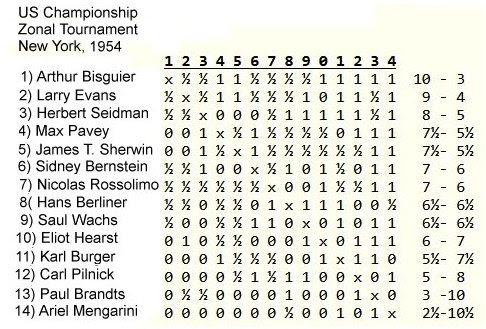
1954 US Championship

Grace Kelly
    
The 1954 US Championship one of the weakest championships ever and it was the probably also the most poorly financed. It was also witnessed by a visiting delegation of Soviet Grandmasters who were to defeat the U.S. by a 20-12 score in a match a few weeks later. 
    The problem was that the US Chess Federation didn't have the money to hold the championship in a hotel exhibition room as it had in the past and as a last resort the Marshall Chess Club offered its rooms to the 14 players. 
    The winner, Arthur Bisguier, was 23 years old and he had just gotten out of the Army and he was attending college classes during the day. At night he ended up sleeping in one of the Marshall's upstairs apartments. 
    The field was relatively weak. At the time Bisguier was only eighth on the USCF's latest rating list, and Larry Evans, the defending champion, was only tenth. None of the five top rated players, Samuel Reshevsky, Robert Byrne, George Kramer, Donald Byrne and Arnold Denker had accepted invitations.
 
 
    Evans and Bisguier were the favorites, but they were expected to get get some competition from French emigre Rossolimo, the Manhattan Chess Club champion Max Pavey and the latest Marshall Chess Club junior star, James T. Sherwin. 
    As it happened, 20-year-old Sherwin, ranked only 24th, did take the early lead after five lively rounds, but he was unable to sustain the pace. Despite his success in many European tournaments Nicolas Rossolimo was not up to the task even though he had scored quite well in the recent US Open. 
    It was a close race though as the championship wasn’t decided until the last round when Evans was held to a draw by Herbert Seidman and Bisguier defeated Ariel Mengarini. 
    It’s hard to believe, but GM Larry M. Evans has been gone 14 years. He passed away on November 15, 2010 in Reno, Nevada from complications from gall bladder surgery. This is rather unusual. The gall bladder is a small sac-shaped organ beneath the liver in which bile is stored after secretion by the liver and before it is released into the intestine. Surgery on it is a safe operation and usually carries only a small risk of complications. In most people incision is small and the patient can go home the same day. 
    Evans was born into a Jewish family on March 22, 1932, in Manhattan. He learned a lot about chess by playing for ten cents an hour on 42nd Street in New York City. A prolific, if controversial, author of chess books, he won or shared the US.Chess Championship five times and the US Open Chess Championship four times. 
    His opponent in this game was Rabbi Saul Wachs who was a very strong Master. In the He lived in Columbus Ohio and in the 1960s was routinely winning events in the Midwest. Unfortunately he gave up chess to pursue his career as an educator. I believe Wachs was born in 1931 and it is possible that he is still with us...he would be 93 years old. 
    The following game is very interesting in that it shows how very difficult it is even for a very strong Master like Wachs to score against a player like Evans who was an IM (awarded in 1952) at the time and would get the GM title just three years after this game. Wachs made no serious errors...he was just outplayed. 
    This game is being presented in a different format that’s available using Fritz 17. I leave it to the reader to play through the variations!