Random Posts

Tuesday, July 10, 2018

Chess Before Morphy

     Chess as we know it wasn't initiated until about 1485 when important rule changes were made. The main changes were the Queen, which could only move one square diagonally suddenly became the most powerful piece. The Bishop originally could only move two square diagonally. 
     By 1510 the “old” chess was obsolete. Openings known today as the Ruy Lopez, Giuoco Piano, Petroff Defense, Philidor Defense, Bishop's Opening and Queen's Gambit Accepted, were first outlined in a late 15th century manuscript and the first best seller was Damiano's book printed in Rome in 1512. 
     Ruy Lopez was the leading player of Spain for over 20 years and noted for his skill at blindfold chess. In 1561, Lopez published a book on chess containing rules, general advice and a miscellaneous collection of openings, but opening analysis is considered weak. 
     Among the leading Italian players of the period 1560 to 1630 were Paolo Boi, Giovanni Leonardo da Cutri, Giulio Cesare Polerio and Gioachino Greco. 
     Existing chess books had become obsolete, but the strong players of the period did not publish their findings. The high stakes for which they played made them secretive. However, for a fee it was possible to obtain a copy of their notes on openings and many of these manuscripts have survived. The manuscripts of Polerio, considered the leading player of Rome in 1606 and some some other books from this period, including three works published by Dr. Alessandro Salvio, one of the leading Neapolitan players, who for his time was a good analyst have survived. 
     Greco was one of the last great Italian players. A man of poor parentage and no education, he left his mark on chess history when in about 1619 he began to keep a collection of games and gave extracts to wealthy patrons. About 1620 he traveled abroad to France, England and Spain. In 1669, a French translation of his manuscript was published in Paris. After Greco's death in 1634, Italy produced no outstanding players for over a hundred years. 
     In England, France and Germany, however, the popularity of chess had increased and in the 18th century the coffee-houses of London and Paris were the leading centers of chess activity. Andre Philidor dominated this period. Philidor defeated all the strongest players at the Cafe de la Regence in Paris and Slaughter's Coffee House in London. Phildor set forth his theories of chess in his Analyze du Jeu des Echecs and was the first to define and explain the principles of strategy and tactics. 
     At about the same time as Philidor, Italy again produced some gifted players such as Ponziani and G. Lolli. France also produced Verdoni, Leger, Carlier and Bernard. In England there was J . K. Sarratt, William Lewis, John Cochrane, Captain W. D. Evans, William Lewis, Alexander MacDonnell and Howard Staunton. 
     In France, Alexander Deschapelles, Pierre de Saint-Amant, de la Bourdonnais were prominent. Elsewhere in Europe Johann Allgaier (who originated the idea of tabulating openings in a treatise, first published in 1795), von Bilguer (whose famous Handbuch was published in 1843), L. E. Bledow (who started the magazine Schachzeitung in 1846), Horwitz, von der Lasa and C. Mayet. 
     Other masters of the period were the Russian Petroff, Lionel Kieseritzky, Hamppe and the Hungarians Szen and Lowefithal. 
     In 1843 Staunton established himself as the as the leading player by defeating Saint-Amant in a match. Staunton's Chessplayers Handbook, published in 1847, became the leading English text-book.
     But it was the year 1851 that stands out as the beginning of a new age. That was the year that the first International Tournament was held in London and was won by Adolph Anderssen of Berlin. A brilliant player, Anderssen went on to win first place in 7 out of the 12 tournaments in which he participated. 
    The games of the pre-Morphy period may have their faults, but they were played by masters who were self-reliant and had to find their way through uncharted country. Also, many of their recorded games were not played in matches or tournaments, but were played for amusement only. 

 
de La Bourdonnais
    The following game, which Al Horowitz called one of the most magnificent masterpieces on record was the 50th match game played between Louis-Charles Mahe de La Bourdonnais of France and Alexander McDonnell of Ireland. 

     The two played a series of chess matches in 1834 which confirmed La Bourdonnais as the leading player in the world. It was the first match of importance and is sometimes referred to today as the World Championship of 1834. 
     The games were published widely and were annotated and discussed all over Europe. Both players introduced several innovations, a few of which are still seen today. It might even be said that the modern era of chess began with the McDonnell-La Bourdonnais match of 1834. La Bourdonnais won the first, third, fourth and fifth matches; McDonnell won the second match, and the sixth was abandoned with McDonnell leading. The overall score was La Bourdonnais +45 -27 = 13. 
     One of their better encounters follows. 

Monday, July 9, 2018

Kmoch Clouts Yudovich

Kmoch
     Leningrad has a colorful, and confusing, history. Known as St. Petersburg, the city was renamed Petrograd in 1914, at the beginning of World War I, then named Leningrad after the death of Vladimir Lenin in 1924, and again became St. Petersburg in 1991 when the Soviet Union collapsed. Confusingly, the surrounding region is still known as Leningrad. 
     In the 1920s and 1930s, the poor outskirts of Leningrad were reconstructed into regularly planned boroughs and housing became a government-provided amenity; many apartments were so large that numerous families were assigned to what were called "communal" apartments. 
    On December 1, 1934, Sergey Kirov, the popular communist leader of Leningrad, was assassinated, which became the pretext for the Stalin's massive four-year purge of Soviet society, in which millions of people were imprisoned, exiled, or killed. 
     I posted an instructive game between Botvinnik and Euwe that was played in Leningrad, 1934 a few years ago, but today want to look at another game that was played in the same tournament. 
     The tournament began on Botvinnik's 23rd birthday and was his first tournament in a year. Max Euwe was in Leningrad along with Kmoch, his second, to train for his upcoming match with with Alekhine and the tournament was dubbed, the “Tournament with the Participation of Euwe and Kmoch.” 
    This tournament was considered Botvinnik's second international event and his performance was endangered when he was diagnosed with parathyroid disease and his fever was 102 degrees. As a result, he was granted a six day break that resulted in a considerable juggling of the schedule. As for his being replaced by another Soviet player, as Botvinnik said of them on several occasions, “They are not Botvinnik.” 

     Euwe's poor 6th place finish in which he lost two games (Riumin and Rabinovich) was explained by the fact that he had suffered an injury while swimming in the Black Sea during a visit to Yalta. 
     As for Kmoch, his aggressive play was shown by the fact that he tied for 7th-8th place with Yudovich, scoring only two draws and finished +4 -5 =2.
     Johann "Hans" Joseph Kmoch (July 25, 1894 in Vienna – February 13, 1973 in New York City) was an Austrian-Dutch-American IM, International Arbiter. But, older readers will remember and a chess journalist and author, not for his successes in his playing days.  To here his name pronounced go HERE
     Kmoch wrote for the magazine Wiener Schachzeitung from the early 1920s. His Die Kunst der Verteidigung (The Art of Defense) was the first chess book devoted to this subject. In 1930, Kmoch updated the Bilguer handbook, and wrote the tournament book for the Carlsbad 1929 event. 
     After World War II ended, Kmoch and his wife moved to the United States, settling in New York City where he served as the Secretary and manager of the Manhattan Chess Club and directed tournaments. He also wrote for Chess Review, then one of the leading American chess magazines. In 1959, he wrote his most famous book, Pawn Power in Chess, which is notorious for its use of made up terms such as ram, lever, sweeper, sealer, quartgrip, melanopenia and leukopenia can make it rather difficult to understand. However, if one can get used to Kmoch's terminlogy, it's actually a pretty good book. 
     Kmoch and his Jewish wife Trudy lived in the Netherlands from 1932 to 1947. In 1929 and 1934, he was good enough that he served as Alekhine's second in his matches against Bogoljubow. Kmoch also served as Alekhine's second in the 1935 title match against Euwe. In 1941, he authored a book of Rubinstein's best games. 
     Chessmetrics assigns him best world rank of number16 on 7 different months between February 1931 and June 1941.  The latter list puts him on level with players like Najdorf, Bogoljubow, Horowitz and Vidmar. His highest assigned rating was 2664 in 1941. 
     Kmoch had most of his best competitive results between 1925 and 1931. He won at Debrecen 1925 with a 10-3 score. At Budapest 1926, he shared 3rd-5th places. At Brno 1928, Kmoch placed 3rd and he finished first at Ebensee 1930. He represented Austria three times in Olympiads: 1927, 1930 and 1931. His overall results were +14 -8 =19 8.   His last good result was at Baarn in 1941 where he scored 5.51.5 and finished second behind Euwe. After that he stopped playing competitively. Clearly, Kmoch was much better than most of us give him credit for. 
Yudovich
     Kmoch's opponent in this game was Mikhail Yudovich, Senior. Yudovich (June 8, 1911 – September 19, 1987 in Moscow) was a Russian master, journalist, and writer. He was awarded the titles of IM in 1950, Correspondence IM in 1961 and Correspondence GM in 1973. He was USSR Correspondence Champion in 1966. His son, Yudovich Jr. was also a very strong player. The senior Yudovich is assigned a 2580 rating by Chessmetrics on the May 1937 rating list. 


Seated left to right: Alatortsev, Kmoch, Levenfish, Ily Rabinovich, Lisitsyn, Euwe and Chehover. Standing left to right: Yudovich, Romanovsky, Golubev (the TD), Riumin, Kan and Botvinnik

Saturday, July 7, 2018

Lionel,Shirley, Roger, Jonathan and Oliver

     Lionel Penrose (June 11, 1898 – May 12, 1972) was a British psychiatrist, medical geneticist, pediatrician and mathematician who carried out pioneering work on the genetics of mental retardation. He was the Galton professor of eugenics at University College London, and later emeritus professor. 
     Most sources he was also a chess theorist. Exactly what that means, I have not been able to discover. He seems to have played chess only on a casual basis, but it appears he did dabble in composing two movers. 
     Lionel's daughter is Professor Shirley Victoria Hodgson DM, D(Obst), RCOG, DCH, FRCP, FRSB (nee Penrose, born February 22, 1945) is a British geneticist. She worked as a GP, then became Senior Registrar in Clinical Genetics for the South Thames (East) Regional Genetics Centre and Honorary Senior Registrar at Hammersmith Hospital, London, from 1983 to 1988; then Consultant Geneticist at Addenbrooke's Hospital from 1988–1990. In the 1990s and led the regional cancer genetics service at Guy's and St Thomas' Hospital. In 2003 she became Professor of Cancer Genetics at St George's, University of London. 

     Sir Roger Penrose (born August 8, 1931), is a mathematical physicist, mathematician and philosopher of science. He is Emeritus Professor of Mathematics in the University of Oxford and Emeritus Fellow of Wadham College, Oxford. He is known for his work in mathematical physics, in particular for his contributions to general relativity and cosmology. He has received several prizes and awards, including a 1988 Wolf Prize for physics, which he shared with Stephen Hawking. 
     Sir Roger composed a problem devised "to defeat an artificially intelligent computer but be solvable for humans". The position itself and the logic behind the experiment is not compelling. Still, you may enjoy checking it with a chess engine.  
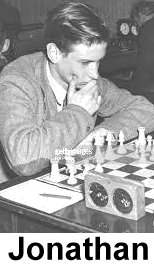
     Jonathan Penrose, OBE (born 7 October 1933) is a GM, both over the board and correspondence, who won the British Chess Championship ten times between 1958 and 1969. He is a psychologist and university lecturer by profession, with a PhD.  
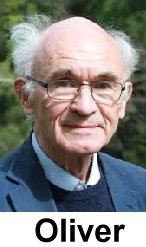
     Oliver Penrose (born 6 June 1929) is a British theoretical physicist. He was associated with the Open University for seventeen years and was a Professor of Mathematics at Heriot-Watt University in Edinburgh from 1986 until his retirement in 1994 where he holds the title of Professor Emeritus. 
     His areas of interest include statistical mechanics, phase transitions in metals and physical chemistry of surfactants. He is particularly known for present-day understanding of superfluids and superconductors. 
     Other more abstract topics in which he has worked include understanding the physical basis for the direction of time and interpretations of quantum mechanics. He is the author of Foundations of Statistical Mechanics and his recreations include music and chess. 
     The following game was played by Oliver in round nine of the inaugural British Universities Chess Association individual championship, held at Trinity College, Cambridge in July of 1950. 

Wednesday, July 4, 2018

A Brilliant Positional Attack by Nimzovich

Nimzovich
     From January 26 to April 19, 1931 Nimzovich was living in Switzerland as a guest of the Berne Chess Club thanks to the support of an anonymous member. During the three months he lived in Berne, Nimzovich taught two chess courses lasting 2 to 2-1/2 hours for 9 evenings, gave talks and played simuls. 
     In addition, he played seven matches against Swiss players. His stay culminated in by his winning a Swiss masters tournament with a score of 7.5-0.5. 
    Nimzovich described the course he taught as being for stronger players he he covered centralization or some other strategy. At the end of the lecture the players had to play a game against each other under his supervision and he pointed out their errors with special emphasis on applying whatever strategy he had just lectured about. 

Training Match Results: 
Defeated Zimmermann 1.5-0.5 
Defeated Voely 1.5-0.5 
Defeated Gygli 2.0-0.0 
Drew Johner 1.0-1.0 
Defeated Michel 2.0-0.0 
Lost Naegeli 0.5-1.5 
Defeated Grob 2.0-0.0 

     In 1931 Nizovich would have been coming off his second place finish behind Alekhine at the 1930 San Remo tournament. That was to be his last great result. He played in Zurich in 1934, but only managed to score +6 -3 =6 which was only good enough to tie for sixth place with Bernstein. He lost to Alekhine, who finished first ahead of Euwe and Flohr, but losses to Johner and Henneberger ruined his chances of a better showing. 
     Then in February of 1934, he played an eight game match against Stahlberg in Gothenburg, Sweden. After four games Nimzovich was leading 2.5-1.5, but then collapsed, losing three in a row and drawing the last game. There is a good account of the match at Chessgames.com HERE
     Although he had long history of heart trouble, at the end of the year (1934) he became ill and was bedridden for three months before dying of pneumonia at the young age of 49. 
     Out of the training matches he played in Berne, one of his games against Walter Michel (November 26, 1888 – September 30, 1969) was of special interest. Michel was Swiss Champion is 1926 and played for Switzerland in four Olympiads: 1927, 1931 and 1935., 1928.
     In the following game the boring looking position at move 15 turns out to be fascinating and is an exceptional display of Nimzo's positional skill. In How To Reassess Your Chess author IM Jeremy Silman stated it was one of his favorite positions.  By the way, I rate HTRYC very highly and only wish I had it 50 years ago. Generally I find Silman's advice first rate. 
Michel
     Silman is on record as saying that an engine is not the non-master's friend and most players would be better served trying to understand things themselves, in human terms. Ideas are what's important, not engine evaluations. His point is that players are so intent on watching engine evaluation numbers that they fail to notice the game’s beauty and instructional value and miss the chance to learn something. And, he is correct. Dennis Monokroussos' blog has an interesting discussion on this subject HERE

     The Michel-Nimzo game is a perfect example. Silman wrote How To Reassess Your Chess back in 1993 when engines were nowhere near as good as they are today, so it's not surprising that he missed some of the nuances of the game. Also, I suspect that authors are sometimes silent on moves that may upset the apple cart when they are trying to make a point, especially in opening books on risky gambits. In the final analysis though, Nimzovich's concept in this game was brilliant and is deserving of all the accolades it's been given. 

Tuesday, July 3, 2018

David G. Baird

 
    Baird (December 3, 1854 in New York City – October 8, 1913 in Elizabeth, New Jersey) lived most of his life in New York City. He won the New York State championship in 1895 and the Manhattan Chess Club championship in 1888, 1890, 1891, and 1895. 
     A writer for The New York Times described him as follows: He plays with characteristic Scotch carefulness, for he is of Scotch descent. Of medium height, he is inclined to stoutness, and is of light complexion. His brother John W. is very thin, although he looks like his brother in the face. He was one of the slowest players in the tournament. 
     His brother, John W, Baird (February 22, 1852 – 1923) was a minor American master, who played in a number of American and international chess tournaments between 1880 and 1906. He played in the 1892 Hauptturnier in Dresden, scoring 4.0-2.0, finishing in 2nd-3rd place and qualifying for the final, where he scored 4.0-4.0 finishing tied 4th-6th. 
    At a strong tournament at New York 1893, Baird finished with 4.5-4.5 (a half point more than his brother), tying for 5th-6th. Baird played in the very strong Meisterturnier (Master Tournament) at Leipzig 1894, scoring a respectable 7.5-9.5 and finished 12th. He also competed in international tournaments at Barmen 1905 and Nuremberg 1906. Chessmetrics assigns John a high rating of 2556 (Number 30 in the world) on the 1895 rating list.
     David participated at Vienna 1898 which was a huge double-round event with 19 players. Tarrasch and Pillsbury tied for first with 27.5-8.5 scores. There were four Americans participating: Pillsbury, Steinitz (4th place with 23.5 points), Jackson W. Showalter (14th place with 15.0 points) and David Baird who finished in 18th (next to last) place with 8 points. 
     In its description of the tournament the American Chess Magazine observed that the 44-year old Baird seemed to have lost the strength of his former years, adding that between 1880 and 1889 he made steady and consistent progress and his games promised a fine future. This description seems rather harsh. He did score wins over Chigorin, Walbrodt, Alapin, Showalter and Trenchard (of England). He also held Maroczy to two draws. So, for an amateur player he did pretty good.
     Chessmetrics assigns him a high rating of 2546 on its 1885 rating list placing him number 27 in the world. His performance rating at Vienna was 2483 against opposition rated 2663. 
     He also played in an international tournament in New York 1922 that was won by Marshall ahead of Capablanca, where he finished next to last, scoring +2 -8 =2. 
     In the following game Baird slaughters Amos Burn in New York, 1889, which was the Sixth American Chess Congress, US Championship and World Championship Candidates Tournament. 
     It was a huge 20-player double round tournament that at the time was one of the longest tournaments in history. In the first half of the tournament, draws were counted as a half point. In the second half, they were replayed once. Between the 38 regular rounds, 8 replay rounds, and 4 game playoff for first at the end, there were 50 rounds.
    This tournament consisted largely of foreign masters and the top American finisher was Solomon Lipschutz, who finished in 6th place with a score of +22-9=7. Lipschutz's supporters in the Eastern US tried to push his claim to being US Champion as a result of this tournament.
     The organizers of this event had announced that the winner would bear the title of US Champion and had made every effort to include the strongest players in the country. After winning the title in this event, in the future the title was to be defended in match play and the champion had to accept all reasonable challenges at proper intervals.
     Everybody didn't accept Lipschuetz's claim because Jackson W. Showalter was amaking a name for himself and their rivalry ended in a short match in 1890 which was won by Showalter, who claimed the title of US Champion.
     In addition to naming a US Champion, the organizers planned to finance the winner in a World Championship match against Steinitz. Max Weiss and Mikhail Chigorn tied for first and remained tied after drawing all 4 games of a playoff.
     Chigorin was not interested in challenging Steinitz again so soon and Weiss was not interested in playing at all, so there was no challenger to Steinitz.
     Isidor Gunsberg, the 3rd place finisher, was interested and the following year he drew a 10 wins match against Tchigorin (9-9 with 5 draws). As a result, Steinitz accepted his challenge and managed to win it with some difficulty. Read about the match HERE.

1-2) Weiss and Chigorin 29.0 – 9.0
3) Gunsberg 28.5-9.5
4) Blackburne 27.0-11.0
5) Burn 26.0-12.0
6) Lipschuetz 25.5-12.5
7) Mason 22.0-16.0 
8) Judd 20.0-18.0 
9-10) Delmar and Showalter 18.0-20.0
11) Pollock 17.5-20.5 
12-13) Bird and Taubenhaus 17.0-21.0
14) Baird, David 16.0-22.0 
15) Burille 15.0-23.0 
16) Hanham 14.0-24.0
17-18) Gossip and Martinez 
19) Baird, John 7.0-31.0
20) MacLeod 6.5-31.5

Monday, July 2, 2018

London 1922 and Buyer's Remorse

     We recently visited a nearby shopping plaza and dined at Texas de Brazil, an upscale Brazilian eatery featuring all-you-can-eat grilled meat carved table side by “gauchos” and a salad bar. 
     It's for meat lovers; if you are looking for anything else, there's not much to offer. Meats included herb marinated pork loin, picanha, garlic pichana, Brazilian sausage, leg of lamb, chicken breast wrapped in bacon, alcatra, lamb chops, filet mignon, filet mignon wrapped in bacon, Parmesan crusted pork loin, braised beef ribs, barbecued pork ribs, Parmesan drumettes and flank steak. Very good!
     You also get a dish of garlic mashed potatoes and some fried bananas. The bananas are meant to cleanse the palate between tasting different cuts of meat, but they were too sweet for my taste. Avoid the coffee, drinks and desserts which cost extra. The coffee is $6 a cup and the desserts $8. Not worth it and they caused the $44.99 per person bill to add up a lot! Generally, not a place you'd visit on a regular basis and don't go there unless it's your intention to gorge yourself. 
     From there we moseyed over to Barnes and Noble book store where I bought some "$5 special" spy novels and history books. I also made an impulse purchase when I spent $10 on the tournament book London 1922 by Geza Maroczy with a forward by Andy Soltis. Why, I don't know. 
     All the games are available for download and Soltis' forward is superfluous and contains nothing much of real interest. In fact, if you want a round by round account of the tournament you can read the British Chess Magazine's account HERE, starting on page 319 and running to page 342. Edward Winter's site also has an article on the tournament by Capablanca. 
     Playing over the games using an engine will also reveal that Maroczy's notes are, I don't know how else to say this, just plain bad...short and riddled with errors. All in all, the book is a hack job. You can download 68 games with Maroczy's crappy notes HERE.  
     As for the tournament itself, it was something else. Unfortunately Borislav Kostic and Frank Marshall had problems with obtaining traveling expenses and couldn't attend, but the lineup was formidable: Capablanca, Alekhine, Vidmar, Rubinstein, Bogoljubov, Reti, Tartakover, Maroczy, Yates, Atkins, Euwe, Znosko-Borovsky plus lesser luminaries Wahltuch, Morrison, Watson and Marotti. 
     A lot of the games will be found in the collections of several of the players; they were that good. The tournament was important because the new world champion, Capablanca, played in his first serious event since winning the title in 1921 and he scored an impressive 13.0-2.0. Alekhine was also undefeated but yielded too many draws. 
     It was at this tournament that Capa introduced the conditions challengers would have to meet to get a match that came to be known as the London Rules.
     What I like about this tournament was that it not only contained some of the biggest names of the time, but there was also enough players to serve as cannon fodder which allowed for some brilliant crushes! There were also very few draws. 
     Speaking of draws, in the penultimate round Capablanca and Rubinstein were paired against each other and a lot of spectators showed up expecting a titanic struggle. Instead they were left indignant when they witnessed a 13 move draw. 
 
Tartakower, a favorite player
    In the following game Tartakower makes some pretty sacrifices against Wahtuch who made the mistake of leaving his King in the center a tad too long. The game really isn't all that great, but it once against demonstrates the ease with which a GM can outplay a master. I have posted this anecdote before concerning this matter: I once witnessed GM Miguel Quinteros playing time handicap games at $20 a game against a local master. The master had 5 minutes on his clock while Quinteros had only one. In the 3-4 games I watched the master lost all of them. 


1) Capablanca 13.0 
2) Alekhine 11.5 
3) Vidmar 11.0 
4) Rubinstein 10.5 
5) Bogoljubov 9.0 
6-7) Reti and Tartakover 8.5 
8-9) Maroczy and Yates 8.0 
10) Atkins 6.0 
11) Euwe 5.5 
12-13) Znosko-Borovsky and Wahltuch 5.0 
14-15) Morrison and Watson 4.5 
16) Marotti 1.5