Random Posts

Friday, February 13, 2015

Stockfish 6 Tactical Results - Important

     I came across an interesting post the other day on the Rybka Forum where a poster said that on his tactical test Stockfish 6 scored 81 percent with an average solve time of 13.92 seconds while Komodo 8 scored 76 percent with 21.48 seconds. Stockfish 6 was very fast on some hard positions but it also completely missed some easy wins. If you're looking for a tactical genius then he recommends either Houdini 3 or 4 on tactical mode which scored around 90% with solve times averaging around 10 seconds. He observed that Stockfish 6 sees moves quickly but in his opinion these days the effort is on verifying that a move is good rather than seeking out the best move.
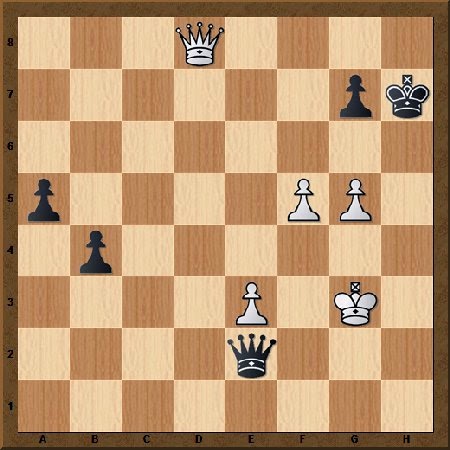
White to move

     The poster wrote that in the above position Stockfish 6 failed to find the best move after 18 hours of searching while Houdini 4 found it after a few seconds! I plugged the position into my program and after about 3 minutes Stockfish 6 (using 2 cores) wanted to play 1.Kf1, evaluating the position at 0.00. Komodo 8 liked 1.Rf8 with the same evaluation.
     I have Houdini 2 and it took only a few seconds to find the correct 1.Bf8+, evaluated at 4.39.  Houdini 1.5 also found 1.Bf8+ in a few seconds! I was curious to see what happened when I showed Stockfish 6 the correct 1.Bf8+. I did not give it a lot of time but just scrolled through the moves and it did not realize white was winning until I got to move 5 which was the same for Komodo 8. Further discussion can be found on the Rybka Forum HERE.
     I checked several other engines (Black Mamba, Critter 1.6, Fritz 11, Gull 3 and Deep Rybka 4). Curiously, after about 20 seconds Critter 1.6 preferred 1.Bf8+ but evaluated the position at 0.00. But when I actually made the move, the evaluation immediately jumped to 5.00! The other engines did not find 1.Bf8+ and even after making the move on the board they didn't change the 0.00 evaluation.
     This is an important lesson! If you are using Stockfish or Komodo to analyze, you should have Houdini running as a second engine!

Thursday, February 12, 2015

DAVID R. SANDS: Nakamura rocks Gibraltar, reclaims top U.S. rating slot in chess

Top-ranked U.S. GM Hikaru Nakamura rules the Rock, having just won this year's edition of the strong Tradewise Gibraltar open tournament on the Mediterranean island with an 8½-1½ score. Nakamura, now being challenged by rising GM Wesley So as the top-rated American player, didn't drop a game, defeating ex-world champion Veselin Topalov and Chinese star GM…

You Can Take Rat Poison On It!


     I was looking through Arnold Denker's great book, The Bobby Fischer I Knew, and he was telling about one of Al Horowitz' favorite sayings, "If I tell you it wins, you can take rat poison on it!"


     Denker gave the following position from the game Horowitz vs. Alex Kevitz, New York, 1931.


     Horowitz announced mate in seven and Kevitz resigned. It got me curious, was there really a mate in 7? Yes, there was: 22.Qg5 g6 23.Qh6 gxf5 24.Rg4+ fxg4 25.Bxh7+ Kh8 26.Bg6+ Kg8 27.Qh7+ Kf8 28.Qxf7mate
     They don't announce mate any more. First, few games get that far these days and technically, I supposed it could be considered against the rules to talk to your opponent as he might think it's annoying.
According to one arbiter, if someone claims that a position is mate and it is not, then the claim has no more status than a spectator making a comment. If a player claims checkmate and it is checkmate, it would have been checkmate whether or not the comment was made. If a player claims a mate and it is not, the game continues and there is no penalty for it.
     Sometimes a player deliberately does make a false claim in order to try to get his opponent to think it is mate and stop playing without looking at the board. That is considered bad sportsmanship and the player who falsely announces checkmate may be subject to sportsmanship penalties if there is any indication that it was done deliberately. Such penalties can be as severe as loss of the game, but it is not automatic. Usually the tournament director will warn the player to stop doing it or adjust clock times before considering forfeiting the game. Article 3.8b of the FIDE Laws of Chess indicates that "Declaring a check is not obligatory". USCF rule 12F states "Calling check is not mandatory".
     A long time ago in a junior tournament I had an opponent announce mate in 6 against me. I didn’t see it and asked to play it out. He got real snotty, called me a couple of names and fetched the TD who told him he wasn’t Morphy and he had to play it out. Every move he slammed the pieces down and hammered the clock (mine). As he delivered mate (in 6, of course) he called me an (expletive deleted) got up and stomped off.
     Capa  wrote, "We have been criticized for not announcing mate in four moves when we could have done so. The reason is very simple - we never announce mate, even if it is mate in one move. In our opinion announcing mate is in poor taste and evinces a certain exhibitionism which is foreign to our character. Besides, announcing mate would in no way have prevented our opponent from continuing playing, which he should have been entitled to do."
      Back in the mid-1800's Mrs. Ellen Gilbert was famous for long announced mates, but those were in correspondence games.  When it comes to OTB games, there was an announced mate in 36 moves, the record, HERE.
     In the following position, B. Burt vs. J.H. Blackburne, Bristol 1869, Blackburne announced mate in 9 moves: 9...Bd4+ 10.Rf2 (10.cxd4 Rxg2+ 11.Kh1 Rxh2+ 12.Kxh2 Qh4+ 13.Kg1 Qg3+ 14.Kh1 Qg2mate) Rxg2+ 11.Kf1 Rg1+ 12.Kxg1 Qg5+ 13.Kf1 Bxf2 14.Qa3+ d6 15.Qxd6+ cxd6 16.Kxf2 Qg2+ 17.Ke1 Qg1 mate. He was correct.


     Here's the position from a game John F. Barry vs. H.N. Pillsbury, Match, Boston 1889. Pillsbury has just played 31...h6 and Barry announced mate in 13. Is it really?


     Yes, Barry was correct: 32.Rxg7+ Kxg7 33.Re7+ Kg8 34.Qxh6 Bg1+ 35.Kh1 Bd4 36.Qg5+ Kh8 37.cxd4 Qxd4 38.Qh4+ Kg8 39.Qg3+ Kh8 40.Bc3 Qxc3 41.Qxc3+ d4 42.Qxd4+ Rf6 43.Qxf6+ Kg8 44.Qg7 mate
     The following position was taken from The American Chess Journal of 1876. It says the position was taken from a game between an amateur and a "Mrs. W," the leading lady player in New York...she announced mate in 6.

Black to move

Highlight for solution: 1...Rh3+ 2.Kg2 Rf2+ 3.Rxf2 Qxe4+ 4.Kf1 Rh1+ 5.Qg1 Bh3+ 6.Rg2 Qe2 mate.
     Of course, you can't always take rat poison on it...in Bled, 1931 the tournament book by Hans Kmoch says that Bogoljubow announced a mate in two against Asztalos in the following position:


Bogoljubow announced "Mate in two moves!" Asztalos looked at the position and said "I do not see it". Then Bogoljubow played 51.g6+ and laughing loudly said, "I apologize, please, I did not notice that your king gets out..." After 51...Kh6 52.Kf4 Qf2+ they agreed to a draw.
     Here's a game where Louis Paulsen announced mate in 11 while playing four blindfold games!!


Tuesday, February 10, 2015

Grace Alekhine

Grace N. Alekhine (née Wishaar ( also Wishar, Wishard, Wishart) Peeke, Freeman) was born on 26 October 1876 and died in March of 1956 in Neuilly-sur-Seine, France.  She was an American–British–French artist, chess player and the fourth and last wife of Alexander Alekhine. It may also have been her 4th marriage. There are reports that she had at least two additional marriages before Archibald Freeman but is has never been verified.
     Born in New Jersey to Emile Bernard Wishard and Marie Ida Smith she received training at the New York School of Art under William Chase and began her career in painting there. In 1898, she married a man named Eisler and moved to Seattle, Washington; that same year her son was born there; he was known as Carroll Earl Beauchamp Peeke throughout his life but it is uncertain where the name "Peeke" came from. She herself was also sometimes known by this name.
     Carroll Earl Beauchamp Peeke was a World War II veteran and newspaperman who died in San Francisco on June 19, 1991 at the age of 92. From his obituary: Colonel Peeke was a native of Seattle and a graduate of Oakland High School and the University of California at Berkeley. He joined the San Francisco Call-Bulletin newspaper in 1922 and later worked as city and diplomatic editor at the Times Herald in Washington, D.C. In 1941, he turned from newspaperman man to soldier, entering the military service as managing editor of the War Department Bureau of Public Relations.
Colonel Peeke

     Later, he served on Army general staff duty in Washington, D.C., and with the U.S. Military Missions and the Fifth Army in Ecuador, Brazil, North Africa and Italy. He earned the Order of the Palms and Croix de Guerre. In 1950, he was elected commander of the San Francisco chapter of the Military Order of World Wars. In the 1970s, he became historian of the Episcopal Diocese of California and wrote extensively about his wife Mary's great grandfather, William Ingraham Kip, the first Episcopal bishop of California.
     Sometime early in the early 1900's she moved to Oakland, California: there, again as Grace Wishaar, she established a career as a visual artist. Interestingly, her work became known on both a large and small scale: as a theatrical scenery painter (in San Francisco's Majestic Theater, and Oakland's Ye Liberty Playhouse), and as a miniature portraitist (author Jack London was a client; she painted his young daughters). Of her stage work, it was reported: One of the bright women in Mr. Harry Bishop's employ is Miss Grace Wishaar. Miss Wishaar is interesting from many points, but she is distinctively interesting from the fact that she is the only woman scenic artist. She began her work at the Herald Square Theater, New York.
     That is, she was grudgingly allowed to make a trial there after showing a persistence that no amount of rebuff could discourage. It was not long, however, until she won the respect of the men with whom she worked because she never took advantage of the fact she was a woman and she never shirked her work. In fact, the men soon learned to appreciate her womanly understanding in the preparation of home scenes, and her settings for the various productions were appreciated for their decorations.
     By the spring of 1914, she was exhibiting her portraiture work at the Spring Salon des Beaux Arts in Paris. 1914 seems to be the year she permanently left the United States. She later married Archibald Freeman, a British tea-planter in Ceylon (he died in the early 1930s), and she retained British citizenship to the end of her life.
     She had won a minor chess tournament in Tokyo and played Alekhine in a simultaneous exhibition there in 1933. Her prize was one of Alekhine's books. She asked him to sign the book and their relationship developed from that moment. They were married in March 1934 at Villefranche-sur-Mer, near Nice, France. The marriage certificate says her maiden name was Wishaar. She was 16 years older than her husband and wealthy, with a magnificent chateau called La Chatellenie Saint-Aubin-le-Cauf, a few miles southwest of Dieppe in Normandy, and an art studio in Paris.
     In 1935, she finished outside the top four in the French Championship (Paulette Schwartzmann won) in Paris. Both she and Alekhine competed at Hastings in 1936/7 when he won the Premier and she won 3rd prize in the 3rd Class Morning A.
  
   During World War II, the Nazis took over their chateau and looted it. Today you can stay there.  She moved to Paris but Alekhine was free to travel; no exit visa was given to Grace. He was effectively exiled to Portugal while Grace elected to remain in France to monitor the welfare of her various properties at the mercy of the invaders.
     She even found time to compete in the Paris Championship of 1944 when she became the Ladies Champion. After World War II, she sold her chateau under American Embassy protection. She spent her final years in her studio in Paris, but visited St. Ives, Cornwall, where she was a member of the local chess club.
     She later led the effort to get Alekhine’s body transferred to the Cimetiere de Montparnasse in Paris. The USSR and French Chess Federation paid to transfer the remains from Portugal to Paris. After she died the notes in Alekhine’s handwriting were allegedly found in her effects to prove he wrote the Nazi articles entitled Aryan and Jewish Chess, published in March 1941 (an anti-Semitic slander of Jewish chess strategies). This was particularly ironic, as Grace herself was likely of Jewish ancestry (surviving the Nazi occupation of France). Her son, however, was raised an Episcopalian, and it is unlikely she practiced Judaism.
     In the early 1950s, she was visited in Paris by her granddaughter Roberta Peeke: the young woman was invited to her address her as "Lady Grace." She was buried next to Alexander in the Cimetière du Montparnasse, Paris, to where Alekhine's body had been transferred from Portugal after a long campaign she had led. Her grave spells her maiden name as Wishar.

Monday, February 9, 2015

Update on Stockfish 6 vs Komodo 8


    For anyone who is interested, a member of Queen Alice ran a 100-game, 40 moves in 5 minutes match between Stockfish 6 and Komodo 8. The match was won by Stockfish 6 with +26 -9 =65. For complete details see the QA post HERE. Stockfish 6 currently is first, ahead of Komodo 8, on the CCLR 40/40 rating list.  Their individual score on CCLR is Stockfish 6 with +11 -4 =39

More on Chess Problem Solving

Sam Loyd (London 1859) Mate in 3. There are also two mates in 5, but they are not part of the actual problem's solution.
 
Highlight for solution: 1.Bd7 [1.Nxc5+ bxc5 2.Bd7 Rxg3 3.d6 b6 4.Nxg3+ Qxg3 and 1.Nc3+ Bxc3 2.Bd7 Rxg3 3.d6 Rd2 4.Nxg3+ Qxg3] 1...Rxg3 2.d6 Qxc4 3.Nxg3#

I have posted on problems before: HERE and HERE.  As mentioned, I've never been a big fan of them in the past, but recently after reading some articles on problem solving and actually trying (mostly unsuccessfully) to do a few, I have discovered that I've been missing out on another enjoyable aspect of the game. So far I am not very good at solving...I am still learning terminology and themes, but eventually, I hope to be more successful as I learn what to look for.
     Just as in OTB play, the titles International Grandmaster, International Master and FIDE Master are awarded by FIDE via the PCCC (Permanent Commission for Chess Composition) for especially distinguished problem and study composers and solvers.
     For composition, the title of Grandmaster for chess composition was established in 1959, with André Cheron, Arnoldo Ellerman, Alexander Gerbstmann, Jan Hartong, and Cyril Kipping being the first honorary recipients. In subsequent years, qualification for the IM title, as well as for the GM title (first awarded in 1972 to Genrikh Kasparyan, Lev Loshinsky, Comins Mansfield, and Eeltje Visserman) and the FM title (first awarded 1990) has been determined on the basis of the number of problems or studies a composer had selected for publication in the FIDE Albums. These albums are collections of the best problems and studies composed in a particular three-year period, as selected by FIDE-appointed judges.
     There are also titles for solvers. For solvers, the GM (International Solving Grandmaster) and IM titles were both first awarded in 1982; the FM title followed in 1997. GM and IM titles can only be gained by participating in the official World Chess Solving Championship (WCSC). The title International Judge of Chess Compositions is given to individuals considered capable of judging composing tournaments at the highest level.

Wikipedia article, Here is an informative pdf book, 101 pages: Chess Problems Made Easy, Start Solving Now Part 1 (USCF article), Start Solving Part 2 (USCF article), Compose like Mozart (USCF article), British Chess Problem Society - This is a great site.

Saturday, February 7, 2015

Your Chess

I stumbled across this site the other day. It looks like it's been around for awhile and I don't know if it is current or not, but it has a lot of rss feeds/podcasts, blogs, etc, etc. and you can customze it to meet your personal needs. Anyway, if you go up to the right hand side near the top and click on the "Add Widget" a box pops up on the left that says "ADD WIDGETS" and then if you click on "Widget Library" and then click on "Modules" then 179 blogs, forums, news and a bunch of other stuff pops up. From that point on you can amuse yourself surfing chess blogs and miscellany. A lot of it is from blogs that have ceased production, but every once in awhile you might come across something that's interesting.  Visit the site

Friday, February 6, 2015

Ludek Pachman

 
    Ludek Pachman was a strong Grandmaster, chess book author and political activist who, after the Soviet invasion of Czechoslovakia, was tortured nearly to death by the Soviets in a Prague cellar. After this horrible experience Pachman was allowed to emigrate to West Germany where lived the remainder of his life and resumed his career. Despite his ordeal he was quite successful in that he qualified for the Interzonal in 1976 and won the West German Championship in 1978.
     Pachman (May 11, 1924, Bělá pod Bezdězem, today Czech Republic) won his first championship in 1940, when he became champion of the nearby village of Cista (population 900). In 1943 he was invited to an international tournament in Prague. Alekhine dominated the event and Paul Keres finished second. Pachman finished ninth in the nineteen-player tournament but his play was noticed by Alekhine who paid him a compliment in a newspaper article and invited Pachman to analyze with him in the evenings.
     At one time Pachman was considered one of the world's leading players, winning fifteen international tournaments plus he won the Czechoslovak championship seven times between 1946 and 1966. He became the champion of West Germany in 1978. He played in six Interzonal tournaments from Saltsjöbaden 1948 to Manila 1976 and represented Czechoslovakia in eight consecutive Olympiads from 1952 through 1966, usually playing first board. He had an even lifetime score against Fischer, +2 −2 =4.
     Pachman was politically active throughout his life. At first he was a staunch Communist but later became an equally staunch anti-Communist. He was a passionate speaker and writer about whatever cause he was involved in at the time and those who knew him said he loved to argue and often changed his mind. This sometimes left people not knowing if they were still his friend or not because like Fischer, he was known to sever his relationship with people who had tried to help him.
     He got into trouble with the Soviets because he was an enthusiastic supporter of Alexander Dubcek, head of Czechoslovakia's Communist Party, who had instituted reforms. After the Soviets invaded Prague and Dubcek was ousted Pachman spoke out in support of Dubcek and against the policies of the Soviet-installed government; it resulted in his arrest. He spent several months in prison without being charged, going on a hunger strike at one point to protest his treatment. He was released in 1970, but was rearrested in January 1972. At one point in his incarceration, he attempted suicide by jumping head first from his bed onto the floor, causing permanent injuries to his head and spine. He was released again in the summer of 1972 and in November he was allowed to leave the country and arrived in Munich with only his wife and cat.
     In 1989 Pachman reacquired his Czech citizenship, but by 1998 he had become disillusioned with the Czech government, changed his mind again, renounced his Czech citizenship and settled in Passau, located in Lower Bavaria, Germany. Living in what was then West Germany, he was a political activist with strong anti-communist views and made regular appearances on political talk shows. Tournaments in which Pachman was playing were boycotted by the Soviets and their allies, but when he qualified for the Interzonal in Manila, they had no choice but to end the boycott.
     Pachman also wrote eighty chess books published in five languages. He considered Modern Chess Strategy, published in 1959, to be his best book. His book Checkmate in Prague recounts his treatment at the hands of the Communist.
     Pachman described meeting Bobby Fischer in 1959 in Santiago and the day before the tournament Fischer asked him to be his translator. Fischer was accompanied by his mother and when the organizer asked if they needed separate rooms, Fischer replied that he wanted his mother put up in a room that was “at least ten miles away.” Even in those days Fischer was difficult to deal with. He wanted to know about prize money and when the organizer informed him all that information had been in the letter he had been sent, Fischer replied that he never read letters. When informed about the prizes, he complained that it was too low threatened to leave. Pachman tried to tell Fischer that his behavior was not acceptable, but Fischer didn't care; he wanted more money. Booby was a snot face from the very beginning, I guess. Pachman also had great disdain for chess engines, believing they would never be very good. He died March 6, 2003, in Passau, Germany at the age of 78.
     The following game was given by Pachman in Modern Chess Strategy as an example of how opening files for an attack with Rooks often requires Pawn advances to open up files. He calls this game “a simple example.” Analyzing the game with Stockfish 6 and Houdini 2 showed things weren't so simple because according to both engines, black had a slight advantage until his blunder on move 25. Going over Pachman's variations also revealed some errors in analysis. This situation is not uncommon in annotations written before engines. It's not unusual for authors to miss tactical shots and engines often find lines that are better than the authors' suggestions. In their haste to get the book out they may have missed some things. Also, sometimes they ignore possibly better moves in an effort to illustrate their point. Author's of those Play the (fill in the blank) Gambit and Rack Up Easy Points do it all the time. That does not always detract from the enjoyment or value of the games though. Even if a few warts show up, the old-timers still knew something about how to play chess.


Wednesday, February 4, 2015

A Bizarre Game: Levy vs Dunst, Marshall CCC 1956

     The Belgian master Bernard De Bruycker worked out a way to defend against 1.e4: 1...c6, 2...Na6 and 3...Nc7. In Europe this is generally known as De Bruycker's Defense but American master Theodore Dunst had played earlier. Dunst usually followed it up with ...d5 and ...e6. The problem with Dunst's continuation is that the N maneuver was not part of any particular “plan” so his games are not of any theoretical value. It was in 1978 that De Bruycker started to experiment with his system and he actually played it with both colors and against everything. He later concluded it was best against 1.e4. His system is a counterattack against the white classical center with Pawns on e4 and d4.
     Here is a game by Theodore Dunst, inventor of the Dunst Opening, played in the 1956 Marshall Chess Club Championship which I can only describe as bizarre. His opponent, Louis Levy, was also a solid master player who was good enough to have played in the US Championship. When analyzing the game with Stockfish 6 and Houdini 2 they kept showing blunder after blunder, but it's hard to be harsh on the two players! Not only were some of the tactics very difficult to see OTB, but the material was so unbalanced that evaluations are suspect even with engines. Like I said, a very bizarre game but one that must have been exciting to witness.

Tuesday, February 3, 2015

Semyon Furman

     Sometime in the mid-1960's I believe it was, I subscribed to a short-lived edition of Shakhmatny Bulletin in English. I don't remember who the translator/publisher was and the magazine was about 6 months behind the Russian edition, but it was always interesting because in those days any news coming out of Russia was welcomed. There was always plenty of opening analysis that was handy for correspondence games. That's where I first heard the name Semyon Furman.
     Semyon Abramovich Furman (December 1, 1920 – March 17, 1978) was a Soviet International Grandmaster and trainer. He is best known for developing Anatoly Karpov into a World Champion, but was a formidable player himself as well as a successful coach for several other world-class players.
     Born in Pinsk, Furman was a factory worker in Leningrad who developed his chess skills in his spare time and was a late bloomer by chess standards, not reaching even National Master strength until he was well into adulthood. His chess development was on hold during World War II, as Leningrad was placed under siege by the Nazis beginning in 1941. Organized chess started up again as the Second World War ended and Furman began slowly moving up through the very deep ranks of Soviet players.

     Pinsk, in Belorussia, was mostly Jewish and Furman's parents spoke Yiddish and he also understood it, but no Jewish festivals or traditions were observed in the family. Also, Furman was not a Communist Party member and although he was pressed to join, he never did and many of his tournaments and foreign trips did not take place precisely because of that.
     The year 1947 brought some rewards for Furman. He tied for first place in the All-Union Championship of the Spartak Club, with Vladimir Simagin, but lost the playoff match. Then, in the Leningrad Championship, he tied for 3rd-4th places and the Saratov 1947 National Tournament, he tied 2nd-3rd place. After that he began registering considerable successes in Soviet Championships and even when he failed to qualify his results were solid, especially considering the company he was playing in.
     Furman gradually proved he belonged in the upper echelon of Soviet chess elite, with many victories over top players but he did not become a Grandmaster until 1966, at age 46, after his first place result at Harrachov. It was difficult in those years for all but the very top Soviet players to travel abroad to international tournaments, where titles could be earned, and Furman had few opportunities. He did play for the USSR in the 1961 European Team Championship at Oberhausen on board ten, scoring 4/7, and contributing to the overall gold medal team victory. Chessmetrics.com puts Furman's peak rating at 2708 in 1948 which put him number 11 in the world at that time. Because of lack of international opportunities, Furman did not formally receive the title until eighteen years later.
     Furman was awarded the Honored Trainer of the USSR in 1973 for his work with young players. He served as trainer to the combined Soviet teams to the 1974 Nice Olympiad and the 1977 European Team Championship in Moscow. An exceptional opening specialist he was respected as being of virtually world-class strength with the White pieces, with which he scored most of his wins over the top players. He was sometimes referred to as "the world champion when playing White." He could not score anywhere near as well as Black, and this held back his success.
     Furman's health began to deteriorate in the mid-1960s. He became seriously ill and lost about 40 pounds in a month and had to undergo an operation for stomach cancer. He was operated on by Melnikov, a leader in oncology at that time. The operation was a success, but the cancer eventually returned eleven years later and he died at Leningrad in 1978, just before Karpov's match with Korchnoi for the World Championship. Karpov wrote that he missed Furman's help greatly during that match, which he won only narrowly.
    GM Genna Sosonko told about how one time he was analyzing with Furman and after one of Sosonko's moves Furman characteristically raised his eyebrows and glanced under his glasses and said, “Interesting. Who did you get this idea from?” Sosonko swore that he had thought it up at the board. Furman then replied, “That may be so, but all the same in your subconscious there remained a game seen earlier played by one of the classics.” This statement makes a good point for playing over a lot of GM games subconsciously absorbing patterns.
     When it came to opening analysis Furman always tried to delve into every position for himself even though he had an excellent memory for the analysis of others. His analysis often reached deep into the endgame and everything was recorded in thick notebooks , accompanied with diagrams drawn by hand.
     Furman was described by Sosonko as a simple and uneducated man who never studied anywhere after school adding that while he was no intellectual, he was a very devoted friend, and, although he did not have a lot to say , he had a very good sense of humor.
     With white Furman practically always opened with l . d4, occasionally playing l.c4 or l.Nf3 , whereas with black he played many openings such as the Gruenfeld, Pirc and the Alekhine Defences, and Indian set-ups. As strong a practical player as he was, he was a stronger theoretician whose contributions to the Nimzo-Indian, King ' s Indian, Sicilian, the Queen ' s Gambit Accepted and the Breyer Variation in the Ruy Lopez are important even today.
     Furman was a taciturn man. He spoke slowly and his movements were measured. He would unhurriedly move the pieces on the board, slowly reach for the clock button , take out a cigarette , turn on his lighter, adjust his spectacles. His wife described him as studying chess all the time. He liked to use a pocket set because they did not have much room in their house. But even without a set he was always thinking about chess.

Monday, February 2, 2015

Weather

     Since 10:00 am yesterday I have been outside six times blowing snow...twice this morning. I cleared the driveway at about 6:00 am so the wife could get out to go to work, but another burst of snow came along and dumped another inch plus, so I was back out there at 9:00 am doing it all over.
Top: Where I am
Bottom: Where I want to be
     Last fall the city decided to repave our street which required digging up the concrete and pouring new, then paving over the top of it with blacktop. It was a major inconvenience having the street torn up for two weeks, but they never finished the job. They waited too long and there was some bad weather, so the street never got blacktopped. As a result, they cannot salt our street when they plow because the salt will eat up the concrete. I think they will probably have to repair the concrete in the spring anyway; after all the patches freeze and thaw they'll probably all be cracked. That's the problem...no salt. 
     So while I was out there the second time this morning some guy got stuck in the front of the neighbor's house, so me and a neighbor from across the street had to help dig/push the guy out. He made it about 100 feet to the intersection and got stuck again. I walked down to help him and in the meantime some guy pulled up behind and had to wait because the intersection was blocked. I could not believe that the guy that pulled up behind just sat in his car while I was digging and pushing trying to get the first guy unstuck. Fortunately a van with two guys big as NFL linebackers came along and all three of us got the car out of the drift and on it's way. After that, guy number two pulled through the intersection and I have to be honest, I was hoping he got stuck too. If he did I was not going to help him. Yep! I admit it, I was going to walk back to the house with my shovel and leave him sitting there and spinning his wheels.
     Right now the snow is over, but it's cold and windy. I see the sidewalks and driveway are covered with drifting snow, but I am not going back out. Why do I live here?
The forecast for Key West, Florida looks a lot nicer.

Milton L. Hanauer

    Milton Loeb Hanauer (5 August 1908 – 16 April 1988), described as a cultured and kindly man, was a public school principal, chess book author, master and Marshall Chess Club official. Born in Harrison, New York, he is best known for running the New York school competition that became known as the Hanauer League (citywide chess competitions for students in the early 1960s) and for writing the book Chess Made Simple. This book is both a manual for beginners and a refresher course for experienced players. Clear and methodical explanations begin with the pieces and proceed to more advanced play. One reviewer commented that this book took him to 1600. I had the book many years ago and found it a very good read. It can still be found on the Internet.        


     Not much is known about Hanauer's chess career, but he played on the silver medal winning US team in the 2nd Chess Olympiad at The Hague 1928, qualified for four US Championships, and he won games from Reuben Fine and this one from Isaac Kashdan. Eventually Hanauer gave up all but skittles chess and became an avid bridge player at the Marshall Chess Club.

Friday, January 30, 2015

Stockfish 6 vs. Komodo 8 (G5)

Here is a game from the aforementioned blitz match: