Random Posts

Wednesday, August 12, 2015

A Positional Lesson by Schlechter from Barmen 1905


1-2. Janowsky 10.5
1-2. Maroczy
3. Marshall 10.0
4-5.Bernstein 9.0
4-5. Schlechter
6. Berger 8.0
7-10. Chigorin 7.0
7-10. Wolf
7-10. Leonhardt
7-10. John
11-12. Suechting 6.5
11-12. Bardeleben
13-14. Burn 6.0
13-14. Alapin
15-16. Gottschall 5.0
15-16. Mieses

     Barmen brought together the greatest assembly of recognized masters and strong amateurs of that time. In his book, Decisive Games in Chess History, Ludek Pachman observed that the tournament was unusual because it was decided by six endings.
     In addition to the main event, there was also a 'B' tournament plus eight other side events and one of them, the Main A, had two players that would eventually make their mark in chess history, Akiba Rubinstein and Oldrich Duras who were fighting to gain their mater title in this event. The event was also notable for the absence of Tarrash and Lasker, but apart from them, the tournament was exceptionally strong having four players who were later to play world championship matches: Chigorin, Janowsky, Marshall and Schlechter.
     The final placing of all four of these players was determined by difficult endings. Maroczy started slowly, having only an even score after eight rounds and was two points off the lead. On the other hand, Ossip Bernstein started well, scoring 5 out of 6, but then he began to fade, scoring three draws then three losses. Schlechter was among the leaders but losses to Marcozy and Berger in rounds 9 and 10 dropped him behind Janowsky and Marshall, who then lead until disaster struck in round 15 when both lost. Janowsky to Berger and Marshall to Chigorin. That meant that going into the last round Maroczy had caught Janowsky and they were leading by a half-point ahead of Marshall and Schlechter.
     This led to a dramatic finish. Schlechter was playing White against Janowsky, but went down to defeat. That meant Maroczy had to defeat tailender Von Gottschall to tie for first. It took him nearly 100 moves and every maneuver under the sun, but he pulled it off to cap a finish with 6 1/2 points in his last seven games. For a list of games in pgn format go to Chessgamesdotcom. 
    Schlechter's opponent in this game was the German master Walter John (January 1879 – December 1940). John was born at Thorn, Poland (then German Empire) and was usually found lurking somewhere in the middle of the tournament crosstables in events of his day. In Leipzig, 1917 he drew a match (+1 -1 =3) with Jacques Mieses. In December 1940, he died in Berlin. 
     The following game was one I found very instructive. First, the position is on the amateurs might very well run into and second, the game features Knights and their outposts triumphing over Bishops. The fact that this game is instructive is demonstrated that it has been published in books such as Reti's Modern Ideas in Chess, Chrenev's The Most Instructive Games of Chess Ever Played and Silman in How to Reassess Your Chess!  
     I could not believe one comment on this game that appeared on Chessdotcom, "I don't see what can be learned from one-sided games like this."  Plenty!  That's why it has appeared in so many books!
 

Tuesday, August 11, 2015

News Flash

     In a Facebook article just posted Magnus Carlsen: “In advance of traveling to the US to prepare for the Sinquefield Cup, I felt it important to share with you something I have been thinking about a great deal: the World Championship cycle format.” Read article… 

     Also, an interesting old (April, 2014) interview on Chess News with GM Belyavsky held back in April: “But the fact is that if (you) completely reject the computer and rely solely on the knowledge that was when there was no computer – well, I want to say that this time is gone forever.” Read article…

Monday, August 10, 2015

Articles on Arthur Dake

     Arthur William Dake (1910-2000) born in 1910 and raised in Portland, Oregon burst upon the international chess scene as a teenage phenomenon. He learned chess at age seventeen, and within three years was one of the best players in the world. In 1932, at a tournament in Pasadena, California, he defeated the World Chess Champion, Alexander Alekhine, who had only lost three tournament games in the previous nine years. Dake was a vital member of three victorious American Olympiad teams, and played at the master level into the last decade of his life. Read more at Oregon Encyclopedia...
     Here is a must read article on Dake that appeared in 1859 Magazine: "After twenty-five years at the Oregon DMV(Department of Motor Vehicles), in 1973, Arthur Dake loaded his car and headed south to Lone Pine, California. His radar detector on, Dake sped down the interstate with urgency, stopping for an evening at blackjack tables in Reno before arriving at the chess tournament." Read more…

Saturday, August 8, 2015

Rubinstein vs. Alekhine

     Alexander Alekhine's Best Games by Alekhine. This book was originally published in three volumes (My Best Games of Chess 1 908-1923, My Best Games of Chess 1924-1937 and also one by CHO'd Alexander, Alekhine's Best Games of Chess 1 1938-1945).  This edition is a reprint of the originals with additional notes by John Nunn. 
     I had all three volumes many years ago and they were great books, but all of them were destroyed in a house flood last year, so this book is the replacement. What I like about this book is all the games are in one volume and Nunn converted it to figurine algebraic notation. The best part is that he didn't tinker with Alekhine's annotations; if he had something to add, he did it in a footnote.


Trust me, you'll never get tired of playing over Alekhine's games. An international tournament at Semmering was held at the Grand Hotel Panhas in the Semmering Pass south of Vienna from March 7th to the 29th, 1926. The event was organized by Ossip Bernstein, who invited 18 players who were among the very best of the day. Spielmann, the great romantic, emerged as the winner over Alekhine in the last round. It was Spielmann's best tournament performance of his chess career.  Just look at the participants and you know the games will be great ones.

1. Spielmann 13.0 
2. Alekhine 12.5 
3. Vidmar 12.0 
4-5. Nimzowitsch 11.5 
4-5. Tartakower 5 
6-7. Rubinstein 10.0 
6-7. Tarrasch 
8. Réti 9.5 
9. Grünfeld 9.0 
10. Janowski 8.5 
11. Treybal 8.0 
12. Vajda 7.5 
13.Yates 7.0 
14-15. Gilg 6.0 
14-15. Kmoch 
16. Davidson 5.5 
17. Michel 4.5 
18. Rosselli del Turco 1.0 

You can just pick a game from the book at random and enjoy some remarkable chess. In this game Alekhine's 18...Nxf2 is incredible, but that was Alekhine's great strength...he uncovered moves that weren't obvious. Spielmann once wrote that he could see combinations as well as Alekhine, but he just couldn't get the positions Alekhine got. 

Thursday, August 6, 2015

LSS World Championship Final 2013 Finished - Sinisa Loinjak WIns Again

     After nearly two years, the LSS World Championship Final 2013 was decided. Sinisa Loinjak (CRO) won the event with 10 points out of 16 games ahead of Alan Sassler (USA), who also scored 10 points, with 0.25 Sonneborn-Berger-Points less.
     Loinjak has won the title now for the third time. The event was decided in the very last game when Sassler could only achieve a draw against former LSS WCH winner Alex Bubir. Achieving a second win against this opponent would have put the crown of the LSS World Champion onto his head. It was a tight event as the next to last place player scored only 2 points less then the winner. (The last place finisher  withdrew about six months after tournament started, forfeiting all his games). 
     As is typical in this day of a dedicated computer and an engine vs. a dedicated computer and an engine, Loinjak's score was +2 -0 =12 (not counting the two wins against the withdrawn player).  This was a 9-player, double round event and not counting the withdrawn player, the guy who finished in 8th place scored +1 -3 =10, also not counting the two forfeit wins against the withdrawn player. A grand total of 7 games were decisive. 
     Loinjak is a Senior International Correspondence Master with the ICCF, a title which he was awarded in 2011. His rating is 2530. I was going to post a game from the event, but decided what's the point? Who wants to play over a game between engines? Also, I realized that my puny 4-core Toshiba Satellite laptop running Komodo 8 isn't going to show anything!  
     With draws in correspondence chess at unacceptable numbers I am beginning to think that Arno Nickel may have the solution. His solution is a new scoring system for different kinds of draws. 

   Barring a mouse-slip what are the chances that I will ever play another correspondence game (at the time we used post cards!) like this again? 
 

Lucas Chess

Thanks to reader Alastair who drew my attention to this training site.  Lucas Chess is a handy program that received excellent reviews a few years ago on Chessdotcom and is a fun training utility that players of any level will enjoy and it's FREE. For a complete description visit the Immortal Chess Forum. An instructional YouTube video is also available HERE.

Wednesday, August 5, 2015

Julius Finn

     Never heard of him? Julius Finn (28 April 1871 – 6 December 1931) was an American chess master. 
     Born into a Jewish family in Władysławowo, Poland (then Prussia), he came to New York in 1887. From a start as a street peddler on the Lower East Side, Finn swiftly rose to become one of New York’s strongest masters and one of the country’s best blindfold entertainers.
     Finn’s first tournament in the United States was a handicap tournament played in New York’s Café Boulevard in 1895 where he was ranked as a 2nd class player at the beginning of the competition. As it happened, he took home the 1st prize ahead of William E. Napier, Hermann Helms, and many other well-known players. 
     In July 1897, Finn led a consultation team to victory against the veteran Wilhelm Steinitz at the Metropolitan Chess Club. He won the New York State Championship three times: 1901, 1907, 1908. He won the Rice Gambit tournament at the Manhattan Chess Club in 1903. He also played two interesting cable games. One with a Cuban team led by Capablanca in 1903 and the other was the New York – Berlin Cable Match from 1905 where he played on the third board for New York, drawing his game with Emil Schallopp. 
     Finn acted as referee at the World Chess Championship 1921 between Lasker and Capablanca in Havana. He was one of the organizers of the New York 1924 tournament and the president of the 1927 New York Tournament. He also served as adjudicator for the college chess league with which Columbia, Harvard, Yale and Princeton were affiliated. He had been a member of the Manhattan Chess Club and Rutgers Club for many years. 
     His obituary appeared in the Thursday, December 10, 1931 edition of the Brooklyn Daily Eagle: 

In the death of Julius Finn of the Manhattan Chess Club, for whom funeral services were held Tuesday afternoon at the Riverside Memorial Chapel in Manhattan, chess in the United States has suffered another great loss. As a player, he was of master rank; as an analyst, a recognized authority and as a blindfold artist, excelled by none in this country, excepting only Pillsbury. He occupied a unique position in that he made of himself a most successful business man, despite his fondness for chess and his outstanding proficiency at it. 
     Although invited to play in the great international tournament at Cambridge Springs, PA in 1904, he wisely declined for business reasons. One of the strongest amateurs of which this country could boast, he was also a liberal patron commensurate with his ample means. 
     Ever ready to encourage undertakings that were worth while and had the good of the game in view, Finn was one of the chief factors in the successful efforts which resulted in the arrangement of the two New York international tournaments in 1924 and 1927. Of the latter he was president. 
     Finn first came to notice in chess circles on the East Side where he won a handicap tournament from a large field at the Cafe Boulevard during the nineties. He became prominent as a member of the I.L. Rice Progressive Chess Club, and as an analyst of the Rice Gambit he took high rank. 
     Twice he won the championship of the New York State Chess Association when its winter meetings were held in New York. The Rice trophy, emblematic of the State championship was finally won by Jacob Bernstein, but it was in the custody of Finn at the time of his death.
     Quick thinking and rapid decisions that go with a keen mind, a certain impulsiveness and generous heart were outstanding qualities in the picturesque personality the was Julius Finn. He was 60 years of age and it was a shock to have him go seemingly so prematurely. 
     Of late he had been content to play the role of onlooker, but his ability as a critic never failed him. He will be sadly missed. 

For information on his opponent in this game see my post on Harlow B. Daly.
 

Tuesday, August 4, 2015

Kasparov the Politician

     I received an e-mail this morning informing me that Garry Kasparov, now headquartered in New York City, has a new book book coming out and its publication has been timed to coincide with the foreign-policy debates in the U.S. primaries. I'm not sure how much “meat” there will be in foreign-policy debates by idiot U.S. politicians, but that's beside the point. 
     The book is being published by Public Affairs. Public Affairs is an independent publishing house that was founded by Peter Osnos in1997 with the goal of, they say, publishing good books about things that matter. 
     For more than a decade Kasparov has been a human rights activist and more specifically he has been warning the world that Russian President Vladimir Putin would do anything to retain and expand his power. Now he has written a book about it. The full title is Winter Is Coming: Why Vladimir Putin and the Enemies of the Free World Must Be Stopped.
     “Kasparov wants this book out fast, in a way that has potential to influence the discussion during the [U.S.] primary season,” explained David Steinberger, president and chief executive of the Perseus Group, whose PublicAffairs imprint has acquired the title.
     Kasparov's Face Book page lists him as a politician and the page is described as being “The official page of the Russian pro-democracy activist and former world chess champion.” His latest post is about U.S. Politics. Is he going to be active as a spokesman in U.S. politics? Interesting.  See also Kasparov's Website. You can read a Washington Post interview with him HERE. If you are interested, the book can be pre-ordered from Amazon...


Monday, August 3, 2015

A True Story?!


    What do you do if you don't want to look at your opponent's ugly face during a game? Using this alleged Nimzovich tactic may be the answer.
     The St. Petersburg Chess Club organized the All-Russian Masters Tournament in 1914. On January 3rd the players were welcomed by the tournament committee and lots were drawn for the pairings. 
     There was still an open slot in the list of participants. The name of the absent player was not revealed by the committee because they still weren't sure if he was going to play. When the lots were drawn Nimzovich had to play the unknown player in the first round and so he was forced to delay his game for a few days. In the end, the unknown player failed to reply, so before the second round started the committee admitted a player named Smorodsky who had finished second in a qualifying tournament.  They also revealed that the unknown player was Fyodor Dus-Chotimirsky. It wasn't said exactly why he refused his invitation, but some thought it may have been due to his wanting an appearance fee or possibly some other consideration. 
     The result was that Nimzovich ended up having to finish two games in one day...an adjourned game against Levitsky from the second round plus his first round game against the replacement, Smorodsky. It was a disaster when Nimzovich lost in 24 moves and, as it turned out, it was an important loss. In addition to that loss, Nimzovich lost his individual game to Alekhine, and had he even drawn with Smorodsky, he would have edged Alekhine  for first place by half a point.  For his part, Alekhine lost three games: Levitsky, Bogoljubow and one of the tailenders, Gregory.
     Nimzovich and Alekhine emerged tied for first when in the last round Flamberg, who was leading by a half point, lost to Znosko-Borovsky; the loss dropped him to third place behind Nimzovich and Alekhine.  According to the rules then, those two had to play a four game match to determine first place. First place was very important because the winner would be seeded into the historic St. Petersburg tournament which was scheduled to be played in April, 1914.
     Alekhine won the first game and Nimzovich the second and that's when Nimzovich proposed they declare the match drawn and share first place; the committee agreed, giving both players the right to play in the upcoming tournament. 
     An interesting, and some believe an apocryphal, story about the second game was printed by Dus-Chotimirsky. In describing the second game he wrote, “The second game was conducted by Nimzovich in a very unusual way. In order to play against Alekhine, he stipulated that he should be allowed to play using only his pocket chess set, and he justified this claim by his reluctance to look at the unsympathetic face that Alekhine apparently offered to him. The requirement was met. Alekhine sat at the board against an invisibe opponent, while Nimzovich went around the room among the audience with his pocket set in his hands, offering smart remarks and announcing his moves through his second. Nimzovich's psychological attack achieved its goal: Nimzovich won the second game and equalized the match score.” 
     True or not? It's hard to believe such conduct would be tolerated by the tournament committee, much less Alekhine and, besides, the game was adjourned twice which makes his account even harder to believe. On the other hand, Dus-Chotimirsky DID publish the story and it's also possible he was an eyewitness.

Sunday, August 2, 2015

Chess Books From the Library

 
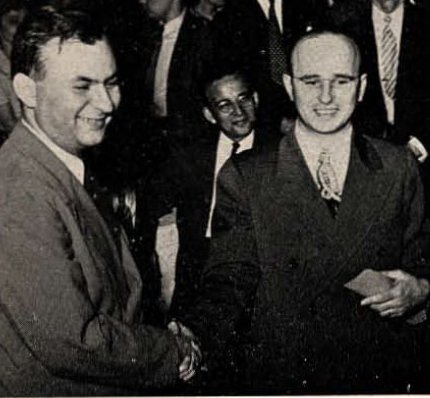
Fine and Reshevsky in 1943
    A trip to the library the other day lead to me bringing home Grandmasters of Chess by Harold Schonberg and American Chess Masters from Morphy to Fischer by Arthur Bisguier and Andrew Soltis. 

     Harold Schonberg (November 29, 1915 – July 26, 2003) was an American music critic and journalist, most notably for The New York Times. He was the first music critic to win the Pulitzer Prize for Criticism (1971). He also wrote a number of books on musical subjects and one on chess. 
     According to Wikipedia, Schonberg was a devoted and skilled chess player and he covered the championship match between Spassky and Fischer in 1972. Schonberg was also an avid golfer, though a poor one by his own estimation. He co-authored the book How To Play Double Bogey Golf along with Hollis Alpert, founder of the National Society of Film Critics, and fellow author Ira Mothner. When it comes to chess, he may have been avid, but I have not been able to verify his skill. 
     He gives brief bios of GM's through Bobby Fischer and some sample games. I have seen reviews claiming this book is lacking in depth and it certainly is. On the back cover Kurt Vonnegut wrote, “This charming history of modern chess will not be surpassed in our time… Mr. Schonberg has given us a playful, musical, haunting account of huge, often irresponsible, unsociable animals who have devoted their lives to thinking that is pure as snow.” Kurt Vonnegut apparently doesn't know much about chess either. 
     NM James Schroeder, a man who at least knows something about chess, wrote, “(It) is a rotten book that consists of yellow journalism based upon the writer’s ignorance and incredible stupidity. Mr. Schonberg does not understand chess, chess masters, chess history, or anything else of what he writes. The book HAS NO HISTORICAL VALUE and is 90 percent fiction.” Schroeder is spot on. 
     The other book was American Chess Masters from Morphy to Fischer by Arthur Bisguier and Andrew Soltis. According to Soltis he wrote the book all by himself. Supposedly Bisguier agreed to help write the book, but then did nothing. 
     If you ever met Andy Soltis, you'd like him a lot because he is a really nice guy and generally I like his writing because he is always entertaining. Sometimes he's been accused of getting his facts mixed up though. For example, he said Margate 1935 was Reshevsky’s first international event, but it wasn't. It was actually the 1922 New York Masters tournament at the age of ten. 
     His real international debut though might have been said to be in 1935, but Margate was his second tournament. Before that he finished first at Great Yarmouth in the Major Open where he scored ten wins and lost one game to Vera Menchik who finished third. Dr. A. Seitz finished second, losing only to Reshevsky. Though most of the players were from England, there were also players from Germany, Austria and the Netherlands so it WAS an international tournament. 
     Writing about the 1940 US Championship Soltis states that a careless loss to Kupchik cost Fine his chance to win the Championship which is totally wrong. 
     The 1940 Championship was only the third one, but it was the last to bring Fine, Reshevsky and Kashdan, the “Big Three” of the day, together. All of them continued to play chess past this event, but they never again played together in a championship tournament.
     Later Reshevsky described the tournament as a personal battle between him and Fine as indeed it was. They were paired in the last round and that game would determine who would be declared the champion. 
     Kashdan had been playing well for much of the tournament. He grabbed an early lead and as late as round 12 (out of 16) he was ahead of Reshevsky with Fine some distance back, mostly the result of a fifth round loss to Abrham Kupchik, a solid master with a colorless style. 
     Kashdan faded in round 13 after a bitter loss to Reshevsky. Kashdan, playing white, had been hanging tough, then on his 54th move he blundered badly, throwing away a draw, and had to resign on move 55. Kashdan was so shaken up he lost the next day to Weaver Adams, a player of considerably less talent. 
     Fine had overcome his 5th round loss to Kupchik and had won 10 games and drawn four. So, going into the last round Fine had a score of 12.0 (+10 -1 =4) and Reshevsky had 12.5 (+10 -0 =5). 
     Everything hung on their individual game. If Fine could win he would be the U.S. Champion. Fine was playing white and Reshevsky defended with the Two Knights Defense. Since all Reshevsky needed was a draw, Fine made a good practical as well as psychological choice when he played 4.Ng5. 
     Reshevsky was placed in the situation of having to play sharp positions when he would have preferred quieter lines. Also, Fine was an expert on openings while Reshevsky wasn't, and so it was unlikely he would be familiar with theory. It was good strategy on Fine's part because Reshevsky went for an inferior line at move 11. As a result Fine was better developed and had excellent prospects owing to having two bishops and a superior P-structure. In addition, Reshevsky had a N out of play on the Q-side. 
     Unfortunately for Fine, he reached a position where he would have winning chances, but he would have had to trade pieces which would have resulted in an endgame with bishops of opposite color... possibly allowing Reshevsky drawing chances. In order to avoid that, Fine made a promising sacrifice of the exchange. As a result, in a few moves Fine had a promising position and Reshevsky was desperate. In fact, witnesses said Reshevsky was in tears over his situation. 
     What happened next is what cost Fine his U.S. Championship. At move 27 he had a choice of two moves. He saw a four move combination and chose it instead of the other move which would have won without any great difficulty. Things went according to plan until they reached move 29. That's when Fine saw to his horror that he had miscalculated and the win had disappeared. They played on another 30-some moves, but in the end agreed to a draw and Fine finished second and he never again entered a championship tournament when Reshevsky was playing. 
     As a sequel, Reshevsky sat out the 1944 championship, so Fine did play in that one. That was the year Arnold Denker played the tournament of his life, defeated Fine in their individual game, and finished first with 15.5-1.5 to Fine's 14.5-2.5 which got him undisputed second place.
 

Friday, July 31, 2015

Browsing the West Virginia Chess Bulletins

     While looking through some back issues of the Bulletin I came across the name of one Milton Q. Ellenby and that name rang a bell. I had seen it before in an old (I think) issue of Chess Review and I remembered Ellenby as having been from Ohio. 
     Ellenby was a frequent participant in Ohio and West Virginia tournaments during the war years, but very little about him turned up on a Google search. What I did find was that he was born on October 18, 1923 and passed away on Thursday, September 16, 2010 at the age of 86 in Skokie, Illinois. He was married to Helaine for over 53 years and had three sons: Alan, Martin and Miles. 
     Ellenby was an actuary and what is considered to be an “expert witness” as well as an author on the profession. An expert witness is a person who is permitted to testify at a trial because of special knowledge or proficiency in a particular field that is relevant to the case.
     It appears that he may have given up chess in favor of bridge because he participated in numerous World Team Championships for the game and there are frequent references to him and bridge in Google searches. 
     According to the October 1948 issue of the WV Chess Bulletin he had won the first Tri-State (West Virginia, Ohio and Pennsylvania) Championship in 1945 at the age of 22 and in 1944 he had won the Ohio Junior Championship. At the time he was living in Dayton, Ohio. I was unable to locate any further information on him and didn't find any of his games either. 
      The Tri-State Championship was started in 1945 by Gene Collett, the WVCA Bulletin editor, Bill Byland, president of the Pennsylvania Chess Association and S. S. Keeney of the Ohio Chess Association. It was determined that the top two finishers in each state's championship would be invited to play for the Tri-State Championship. If one of the invited players could not participate, the state could find a replacement. The site of the event rotated among the three states. 
     Originally, the side events consisted of state matches, but full participation by all three states was hard to achieve. In 1949, a Junior event was started and in 1951, an Open Tournament was initiated and became part of the Tri-State festivities which were usually held on Veterans Day weekend. The Tri-State Junior Championship was a separate event until 1955. In 1955, there were not enough juniors to stage an event, so they were all entered in the Open Tournament. The highest finisher on the Open would then be declared the Junior Champion. 
     A list of the various champions is a Who's-Who of chess in the Tri-State area from 1945 to 1963. In the three tournaments one sees names like Milton Q. Ellenby, H. Landis Marks, Herman Hesse, Glen Hartleb, Saul Wachs, Tony Archipoff, Dr. Siegfried Werthammer, Charles Kalme, Charles Heising, Robert Bornholz, Jerry Fink, Richard Kause, Roger Johnson, Thomas Wozney, George Berry, Dr. Val Berzzarins, James Harkins and Lajos Szedlascek. Names from a bygone era that are mostly unknown even to modern players of the three states involved. 
     Here was an interesting little sidelight that happened in the 1947 championship played in Huntington: One player during the 1946 event had complained about the lack of chess clocks and proposed that the Association start a fund to buy clocks for the next championship. Officials investigated the possibility but discovered there were no clocks on the market! Their production had been discontinued during the war. 
    The solution was that several players made their own clocks and one produced by the brother of one of the players was said to actually resemble those sold commercially. And so, the 1948 tournament was the first state championship where clocks were used...an historic event!! 
     I did play over one interesting game from the preliminaries of the 1948 Charleston, West Virginia city championship that was annotated by Dr. Werthammer. His analysis was pretty good, but Komodo 8 and Stockfish 6 analysis showed that black's win was not so simple and white had some hidden resources. Isn't that always the case! I enjoyed playing over the game so I present it here.